
Report Feature
Air Crane Helicopter Market Trends and Forecast
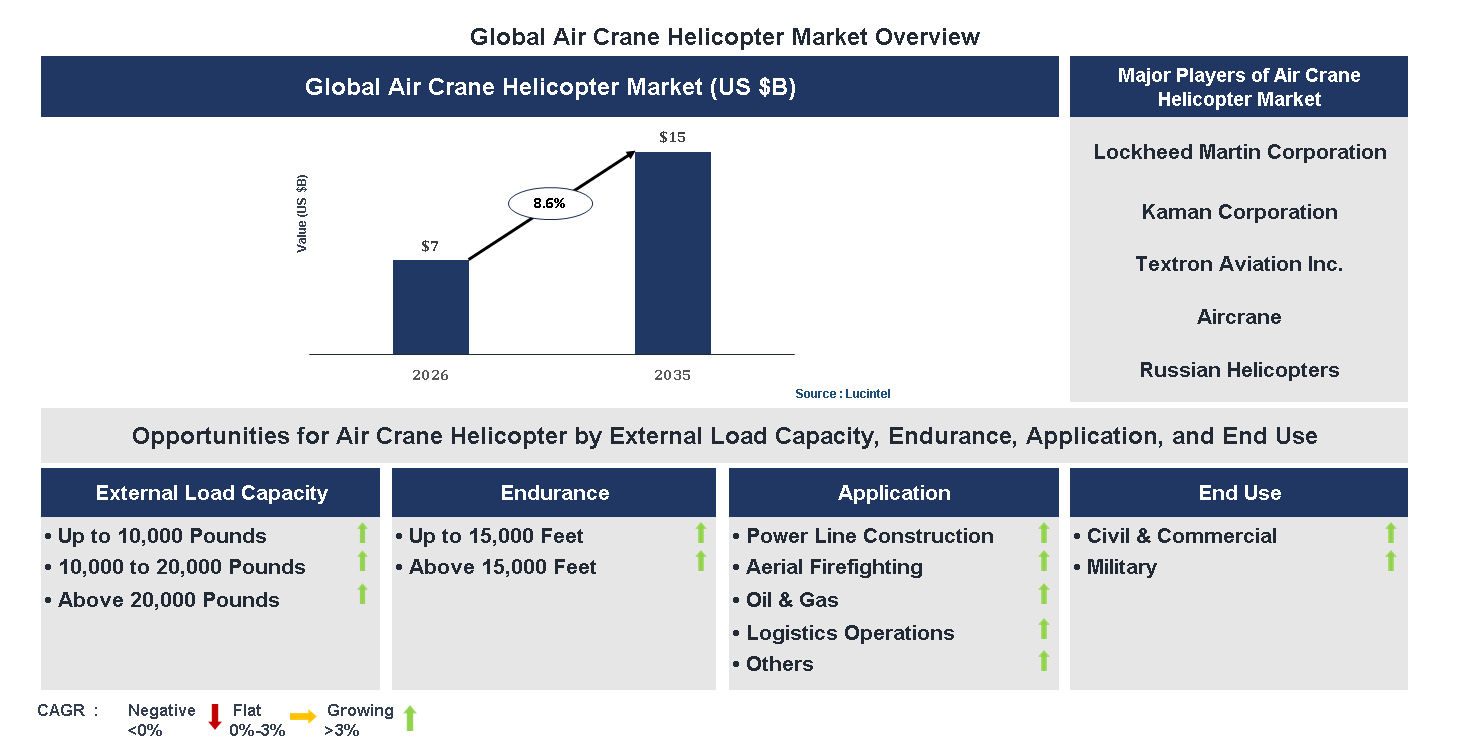
The future of the global air crane helicopter market looks promising with opportunities in the civil & commercial and military markets. The global air crane helicopter market is expected to reach an estimated $15 billion by 2035 with a CAGR of 8.6% from 2026 to 2035. The major drivers for this market are the increasing demand for heavy-lift operations, the rising need for disaster relief support, and the growing adoption of aerial firefighting solutions.• Lucintel forecasts that, within the application category, aerial firefighting is expected to witness the highest growth over the forecast period.
• Within the end use category, civil & commercial is expected to witness higher growth.
• In terms of region, APAC is expected to witness the highest growth over the forecast period. Gain valuable insights for your business decisions with our comprehensive 150+ page report. Sample figures with some insights are shown below.
Emerging Trends in the Air Crane Helicopter Market
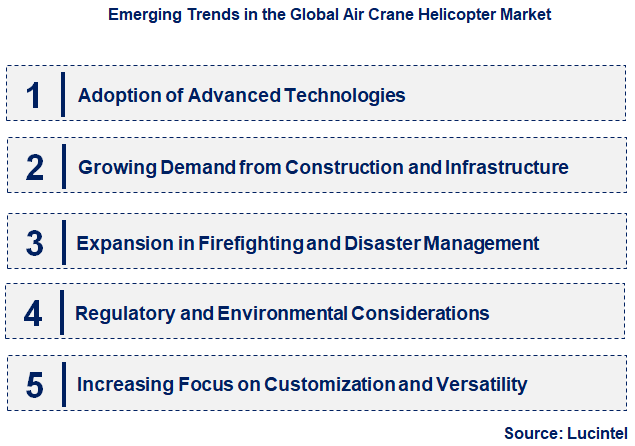
The air crane helicopter market is experiencing rapid evolution driven by technological advancements, increasing demand across various sectors, and shifting regulatory landscapes. As industries such as construction, firefighting, and logistics seek more efficient and versatile aerial solutions, market players are innovating to meet these needs. Emerging trends are shaping the future of this market, influencing product development, operational strategies, and customer expectations. Understanding these key trends is essential for stakeholders aiming to capitalize on growth opportunities and navigate competitive challenges in this dynamic environment.• Adoption of Advanced Technologies: Integration of automation, AI, and IoT is transforming helicopter operations. These innovations enhance safety, improve efficiency, and enable predictive maintenance, reducing downtime and operational costs. As technology becomes more accessible, operators can perform complex tasks with greater precision, opening new applications and markets for air crane helicopters.
• Growing Demand from Construction and Infrastructure: The construction sector increasingly relies on air cranes for lifting heavy materials in challenging terrains and urban environments. This trend is driven by the need for faster project completion and access to hard-to-reach areas, boosting sales and rental services. The market is witnessing a surge in customized solutions tailored to specific construction needs.
• Expansion in Firefighting and Disaster Management: Air crane helicopters are vital in firefighting and disaster response due to their ability to access remote or hazardous areas. The rising frequency of wildfires and natural calamities globally is propelling demand. Enhanced payload capacities and specialized equipment are making these helicopters more effective, thereby expanding their role in emergency services.
• Regulatory and Environmental Considerations: Stricter safety standards and environmental regulations are influencing market dynamics. Manufacturers are investing in greener technologies, such as electric or hybrid engines, to reduce emissions. Compliance with evolving regulations is driving innovation and shaping the design and operation of air crane helicopters.
• Increasing Focus on Customization and Versatility: Customers demand tailored solutions that meet specific operational needs. Manufacturers are offering customizable configurations, including different payload capacities, cabin layouts, and specialized attachments. This trend enhances the versatility of air crane helicopters, enabling their use across diverse industries and applications. These emerging trends are significantly reshaping the air crane helicopter market by fostering technological innovation, expanding application areas, and emphasizing sustainability. They are driving market growth, encouraging competitive differentiation, and setting the stage for a more versatile and efficient aerial lifting industry.
Recent Development in the Air Crane Helicopter Market
The air crane helicopter market is experiencing rapid growth driven by technological advancements, increasing demand across various industries, and expanding applications in construction, firefighting, and logistics. As industries seek more efficient and versatile aerial solutions, market players are innovating to meet these needs. Recent developments reflect a focus on enhancing safety, operational efficiency, and environmental sustainability, positioning the market for sustained expansion. These trends are shaping a dynamic landscape with significant opportunities for stakeholders.• Technological Innovations in Helicopter Design: Advancements in rotor technology and lightweight materials are improving performance, fuel efficiency, and safety. These innovations enable helicopters to carry heavier loads over longer distances, opening new markets in construction and heavy-lift operations. Enhanced avionics and automation systems also reduce pilot workload and increase operational precision, making these helicopters more reliable and cost-effective. This progress attracts more clients and expands the market’s scope.
• Increased Demand in Construction and Infrastructure: The construction sector is increasingly utilizing Air Crane Helicopters for lifting heavy materials and equipment in high-rise projects and remote locations. Their ability to access difficult terrains accelerates project timelines and reduces costs. Governments and private developers are investing heavily in infrastructure, boosting demand for these helicopters. This trend enhances market growth by providing faster, safer, and more efficient lifting solutions, especially in urban and inaccessible areas.
• Expansion in Firefighting and Emergency Response: Air Crane Helicopters are vital in firefighting, especially in wildfires and large-scale emergencies, due to their ability to deliver water and supplies rapidly. Recent developments include specialized firefighting equipment and improved maneuverability. These helicopters help contain fires more effectively, saving lives and property. The increasing frequency of wildfires globally and the need for swift emergency response are driving market expansion in this segment.
• Growing Focus on Environmental Sustainability: Innovations aimed at reducing emissions and noise pollution are gaining traction. Use of hybrid power systems and cleaner fuels are making operations more environmentally friendly. Regulatory pressures and public awareness are encouraging companies to adopt sustainable practices. This focus not only aligns with global environmental goals but also broadens market appeal, attracting clients seeking eco-friendly solutions and ensuring long-term market viability.
• Rising Adoption in Logistics and Supply Chain Operations: The ability of Air Crane Helicopters to deliver goods to remote or inaccessible areas is transforming logistics. Recent developments include enhanced payload capacities and improved flight range. These helicopters facilitate faster delivery times, reduce transportation costs, and improve supply chain resilience. The growth of e-commerce and the need for rapid logistics solutions are fueling demand, positioning the market for significant expansion in logistics applications. These recent developments are significantly impacting the air crane helicopter market by enhancing operational efficiency, safety, and environmental sustainability. Technological innovations and expanding applications across construction, firefighting, and logistics are driving market growth. As demand continues to rise, stakeholders are investing in advanced, eco-friendly solutions, ensuring the market remains competitive and dynamic. Overall, these opportunities are fostering a robust environment for sustained growth and innovation in the industry.
Strategic Growth Opportunities in the Air Crane Helicopter Market
The air crane helicopter market is experiencing significant growth driven by increasing demand across construction, firefighting, oil and gas, and logistics sectors. Technological advancements, regulatory support, and expanding applications are fueling market expansion. Companies are investing in innovative designs and operational efficiencies to meet rising customer needs. This dynamic environment presents numerous strategic opportunities for market players to enhance their offerings, expand geographic reach, and capitalize on emerging applications, ultimately shaping the future landscape of aerial lifting and transportation solutions.• Expansion into Emergency and Disaster Response Services: Air crane helicopters are increasingly vital in emergency and disaster response, providing rapid deployment of rescue teams, medical supplies, and relief materials to inaccessible areas. The ability to operate in challenging terrains and deliver large payloads quickly makes them indispensable during natural calamities, wildfires, and humanitarian crises. Growing government and private sector investments in disaster preparedness are expected to boost demand for specialized aerial lifting solutions, creating substantial growth opportunities for market players to develop tailored, high-capacity helicopter models.
• Adoption of Advanced Technologies for Enhanced Efficiency: Integrating cutting-edge technologies such as automation, GPS navigation, and real-time data analytics can significantly improve operational efficiency and safety. These innovations enable precise load handling, reduce operational costs, and minimize risks associated with complex lifting tasks. As technology adoption accelerates, companies investing in smart systems and digital solutions will gain competitive advantages. This trend opens avenues for developing next-generation air crane helicopters that offer superior performance, reliability, and cost-effectiveness across diverse applications.
• Growing Demand in the Oil and Gas Industry for Heavy Lifting: The oil and gas sector relies heavily on air crane helicopters for offshore platform construction, maintenance, and transportation of heavy equipment. Increasing exploration activities and infrastructure development in remote locations are driving demand for high-capacity lifting solutions. Market players can capitalize on this by offering customized, robust helicopters capable of handling extreme conditions and heavy payloads. Strategic partnerships with oil companies and service providers will further expand market reach and foster long-term growth in this lucrative segment.
• Expansion of Market in Emerging Economies: Emerging economies are witnessing rapid infrastructure development, urbanization, and industrialization, creating a surge in demand for aerial lifting solutions. Countries in Asia-Pacific, Africa, and Latin America are investing in construction, mining, and energy projects that require efficient heavy-lift transportation. Market players can explore opportunities by establishing local manufacturing, service centers, and training facilities. Tailoring offerings to regional needs and regulatory environments will facilitate market penetration and sustainable growth in these high-potential regions.
• Increasing Use in Commercial and Industrial Construction Projects: Air crane helicopters are increasingly employed in large-scale construction projects, including bridges, skyscrapers, and industrial facilities, where traditional methods are impractical. Their ability to lift and position heavy materials precisely reduces construction time and costs. As urbanization accelerates globally, demand for aerial lifting solutions in construction is expected to rise. Companies can leverage this trend by developing versatile, high-capacity helicopters and offering comprehensive maintenance and support services to capture a larger share of the construction market. These strategic growth opportunities are poised to significantly influence the air crane helicopter market, fostering innovation, expanding applications, and opening new regional avenues. Embracing technological advancements, targeting emerging sectors, and customizing solutions for specific industries will enable market players to strengthen their competitive position. Overall, these opportunities will drive market expansion, enhance operational efficiencies, and meet the evolving demands of diverse industries worldwide.
Air Crane Helicopter Market Driver and Challenges
The air crane helicopter market is influenced by a variety of technological, economic, and regulatory factors that shape its growth and development. Advances in helicopter technology, increasing demand across industries such as construction, firefighting, and oil & gas, and evolving safety standards are key drivers. Conversely, challenges such as high operational costs, regulatory restrictions, and environmental concerns pose significant hurdles. Understanding these drivers and challenges is essential for stakeholders to navigate market opportunities and risks effectively. The interplay of these factors determines the market's trajectory, influencing investment decisions, innovation, and competitive dynamics within the industry. The factors responsible for driving the air crane helicopter market include:-• Technological Advancements: The development of more efficient, reliable, and versatile helicopter models has significantly expanded operational capabilities. Innovations such as improved rotor designs, advanced avionics, and increased payload capacities enable operators to undertake complex tasks with greater safety and efficiency. These technological improvements reduce operational costs and enhance performance, making air crane helicopters more attractive for diverse applications like heavy lifting, construction, and disaster response. As technology continues to evolve, market players are investing heavily in R&D to stay competitive, which further propels market growth.
• Growing Industrial Demand: The rising need for heavy lifting and transportation solutions across sectors such as construction, oil & gas, and infrastructure development is a major driver. Air crane helicopters are indispensable for tasks in remote or inaccessible areas, providing quick and efficient solutions that traditional methods cannot match. The expansion of infrastructure projects, offshore oil exploration, and disaster management initiatives are fueling demand. This industrial growth is complemented by increasing investments in large-scale projects, which require specialized aerial lifting capabilities, thereby boosting market expansion.
• Increasing Adoption in Emergency Services: The use of air crane helicopters in firefighting, search and rescue, and disaster relief operations is expanding rapidly. Their ability to access difficult terrains and deliver large payloads quickly makes them vital in emergency scenarios. Governments and private organizations are investing in these helicopters to enhance response times and operational effectiveness. The integration of advanced firefighting equipment and rescue technology further enhances their utility. This trend is expected to continue as climate change and urbanization increase the frequency and severity of emergencies, driving sustained demand for specialized aerial lifting solutions.
• Regulatory Support and Safety Standards: Evolving regulations aimed at improving safety and operational efficiency are positively impacting the market. Governments and aviation authorities are establishing stringent standards for helicopter operations, which encourage the adoption of newer, safer models. Certification processes and compliance requirements promote technological upgrades and innovation. Additionally, government incentives and subsidies for infrastructure development and disaster management projects support market growth. These regulatory frameworks ensure safer operations, instill confidence among users, and foster a conducive environment for market expansion. The challenges facing the air crane helicopter market include:-
• High Operational and Maintenance Costs: Operating air crane helicopters involves significant expenses, including fuel, maintenance, and skilled personnel. The complexity of these machines necessitates regular, costly maintenance to ensure safety and performance. Fluctuations in fuel prices and the need for specialized training further escalate costs. These high expenses can limit market penetration, especially among smaller operators or in regions with budget constraints. Additionally, the economic viability of projects depends heavily on cost management, making high operational costs a persistent challenge for sustained growth.
• Regulatory and Environmental Restrictions: Stringent regulations related to noise pollution, emissions, and flight permissions can hinder market expansion. Environmental concerns, especially regarding carbon emissions, are leading to stricter policies that may restrict helicopter operations in certain areas or require costly modifications. Regulatory delays and complex approval processes can also slow down project implementation and fleet expansion. These restrictions increase operational complexity and costs, posing significant barriers for market players seeking to expand their services or introduce new models.
• Market Competition and Technological Obsolescence: The market faces intense competition from established manufacturers and new entrants offering innovative solutions. Rapid technological advancements can render existing helicopter models obsolete, forcing companies to invest heavily in upgrades or new designs. Price competition and differentiation challenges can squeeze profit margins. Additionally, the emergence of alternative lifting technologies or unmanned aerial systems could disrupt traditional market dynamics. Staying ahead in innovation while managing costs remains a critical challenge for sustaining competitive advantage. The air crane helicopter market is driven by technological progress, increasing industrial and emergency service demand, and supportive regulatory frameworks. However, high operational costs, regulatory restrictions, and intense competition pose significant challenges. These factors collectively influence market growth, requiring stakeholders to innovate, adapt, and strategize effectively. The overall impact suggests a dynamic industry with substantial opportunities for growth, provided that challenges are managed through technological innovation and regulatory compliance.
List of Air Crane Helicopter Companies
Companies in the market compete on the basis of product quality offered. Major players in this market focus on expanding their manufacturing facilities, R&D investments, infrastructural development, and leverage integration opportunities across the value chain. With these strategies air crane helicopter companies cater increasing demand, ensure competitive effectiveness, develop innovative products & technologies, reduce production costs, and expand their customer base. Some of the air crane helicopter companies profiled in this report include-• Lockheed Martin Corporation
• Kaman Corporation
• Textron Aviation Inc.
• Aircrane
• Russian Helicopters
• Airbus SE
• Erickson Incorporated
• High Performance Helicopters Corp
• Columbia helicopters
• The Boeing Company
Air Crane Helicopter Market by Segment
The study includes a forecast for the global air crane helicopter market by external load capacity, endurance, application, end use, and region.Air Crane Helicopter Market by External Load Capacity [Value from 2019 to 2035]:
• Up to 10,000 Pounds
• 10,000 to 20,000 Pounds
• Above 20,000 Pounds
Air Crane Helicopter Market by Endurance [Value from 2019 to 2035]:
• Up to 15,000 Feet
• Above 15,000 Feet
Air Crane Helicopter Market by Application [Value from 2019 to 2035]:
• Power Line Construction
• Aerial Firefighting
• Oil & Gas
• Logistics Operations
• Others
Air Crane Helicopter Market by End Use [Value from 2019 to 2035]:
• Civil & Commercial
• Military
Air Crane Helicopter Market by Region [Value from 2019 to 2035]:
• North America
• Europe
• Asia Pacific
• The Rest of the World
Country Wise Outlook for the Air Crane Helicopter Market
The air crane helicopter market has experienced significant growth and innovation driven by increasing demand for heavy-lift capabilities, infrastructure development, and emergency response services worldwide. Technological advancements, regulatory changes, and expanding applications have shaped recent trends in this sector. Countries are investing in new models, improving safety standards, and expanding operational capacities to meet diverse needs. The market's evolution reflects broader economic and technological shifts, with key players focusing on sustainability and efficiency. Here is a country-specific overview of recent developments in the United States, China, Germany, India, and Japan.• United States: The US market has seen substantial growth with the introduction of advanced heavy-lift helicopters, such as the Sikorsky S-64 Sky crane. Increased demand from the construction, oil and gas, and firefighting sectors has driven innovation. Regulatory agencies have implemented stricter safety standards, prompting manufacturers to upgrade existing models. The US also witnesses a rise in leasing and rental services, making these helicopters more accessible for various industries. Additionally, technological integration like GPS and automation has enhanced operational efficiency and safety.
• China: China has rapidly expanded its air crane helicopter fleet to support infrastructure projects like high-speed rail and urban development. Domestic manufacturers, such as AVIC, are developing new models tailored for heavy-lift operations, emphasizing cost efficiency and versatility. The government’s focus on modernization and technological innovation has led to increased R&D investments. China is also leveraging these helicopters for disaster management and firefighting, reflecting a broader push for emergency preparedness. The market is characterized by a mix of domestic production and international collaborations to enhance capabilities.
• Germany: Germany’s market is characterized by a focus on safety, precision, and environmental sustainability. Recent developments include the deployment of specialized helicopters for wind turbine installation and maintenance, aligning with the country’s renewable energy goals. German companies are investing in hybrid and electric helicopter technologies to reduce emissions. The regulatory environment emphasizes rigorous safety standards, fostering innovation in design and operation. The market also benefits from Germany’s strong aerospace sector, which supports technological advancements and integration of digital systems for improved performance.
• India: India has seen a surge in demand for air crane helicopters driven by infrastructure projects, mining, and disaster relief efforts. The government’s push for urban development and rural connectivity has increased procurement of heavy-lift helicopters. Domestic companies are collaborating with international firms to upgrade their fleets and develop indigenous models. The focus is on cost-effective solutions that can operate in challenging terrains. Additionally, India is expanding its capabilities for firefighting and emergency response, with recent investments in training and safety protocols to enhance operational efficiency and safety standards.
• Japan: Japan’s market is evolving with a focus on disaster management, infrastructure maintenance, and renewable energy projects. Recent developments include deploying helicopters for earthquake and tsunami response, reflecting the country’s emphasis on disaster preparedness. Technological innovations such as hybrid propulsion systems and advanced navigation tools are being integrated to improve efficiency and reduce environmental impact. Japan’s aerospace industry is also exploring automation and remote operation capabilities. The government supports research and development initiatives aimed at enhancing the safety and sustainability of air crane helicopter operations, aligning with its broader environmental and safety policies.

Features of the Global Air Crane Helicopter Market
Market Size Estimates: Air crane helicopter market size estimation in terms of value ($B). Trend and Forecast Analysis: Market trends (2019 to 2025) and forecast (2026 to 2035) by various segments and regions. Segmentation Analysis: Air crane helicopter market size by various segments, such as by external load capacity, endurance, application, end use, and region in terms of value ($B). Regional Analysis: Air crane helicopter market breakdown by North America, Europe, Asia Pacific, and Rest of the World. Growth Opportunities: Analysis of growth opportunities in different external load capacity, endurance, applications, end uses, and regions for the air crane helicopter market. Strategic Analysis: This includes M&A, new product development, and competitive landscape of the air crane helicopter market. Analysis of competitive intensity of the industry based on Porter’s Five Forces model.
FAQ
Q1. What is the air crane helicopter market size? Answer: The global air crane helicopter market is expected to reach an estimated $15 billion by 2035. Q2. What is the growth forecast for air crane helicopter market? Answer: The global air crane helicopter market is expected to grow with a CAGR of 8.6% from 2026 to 2035. Q3. What are the major drivers influencing the growth of the air crane helicopter market? Answer: The major drivers for this market are the increasing demand for heavy-lift operations, the rising need for disaster relief support, and the growing adoption of aerial firefighting solutions. Q4. What are the major segments for air crane helicopter market? Answer: The future of the air crane helicopter market looks promising with opportunities in the civil & commercial and military markets. Q5. Who are the key air crane helicopter market companies? Answer: Some of the key air crane helicopter companies are as follows:• Lockheed Martin Corporation
• Kaman Corporation
• Textron Aviation Inc.
• Aircrane
• Russian Helicopters
• Airbus SE
• Erickson Incorporated
• High Performance Helicopters Corp
• Columbia helicopters
• The Boeing Company Q6. Which air crane helicopter market segment will be the largest in future? Answer: Lucintel forecasts that, within the application category, aerial firefighting is expected to witness the highest growth over the forecast period. Q7. In air crane helicopter market, which region is expected to be the largest in next 8 years? Answer: In terms of region, APAC is expected to witness the highest growth over the forecast period. Q8. Do we receive customization in this report? Answer: Yes, Lucintel provides 10% customization without any additional cost.
Table of Contents
List of Figures
List of Tables
Methodology
- In-depth interviews of the major players in this market
- Detailed secondary research from competitors’ financial statements and published data
- Extensive searches of published works, market, and database information pertaining to industry news, company press releases, and customer intentions
- A compilation of the experiences, judgments, and insights of Lucintel’s professionals, who have analyzed and tracked this market over the years.


Buy Now
Choose a license that fits your team. Instant PDF delivery.
Prices exclude taxes. Instant delivery. Custom licensing available on request.
Key Questions
- • What are some of the most promising, high-growth opportunities for the air crane helicopter market by external load capacity (up to 10,000 pounds, 10,000 to 20,000 pounds, and above 20,000 pounds), endurance (up to 15,000 feet and above 15,000 feet), application (power line construction, aerial firefighting, oil & gas, logistics operations, and others), end use (civil & commercial and military), and region (North America, Europe, Asia Pacific, and the Rest of the World)?
- • Which segments will grow at a faster pace and why?
- • Which region will grow at a faster pace and why?
- • What are the key factors affecting market dynamics? What are the key challenges and business risks in this market?
- • What are the business risks and competitive threats in this market?
- • What are the emerging trends in this market and the reasons behind them?
- • What are some of the changing demands of customers in the market?
- • What are the new developments in the market? Which companies are leading these developments?
- • Who are the major players in this market? What strategic initiatives are key players pursuing for business growth?
- • What are some of the competing products in this market and how big of a threat do they pose for loss of market share by material or product substitution?
- • What M&A activity has occurred in the last 7 years and what has its impact been on the industry? For any questions related to Air Crane Helicopter Market, Air Crane Helicopter Market Size, Air Crane Helicopter Market Growth, Air Crane Helicopter Market Analysis, Air Crane Helicopter Market Report, Air Crane Helicopter Market Share, Air Crane Helicopter Market Trends, Air Crane Helicopter Market Forecast, Air Crane Helicopter Companies, write Lucintel analyst at email: helpdesk@lucintel.com. We will be glad to get back to you soon.


