
Market Report · July 22, 2026

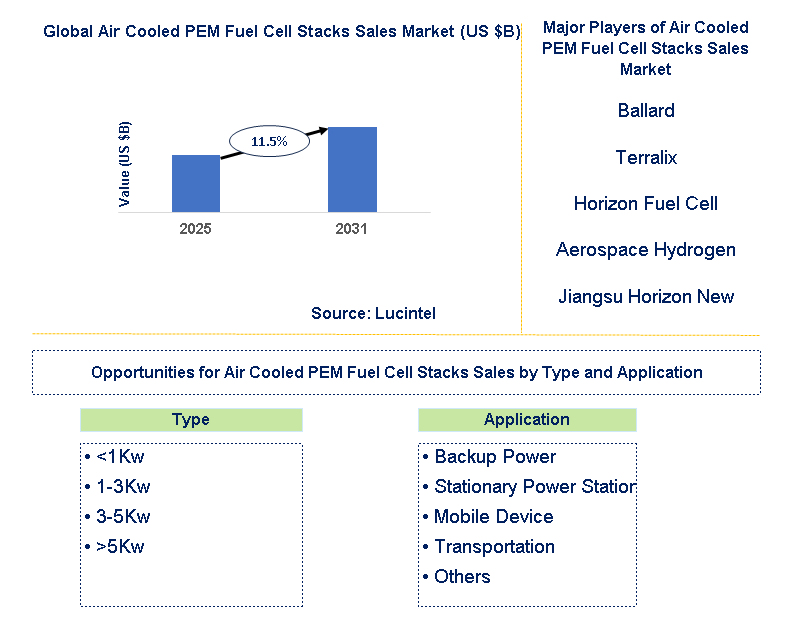
Key data points: The growth forecast = 11.5% annually for the next 7 years. Scroll below to get more insights. This market report covers Trends, opportunities and forecasts in air cooled PEM fuel cell stacks sales market to 2031 by type (<1kW, 1-3kW, 3-5kW, and >5kW), application (backup power, stationary power station, mobile device, transportation, and others), and region (North America, Europe, Asia Pacific, and the Rest of the World)
We'll send your sample report shortly.
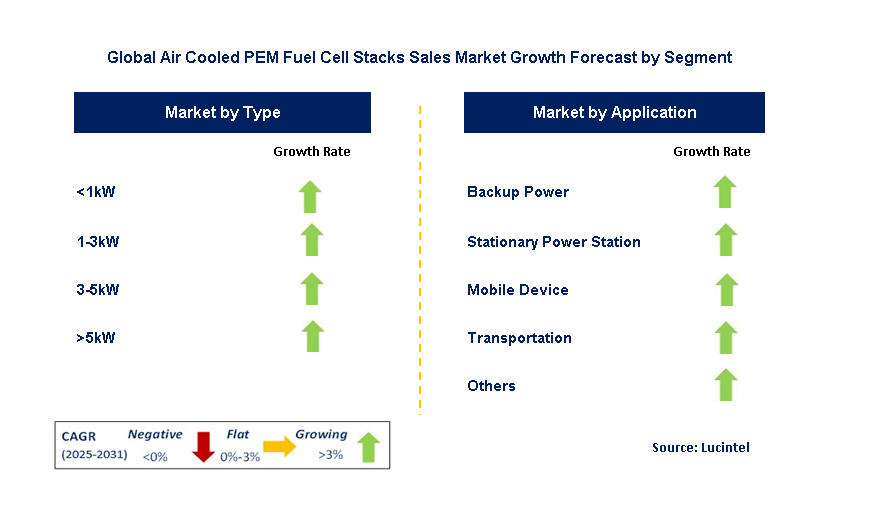
• Lucintel forecasts that, within the type category, 1-3 kW will remain the highest segment over the forecast period due to the rising demand for compact cell stacks.
• Within the application category, transportation is expected to witness the highest growth due to the growing adoption of hydrogen-powered transportation.
• In terms of region, APAC is expected to witness the highest growth over the forecast period due to the rising demand for clean energy solution.
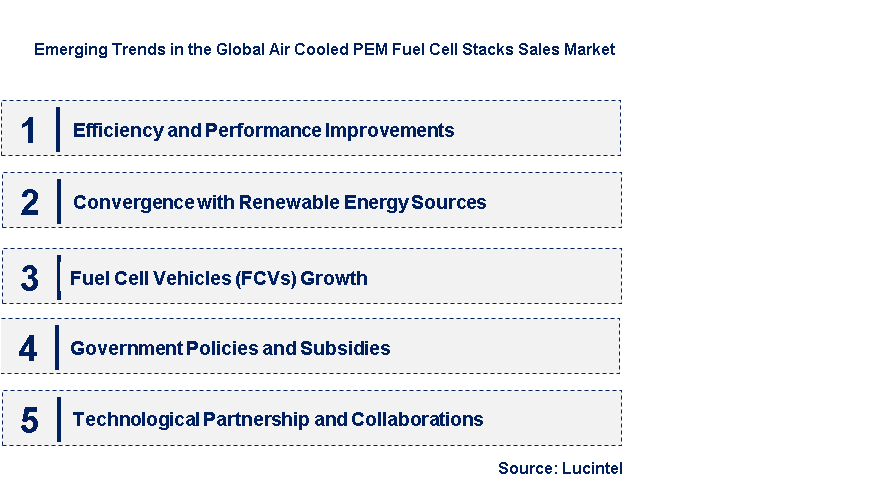
• Efficiency and Performance Improvements: Consistent progress in designing and producing air-cooled PEM fuel cell stacks enhances their power output and efficiency. The research efforts are targeted towards maximizing the fuel cell stack's lifespan, lowering its running cost, and boosting power density. Consequently, air-cooled fuel cells become economically viable across an array of uses, including vehicles, stationary power, and mobile devices. This enhancement in performance is propelling higher adoption from diverse industries and enhancing the general market growth.
• Convergence with Renewable Energy Sources: Integration of these systems with renewable energy sources such as solar and wind is one of the key trends in the air-cooled PEM fuel cell market. Fuel cells are utilized for energy storage from surplus power derived from renewable resources, with the goal of creating a reliable and consistent energy source when solar or wind power cannot be used. This is highly applicable to those areas with large penetration of renewable energy, as fuel cells become complementary technologies in supporting grid stability and energy security.
• Fuel Cell Vehicles (FCVs) Growth: The rise of fuel cell vehicles (FCVs) is a prominent trend, especially in markets like Japan, the United States, and Germany. The development of air-cooled PEM fuel cell stacks is crucial to supporting the FCV industry, as it enables the production of more efficient and durable fuel cells. With more automakers investing in hydrogen-powered cars and governments providing incentives, the demand for fuel cell stacks is rapidly increasing. This is likely to be the driving force behind increased technology and market expansion.
• Government Policies and Subsidies: Governments across the globe are imposing policies and incentives that promote hydrogen fuel cell technologies development and deployment. Such accommodative policies can be seen to be most intense in nations such as China, Germany, and Japan, which view fuel cell technology as integral to the future of clean energy. The resultant growing availability of incentives is facilitating fuel cell technologies' appeal among investors and final consumers alike, further driving the demand for air-cooled PEM fuel cell stacks.
• Technological Partnership and Collaborations: Joint ventures among fuel cell producers, research organizations, and automakers are a leading trend in the market. They are intended to promote the commercialization of air-cooled PEM fuel cell stacks through knowledge sharing, cost cutting, and technological improvements. For example, motor manufacturers such as Toyota and Hyundai are working together with fuel cell manufacturers to increase the efficiency of the stack and lower the costs of production. Such joint ventures are improving technology innovation and enhancing the size of the global market. These new trends are significantly influencing the future of the air cooled PEM fuel cell stacks market. As efficiency increases, integration of renewable energy increases, and government regulations support fuel cell technologies, the market is destined for long-term growth. The growing popularity of fuel cell cars and greater technology cooperation will also contribute to the global use of air-cooled PEM fuel cells.
• Fuel Cell Durability Improvements: Improvement in fuel cell component durability is one of the key advancements in the air-cooled PEM fuel cell stacks market. Advances in materials and processes have contributed to improved lifespan and performance in tough conditions. With these advances, air-cooled fuel cells become more reliable for extended use, particularly in such applications as automotive and stationary power generation. Greater durability will lower the overall cost of ownership, making more companies and consumers use these systems.
• Cost Reduction in Manufacturing: Production costs of air-cooled PEM fuel cells have come down sharply with improvement in production technologies and economies of scale. Both cost reduction of raw materials, and enhanced production efficiency, have decreased the costs of fuel cells to consumers as well as to industry. Reducing costs is paving the way for the large-scale commercialization of fuel cells across industries like transport and energy storage and should extend to mass-market applications over the next few years.
• Electric Vehicle (EV) Integration: One of the main developments is the coupling of fuel cell technology with electric vehicles. The big manufacturers like Toyota, Hyundai, and Honda are introducing air-cooled PEM fuel cells in their hydrogen-fueled electric vehicles. The trend will persist, with the companies enhancing the production capacity and fuel cell technology to further enable hydrogen cars to become competitive. The installation of hydrogen refueling infrastructure is also fueling this market segment.
• More Emphasis on Hydrogen Infrastructure: One major trend in the air-cooled PEM fuel cell stacks market is the development of hydrogen refueling infrastructure. Private entities and governments are putting money into hydrogen refueling stations to accommodate the increasing number of hydrogen fuel-powered vehicles. Developing this infrastructure is key to increased fuel cell technology adoption, as it provides the means for fuel cell vehicles and other hydrogen fuel-based systems to get the power they require for function.
• Industry Leaders' Collaborations: Strategic collaborations among fuel cell producers and industry leaders in the automotive, energy, and transportation sectors have been increasing. These partnerships are speeding up the development of air-cooled PEM fuel cell technologies and guaranteeing their commercial success. Through shared resources and capabilities, these collaborations are overcoming technology hurdles, minimizing production costs, and enhancing the overall performance of fuel cell stacks. This trend is set to persist, as increasing numbers of companies acknowledge the promise of air-cooled PEM fuel cells in the clean energy revolution. The latest trends in the air cooled PEM fuel cell stacks market are radically changing its future. As the durability of fuel cells improves, the cost of manufacturing declines, and partnerships between industry players increase, the market is likely to witness a surge in growth. These trends are not just increasing the commercial appeal of fuel cell technologies but also fueling the transition toward clean energy solutions worldwide.
• Hydrogen-Powered Transportation: The transportation market is one of the most promising growth areas for air-cooled PEM fuel cells. As the demand for fuel cell electric vehicles (FCEVs) and government support increase, this segment is likely to grow at a fast pace. Automakers like Toyota, Hyundai, and Mercedes-Benz are putting a lot of money into fuel cell technology for commercial vehicles, buses, and passenger vehicles. There will be growing demand for cost-saving and energy-efficient fuel cell stacks as fuel cell cars become increasingly common.
• Residential and Commercial Stationary Power Systems: Air-cooled PEM fuel cells are being used more and more in stationary power systems for residential and commercial use. The systems offer a clean, reliable, and affordable source of energy, particularly in regions with poor access to conventional grid infrastructure. The increasing demand for energy independence and sustainability is fueling the use of fuel cell-based power solutions, offering tremendous growth prospects for fuel cell makers.
• Portable Power Solutions: Portable fuel cell systems, designed for applications such as backup power and remote energy solutions, constitute another major area of growth opportunity. With progress in technology, air-cooled PEM fuel cells are getting efficient and smaller and are finding new uses in portable products like laptops, drones, and emergency back-up systems. The market will continue to rise with the requirement for stable and renewable portable energy.
• Integration with Renewable Energy Systems: Air-cooled PEM fuel cells are being increasingly combined with alternate energy sources like solar and wind energy. Fuel cells offer a method of storing surplus energy produced by renewable sources, providing a secure and steady power supply. The integration of fuel cells with renewable energy technologies is predicted to have a significant role in diminishing the reliance on fossil fuels and promoting the sustainability of power generation.
• Emerging Developing Countries Markets: Emerging economies in the developing world are a major prospect for air-cooled PEM fuel cell technology. As the countries industrialize and urbanize, there is increased demand for secure, sustainable power solutions. Fuel cells provide an attractive alternative to conventional power solutions, particularly where infrastructure is scarce. The emerging markets are projected to see greater demand for fuel cell technology driven by government intervention and private investments. The market opportunity for strategic growth in Air Cooled PEM Fuel Cell Stacks is multi-dimensional and transdisciplinary across different applications. The application range encompasses transportation through hydrogen and portable power technologies, the use of clean and efficient energy solutions accelerating worldwide. With exploitation of these market opportunities, companies stand to capture their leadership roles within the emergent fuel cell business.
• Ballard
• Terralix
• Horizon Fuel Cell Technologies
• Aerospace Hydrogen Energy
• Jiangsu Horizon New Energy Technologies
• Sinosynergy
• TIANNENG BATTERY GROUP
• <1kW
• 1-3kW
• 3-5kW
• >5kW
• Backup Power
• Stationary Power Station
• Mobile Device
• Transportation
• Others
• North America
• Europe
• Asia Pacific
• The Rest of the World
• United States: The air cooled PEM fuel cell stacks market in the United States has recorded strong growth as a result of federal and state-level policies for encouraging clean energy and curbing greenhouse gas emissions. The American government has significantly invested in developing hydrogen infrastructure and fuel cell adoption, especially in the transportation segment. In addition, technological innovation in air-cooled systems has resulted in improved efficiency and lowered operational expenses. Major corporations in the U.S. are designing next-generation fuel cell stacks for use in commercial trucks, buses, and stationary power systems.
• China: China, being a world leader in renewable energy, has taken great leaps in the commercialization and development of Air Cooled PEM Fuel Cell Stacks. The Chinese government has been actively promoting fuel cell technology through incentives and subsidies to increase hydrogen-based energy solutions. With increasing investments in research and development, China is improving the performance and scalability of air-cooled fuel cells. Additionally, there has been a significant rise in the use of fuel cell vehicles (FCVs) and industrial power systems, making China a leading player in the international market for fuel cell stacks.
• Germany: Germany has been at the forefront of adopting fuel cell technologies, with good government and private sector support. The nation's ambition to be carbon neutral by 2050 has resulted in a boost to the development of air-cooled PEM fuel cell stacks, particularly for automotive and stationary power. Germany's automotive sector, especially industry leaders such as Volkswagen and BMW, is investing in hydrogen fuel cell vehicles, heavily increasing the demand for fuel cell stacks. Germany has also been developing its hydrogen infrastructure, further complementing the market growth.
• India: India is quickly becoming a prominent participant in the air cooled PEM fuel cell stacks market due to the requirement for clean energy solutions in both rural and urban settings. The government of India has made it a priority to develop clean energy and is initiating policies to foster the utilization of hydrogen fuel cells, especially for public transport and industrial uses. Top Indian businesses are working on lowering the price of fuel cell stacks to bring them within reach for mass commercial applications. The market is also being driven by collaborations with overseas businesses to establish indigenous fuel cell technologies.
• Japan: Japan continues to dominate the world's air cooled PEM fuel cell stacks market, with huge public and private investments. The government of Japan has been a key proponent of hydrogen energy, embracing fuel cells across industries like transportation, household power, and industrial uses. Japan's strategic initiative to become a hydrogen economy has driven fuel cell technology developments forward, and air-cooled PEM stacks have become more widely adopted. Moreover, Japanese auto manufacturers such as Toyota and Honda are leading the way in manufacturing fuel cell electric vehicles (FCEVs), fueling the demand for fuel cell stacks.


• Ballard
• Terralix
• Horizon Fuel Cell Technologies
• Aerospace Hydrogen Energy
• Jiangsu Horizon New Energy Technologies
• Sinosynergy
• TIANNENG BATTERY GROUP Q5. Which air cooled PEM fuel cell stacks sales market segment will be the largest in future? Answer: Lucintel forecasts that, within the type category, 1-3 kW will remain the highest segment over the forecast period due to the rising demand for compact cell stacks. Q6. In air cooled PEM fuel cell stacks sales market, which region is expected to be the largest in next 5 years? Answer: In terms of region, APAC is expected to witness the highest growth over the forecast period due to the rising demand for clean energy solution. Q7. Do we receive customization in this report? Answer: Yes, Lucintel provides 10% customization without any additional cost.


Choose a license that fits your team. Instant PDF delivery.
Prices exclude taxes. Instant delivery. Custom licensing available on request.
Market Report · July 22, 2026
Market Report · July 22, 2026
Market Report · July 17, 2026
Trusted partner for strategic intelligence and business growth


Receive a complimentary market analysis tailored to your industry. Our analysts will identify key growth opportunities and competitive dynamics specific to your business.

Market size, growth rate, and key trend analysis for your specific sector.

Top competitor positioning and market share analysis.

Strategic recommendations backed by data-driven insights.
Get curated market intelligence and competitive moves straight to your inbox.
By subscribing, you agree to receive our monthly insights. Unsubscribe anytime.
Receive a complimentary market analysis tailored to your industry. Our analysts will identify key growth opportunities and competitive dynamics specific to your business.
Market size, growth rate, and key trend analysis for your specific sector.
Top competitor positioning and market share analysis.
Strategic recommendations backed by data-driven insights.
Get curated market intelligence, emerging trends, and competitive moves straight to your inbox each month.
By subscribing, you agree to receive our monthly insights. Unsubscribe anytime.
We'll send your sample report shortly.