
Report Feature
AI-Powered Cyber Threat Intelligence Market Trends and Forecast
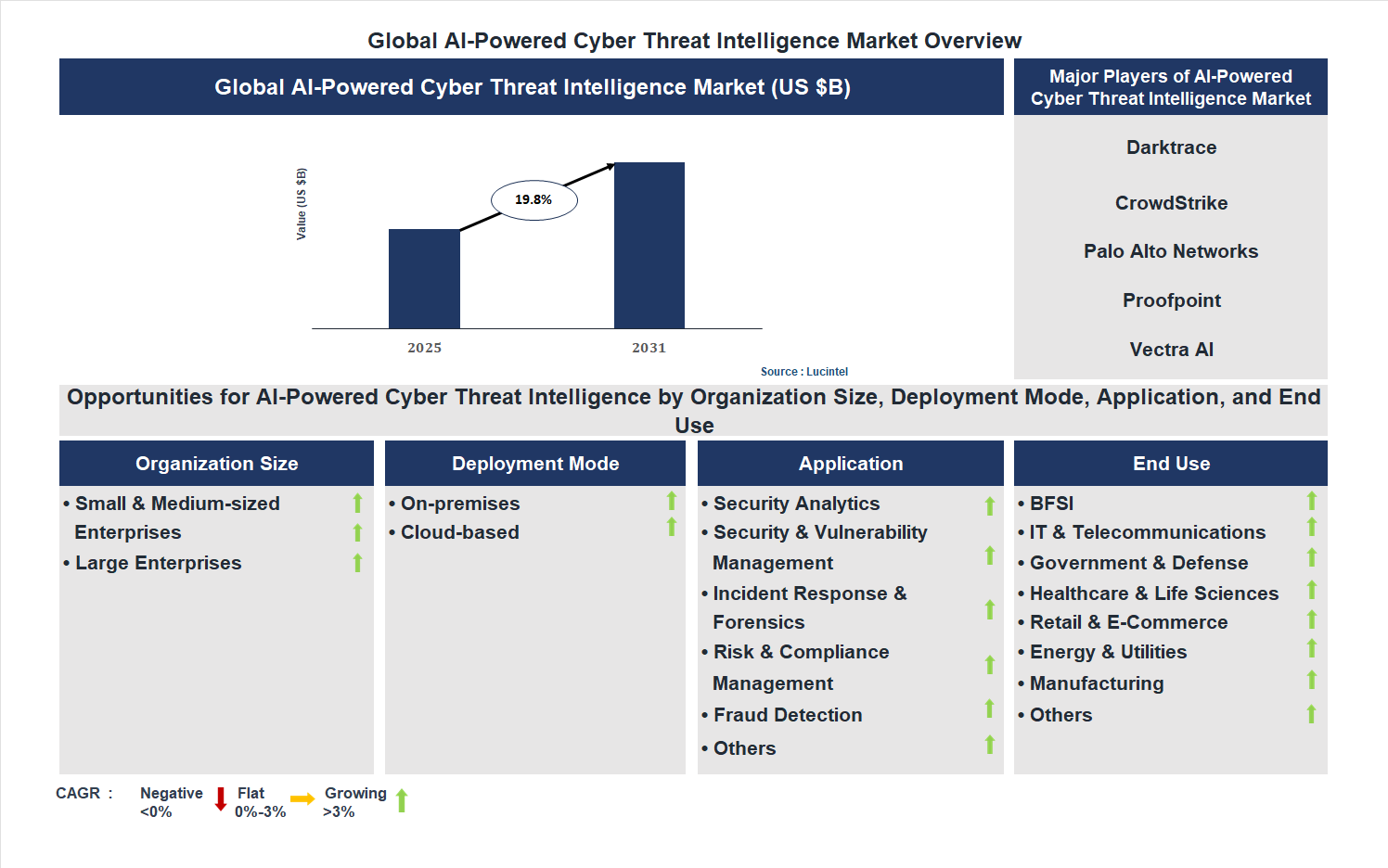
The future of the global AI-powered cyber threat intelligence market looks promising with opportunities in the BFSI, IT & telecommunication, government & defense, healthcare & life science, retail & e-commerce, energy & utility, and manufacturing markets. The global AI-powered cyber threat intelligence market is expected to grow with a CAGR of 19.8% from 2025 to 2031. The major drivers for this market are the increasing volume of complex cyberattacks, the rising demand for automated threat detection, and the growing reliance on predictive security analytics.• Lucintel forecasts that, within the organization size category, small & medium-sized enterprise is expected to witness higher growth over the forecast period.
• Within the end use category, healthcare & life science is expected to witness the highest growth.
• In terms of region, APAC is expected to witness the highest growth over the forecast period. Gain valuable insights for your business decisions with our comprehensive 150+ page report. Sample figures with some insights are shown below.
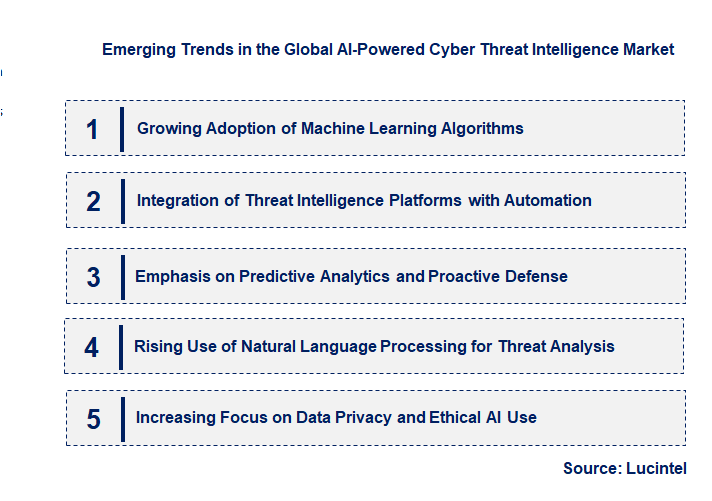
Emerging Trends in the AI-Powered Cyber Threat Intelligence Market
The AI-powered cyber threat intelligence market is experiencing rapid growth driven by increasing cyber threats and advancements in artificial intelligence technology. Organizations are seeking more proactive and efficient ways to detect, analyze, and respond to cyber threats. The integration of AI into cybersecurity solutions is transforming how businesses defend their digital assets, enabling real-time threat detection, predictive analytics, and automated responses. As cyber threats become more sophisticated, the market is evolving to meet these challenges with innovative AI-driven tools. These developments are not only enhancing security but also reshaping industry standards, investment strategies, and operational practices across various sectors.• Growing Adoption of Machine Learning Algorithms: The market is witnessing increased use of machine learning algorithms to identify patterns and anomalies in vast data sets. This trend enhances the ability to detect emerging threats faster and more accurately, reducing false positives. Machine learning models continuously improve through data exposure, making threat detection more dynamic and adaptive. As cyber threats evolve, AI systems with advanced learning capabilities are becoming essential for real-time threat intelligence, providing organizations with a competitive edge in cybersecurity defense.
• Integration of Threat Intelligence Platforms with Automation: Automation is becoming a core component of threat intelligence platforms, enabling faster response times and reducing manual intervention. Automated workflows can analyze threats, prioritize alerts, and initiate countermeasures without human input. This trend improves operational efficiency and minimizes the window of vulnerability. Organizations are increasingly investing in integrated platforms that combine AI-driven insights with automated response mechanisms, leading to more resilient cybersecurity infrastructures capable of handling sophisticated attacks swiftly.
• Emphasis on Predictive Analytics and Proactive Defense: Predictive analytics powered by AI is shifting the focus from reactive to proactive cybersecurity strategies. By analyzing historical data and identifying potential vulnerabilities, these tools can forecast future threats and suggest preemptive actions. This trend allows organizations to anticipate attacks before they occur, significantly reducing potential damage. The adoption of predictive analytics is transforming cybersecurity from a reactive discipline into a strategic, forward-looking approach, thereby enhancing overall security posture and resilience.
• Rising Use of Natural Language Processing (NLP) for Threat Analysis: NLP enables AI systems to interpret and analyze unstructured data such as threat reports, social media, and dark web forums. This capability helps in early detection of emerging threats and understanding attacker tactics, techniques, and procedures (TTPs). NLP-driven threat analysis provides deeper insights into cybercriminal activities and enhances situational awareness. As cyber threats become more complex and covert, NLP is increasingly vital for extracting actionable intelligence from diverse data sources, making threat detection more comprehensive and timely.
• Increasing Focus on Data Privacy and Ethical AI Use: As AI becomes more integral to cybersecurity, concerns around data privacy, bias, and ethical use are gaining prominence. Market players are adopting privacy-preserving techniques and transparent AI models to ensure compliance with regulations and maintain trust. Ethical AI practices are crucial for avoiding unintended consequences and ensuring fair, unbiased threat assessments. This trend influences product development, regulatory frameworks, and corporate policies, shaping a responsible approach to AI deployment in cybersecurity. In summary, these trends are collectively transforming the AI-powered cyber threat intelligence market by making threat detection more accurate, automated, predictive, and ethically responsible. They are enabling organizations to stay ahead of increasingly sophisticated cyber threats, fostering a more resilient and proactive cybersecurity landscape. This evolution is redefining industry standards, driving innovation, and creating new opportunities for market growth and strategic investment.
Recent Development in the AI-Powered Cyber Threat Intelligence Market
The AI-powered cyber threat intelligence market is experiencing rapid growth driven by increasing cyber threats and advancements in artificial intelligence technology. Organizations are seeking smarter, faster ways to detect and respond to cyber attacks, leading to innovations in threat intelligence solutions. This markets evolution is influenced by rising cybercrime sophistication, regulatory requirements, and the need for proactive security measures. As AI becomes more integrated into cybersecurity, the market is poised for significant expansion, with new players and technologies emerging to address evolving threats. These developments are shaping a more resilient and intelligent cybersecurity landscape, crucial for safeguarding digital assets in an interconnected world.• Growing Adoption of Machine Learning Algorithms: The integration of advanced machine learning algorithms enhances threat detection accuracy and speed. This development allows real-time analysis of vast data sets, reducing false positives and enabling quicker response times. As a result, organizations can proactively identify emerging threats, strengthening their security posture and reducing potential damages from cyber attacks.
• Increased Use of Threat Intelligence Platforms: The deployment of comprehensive threat intelligence platforms provides centralized, real-time insights into cyber threats. These platforms facilitate better collaboration among security teams and automate threat analysis processes. Their adoption improves overall incident response efficiency and helps organizations stay ahead of cybercriminal activities, thereby reducing vulnerabilities.
• Expansion of Threat Data Sources: The market is witnessing an expansion in threat data sources, including dark web monitoring, social media analysis, and IoT device data. This diversification offers a more holistic view of potential threats, enabling early detection of cyber risks. Enhanced data sources improve predictive capabilities and help organizations develop more effective defense strategies.
• Integration of AI with Security Orchestration: AI-powered security orchestration tools automate complex security workflows and incident response procedures. This integration reduces manual intervention, accelerates threat mitigation, and minimizes human error. It enables security teams to focus on strategic tasks while ensuring rapid, coordinated responses to cyber incidents.
• Regulatory and Compliance-driven Developments: Increasing regulatory requirements for data protection and cybersecurity are driving innovation in threat intelligence solutions. Vendors are developing compliance-focused features, such as audit trails and reporting tools, to meet legal standards. These developments ensure that organizations not only enhance security but also adhere to evolving legal frameworks, reducing legal and financial risks. The recent developments in the AI-powered cyber threat intelligence market are significantly enhancing threat detection capabilities, improving response times, and fostering better collaboration among security teams. The expansion of data sources and integration with automation tools are making threat intelligence more comprehensive and actionable. Regulatory-driven innovations ensure compliance and reduce legal risks. Overall, these advancements are creating a more proactive, efficient, and resilient cybersecurity environment, enabling organizations to better defend against increasingly sophisticated cyber threats.
Strategic Growth Opportunities in the AI-Powered Cyber Threat Intelligence Market
The AI-powered cyber threat intelligence market is experiencing rapid growth driven by increasing cyber threats and the need for advanced security solutions. As organizations seek proactive measures to defend their digital assets, AI-driven technologies are becoming essential across various sectors. This evolution presents multiple strategic growth opportunities across key applications, enabling market players to capitalize on emerging demands. These opportunities not only enhance security capabilities but also foster innovation, creating a competitive landscape that benefits both providers and users. Understanding these growth avenues is crucial for stakeholders aiming to leverage AI to combat evolving cyber threats effectively.• Financial Services: Enhanced Fraud Detection : AI-powered threat intelligence enables real-time detection of fraudulent activities, reducing financial losses and improving customer trust. Financial institutions can analyze vast transaction data to identify anomalies swiftly, preventing cyber-attacks before they cause significant damage. This growth opportunity drives the adoption of AI solutions in banking, insurance, and investment sectors, strengthening their cybersecurity infrastructure.
• Healthcare: Protecting Sensitive Data : The healthcare sector benefits from AI-driven threat intelligence by safeguarding patient records and sensitive information. As healthcare data becomes a prime target for cybercriminals, AI tools help identify vulnerabilities and respond to threats proactively. This application enhances compliance with data protection regulations and ensures the integrity of critical health information.
• Government & Defense: National Security Enhancement : Governments leverage AI-powered cyber threat intelligence to defend against nation-state attacks and cyber espionage. These solutions provide real-time insights into emerging threats, enabling swift countermeasures. This growth opportunity is vital for maintaining national security and protecting critical infrastructure from sophisticated cyber threats.
• Retail & E-commerce: Securing Customer Data : Retailers utilize AI to monitor transactions and online activities for signs of cyber threats, such as account takeovers and payment fraud. AI-driven threat intelligence helps in early detection and response, safeguarding customer data and maintaining brand reputation. This application supports the digital transformation of retail businesses while ensuring security.
• Critical Infrastructure: Resilience Against Cyber Attacks : AI-powered threat intelligence enhances the security of utilities, transportation, and communication networks. By predicting potential attack vectors and identifying vulnerabilities, these solutions improve resilience against cyber disruptions. This growth opportunity is crucial for maintaining operational continuity and public safety. In summary, these key growth opportunities across various applications are significantly impacting the AI-powered cyber threat intelligence market by expanding its scope and effectiveness. They enable organizations to adopt proactive security measures, reduce risks, and respond swiftly to cyber threats. As a result, the market is witnessing accelerated adoption of AI-driven solutions, fostering innovation and strengthening cybersecurity defenses worldwide.
AI-Powered Cyber Threat Intelligence Market Driver and Challenges
The AI-powered cyber threat intelligence market is influenced by a complex interplay of technological advancements, economic shifts, and regulatory frameworks. Rapid developments in artificial intelligence and machine learning are enabling more sophisticated threat detection and response capabilities. Economic factors such as increasing cybercrime costs and the rising need for cybersecurity investments drive market growth. Additionally, evolving regulatory requirements compel organizations to adopt advanced threat intelligence solutions to ensure compliance. These drivers collectively shape the market landscape, fostering innovation and adoption. However, the market also faces challenges including technological limitations, data privacy concerns, and regulatory uncertainties that could hinder growth. Understanding these factors is essential for stakeholders to navigate the dynamic environment effectively. The factors responsible for driving the AI-powered cyber threat intelligence market include:• Technological Innovation: Rapid advancements in AI and machine learning enable real-time threat detection, predictive analytics, and automated response systems. These innovations improve accuracy and efficiency, reducing the time and resources needed to identify and mitigate cyber threats. As technology continues to evolve, organizations are increasingly adopting AI-driven solutions to stay ahead of sophisticated cybercriminal tactics, thus fueling market growth.
• Increasing Cybersecurity Spending: Organizations worldwide are escalating their cybersecurity budgets due to the rising frequency and sophistication of cyberattacks. Governments and private sectors recognize the importance of proactive threat intelligence to safeguard critical infrastructure and sensitive data. This increased investment accelerates the deployment of AI-powered solutions, expanding the market and encouraging further innovation.
• Growing Cyber Threat Landscape: The proliferation of cyber threats, including ransomware, phishing, and advanced persistent threats, necessitates more intelligent and adaptive defense mechanisms. AI-powered threat intelligence provides predictive insights and automated responses, enabling organizations to preempt attacks. The expanding threat landscape directly correlates with increased demand for advanced cybersecurity tools, thus driving market expansion.
• Regulatory and Compliance Pressures: Stringent data protection laws and cybersecurity regulations compel organizations to adopt comprehensive threat intelligence solutions. Compliance requirements such as GDPR, HIPAA, and others mandate proactive threat detection and reporting. AI-powered solutions help organizations meet these legal obligations efficiently, promoting market growth driven by regulatory compliance needs. The challenges facing this Market include:
• Technological Limitations: Despite rapid advancements, AI systems still face limitations such as false positives, data biases, and interpretability issues. These technological constraints can hinder the effectiveness of threat detection and response, leading to potential vulnerabilities. Overcoming these limitations requires ongoing research and development, which can be resource-intensive and slow market adoption.
• Data Privacy and Ethical Concerns: The deployment of AI in cybersecurity involves processing vast amounts of sensitive data, raising privacy issues. Concerns over data misuse, surveillance, and ethical implications can restrict the adoption of AI-powered threat intelligence solutions. Organizations must balance security benefits with privacy rights, which can complicate implementation and compliance.
• Regulatory Uncertainty: The evolving regulatory landscape creates ambiguity around the use of AI in cybersecurity. Lack of clear standards and guidelines can delay deployment and innovation, as organizations hesitate to invest heavily without certainty of legal compliance. This uncertainty hampers market growth and necessitates ongoing engagement with policymakers. In summary, the AI-powered cyber threat intelligence market is driven by technological innovation, increased cybersecurity spending, an expanding threat landscape, and regulatory pressures. However, technological limitations, privacy concerns, and regulatory uncertainties pose significant challenges. These factors collectively influence the markets trajectory, requiring stakeholders to innovate responsibly and adapt to evolving legal and ethical standards. The overall impact is a dynamic environment with substantial growth potential tempered by the need for addressing critical challenges to ensure sustainable development.
List of AI-Powered Cyber Threat Intelligence Companies
Companies in the market compete on the basis of product quality offered. Major players in this market focus on expanding their manufacturing facilities, R&D investments, infrastructural development, and leverage integration opportunities across the value chain. With these strategies AI-powered cyber threat intelligence companies cater increasing demand, ensure competitive effectiveness, develop innovative products & technologies, reduce production costs, and expand their customer base. Some of the AI-powered cyber threat intelligence companies profiled in this report include-• Darktrace
• CrowdStrike
• Palo Alto Networks
• Proofpoint
• Vectra AI
• Legit Security
• Protect AI
• SentinelOne
• Anomali
• Bitsight
AI-Powered Cyber Threat Intelligence Market by Segment
The study includes a forecast for the global AI-powered cyber threat intelligence market by organization size, deployment mode, application, end use, and region.AI-Powered Cyber Threat Intelligence Market by Organization Size [Value from 2019 to 2031]:
• Small & Medium-sized Enterprises
• Large Enterprises
AI-Powered Cyber Threat Intelligence Market by Deployment Mode [Value from 2019 to 2031]:
• On-premises
• Cloud-based
AI-Powered Cyber Threat Intelligence Market by Application [Value from 2019 to 2031]:
• Security Analytics
• Security & Vulnerability Management
• Incident Response & Forensics
• Risk & Compliance Management
• Fraud Detection
• Others
AI-Powered Cyber Threat Intelligence Market by End Use [Value from 2019 to 2031]:
• BFSI
• IT & Telecommunications
• Government & Defense
• Healthcare & Life Sciences
• Retail & E-Commerce
• Energy & Utilities
• Manufacturing
• Others
AI-Powered Cyber Threat Intelligence Market by Region [Value from 2019 to 2031]:
• North America
• Europe
• Asia Pacific
• The Rest of the World
Country Wise Outlook for the AI-Powered Cyber Threat Intelligence Market
The AI-powered cyber threat intelligence market is experiencing rapid growth driven by increasing cyber threats and advancements in artificial intelligence technology. Countries are investing heavily to enhance their cybersecurity infrastructure, develop innovative AI solutions, and stay ahead of cybercriminal activities. This global race for better threat detection and prevention is shaping the future landscape of cybersecurity, with each nation adopting unique strategies to strengthen their defenses and leverage AI capabilities.• United States: The US leads in AI-powered cyber threat intelligence, with significant investments from government agencies and private firms. Major tech companies are developing advanced AI tools for real-time threat detection and response. The government has launched initiatives to improve national cybersecurity resilience, including public-private partnerships. The market is also witnessing increased adoption of machine learning algorithms to predict and mitigate emerging threats, making the US a global leader in this domain.
• China: China is rapidly advancing in AI-driven cybersecurity, focusing on integrating AI into its national security framework. The government promotes domestic AI development through substantial funding and policy support. Chinese firms are developing sophisticated threat intelligence platforms that utilize deep learning and big data analytics. The country emphasizes self-reliance in cybersecurity technology, aiming to reduce dependence on foreign solutions and enhance its cyber defense capabilities.
• Germany: Germany is emphasizing the integration of AI in cybersecurity within its industrial and critical infrastructure sectors. The country’s focus is on safeguarding manufacturing, automotive, and energy industries from cyber threats. German companies are investing in AI-based anomaly detection systems and automated response tools. The government collaborates with research institutions to develop innovative AI solutions, ensuring compliance with strict data privacy regulations while enhancing threat intelligence.
• India: India is rapidly expanding its cybersecurity infrastructure, with a focus on AI-powered threat detection to combat rising cybercrime. The government has launched initiatives like the National Cyber Security Policy to strengthen defenses. Indian startups and tech firms are developing AI-driven platforms for threat analysis and incident response. The country aims to build a resilient cybersecurity ecosystem, leveraging AI to protect its growing digital economy and critical infrastructure.
• Japan: Japan is advancing its AI cybersecurity capabilities, particularly in protecting its financial and manufacturing sectors. The government promotes AI research and collaborates with private sector firms to develop threat intelligence solutions. Japan emphasizes the use of AI for predictive analytics and automated threat mitigation. The country also invests in workforce training to address the evolving cyber threat landscape, ensuring its cybersecurity measures remain robust and innovative.

Features of the Global AI-Powered Cyber Threat Intelligence Market
Market Size Estimates: AI-powered cyber threat intelligence market size estimation in terms of value ($B). Trend and Forecast Analysis: Market trends (2019 to 2024) and forecast (2025 to 2031) by various segments and regions. Segmentation Analysis: AI-powered cyber threat intelligence market size by various segments, such as by organization size, deployment mode, application, end use, and region in terms of value ($B). Regional Analysis: AI-powered cyber threat intelligence market breakdown by North America, Europe, Asia Pacific, and Rest of the World. Growth Opportunities: Analysis of growth opportunities in different organization sizes, deployment mode, applications, end uses, and regions for the AI-powered cyber threat intelligence market. Strategic Analysis: This includes M&A, new product development, and competitive landscape of the AI-powered cyber threat intelligence market. Analysis of competitive intensity of the industry based on Porter’s Five Forces model.
FAQ
Q1. What is the growth forecast for AI-powered cyber threat intelligence market? Answer: The global AI-powered cyber threat intelligence market is expected to grow with a CAGR of 19.8% from 2025 to 2031. Q2. What are the major drivers influencing the growth of the AI-powered cyber threat intelligence market? Answer: The major drivers for this market are the increasing volume of complex cyberattacks, the rising demand for automated threat detection, and the growing reliance on predictive security analytics. Q3. What are the major segments for AI-powered cyber threat intelligence market? Answer: The future of the AI-powered cyber threat intelligence market looks promising with opportunities in the BFSI, IT & telecommunication, government & defense, healthcare & life science, retail & e-commerce, energy & utility, and manufacturing markets. Q4. Who are the key AI-powered cyber threat intelligence market companies? Answer: Some of the key AI-powered cyber threat intelligence companies are as follows:• Darktrace
• CrowdStrike
• Palo Alto Networks
• Proofpoint
• Vectra AI
• Legit Security
• Protect AI
• SentinelOne
• Anomali
• Bitsight Q5. Which AI-powered cyber threat intelligence market segment will be the largest in future? Answer: Lucintel forecasts that, within the organization size category, small & medium-sized enterprise is expected to witness higher growth over the forecast period. Q6. In AI-powered cyber threat intelligence market, which region is expected to be the largest in next 5 years? Answer: In terms of region, APAC is expected to witness the highest growth over the forecast period. Q7. Do we receive customization in this report? Answer: Yes, Lucintel provides 10% customization without any additional cost.
Table of Contents
List of Figures
List of Tables
Methodology
- In-depth interviews of the major players in this market
- Detailed secondary research from competitors’ financial statements and published data
- Extensive searches of published works, market, and database information pertaining to industry news, company press releases, and customer intentions
- A compilation of the experiences, judgments, and insights of Lucintel’s professionals, who have analyzed and tracked this market over the years.


Buy Now
Choose a license that fits your team. Instant PDF delivery.
Prices exclude taxes. Instant delivery. Custom licensing available on request.
Key Questions
- • What are some of the most promising, high-growth opportunities for the AI-powered cyber threat intelligence market by organization size (small & medium-sized enterprises and large enterprises), deployment mode (on-premises and cloud-based), application (security analytics, security & vulnerability management, incident response & forensics, risk & compliance management, fraud detection, and others), end use (BFSI, IT & telecommunications, government & defense, healthcare & life sciences, retail & e-commerce, energy & utilities, manufacturing, and others), and region (North America, Europe, Asia Pacific, and the Rest of the World)?
- • Which segments will grow at a faster pace and why?
- • Which region will grow at a faster pace and why?
- • What are the key factors affecting market dynamics? What are the key challenges and business risks in this market?
- • What are the business risks and competitive threats in this market?
- • What are the emerging trends in this market and the reasons behind them?
- • What are some of the changing demands of customers in the market?
- • What are the new developments in the market? Which companies are leading these developments?
- • Who are the major players in this market? What strategic initiatives are key players pursuing for business growth?
- • What are some of the competing products in this market and how big of a threat do they pose for loss of market share by material or product substitution?
- • What M&A activity has occurred in the last 5 years and what has its impact been on the industry? For any questions related to AI-Powered Cyber Threat Intelligence Market, AI-Powered Cyber Threat Intelligence Market Size, AI-Powered Cyber Threat Intelligence Market Growth, AI-Powered Cyber Threat Intelligence Market Analysis, AI-Powered Cyber Threat Intelligence Market Report, AI-Powered Cyber Threat Intelligence Market Share, AI-Powered Cyber Threat Intelligence Market Trends, AI-Powered Cyber Threat Intelligence Market Forecast, AI-Powered Cyber Threat Intelligence Companies, write Lucintel analyst at email: helpdesk@lucintel.com. We will be glad to get back to you soon.


