
Market Report · July 31, 2026

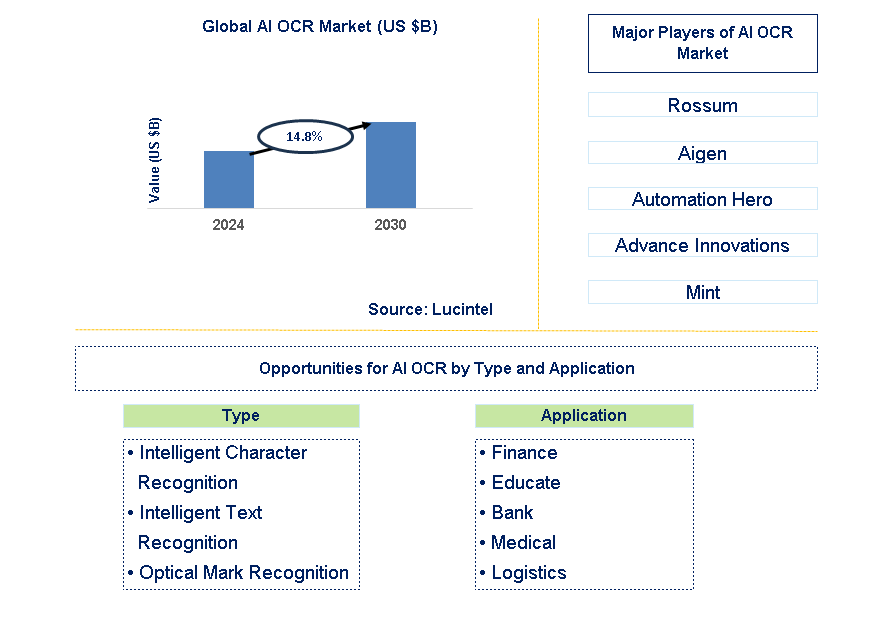
Key data points: The growth forecast = 14.8% annually for the next 6 years. Scroll below to get more insights. This market report covers trends, opportunities, and forecastss in the global AI OCR market to 2030 by type (intelligent character recognition, intelligent text recognition, and optical mark recognition), application (finance, educate, bank, medical, and logistics), and region (North America, Europe, Asia Pacific, and the Rest of the World)
We'll send your sample report shortly.
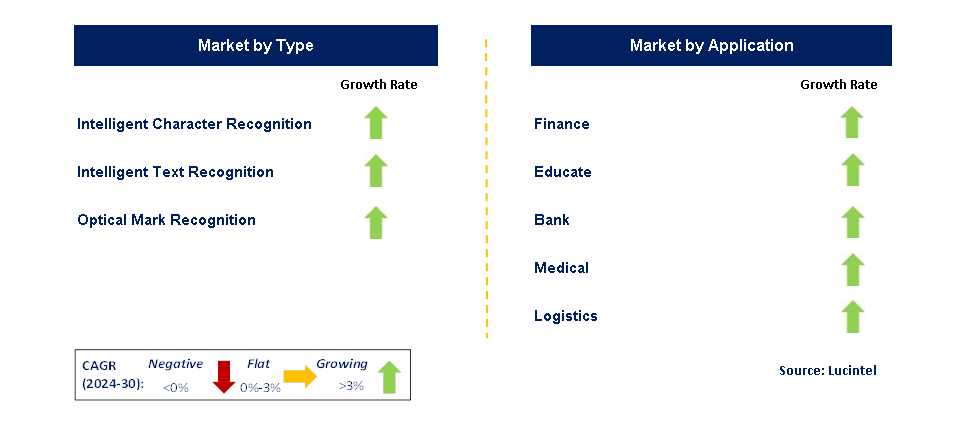
• Lucintel forecasts that intelligent character recognition is expected to witness the highest growth over the forecast period.
• Within this market, finance is expected to witness the highest growth.
• APAC is expected to witness the highest growth over the forecast period. Gain valuable insights for your business decisions with our comprehensive 150+ page report.
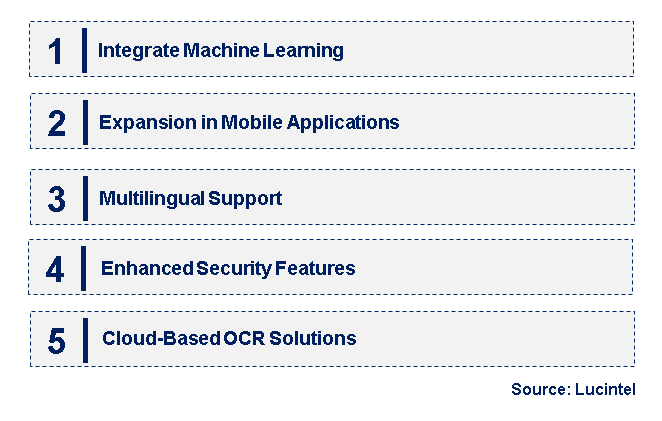
• Integration of Machine Learning: The integration of machine learning algorithms further increases the practicality and accuracy of OCR solutions. Through training on data patterns, text recognition becomes possible in various fonts and layouts, significantly improving performance in real-world applications.
• Expansion in Mobile Applications: With the proliferation of mobile devices comes the rise of mobile OCR applications. Users can now capture documents on the go and direct digitization into systems for instant processing and access. This trend has a substantial impact on areas like retail and finance, where rapid data entry is essential.
• Multilingual Support: Due to increasing global business expansion, the demand for multilingual OCR is growing. AI technologies are evolving to support multiple languages and scripts, simplifying document management for organizations in diverse international markets.
• Enhanced Security Features: AI OCR solutions are addressing growing concerns over data privacy and security by implementing enhanced security features. These include encryption and compliance with data protection regulations, ensuring that sensitive information is treated securely while facilitating efficient data processing.
• Cloud-Based OCR Solutions: Cloud computing significantly affects the OCR market. The scalability, easy access, and integration capabilities of cloud-based OCR solutions provide organizations the opportunity to use OCR technology without heavy upfront investments, thereby enhancing operational flexibility. All these emerging trends are impacting the AI OCR market by adding functionalities, making it more accessible, and improving security. For organizations that recognize the importance of automated processing, these trends will further promote innovation and adoption across sectors.
• Improved Recognition Algorithms: Advances in deep learning and neural networks have led to the development of more sophisticated recognition algorithms. These evolved algorithms are particularly effective for reading handwritten and stylized text, allowing OCR systems to be more versatile across various applications.
• AI-Powered Data Extraction: Businesses are increasingly utilizing AI for data extraction processes. AI-based OCR solutions can intelligently read documents, categorize them, and perform relevant extractions with minimal human interference, thus streamlining workflows and minimizing errors.
• User-Friendly Interfaces: The development of intuitive user interfaces for OCR applications is on the rise. Users, even those with no technical background, can work with OCR technologies using modern interfaces designed for easy interaction.
• Robust APIs for Integration: The emergence of robust APIs has simplified the integration of OCR capabilities into existing software systems. Businesses are evolving their applications by incorporating OCR functionalities, thereby enhancing overall efficiency in data management.
• Sustainability Focus: Greater awareness of environmental sustainability has led to the growth of OCR solutions among companies. Further developments in these technologies promote digital documentation, helping organizations reduce their carbon footprint and enhance overall resource efficiency. Such developments greatly influence the AI OCR market by enhancing capabilities, improving user experiences, and driving efficiency. With the adoption of these innovations by organizations, significant improvements in data processing workflows are expected.
• Financial Services Automation: AI OCR is increasingly applied in automating invoice processing, loan applications, and compliance documentation in the financial sector. This automation reduces manpower requirements while accelerating operations and improving accuracy in handling sensitive financial information.
• Healthcare Documentation: Healthcare providers are increasingly using AI OCR to digitize patient care records and streamline billing processes. This application enhances a patient-centric approach by ensuring the ready availability of critical information and reducing paperwork along with the administrative burden.
• Legal Document Management: Law firms are using AI OCR solutions to enhance document management and case preparation. Automation in extracting data from legal documents increases efficiency and productivity, ensuring that important information is easily accessible.
• Retail Inventory Management: AI OCR technologies in the retail industry help businesses improve inventory management. By automating stock-taking and order processing, these solutions enhance accuracy and reduce the time spent on manual inventory management.
• Government and Public Sector Applications: Governments are adopting AI OCR to efficiently digitize and manage public records. This leads to improved transparency, reduced paperwork, and enhanced public service delivery, thereby boosting growth in this sector. These strategic growth opportunities represent significant potential in the AI OCR market across different applications. Focusing on the finance, healthcare, legal, retail, and government sectors can help businesses leverage AI OCR technologies for increased efficiency and innovative applications.
• Technological Advancements: The main growth drivers in the AI OCR market are advances in artificial intelligence and machine learning. These technologies have increased the speed and accuracy of OCR, making them essential for data processing in various industries.
• Growing Demand for Automation: The need for automation across different sectors is a major driver for AI OCR technologies. Businesses are seeking to minimize manual data entry while benefiting from efficient operations, leading to increased adoption of OCR systems.
• Regulatory Compliance: Regulatory requirements, particularly in finance and healthcare, are fostering the adoption of AI OCR technologies. Organizations must ensure efficient and secure data management processes to comply with data protection regulations. Challenges in the AI OCR market include:
• Data Privacy Concerns: Privacy issues may deter the adoption of AI OCR technologies. Organizations must navigate complex regulations, making implementation more challenging.
• Integration Complexities: Integrating AI OCR solutions into existing systems can be challenging, especially for organizations with legacy infrastructure. These complexities may increase costs and extend the time required to deliver such solutions.
• Limitations in Language Processing: Despite significant advancements, challenges remain in effectively processing documents in multiple languages or complex scripts using AI OCR systems. Addressing these limitations is crucial for wider adoption. These challenges and drivers are interconnected, each influencing the overall AI OCR market. Innovation and growth can be systematically guided by understanding the areas of challenge and the drivers to leverage.
• Rossum
• Aigen
• Automation Hero
• Advance Innovations
• Mint
• Net Smile
• Processmaker
• Intelligent Character Recognition
• Intelligent Text Recognition
• Optical Mark Recognition
• Finance
• Educate
• Bank
• Medical
• Logistics
• North America
• Europe
• Asia Pacific
• The Rest of the World
• United States: AI OCR technologies in the U.S. are increasingly applied to streamline business processes and automate data entry and document scanning. Significant improvements include machine learning algorithms that enhance text recognition in complex documents. Compliance with data protection regulations is also a key focus, leading to the design of secure and scalable OCR solutions. Investments across industries are increasing to achieve operational efficiency and reduce costs through AI-driven technologies.
• China: The country is rapidly adopting AI OCR technology, particularly within the e-commerce and finance sectors. Companies are leveraging advanced OCR functionalities to automate invoice processing and customer service. Innovation is flourishing as the government continues to promote digital transformation. However, concerns regarding data safety and confidentiality necessitate the establishment of strong regulatory frameworks to ensure safe utilization of these technologies.
• Germany: Germany's manufacturing and automotive sectors significantly influence the AI OCR market. Businesses are deploying OCR solutions to manage documents and extract data from technical materials. The demand for Industry 4.0 solutions is growing, with firms interested in AI OCR to improve operational efficiency while ensuring compliance with GDPR regarding sensitive data protection.
• India: The Indian AI OCR market is growing rapidly, particularly in the banking and healthcare sectors, where efficient data management is essential. Companies are investing heavily in OCR technologies for document processing automation and improved service delivery. High penetration of smartphones is also driving demand for mobile-based OCR applications. However, challenges remain in processing regional languages, necessitating further advancements in AI to cater effectively to diverse users.
• Japan: AI OCR solutions are increasingly recognized in sectors such as logistics and retail, where businesses seek to enhance operational efficiency through automated inventory and order management. Innovations in image recognition and natural language processing continue to improve OCR precision. Additionally, rising age-related pressures are driving demand for automation as businesses aim to alleviate workforce shortages. Regulatory considerations surrounding data handling are crucial for developing secure OCR applications that comply with emerging technologies.


• Rossum
• Aigen
• Automation Hero
• Advance Innovations
• Mint
• Net Smile
• Processmaker Q5. Which AI OCR market segment will be the largest in future? Answer: Lucintel forecasts that intelligent character recognition is expected to witness the highest growth over the forecast period. Q6. In AI OCR market, which region is expected to be the largest in next 5 years? Answer: APAC is expected to witness the highest growth over the forecast period. Q.7 Do we receive customization in this report? Answer: Yes, Lucintel provides 10% customization without any additional cost.


Choose a license that fits your team. Instant PDF delivery.
Prices exclude taxes. Instant delivery. Custom licensing available on request.
Market Report · July 31, 2026
Market Report · July 31, 2026
Market Report · July 31, 2026
Trusted partner for strategic intelligence and business growth


Receive a complimentary market analysis tailored to your industry. Our analysts will identify key growth opportunities and competitive dynamics specific to your business.

Market size, growth rate, and key trend analysis for your specific sector.

Top competitor positioning and market share analysis.

Strategic recommendations backed by data-driven insights.
Get curated market intelligence and competitive moves straight to your inbox.
By subscribing, you agree to receive our monthly insights. Unsubscribe anytime.
Receive a complimentary market analysis tailored to your industry. Our analysts will identify key growth opportunities and competitive dynamics specific to your business.
Market size, growth rate, and key trend analysis for your specific sector.
Top competitor positioning and market share analysis.
Strategic recommendations backed by data-driven insights.
Get curated market intelligence, emerging trends, and competitive moves straight to your inbox each month.
By subscribing, you agree to receive our monthly insights. Unsubscribe anytime.
We'll send your sample report shortly.