
Report Feature
AI Director Market Trends and Forecast
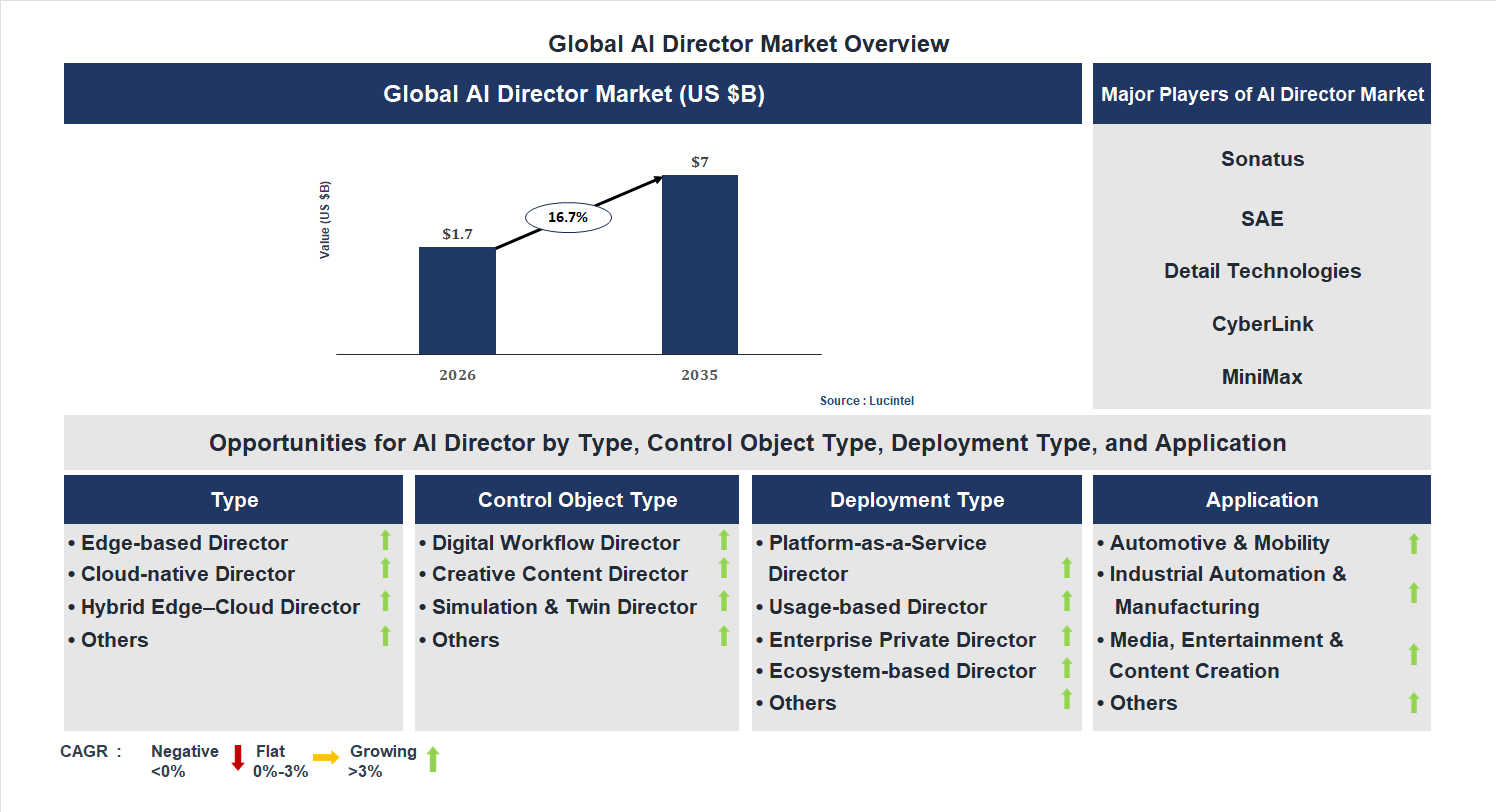
The future of the global AI director market looks promising with opportunities in the automotive & mobility, industrial automation & manufacturing, and media, and entertainment & content creation markets. The global AI director market is expected to reach an estimated $7 billion by 2035 with a CAGR of 16.7% from 2026 to 2035. The major drivers for this market are the increasing deployment of enterprise AI systems, the rising need for AI workflow orchestration, and the growing adoption of hybrid cloud architectures.• Lucintel forecasts that, within the type category, hybrid edge–cloud director is expected to witness the highest growth over the forecast period.
• Within the application category, industrial automation & manufacturing is expected to witness the highest growth.
• In terms of region, APAC is expected to witness the highest growth over the forecast period. Gain valuable insights for your business decisions with our comprehensive 150+ page report. Sample figures with some insights are shown below.
Emerging Trends in the AI Director Market
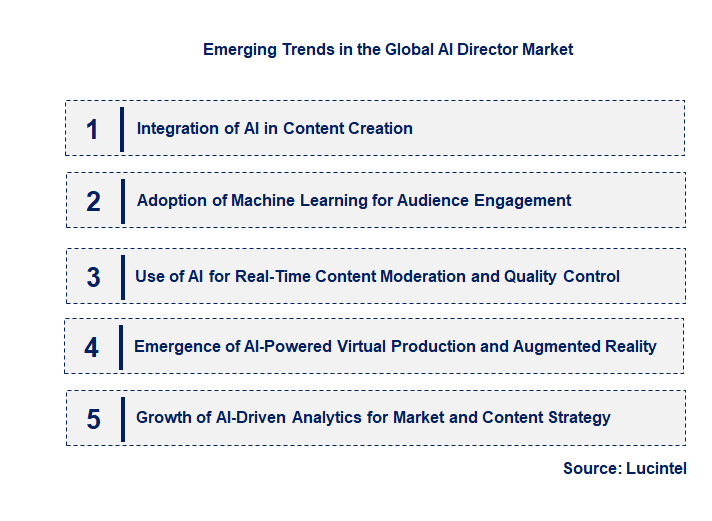
The AI director market is experiencing rapid growth driven by technological advancements, increasing demand for automation, and evolving entertainment and media landscapes. As organizations seek innovative ways to enhance storytelling, streamline production, and engage audiences, the market is witnessing significant shifts. Emerging trends are shaping the future of AI-driven content creation, management, and distribution, leading to more personalized, efficient, and immersive experiences. These developments are not only transforming how content is produced and consumed but also redefining industry standards and competitive dynamics. Understanding these key trends is essential for stakeholders aiming to capitalize on the markets potential and navigate its evolving landscape.• Integration of AI in Content Creation: AI tools are increasingly being integrated into content creation processes, enabling directors to generate scripts, storyboards, and visual effects more efficiently. This trend reduces production time and costs while expanding creative possibilities. AI-driven algorithms can analyze audience preferences to tailor content, making productions more engaging and personalized. As a result, directors can experiment with innovative storytelling techniques, leading to richer, more diverse content. This integration is transforming traditional workflows and empowering creators with advanced technological support.
• Adoption of Machine Learning for Audience Engagement: Machine learning models analyze vast amounts of viewer data to predict preferences and behaviors. AI directors leverage these insights to craft targeted content and marketing strategies, increasing viewer engagement and retention. Personalized recommendations and adaptive storytelling enhance the viewer experience, fostering loyalty. This trend allows content providers to optimize distribution channels and maximize reach. As audience expectations evolve, AI-driven personalization becomes a critical competitive advantage, shaping how content is tailored and delivered across platforms.
• Use of AI for Real-Time Content Moderation and Quality Control: AI systems are being employed to monitor content in real-time, detecting inappropriate material, ensuring compliance with regulations, and maintaining quality standards. This reduces the need for manual oversight, speeds up review processes, and minimizes errors. AI-driven moderation tools can adapt to new content trends and language nuances, providing scalable solutions for large-scale productions. This trend enhances the integrity and safety of content, building trust with audiences and stakeholders while streamlining operational workflows.
• Emergence of AI-Powered Virtual Production and Augmented Reality: AI is playing a pivotal role in virtual production techniques, including real-time rendering, motion capture, and augmented reality integration. These technologies enable directors to craft highly immersive environments without extensive physical sets, reducing costs and logistical challenges. AI enhances the realism and interactivity of virtual scenes, offering new storytelling dimensions. This trend is revolutionizing film, television, and live events by providing innovative ways to engage audiences and deliver cutting-edge visual experiences, expanding creative horizons.
• Growth of AI-Driven Analytics for Market and Content Strategy: Advanced analytics powered by AI provide insights into market trends, audience preferences, and content performance. Directors and producers utilize these insights to inform strategic decisions, optimize content portfolios, and identify new opportunities. AI analytics facilitate predictive modeling, helping stakeholders anticipate industry shifts and adapt proactively. This trend enhances competitiveness by enabling more informed, data-backed choices, ultimately leading to more successful content launches and market positioning. In summary, these emerging trends are fundamentally reshaping the AI director market by fostering innovation, improving efficiency, and enhancing audience engagement. They are driving a shift toward more personalized, immersive, and data-driven content creation and distribution, positioning the market for sustained growth and transformation in the digital age.
Recent Development in the AI Director Market
The AI director market is experiencing rapid growth driven by technological advancements and increasing demand for intelligent automation across industries. Companies are investing heavily in AI-driven solutions to enhance decision-making, streamline operations, and improve customer experiences. This evolving landscape presents significant opportunities for innovation and market expansion. Stakeholders must stay informed about these developments to capitalize on emerging trends and maintain a competitive advantage in a dynamic environment.• Growing Adoption of AI in Media Production: The integration of AI directors in media and entertainment is revolutionizing content creation. AI systems now assist in scene selection, editing, and real-time decision-making, reducing production time and costs. This development enhances creative possibilities and enables personalized content delivery, attracting more consumers. As AI becomes more sophisticated, its role in directing and managing media projects will expand, creating new revenue streams and operational efficiencies for industry players.
• Advances in AI-Driven Content Personalization: AI directors are enabling highly tailored content experiences by analyzing user preferences and behaviors. This personalization increases viewer engagement and loyalty, driving revenue growth for streaming platforms and broadcasters. Enhanced algorithms facilitate dynamic content adjustments, making programming more relevant to individual audiences. The market benefits from increased consumer satisfaction and retention, fostering competitive differentiation. As personalization technology evolves, it will further transform how content is curated and delivered.
• Integration of AI with Virtual and Augmented Reality: The convergence of AI with VR and AR technologies is creating immersive, interactive experiences guided by AI directors. This synergy enhances storytelling, gaming, and training applications, offering more realistic and engaging environments. Businesses leverage these innovations to attract users and generate new monetization opportunities. The market sees a surge in demand for AI-powered virtual environments, which are redefining entertainment, education, and enterprise solutions, expanding the scope of AI director applications.
• Development of Autonomous AI Directors: Autonomous AI systems capable of independently managing complex projects are emerging. These AI directors can coordinate multiple tasks, optimize workflows, and make real-time decisions without human intervention. This advancement reduces operational costs and increases efficiency across industries such as film production, advertising, and live events. The market benefits from scalable, cost-effective solutions that improve project outcomes and enable rapid adaptation to changing conditions, fostering innovation and competitive advantage.
• Enhanced AI Ethical and Regulatory Frameworks: As AI directors become more prevalent, regulatory bodies are establishing guidelines to ensure ethical use and transparency. These frameworks aim to address concerns related to bias, accountability, and data privacy. Implementing such standards builds consumer trust and promotes responsible AI deployment. The market experiences increased stability and confidence, encouraging broader adoption of AI director solutions. Ongoing regulatory developments will shape future innovations and market growth trajectories. The overall impact of these developments is a more dynamic, efficient, and personalized AI director market. They drive innovation, reduce costs, and open new revenue streams, positioning the industry for sustained growth. Companies that adapt quickly to these trends will gain competitive advantages, shaping the future landscape of AI-driven media and entertainment.
Strategic Growth Opportunities in the AI Director Market
The AI director market is experiencing rapid expansion driven by advancements in artificial intelligence, increasing adoption across industries, and the need for intelligent automation. As organizations seek to optimize operations, enhance decision-making, and improve customer experiences, the market presents significant growth opportunities. Key applications such as media production, entertainment, advertising, and corporate training are leveraging AI directors to streamline workflows and deliver innovative content. This evolving landscape offers numerous avenues for strategic investment and technological development, shaping the future of AI-driven content creation and management.• Integration of AI Directors in Media Production: AI directors are increasingly integrated into film, television, and digital content creation, enabling automated scene management, real-time editing, and enhanced visual effects. This reduces production time and costs while improving creative flexibility. As AI technology advances, more studios and content creators are adopting AI-driven tools to streamline workflows, personalize content, and deliver high-quality productions efficiently, creating a substantial growth trajectory for the market.
• Adoption of AI in Advertising and Marketing Campaigns: AI directors are transforming advertising by enabling dynamic content generation, personalized messaging, and real-time campaign adjustments. Marketers leverage AI to analyze consumer data, optimize ad placements, and generate creative assets automatically. This results in more targeted, engaging campaigns with higher ROI. As digital advertising continues to grow, the demand for AI-driven creative solutions is expected to surge, expanding the market significantly.
• AI-Driven Content Personalization and User Engagement: AI directors facilitate highly personalized content experiences across platforms such as streaming services, social media, and gaming. By analyzing user preferences and behaviors, AI can tailor content in real-time, increasing engagement and retention. This personalization enhances customer satisfaction and loyalty, prompting companies to invest heavily in AI content management systems, thereby fueling market growth and innovation in user-centric content delivery.
• Expansion of AI in Corporate Training and Virtual Events: AI directors are increasingly used in virtual training sessions, webinars, and corporate events to automate content delivery, manage interactive elements, and provide real-time feedback. This enhances the effectiveness of remote learning and engagement, reducing logistical costs and improving participant experience. As remote work and online education expand, the adoption of AI-driven virtual event management tools is expected to grow, opening new avenues for market expansion.
• Development of AI-Enabled Autonomous Filmmaking and Content Creation: Autonomous AI systems are emerging to independently generate scripts, direct scenes, and produce entire content pieces without human intervention. This innovation promises to drastically reduce production costs and time while enabling creative experimentation. As AI becomes more sophisticated, autonomous filmmaking could revolutionize content creation, attracting investments and opening new markets for AI directors in independent and large-scale productions alike. The overall impact of these opportunities is poised to significantly accelerate market growth, foster innovation, and reshape content creation paradigms across industries, establishing AI directors as essential tools for future media and entertainment landscapes.
AI Director Market Driver and Challenges
The AI director market is influenced by a complex interplay of technological advancements, economic shifts, and regulatory frameworks. Rapid innovations in artificial intelligence, increasing adoption across industries, and evolving data management capabilities are key drivers propelling market growth. Simultaneously, economic factors such as rising investments and the need for cost-effective solutions bolster expansion. However, challenges like data privacy concerns, regulatory uncertainties, and technological complexities pose significant hurdles. Understanding these drivers and challenges is essential for stakeholders to navigate the evolving landscape effectively and capitalize on emerging opportunities while mitigating risks. The factors responsible for driving the AI director market include:-• Technological Innovation: The continuous development of advanced AI algorithms and tools enhances the capabilities of AI directors, enabling more sophisticated decision-making and automation. This technological progress allows organizations to optimize operations, improve efficiency, and gain competitive advantages. As AI technology becomes more accessible and scalable, the demand for AI directors who can oversee and implement these solutions increases, fueling market growth. Additionally, integration with emerging technologies like machine learning and natural language processing further expands the scope and effectiveness of AI directors, making them indispensable in modern enterprise environments.
• Increasing Adoption Across Industries: Industries such as healthcare, finance, retail, and manufacturing are increasingly integrating AI solutions to streamline processes, enhance customer experiences, and drive innovation. AI directors play a crucial role in managing these complex deployments, ensuring alignment with business goals and regulatory standards. The rising need for data-driven decision-making and automation accelerates adoption, creating a robust demand for skilled AI directors. This cross-industry expansion not only broadens market reach but also encourages the development of specialized AI director roles tailored to specific sector needs, further propelling market growth.
• Growing Data Volumes and Complexity: The exponential increase in data generated by digital platforms necessitates sophisticated management and analysis tools. AI directors are essential for designing and overseeing systems that handle large, complex datasets efficiently. Their expertise ensures data quality, security, and compliance, which are critical for deriving actionable insights. As organizations recognize the value of big data, the demand for AI directors capable of orchestrating advanced analytics and machine learning models intensifies. This trend underscores the importance of AI leadership in harnessing datas full potential, thereby driving market expansion.
• Rising Investment in AI Technologies: Significant funding from venture capitalists, corporations, and government initiatives fuels the development and deployment of AI solutions. This influx of capital supports research, talent acquisition, and infrastructure development, creating a fertile environment for AI director roles. Companies are increasingly investing in AI to gain a competitive edge, which necessitates strategic oversight by experienced AI directors. The surge in investment not only accelerates technological innovation but also expands the market by enabling startups and established firms to implement AI-driven projects, thus contributing to overall market growth. The challenges facing this AI director market include:-
• Data Privacy and Security Concerns: As AI systems process vast amounts of sensitive data, ensuring privacy and security becomes paramount. Data breaches and misuse can lead to legal penalties and loss of customer trust. AI directors must navigate complex regulatory landscapes and implement robust security protocols, which can be resource-intensive. The evolving nature of data privacy laws globally adds uncertainty, making compliance a significant challenge. Failure to address these concerns can hinder AI adoption and limit market growth, emphasizing the need for strong governance frameworks within AI strategies.
• Regulatory Uncertainty: The lack of comprehensive and consistent regulations governing AI deployment creates ambiguity for organizations. Unclear legal standards regarding liability, ethical use, and transparency complicate decision-making processes for AI directors. This regulatory unpredictability can delay project approvals, increase compliance costs, and stifle innovation. Companies may hesitate to fully commit to AI initiatives without clear guidelines, which hampers market expansion. As governments and industry bodies work towards establishing standards, the evolving regulatory environment remains a critical challenge for sustainable growth.
• Technological Complexity and Talent Shortage: Developing and managing advanced AI systems requires specialized skills and deep technical expertise. The rapid pace of technological change makes it difficult for organizations to keep up, leading to implementation challenges. Additionally, a significant talent gap exists, with a shortage of qualified AI professionals and directors. This scarcity hampers project execution and innovation, increasing costs and time-to-market. Overcoming these complexities and attracting skilled talent are essential for market growth, but current limitations pose substantial hurdles that need strategic solutions. In summary, the AI director market is driven by rapid technological advancements, cross-industry adoption, increasing data complexity, and substantial investments. However, challenges such as data privacy, regulatory ambiguity, and talent shortages pose significant risks. These factors collectively shape the markets trajectory, requiring stakeholders to balance innovation with risk management. Addressing these challenges while leveraging key drivers will be crucial for sustained growth and competitive advantage in the evolving AI landscape.
List of AI Director Companies
Companies in the market compete on the basis of product quality offered. Major players in this market focus on expanding their manufacturing facilities, R&D investments, infrastructural development, and leverage integration opportunities across the value chain. With these strategies AI director companies cater increasing demand, ensure competitive effectiveness, develop innovative products & technologies, reduce production costs, and expand their customer base. Some of the AI director companies profiled in this report include-• Sonatus
• SAE
• Detail Technologies
• CyberLink
• MiniMax
• AI Video Direct
• AIM
AI Director Market by Segment
The study includes a forecast for the global AI director market by type, control object type, deployment type, application, and region.AI Director Market by Type [Value from 2019 to 2035]:
• Edge-based Director
• Cloud-native Director
• Hybrid Edge–Cloud Director
• Others
AI Director Market by Control Object Type [Value from 2019 to 2035]:
• Digital Workflow Director
• Creative Content Director
• Simulation & Twin Director
• Others
AI Director Market by Deployment Type [Value from 2019 to 2035]:
• Platform-as-a-Service Director
• Usage-based Director
• Enterprise Private Director
• Ecosystem-based Director
• Others
AI Director Market by Application [Value from 2019 to 2035]:
• Automotive & Mobility
• Industrial Automation & Manufacturing
• Media, Entertainment & Content Creation
• Others
AI Director Market by Region [Value from 2019 to 2035]:
• North America
• Europe
• Asia Pacific
• The Rest of the World
Country Wise Outlook for the AI Director Market
The AI director market is experiencing rapid growth driven by technological advancements, increasing adoption across industries, and the need for sophisticated AI management tools. As organizations seek to optimize AI deployment, governance, and ethical considerations, the market landscape is evolving uniquely in different regions. Countries are investing heavily in AI research, infrastructure, and regulatory frameworks to stay competitive. This dynamic environment reflects a global push towards smarter, more efficient AI systems that can address complex challenges across sectors such as healthcare, finance, manufacturing, and entertainment. The following summarizes recent developments in the AI director market for the United States, China, Germany, India, and Japan.• United States: The US market has seen significant advancements with major tech firms launching innovative AI director solutions focused on enterprise governance and ethical AI. Increased investments in AI startups and research institutions are fostering cutting-edge developments. Regulatory efforts are also underway to establish standards for AI transparency and accountability, boosting market confidence. Additionally, government initiatives aim to integrate AI directors into federal agencies to improve decision-making processes.
• China: China is rapidly expanding its AI capabilities, with government-backed projects emphasizing AI governance and strategic deployment. Domestic companies are developing comprehensive AI director platforms tailored for industries like manufacturing and finance. The government’s focus on AI regulation and data security is shaping the market, encouraging local innovation. Collaborations between academia and industry are fostering advanced AI management tools, positioning China as a key player in global AI governance.
• Germany: Germany’s AI director market is characterized by a focus on industrial applications and ethical AI practices. Leading automotive and manufacturing firms are adopting AI directors to enhance automation and safety standards. The country’s strong emphasis on data privacy and regulatory compliance influences product development. Public-private partnerships are promoting research in trustworthy AI, ensuring solutions align with European Union regulations and standards.
• India: India’s AI director market is emerging with a focus on scalable, cost-effective solutions suitable for diverse industries such as agriculture, healthcare, and finance. Government initiatives like Digital India are encouraging AI adoption and innovation. Startups and tech firms are developing localized AI governance tools to address regional challenges. The market is also driven by increasing investments in AI talent and infrastructure, aiming to position India as a global AI hub.
• Japan: Japan is advancing its AI director market through a focus on robotics, manufacturing, and healthcare sectors. The country emphasizes human-centric AI governance, integrating ethical considerations into AI management tools. Collaborations between government agencies and private firms are fostering the development of sophisticated AI oversight systems. Japan’s aging population and need for automation are further propelling the adoption of AI directors to improve efficiency and quality of life.

Features of the Global AI Director Market
Market Size Estimates: AI director market size estimation in terms of value ($B). Trend and Forecast Analysis: Market trends (2019 to 2025) and forecast (2026 to 2035) by various segments and regions. Segmentation Analysis: AI director market size by various segments, such as by type, control object type, deployment type, application, and region in terms of value ($B). Regional Analysis: AI director market breakdown by North America, Europe, Asia Pacific, and Rest of the World. Growth Opportunities: Analysis of growth opportunities in different type, control object type, deployment type, application, and regions for the AI director market. Strategic Analysis: This includes M&A, new product development, and competitive landscape of the AI director market. Analysis of competitive intensity of the industry based on Porter’s Five Forces model.
FAQ
Q1. What is the market size and growth forecast for AI director market? Answer: The global AI director market is expected to reach an estimated $7 billion by 2035 and grow with a CAGR of 16.7% from 2026 to 2035. Q2. What are the major drivers influencing the growth of the AI director market? Answer: The major drivers for this market are the increasing deployment of enterprise AI systems, the rising need for AI workflow orchestration, and the growing adoption of hybrid cloud architectures. Q3. What are the major segments for AI director market? Answer: The future of the AI director market looks promising with opportunities in the automotive & mobility, industrial automation & manufacturing, and media, and entertainment & content creation markets. Q4. Who are the key AI director market companies? Answer: Some of the key AI director companies are as follows:• Sonatus
• SAE
• Detail Technologies
• CyberLink
• MiniMax
• AI Video Direct
• AIM Q5. Which AI director market segment will be the largest in future? Answer: Lucintel forecasts that, within the type category, hybrid edge–cloud director is expected to witness the highest growth over the forecast period. Q6. In AI director market, which region is expected to be the largest in next 5 years? Answer: In terms of region, APAC is expected to witness the highest growth over the forecast period. Q7. Do we receive customization in this report? Answer: Yes, Lucintel provides 10% customization without any additional cost.
Table of Contents
List of Figures
List of Tables
Methodology
- In-depth interviews of the major players in this market
- Detailed secondary research from competitors’ financial statements and published data
- Extensive searches of published works, market, and database information pertaining to industry news, company press releases, and customer intentions
- A compilation of the experiences, judgments, and insights of Lucintel’s professionals, who have analyzed and tracked this market over the years.


Buy Now
Choose a license that fits your team. Instant PDF delivery.
Prices exclude taxes. Instant delivery. Custom licensing available on request.
Key Questions
- • What are some of the most promising, high-growth opportunities for the AI director market by type (edge-based director, cloud-native director, hybrid edge–cloud director, and others), control object type (digital workflow director, creative content director, simulation & twin director, and others), deployment type (platform-as-a-service director, usage-based director, enterprise private director, ecosystem-based director, and others), application (automotive & mobility, industrial automation & manufacturing, media, entertainment & content creation, and others), and region (North America, Europe, Asia Pacific, and the Rest of the World)?
- • Which segments will grow at a faster pace and why?
- • Which region will grow at a faster pace and why?
- • What are the key factors affecting market dynamics? What are the key challenges and business risks in this market?
- • What are the business risks and competitive threats in this market?
- • What are the emerging trends in this market and the reasons behind them?
- • What are some of the changing demands of customers in the market?
- • What are the new developments in the market? Which companies are leading these developments?
- • Who are the major players in this market? What strategic initiatives are key players pursuing for business growth?
- • What are some of the competing products in this market and how big of a threat do they pose for loss of market share by material or product substitution?
- • What M&A activity has occurred in the last 7 years and what has its impact been on the industry? For any questions related to AI Director Market, AI Director Market Size, AI Director Market Growth, AI Director Market Analysis, AI Director Market Report, AI Director Market Share, AI Director Market Trends, AI Director Market Forecast, AI Director Companies, write Lucintel analyst at email: helpdesk@lucintel.com. We will be glad to get back to you soon.


