
Market Report · May 18, 2026

This market report covers trends, opportunities, and forecasts in the global ai chatbots market to 2031 by technology (natural language processing, machine learning, rule-based chatbots, and speech recognition), end use industry (banking, retail, healthcare, telecommunications, and hospitality), and region (North America, Europe, Asia Pacific, and the Rest of the World)
We'll send your sample report shortly.
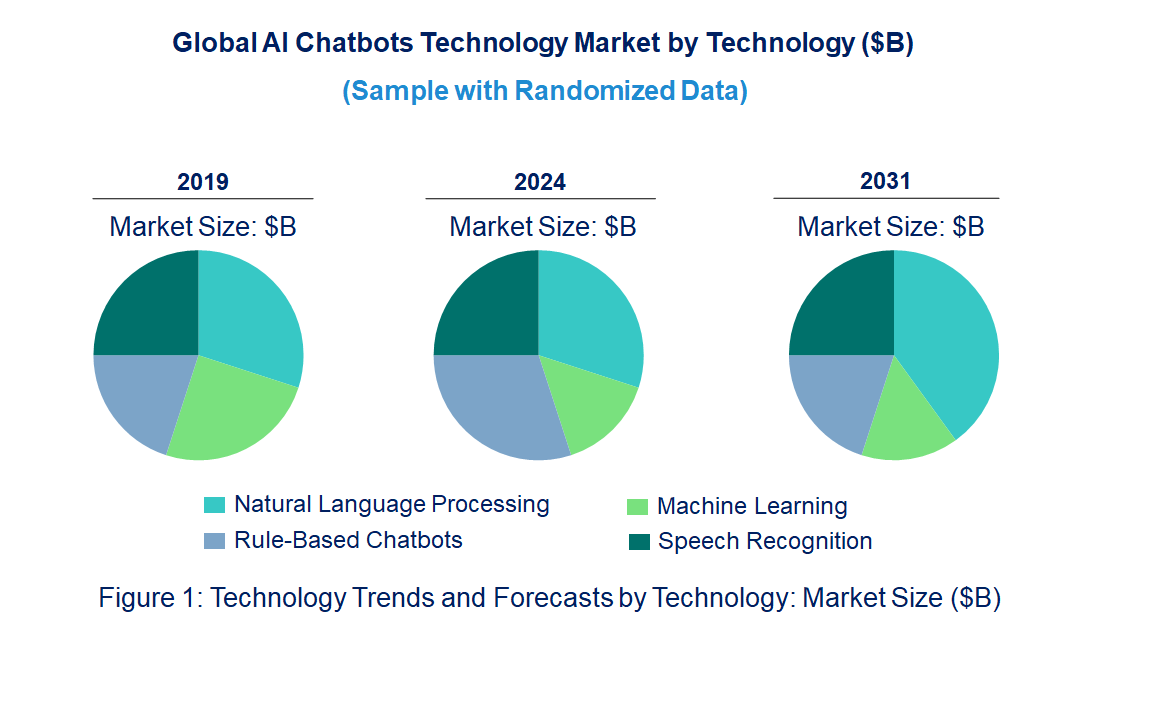
![AI Chatbots Market Trend and Forecast by End Use Industry [Value from 2019 to 2031]:](https://lucintel.com/images/AI-Chatbots-Technology-Market-Segment.png "AI Chatbots Market Trend and Forecast by End Use Industry [Value from 2019 to 2031]:")
• Multimodal Chatbots: It further enhances more multimodal abilities of providing chatbots and interacting text, voice, images, and even videos. As a result, this strengthens user engagement in varied ways in communication preferences while making interaction more accessible to various types of people with different needs. Interaction becomes more vivid, diversified, and versatile for the customer business.
• Interface of Generative AI: The adoption of generative AI technologies like GPT-4 and other large language models enables chatbots to deliver more human-like and context-aware responses. This enhances user satisfaction and expands the capabilities of chatbots into complex problem-solving, creative content generation, and advanced conversational workflows.
• Emotional Intelligence Focus: AI chatbots are becoming increasingly able to interpret and respond to users’ emotions with the aid of sentiment analysis and empathetic responses. Such emotionally intelligent chatbots help enhance the customers’ experience in sectors related to mental health counseling, conflict resolution, and specific shopping assistant services.
• Industry-Specific Chatbots Gone Viral: Tailored chatbots for healthcare, education, and retail industries are on the rise. These chatbots are trained on domain-specific data and provide specialized insights and support, improving operational efficiency and customer satisfaction within targeted sectors.
• Improved Security and Privacy Features: Since chatbots deal with sensitive user information, companies are emphasizing data security and privacy through encryption, regulation compliance (for example, GDPR), and anonymization techniques. This helps in creating user trust and supports the adoption of chatbots in industries such as finance and healthcare, where confidentiality is a critical factor. This marks the transformative power of AI chatbots in shaping digital interactions. Multimodal capabilities, generative AI, and emotional intelligence are making the chatbot smarter and more versatile, and industry-specific applications and advanced security are making it even more adopted in critical sectors. All of these bring it together to push the AI chatbot market into a new era of innovation and utility.
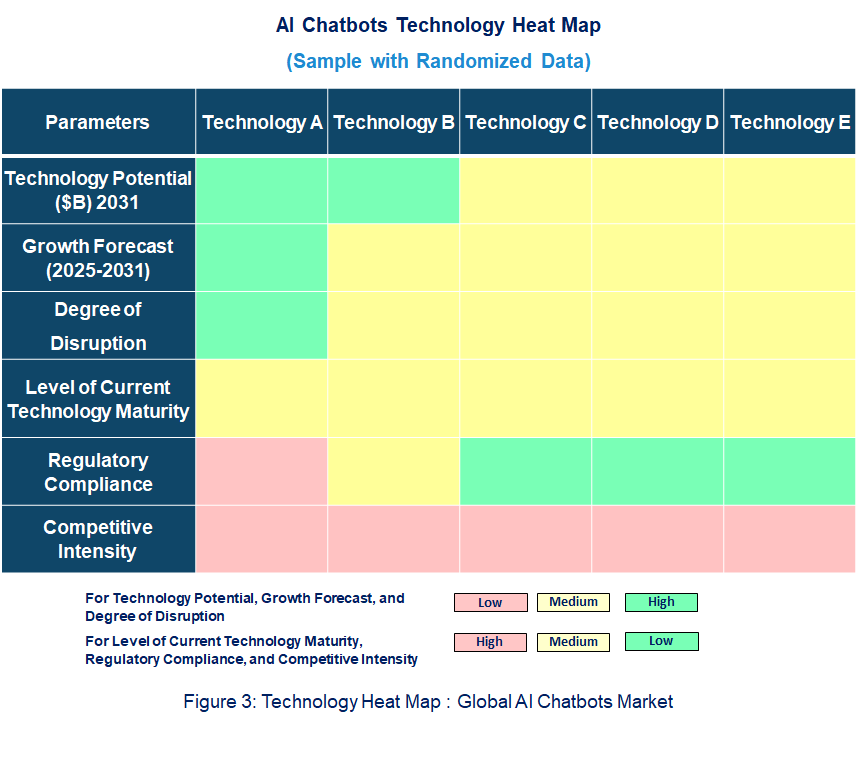
• Potential in Technology: AI chatbots are a source of huge potential in making customer engagement much easier and less costly, as they can be operated 24/7. They can manage repetitive tasks, analyze data for users, and blend well with other technologies, such as CRM systems and IoT devices.
• Degree of Disruption: This industry is very disruptive because of its nature; it brings significant change in traditional models for customer service and modifies the experience for the users. Replacing or augmenting human agents significantly cuts the response time, with potential for increased scalability; that in turn is transforming entire industries dependent on the user.
• Current Level of Technology Maturity: The use of AI chatbots in FAQ handling and lead generation are mature. More sophisticated use, like emotional nuances, complex problem-solving abilities are developing.
• Regulatory Compliance: Regulations surrounding the use of data privacy - for example, GDPR or HIPAA - are more important. Companies must prioritize issues of transparency, data security, and compliance in creating trust and scalability in this AI chatbot market.
• IBM: IBM Watson has introduced major updates for its AI-powered chatbot that features enhanced machine learning algorithms that improve the accuracy and personalization of responses. Integrating advanced sentiment analysis enables the IBM chatbot to understand customer emotions and make them respond accordingly, making them more satisfied in the areas of banking and healthcare.
• Zendesk : Zendesk has upgraded its Answer Bot, which now applies AI to provide more contextually aware responses, improving efficiency in problem resolution. Introducing its chatbot to its customer service tools, Zendesk has enabled businesses to provide 24/7 support, reducing response time and optimizing operational workflows.
• Microsoft: The platform has enhanced its capabilities through adding conversational AI tools and enabled businesses to create sophisticated scalable chatbots for a multitude of applications. Its worthiness is further enhanced through additional support for multiple languages, with integration into Microsoft Teams for organizations looking to strengthen both internal and external communications.
• Salesforce: Einstein Bots from Salesforce, using AI and machine learning, offer the most personalized customer interactions. By being integrated with the CRM platform of Salesforce, these bots can access the customer data and offer targeted recommendations and solve issues, thus significantly improving the customer experience.
• Amazon: Amazon has enhanced its AWS chatbot offering by including Amazon Lex, which is now more advanced with regard to NLP and provides a better understanding of the intent of the user. Furthermore, integration with Amazon Connect has enabled businesses to automate customer interactions across voice and chat, reducing wait times and improving service efficiency.
• SAP: SAP also launched an AI-based chatbot solution known as SAP CoPilot. The solution enables the automation of business processes in enterprise environments. Such a chatbot is capable of performing tasks that include retrieval of data, process automation, and reporting, with a high efficiency and good decision-making.
• Baidu: Baidu has also established its own chatbot platform known as DuerOS that utilizes advanced voice and speech recognition technologies. The company focused this platform mainly for the Chinese market, where integration into smart devices further provides users with more accurate natural conversations for applications in smart homes, education, and healthcare.
• PandaDoc: It has developed an AI-powered chatbot to help customers in generating documents and contracting, which will help enhance the operational efficiency of firms in sales and legal service sectors. PandaDoc’s document workflow automation saves time while doing manual tasks and, at the same time, enhances the user experience.
• Intercom: Intercom has improved the chatbots by adding the feature of machine learning to help the bot answer more complicated questions, and it makes the provision of personalized support to its customers possible. The interface now has proactive messaging and enhanced automation, which supports customer engagement and reduces human agent’s workload.
• Google: Google has continued to enhance its chatbot functionality with Google Dialogflow, now allowing for multi-turn conversations, voice-based interactions, and integration with other Google Cloud services. This makes it possible for businesses to develop more intelligent chatbots to process more complex questions within the retail, hospitality, and telecommunications industries. These trends indicate the growing maturity of AI chatbot technologies as the market leaders are fine-tuning their products to better meet the needs of businesses looking for more efficient, intelligent customer service solutions.
• Increased Demand for Automation: Businesses are adopting AI chatbots across industries to automate customer service and reduce operational costs. This increase in demand is due to higher demands for 24/7 availability faster response times and better customer experience, allowing business organizations to streamline operations and better utilize human resources for much more complex tasks.
• Natural Language Processing: Improved NLP algorithms allow chatbots to read and write more natural, human-like responses. This technological leap strengthens the ability of the chatbot to handle complex questions, thus making communication flow smoother and more effective for a wider range of consumers in the retail, banking, and healthcare industries.
• AI with Existing Platforms: The integration of AI chatbots with CRM systems, websites, social media, and messaging apps is an important growth driver. This integration creates the potential for seamless channel-based customer engagement, resulting in a consistent flow of communication, which leads to greater customer satisfaction and loyalty.
• Personalization and Better Customer Experience: AI chatbots are capable of personalizing interactions by analyzing customer data, preferences, and behaviors. This level of personalization increases customer engagement and satisfaction, leading to better service quality. Enhanced customer experiences drive the adoption of chatbots in e-commerce, healthcare, and other sectors seeking to improve service delivery.
• Cost Reduction and Scalability: AI chatbots help companies save money because they automate repetitive customer inquiries that would otherwise be handled by a human agent. This scalability allows for the handling of large volumes of interactions without proportional increases in staffing, leading to significant cost savings and operational efficiency. Challenges in the AI chatbot market are:
• Technological Limitations: With advances in AI, chatbots have a very difficult time processing complex queries, context, and the subtleties of human communication. In terms of standard inquiries, they work great; however, more complex and ambiguous interactions tend to require human intervention, which severely limits their applications, particularly in highly specialized areas like healthcare and law.
• Data Privacy and Security Concerns: Integration of chatbots in customer care services requires dealing with sensitive information, thus creating issues of privacy and security. Businesses using AI for chatbots face the very crucial challenge of ensuring regulations like GDPR and providing adequate mechanisms for safe data handling, especially in industries as sensitive as finance and health.
• Resistance from the customers to AI interaction: Some customers prefer human interaction rather than AI-powered chatbots, especially for emotionally sensitive or complex issues. This resistance may hinder the adoption of chatbots in certain industries where personalized human touch is seen as an essential requirement, such as healthcare, legal services, and high-value customer support.
• High Initial Investment and Maintenance Costs: The development, implementation, and maintenance of AI chatbot systems are very expensive, especially for small and medium-sized businesses. The investment to integrate advanced AI technologies and keep updating the system can act as a barrier to its adoption, thereby limiting market growth for certain sectors.
• Lack of Multilingual Capabilities: Although AI chatbots are improving, multilingual support is a major challenge. Many chatbots are unable to effectively manage conversations in multiple languages, limiting their use in global markets where businesses need to communicate with customers across different regions and languages. The demand for automation, advancements in NLP, and the integration of AI with business platforms to improve efficiency and customer experience make the AI Chatbots Market. However, technological limitations, data privacy concerns, and customer resistance to AI are slowing adoption in a few sectors. These drivers and challenges shape the market dynamics and the future trajectory of AI chatbots.
• IBM
• Zendesk
• Microsoft
• Salesforce
• Amazon
• SAP
• Technology Readiness: NLP and Machine Learning are at a very high maturity level, where personalized and intelligent chatbots can be developed for complex tasks. Rule-Based Chatbots are widely deployed for simple interactions. Speech Recognition is evolving rapidly, especially in voice-based applications, but is still maturing in terms of accuracy.
• Competitive Intensity and Regulatory Compliance: The AI chatbot market is highly competitive with rapid advancements in NLP and Machine Learning. Regulatory compliance, particularly around data privacy (e.g., GDPR, HIPAA), and ethical AI usage is the need of the hour for trust and responsible AI deployment across industries.
• Disruption Potential: NLP, Machine Learning, Rule-Based Chatbots, and Speech Recognition are disrupting industries. NLP and Machine Learning have made it possible to have dynamic, personalized interactions, whereas Rule-Based Chatbots enable streamlined basic tasks. Speech Recognition is adding voice integration, highly disrupting customer support, healthcare, and e-commerce.
• Natural Language Processing
• Machine Learning
• Rule-Based Chatbots
• Speech Recognition
• Banking
• Retail
• Healthcare
• Telecommunications
• Hospitality
• North America
• Europe
• Asia Pacific
• The Rest of the World
• Latest Developments and Innovations in the AI Chatbots Technologies
• Companies / Ecosystems
• Strategic Opportunities by Technology Type


Choose a license that fits your team. Instant PDF delivery.
Prices exclude taxes. Instant delivery. Custom licensing available on request.
Market Report · May 18, 2026
Market Report · May 18, 2026
Market Report · May 18, 2026
Trusted partner for strategic intelligence and business growth


Receive a complimentary market analysis tailored to your industry. Our analysts will identify key growth opportunities and competitive dynamics specific to your business.

Market size, growth rate, and key trend analysis for your specific sector.

Top competitor positioning and market share analysis.

Strategic recommendations backed by data-driven insights.
Get curated market intelligence and competitive moves straight to your inbox.
By subscribing, you agree to receive our monthly insights. Unsubscribe anytime.
Receive a complimentary market analysis tailored to your industry. Our analysts will identify key growth opportunities and competitive dynamics specific to your business.
Market size, growth rate, and key trend analysis for your specific sector.
Top competitor positioning and market share analysis.
Strategic recommendations backed by data-driven insights.
Get curated market intelligence, emerging trends, and competitive moves straight to your inbox each month.
By subscribing, you agree to receive our monthly insights. Unsubscribe anytime.
We'll send your sample report shortly.