
Report Feature
AI Care Companion Robot Market Trends and Forecast
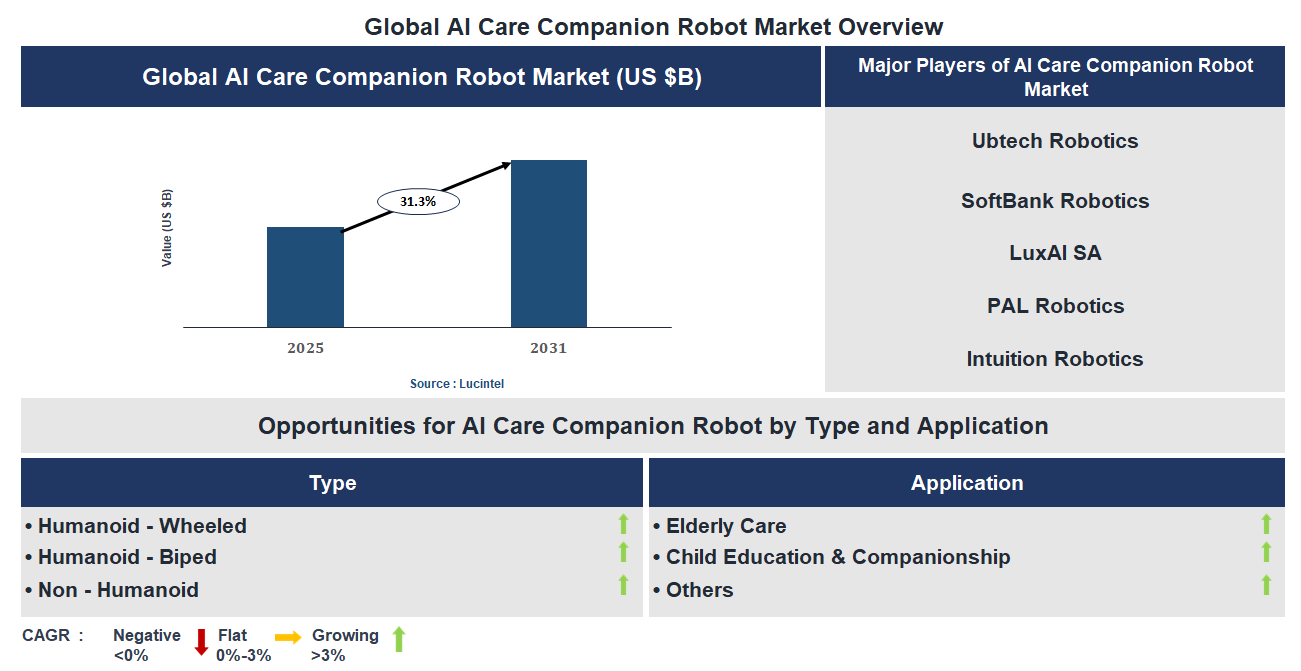
The future of the global AI care companion robot market looks promising with opportunities in the humanoid – wheeled, humanoid – biped, and non - humanoid markets. The global AI care companion robot market is expected to grow with a CAGR of 31.3% from 2025 to 2031. The major drivers for this market are the increasing demand for elderly care solutions, the rising adoption of advanced robotics technology, and the growing need for personalized healthcare services.• Lucintel forecasts that, within the application category, elderly care is expected to witness higher growth over the forecast period.
• Within the type category, humanoid – biped is expected to witness the highest growth.
• In terms of region, APAC is expected to witness the highest growth over the forecast period. Gain valuable insights for your business decisions with our comprehensive 150+ page report. Sample figures with some insights are shown below.
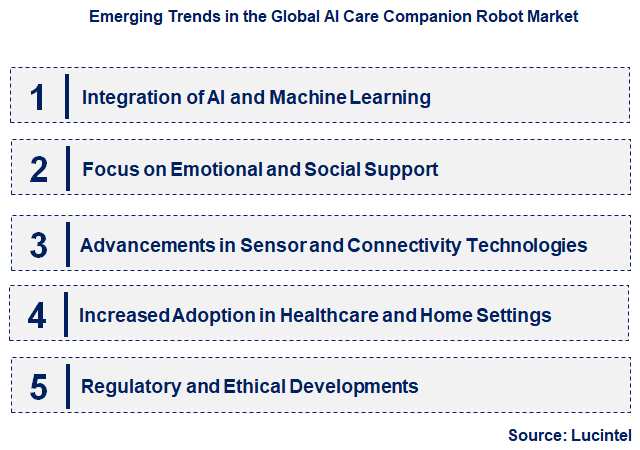
Emerging Trends in the AI Care Companion Robot Market
The AI care companion robot market is experiencing rapid growth driven by technological advancements, aging populations, and increasing demand for personalized healthcare solutions. As these robots become more sophisticated, they are transforming caregiving, improving quality of life, and reducing healthcare costs. Innovations in artificial intelligence, robotics, and sensor technology are enabling these devices to perform complex tasks, offer emotional support, and adapt to individual needs. This evolving landscape presents new opportunities and challenges for manufacturers, healthcare providers, and consumers. Understanding the key emerging trends is essential to grasping how this market is shaping the future of assisted living and healthcare services.• Integration of AI and Machine Learning: AI and machine learning are central to the evolution of care companion robots. These technologies enable robots to learn from interactions, adapt to user preferences, and improve their assistance over time. Enhanced natural language processing allows for more human-like communication, making interactions more intuitive and emotionally engaging. This integration results in more personalized care, better monitoring of health conditions, and increased independence for users. As AI continues to advance, robots will become more autonomous, capable of handling complex tasks and providing tailored support, thereby transforming caregiving dynamics.
• Focus on Emotional and Social Support: Care companion robots are increasingly designed to address emotional and social needs, not just physical assistance. Features such as empathetic responses, facial recognition, and conversational abilities help robots provide companionship and reduce feelings of loneliness, especially among elderly populations. This trend is driven by the recognition that mental health is integral to overall well-being. Robots equipped with emotional intelligence can detect mood changes and respond appropriately, fostering a sense of connection and safety. This development enhances the quality of life for users and supports mental health management in care settings.
• Advancements in Sensor and Connectivity Technologies: The incorporation of advanced sensors and connectivity options is enhancing the capabilities of care robots. Sensors enable real-time monitoring of vital signs, environmental conditions, and user movements, facilitating proactive healthcare interventions. Connectivity features, such as IoT integration, allow seamless data sharing with healthcare providers, enabling remote monitoring and timely responses. These technological improvements improve safety, efficiency, and personalized care. As sensor and connectivity technologies evolve, robots will become more reliable, responsive, and capable of supporting complex healthcare tasks, thus broadening their application scope.
• Increased Adoption in Healthcare and Home Settings: The market is witnessing a surge in the adoption of care companion robots across hospitals, clinics, and private homes. Healthcare providers see these robots as cost-effective solutions to augment staffing and improve patient outcomes. In-home settings, they support independent living for seniors and individuals with disabilities. The COVID-19 pandemic accelerated this trend by highlighting the need for remote care and social distancing. As acceptance grows, the market is expanding rapidly, driven by affordability, ease of use, and demonstrated benefits in enhancing care quality and reducing caregiver burden.
• Regulatory and Ethical Developments: As care robots become more integrated into daily life, regulatory frameworks and ethical considerations are gaining prominence. Governments and industry bodies are working to establish standards for safety, privacy, and data security. Ethical debates focus on issues like user consent, emotional attachment, and the potential for dependency. Clear regulations and ethical guidelines are essential to foster trust, ensure user safety, and promote responsible innovation. These developments will influence market growth, product design, and deployment strategies, shaping a sustainable and ethically sound industry. In summary, these emerging trends are collectively reshaping the AI care companion robot market by enhancing technological capabilities, expanding application areas, and addressing ethical and regulatory challenges. They are driving innovation, improving user experiences, and supporting the shift toward more personalized, accessible, and ethical healthcare solutions. This evolution promises to redefine caregiving paradigms and improve the quality of life for diverse populations worldwide.
Recent Development in the AI Care Companion Robot Market
The AI care companion robot market is experiencing rapid growth driven by technological advancements and increasing demand for elderly and healthcare support. Innovations in robotics, AI, and sensor technology are transforming care delivery, making robots more intelligent, responsive, and user-friendly. These developments are opening new opportunities for healthcare providers, families, and technology companies to enhance quality of life, reduce costs, and address workforce shortages. As the market evolves, stakeholders are focusing on integrating smarter, more adaptable robots into daily care routines.• Enhanced AI Capabilities: Smarter AI algorithms enable robots to better understand and respond to human needs, improving interaction quality and personalized care, which boosts user trust and adoption rates.
• Advanced Sensor Technologies: Improved sensors allow robots to detect environmental changes and human emotions more accurately, leading to safer, more responsive caregiving environments.
• Integration with Healthcare Systems: Seamless connectivity with electronic health records and telemedicine platforms enhances care coordination, resulting in more efficient and comprehensive patient management.
• Cost-Effective Solutions: Development of affordable, scalable robots makes advanced care accessible to a broader population, reducing healthcare costs and expanding market reach.
• Regulatory and Ethical Frameworks: Establishing clear guidelines ensures safe, ethical deployment of care robots, fostering consumer confidence and encouraging wider adoption. The recent developments in AI care companion robots are significantly transforming the market by making robotic caregiving more intelligent, accessible, and integrated. These innovations are improving patient outcomes, reducing operational costs, and addressing workforce shortages. As technology continues to advance, the market is poised for sustained growth, with increased acceptance and deployment of care robots across healthcare and home settings, ultimately enhancing quality of life for users worldwide.
Strategic Growth Opportunities in the AI Care Companion Robot Market
The AI care companion robot market is experiencing rapid growth driven by increasing demand for elderly care, advancements in AI technology, and the need for cost-effective healthcare solutions. These robots are transforming caregiving by providing assistance, companionship, and monitoring capabilities. As populations age globally, the market presents significant opportunities for innovation and expansion across various applications, including healthcare facilities, homes, and assisted living centers. Strategic investments and technological developments are expected to accelerate market penetration and adoption.• Expanding Use in Elderly Care Facilities: AI care companion robots are increasingly integrated into elderly care facilities to address staffing shortages and improve resident well-being. These robots offer companionship, medication reminders, and emergency alerts, reducing caregiver burden. Their ability to provide consistent, 24/7 support enhances the quality of life for residents. As aging populations grow, demand for such solutions will surge, prompting manufacturers to develop more sophisticated, user-friendly robots tailored for institutional settings.
• Growing Adoption in Home Healthcare Settings: The shift towards home-based care is fueling demand for AI care robots that assist seniors and disabled individuals. These robots help with daily activities, monitor health conditions, and provide social interaction, enabling independence and reducing hospital visits. Advances in AI and sensor technology make these robots more intuitive and affordable. Increased awareness of remote healthcare benefits and supportive policies will further accelerate their adoption in private residences.
• Integration with Telehealth and Remote Monitoring: Combining AI care robots with telehealth platforms enhances remote patient monitoring and virtual consultations. Robots can collect vital signs, transmit data to healthcare providers, and facilitate real-time communication. This integration improves early detection of health issues, reduces hospital readmissions, and supports chronic disease management. As telehealth gains prominence, the synergy with AI robots will create comprehensive, accessible healthcare solutions, especially in rural or underserved areas.
• Innovation in Personalized Care and Emotional Support: AI care robots are evolving to deliver personalized interactions and emotional support, addressing mental health and social isolation among seniors. Using machine learning, these robots adapt to individual preferences, recognize emotions, and provide companionship tailored to user needs. This personalization enhances user engagement and satisfaction, making robots more effective caregivers. Growing awareness of mental health will drive investments in emotionally intelligent robots, expanding their role in holistic healthcare.
• Rising Investment and Strategic Collaborations: Increased funding from venture capital, government grants, and corporate partnerships is propelling technological advancements and market expansion. Collaborations between AI developers, healthcare providers, and robotics firms foster innovation and accelerate product deployment. These investments support R&D, regulatory approvals, and market entry strategies, enabling companies to develop more advanced, reliable, and affordable care robots. Such strategic alliances will be crucial in capturing market share and establishing industry standards. The overall impact of these opportunities will significantly enhance the capabilities, accessibility, and acceptance of AI care companion robots, transforming healthcare delivery and improving quality of life for vulnerable populations worldwide.
AI Care Companion Robot Market Driver and Challenges
The AI care companion robot market is influenced by a variety of technological, economic, and regulatory factors that shape its growth trajectory. Advances in artificial intelligence, robotics, and sensor technology are enabling more sophisticated and human-like interactions, driving demand across healthcare and eldercare sectors. Economic factors such as increasing healthcare costs and aging populations are further fueling market expansion, while regulatory frameworks are evolving to ensure safety and ethical standards. However, challenges such as high development costs, data privacy concerns, and regulatory hurdles pose significant barriers. Understanding these drivers and challenges is essential for stakeholders aiming to capitalize on the market's potential and navigate its complexities effectively. The factors responsible for driving the AI care companion robot market include:• Technological Advancements: The rapid development of AI algorithms, machine learning, and sensor technologies has enabled robots to perform complex tasks, recognize speech, and respond empathetically. These innovations improve user experience and reliability, making care robots more appealing to healthcare providers and families. As technology continues to evolve, the capabilities of AI care robots will expand, fostering greater adoption and integration into daily care routines. This ongoing innovation is crucial for meeting the increasing demand for personalized, efficient, and scalable care solutions, especially in aging societies.
• Growing Elderly Population: The global increase in the elderly demographic is a significant driver for AI care robots. Older adults often require assistance with daily activities, medication management, and companionship, which care robots can provide efficiently. This demographic shift results in rising healthcare costs and workforce shortages, creating a pressing need for automated care solutions. AI care robots offer consistent, around-the-clock support, reducing the burden on human caregivers and improving the quality of life for seniors. The market's growth is thus closely tied to demographic trends and the need for sustainable eldercare solutions.
• Healthcare Cost Reduction: Rising healthcare expenses worldwide are prompting institutions and families to seek cost-effective alternatives. AI care companion robots can reduce hospital readmissions, assist with routine tasks, and monitor health parameters, leading to lower overall healthcare costs. By automating routine and repetitive activities, these robots free up human resources for more complex care, enhancing efficiency. The economic incentive to adopt such technology is strong, especially in regions with strained healthcare systems, making cost reduction a key driver for market expansion.
• Increasing Adoption of Smart Home Technologies: The integration of AI care robots with smart home systems enhances their functionality and appeal. Connected devices enable seamless communication, remote monitoring, and personalized care plans, making robots more versatile and user-friendly. As smart home adoption accelerates globally, the synergy with AI care robots creates new opportunities for market growth. This integration supports aging-in-place initiatives and promotes independent living, aligning with societal preferences for home-based care solutions. The convergence of these technologies is expected to further propel market development.
• Supportive Government Initiatives: Governments worldwide are recognizing the potential of AI care robots to address healthcare challenges, especially in aging populations. Many are implementing policies, funding programs, and regulatory frameworks to promote research, development, and deployment of care robots. These initiatives include subsidies, pilot projects, and standards for safety and efficacy, which facilitate market entry and adoption. Supportive policies not only accelerate technological innovation but also build consumer confidence, making AI care companion robots more accessible and acceptable across different regions. The challenges facing this AI care companion robot market include:
• High Development and Implementation Costs: Developing advanced AI care robots requires significant investment in research, hardware, and software. These costs can be prohibitive for smaller companies and startups, limiting innovation and market entry. Additionally, integrating these robots into existing healthcare systems involves substantial expenses related to customization, training, and maintenance. The high upfront costs may slow adoption, especially in cost-sensitive markets, and pose a barrier to widespread deployment despite the potential long-term savings.
• Data Privacy and Security Concerns: AI care robots collect sensitive personal health data, raising significant privacy issues. Ensuring data security and compliance with regulations such as GDPR is complex and costly. Breaches or misuse of data can erode user trust and lead to legal repercussions. As data privacy concerns grow, stakeholders must invest in robust cybersecurity measures, which can further increase costs and complicate deployment. These issues may hinder market growth if not adequately addressed through transparent policies and technological safeguards.
• Regulatory and Ethical Challenges: The deployment of AI care robots faces evolving regulatory landscapes that vary across regions. Establishing standards for safety, efficacy, and ethical use is complex and time-consuming. Regulatory delays can impede product launches and market expansion. Ethical concerns regarding robot autonomy, decision-making, and human interaction also pose barriers, requiring clear guidelines and public acceptance. Navigating these regulatory and ethical issues is critical for sustainable growth, but remains a significant challenge for industry players. In summary, the AI care companion robot market is driven by technological innovations, demographic shifts, cost-saving potentials, smart home integration, and supportive policies. However, high development costs, data privacy issues, and regulatory hurdles present notable challenges. These factors collectively influence the pace and scope of market growth, requiring stakeholders to balance innovation with responsible deployment. Successful navigation of these drivers and challenges will determine the market's future trajectory, shaping the landscape of automated eldercare and healthcare support solutions.
List of AI Care Companion Robot Companies
Companies in the market compete on the basis of product quality offered. Major players in this market focus on expanding their manufacturing facilities, R&D investments, infrastructural development, and leverage integration opportunities across the value chain. With these strategies AI care companion robot companies cater increasing demand, ensure competitive effectiveness, develop innovative products & technologies, reduce production costs, and expand their customer base. Some of the AI care companion robot companies profiled in this report include-• Ubtech Robotics
• SoftBank Robotics
• LuxAI SA
• PAL Robotics
• Intuition Robotics
• Blue Frog Robotics
• Andromeda Robotics
• Human Centred Innovations
• AgingX Labs
• Samsung Electronics
AI Care Companion Robot Market by Segment
The study includes a forecast for the global AI care companion robot market by type, application, and region.AI Care Companion Robot Market by Type [Value from 2019 to 2031]:
• Humanoid - Wheeled
• Humanoid - Biped
• Non - Humanoid
AI Care Companion Robot Market by Application [Value from 2019 to 2031]:
• Elderly Care
• Child Education & Companionship
• Others
AI Care Companion Robot Market by Region [Value from 2019 to 2031]:
• North America
• Europe
• Asia Pacific
• The Rest of the World
Country Wise Outlook for the AI Care Companion Robot Market
The AI care companion robot market is experiencing rapid growth driven by technological advancements, aging populations, and increasing demand for healthcare automation worldwide. Countries are investing heavily in developing intelligent robots to assist with elderly care, healthcare support, and daily assistance. Innovations in AI, machine learning, and robotics are enhancing robot capabilities, making them more adaptable and user-friendly. Regulatory frameworks are evolving to accommodate these new technologies, while market competition intensifies. As nations seek to improve healthcare efficiency and address demographic challenges, the AI care companion robot market is poised for significant expansion across the globe, with each country contributing uniquely to this evolving landscape.• United States: The US market has seen significant advancements in AI-driven care robots, focusing on integrating advanced sensors and machine learning algorithms for personalized elderly care. Major tech companies and startups are collaborating to develop robots that can monitor health, provide companionship, and assist with daily tasks. Regulatory support and increased funding have accelerated innovation, with pilot programs demonstrating successful deployment in healthcare facilities and homes. The US also emphasizes ethical AI use and data privacy, shaping the development of care robots to meet strict standards.
• China: China is rapidly expanding its AI care robot industry, driven by government initiatives and a large aging population. The country has made substantial investments in robotics research and development, resulting in affordable and highly functional robots tailored for elderly care. Chinese firms focus on integrating AI with telemedicine and remote monitoring, enabling widespread deployment in urban and rural areas. The government’s supportive policies and domestic market size have fostered a competitive environment, leading to innovative solutions that emphasize cost-effectiveness and scalability.
• Germany: Germany’s market is characterized by a focus on high-quality, reliable care robots with advanced safety features. The country emphasizes integrating AI with existing healthcare infrastructure, ensuring seamless support for elderly and disabled individuals. German companies are pioneering in developing robots that assist with mobility, medication management, and social interaction. Strong regulatory frameworks and a focus on ethical standards guide the market, with collaborations between academia and industry fostering cutting-edge research and development.
• India: India’s AI care companion robot market is emerging, driven by a large, underserved elderly population and increasing healthcare needs. The focus is on affordable, easy-to-use robots that can operate in resource-constrained environments. Local startups and tech giants are developing solutions tailored to Indian cultural contexts, including language support and local healthcare practices. Government initiatives promoting digital health and robotics are encouraging market growth, with pilot projects demonstrating potential for widespread adoption in urban and rural settings.
• Japan: Japan remains a global leader in robotics, with a mature market for AI care companion robots. The country’s aging population has spurred innovations in robots that provide companionship, assist with daily activities, and support healthcare workers. Japanese firms emphasize humanoid robots with natural interaction capabilities and advanced AI integration. Government policies promote robotics research, and collaborations with international partners enhance technological development. The market continues to evolve with a focus on improving the quality of life for seniors and addressing labor shortages in healthcare.

Features of the Global AI Care Companion Robot Market
Market Size Estimates: AI care companion robot market size estimation in terms of value ($B). Trend and Forecast Analysis: Market trends (2019 to 2024) and forecast (2025 to 2031) by various segments and regions. Segmentation Analysis: AI care companion robot market size by type, application, and region in terms of value ($B). Regional Analysis: AI care companion robot market breakdown by North America, Europe, Asia Pacific, and Rest of the World. Growth Opportunities: Analysis of growth opportunities in different types, applications, and regions for the AI care companion robot market. Strategic Analysis: This includes M&A, new product development, and competitive landscape of the AI care companion robot market. Analysis of competitive intensity of the industry based on Porter’s Five Forces model.
FAQ
Q1. What is the growth forecast for AI care companion robot market? Answer: The global AI care companion robot market is expected to grow with a CAGR of 31.3% from 2025 to 2031. Q2. What are the major drivers influencing the growth of the AI care companion robot market? Answer: The major drivers for this market are the increasing demand for elderly care solutions, the rising adoption of advanced robotics technology, and the growing need for personalized healthcare services. Q3. What are the major segments for AI care companion robot market? Answer: The future of the AI care companion robot market looks promising with opportunities in the humanoid – wheeled, humanoid – biped, and non - humanoid markets. Q4. Who are the key AI care companion robot market companies? Answer: Some of the key AI care companion robot companies are as follows:• Ubtech Robotics
• SoftBank Robotics
• LuxAI SA
• PAL Robotics
• Intuition Robotics
• Blue Frog Robotics
• Andromeda Robotics
• Human Centred Innovations
• AgingX Labs
• Samsung Electronics Q5. Which AI care companion robot market segment will be the largest in future? Answer: Lucintel forecasts that, within the application category, elderly care is expected to witness higher growth over the forecast period. Q6. In AI care companion robot market, which region is expected to be the largest in next 5 years? Answer: In terms of region, APAC is expected to witness the highest growth over the forecast period. Q7. Do we receive customization in this report? Answer: Yes, Lucintel provides 10% customization without any additional cost.
Table of Contents
List of Figures
List of Tables
Methodology
- In-depth interviews of the major players in this market
- Detailed secondary research from competitors’ financial statements and published data
- Extensive searches of published works, market, and database information pertaining to industry news, company press releases, and customer intentions
- A compilation of the experiences, judgments, and insights of Lucintel’s professionals, who have analyzed and tracked this market over the years.


Buy Now
Choose a license that fits your team. Instant PDF delivery.
Prices exclude taxes. Instant delivery. Custom licensing available on request.
Key Questions
- • What are some of the most promising, high-growth opportunities for the AI care companion robot market by type (humanoid - wheeled, humanoid - biped, and non - humanoid), application (elderly care, child education & companionship, and others), and region (North America, Europe, Asia Pacific, and the Rest of the World)?
- • Which segments will grow at a faster pace and why?
- • Which region will grow at a faster pace and why?
- • What are the key factors affecting market dynamics? What are the key challenges and business risks in this market?
- • What are the business risks and competitive threats in this market?
- • What are the emerging trends in this market and the reasons behind them?
- • What are some of the changing demands of customers in the market?
- • What are the new developments in the market? Which companies are leading these developments?
- • Who are the major players in this market? What strategic initiatives are key players pursuing for business growth?
- • What are some of the competing products in this market and how big of a threat do they pose for loss of market share by material or product substitution?
- • What M&A activity has occurred in the last 6 years and what has its impact been on the industry? For any questions related to AI Care Companion Robot Market, AI Care Companion Robot Market Size, AI Care Companion Robot Market Growth, AI Care Companion Robot Market Analysis, AI Care Companion Robot Market Report, AI Care Companion Robot Market Share, AI Care Companion Robot Market Trends, AI Care Companion Robot Market Forecast, AI Care Companion Robot Companies, write Lucintel analyst at email: helpdesk@lucintel.com. We will be glad to get back to you soon.


