
Market Report · July 22, 2026

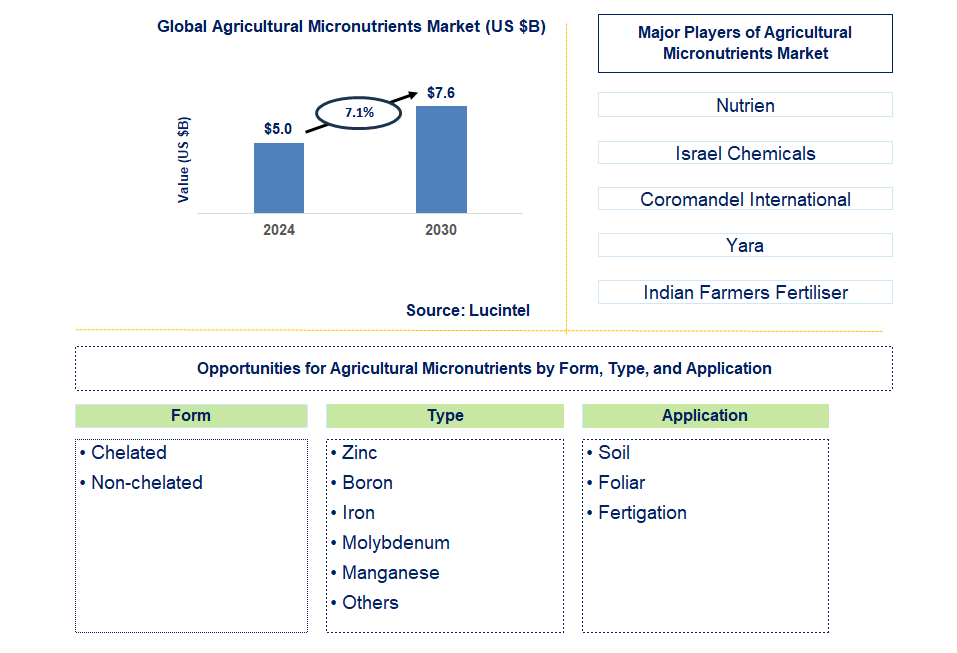
Key data points: The market size in 2030 = $7.6 billion, growth forecast = 7.1% annually next 6 years. Scroll below to get more insights. This market report covers trends, opportunities, and forecast in the global agricultural micronutrients market to 2030 by form (chelated and non-chelated), type (zinc, boron, iron, molybdenum, manganese, and others), application (soil, foliar, and fertigation), and region (North America, Europe, Asia Pacific, and the Rest of the World)
We'll send your sample report shortly.
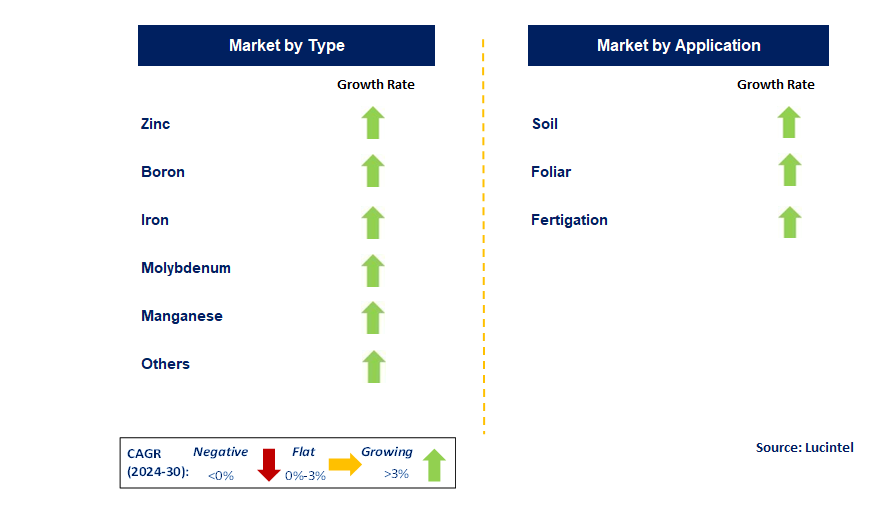
• Lucintel forecast that zinc is expected to witness the highest growth over the forecast period because of growing understanding of the global zinc shortage in soils and its many roles in plant development.
• APAC is expected to witness the highest growth over the forecast period because the public demand for crops farmed responsibly is rising, and there is a growing emphasis on using environmentally friendly farming methods to cut down on waste and carbon emissions. A more than 150-page report is developed to help in your business decisions.
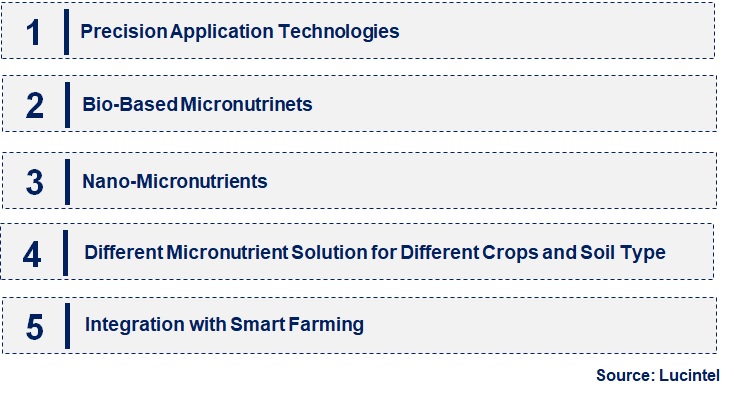
• Precision Application Technologies: Growing momentum is witnessed in precision agriculture technologies that allow for greater precision in the application of micronutrients. This, in turn, enhances nutrient use efficiency, minimizes waste, and improves crop yield with reduced environmental impacts.
• Bio-Based Micronutrients: Bio-based micronutrients are in demand, and organic micronutrient products are on the rise. These solutions ensure environmental safety, meet sustainability goals, and provide a more organic alternative method for nutrient supplementation.
• Nano-Micronutrients: Nano-micronutrient delivery-based formulations represent the latest development in micronutrient fertilizers. Nano-size particles enhance delivery and uptake of micronutrients in plants, increasing the effectiveness and reducing application rate.
• Different Micronutrient Solution for Different Crops and Soil Type: Recently, there is a greater trend towards customized micronutrient solutions according to crops and soil type. The solutions help in improving crop health and productivity by addressing the individual needs of crops for nutrients.
• Integration with Smart Farming: Micronutrient management is increasingly integrated into smart farming. IoT and data analytics can help in optimizing nutrient application based on real-time data for better efficiency and sustainability. These trends are restructuring the agricultural micronutrients market, adding more precision, sustainability, and customization to it. Innovation supporting sustainable agriculture through advanced application technologies, bio-based products, and smart farming creates high demand for agricultural micronutrients that focus on advanced application technologies, bio-based products, and smart farming.
• Development of Nano-Micronutrients: To improve nutrient delivery and uptake, nano-micronutrient products were developed. These formulae assure better efficiency and effectiveness; hence, the challenges related to nutrient absorbability and soil type are overcome.
• Organic Micronutrient Solutions: Many new organic and bio-based micronutrient products have been developed. These kinds of solutions conform to emerging demand for sustainable and eco-friendly agricultural practices and at the same time correspond to environmental regulations and consumer preference.
• Precision Application: Innovations in precision agriculture technologies have stepped up the accuracy of application for micronutrients. This is helping farmers in minimizing waste, optimizing nutrient use efficiency, and increasing crop yield.
• Expanding Micronutrient Supplementation Programs: Micronutrient supplementation programs have been extended, especially in those areas with soils lacking certain nutrients. The programs for improving soil health and crop productivity support food security and sustainable agriculture.
• Smart Farming Technologies: Integration between micronutrient management and smart farming technologies has further been extended. IoT and data analytics tools are put to use for optimization of nutrient applications based on real-time data, hence making the process more efficient and sustainable. These developments are driving growth in the agricultural micronutrients market as they improve product effectiveness, increase sustainability, and enhance application precision. Innovation in nano-micronutrients, organic solutions, and smart farming technologies will address key challenges and enhance agricultural productivity.
• Precision Agriculture: Precision agriculture will present huge potential in applications. A micronutrient solution integrated with precision farming technologies can enhance nutrient efficiency in crops and yields, thereby offering a growth opportunity in the sector.
• Organic Farming: Organic farming also creates new vistas for the spread of bio-based micronutrient products. In this perspective, such products represent sustainability goals and meet the growing need for organic inputs in agriculture.
• Soil Health Management: Products corresponding to the management of soil health, as micronutrient solutions, create possibilities for expansion. Such products, which treat soil deficiencies and enhance fertility, will see opportunities for market growth in areas with low levels of nutrient content in the soil.
• Product Differentiation through Novel Micronutrient Blends: Growth opportunities may come from the demand for specific blends of micronutrients for every type of crop and soil. These solutions provide targeted nutrient management that further yields an improvement in crop productivity and quality.
• Emerging Markets: The growth opportunities are viewed to arise in emerging markets, especially in Asia and Africa, for micronutrient products. Expanding agricultural practices and growing awareness about nutrient deficiencies are yielding demands for effective and affordable solutions. From here, one infers that the strategic growth opportunities identified in the agricultural micronutrients market will encompass precision agriculture, organic farming, soil health management, customized nutrient blends, and expansion into developing markets. These opportunities are driving innovation and market expansion to support improved crop productivity and sustainability.
• Nutrien
• Israel Chemicals
• Coromandel International
• Yara
• Indian Farmers Fertiliser
• Koch Agronomic
• Marubeni
• Nouryon Chemicals
• Chelated
• Non-chelated
• Zinc
• Boron
• Iron
• Molybdenum
• Manganese
• Others
• Soil
• Foliar
• Fertigation
• North America
• Europe
• Asia Pacific
• The Rest of the World
• United States: The country is seeing new advanced micronutrient formulations and delivery systems, involving slow-release and nano-micronutrients in increasing numbers. Efficiency in the use of nutrients and enhanced crop productivity in conditions of soil nutrient depletion or challenges in nutrient management result from these innovations.
• China: New laws and policies have been introduced to the Chinese government, which encourages the use of micronutrients in agriculture. Now, it is focused on increasing the efficiency of micronutrient use and integrating efficient advanced technology for higher yields and greater soil health on large-scale farmlands.
• Germany: Germany is leading in the development of sustainable micronutrient solutions. Recent advancements include the use of organic and bio-based micronutrient products that align with the country’s emphasis on eco-friendly and sustainable agricultural practices.
• India: In India, especially in the smallholder farms, the supplementation programs for micronutrients are picking up pace. Affordable and accessible micronutrient solutions are targeted to overcome the deficiency and improve crop productivity under different agricultural conditions.
• Japan: Japan, too, is forging ahead with precision agriculture by micronutrient solutions designed for particular crop needs. Innovations range from nutrient blends to customized application technologies that further enhance nutrient use efficiency and increase crop yields in conventional and high-tech farming systems.


• Nutrien
• Israel Chemicals
• Coromandel International
• Yara
• Indian Farmers Fertiliser
• Koch Agronomic
• Marubeni
• Nouryon Chemicals Q6. Which agricultural micronutrients market segment will be the largest in future? Answer: Lucintel forecast that zinc is expected to witness the highest growth over the forecast period because of growing understanding of the global zinc shortage in soils and its many roles in plant development. Q7. In agricultural micronutrients, which region is expected to be the largest in next 5 years? Answer: APAC is expected to witness the highest growth over the forecast period because the public demand for crops farmed responsibly is rising, and there is a growing emphasis on using environmentally friendly farming methods to cut down on waste and carbon emissions. Q.8 Do we receive customization in this report? Answer: Yes, Lucintel provides 10% customization without any additional cost.


Choose a license that fits your team. Instant PDF delivery.
Prices exclude taxes. Instant delivery. Custom licensing available on request.
Market Report · July 22, 2026
Market Report · July 20, 2026
Market Report · July 20, 2026
Trusted partner for strategic intelligence and business growth


Receive a complimentary market analysis tailored to your industry. Our analysts will identify key growth opportunities and competitive dynamics specific to your business.

Market size, growth rate, and key trend analysis for your specific sector.

Top competitor positioning and market share analysis.

Strategic recommendations backed by data-driven insights.
Get curated market intelligence and competitive moves straight to your inbox.
By subscribing, you agree to receive our monthly insights. Unsubscribe anytime.
Receive a complimentary market analysis tailored to your industry. Our analysts will identify key growth opportunities and competitive dynamics specific to your business.
Market size, growth rate, and key trend analysis for your specific sector.
Top competitor positioning and market share analysis.
Strategic recommendations backed by data-driven insights.
Get curated market intelligence, emerging trends, and competitive moves straight to your inbox each month.
By subscribing, you agree to receive our monthly insights. Unsubscribe anytime.
We'll send your sample report shortly.