
Market Report · July 22, 2026

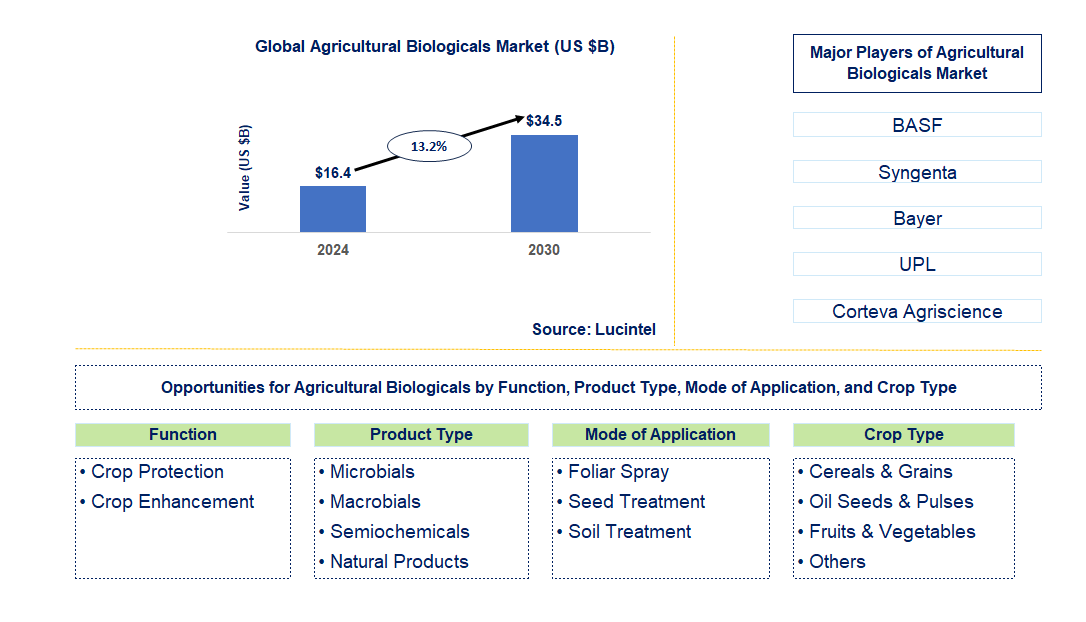
Key data points: The market size in 2030 = $34.5 billion, growth forecast = 13.2% annually for the next 6 years. Scroll below to get more insights. This market report covers trends, opportunities, and forecast in the global agricultural biologicals market to 2030 by function (crop protection and crop enhancement), product type (microbials, macrobials, semiochemicals, and natural products), mode of application (foliar spray, seed treatment, and soil treatment), crop type (cereals & grains, oil seeds & pulses, fruits & vegetables, and others), and region (North America, Europe, Asia Pacific, and the Rest of the World)
We'll send your sample report shortly.
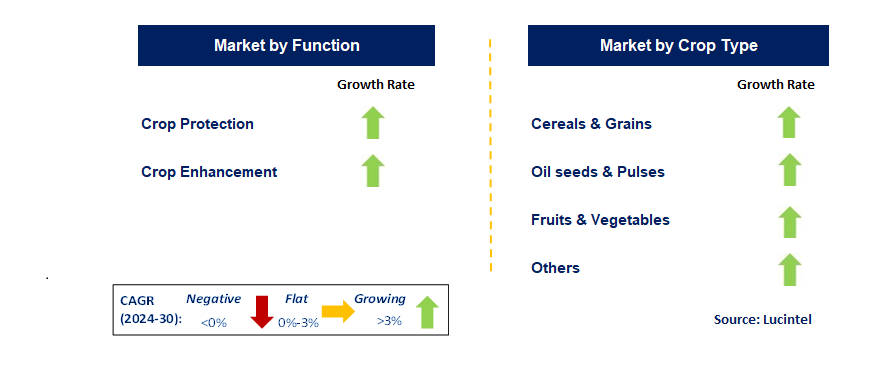
• Lucintel forecasts that, within the function category, crop protection will remain the larger segment over the forecast period.
• Within the crop type category, fruits and vegetables are expected to witness the highest growth.
• In terms of regions, North America will remain the largest region over the forecast period due to increasing awareness and willingness among farmers and the growing demand for organic food in the region. A more than 150-page report is developed to help in your business decisions.
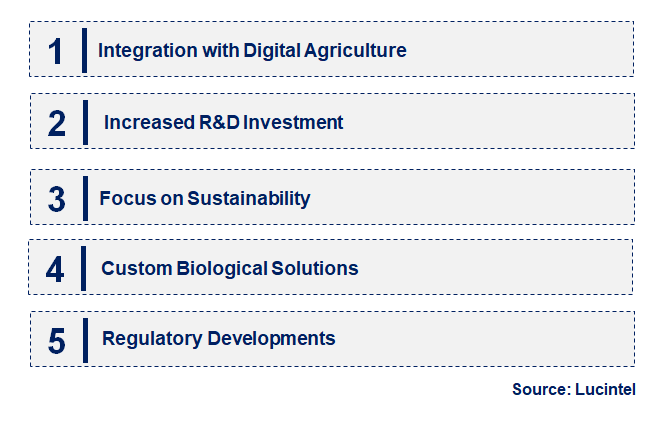
• Integration with Digital Agriculture: The adoption of digital tools, such as sensors and AI, to improve the application and effectiveness of agricultural biologicals is on the rise globally. This enables precise monitoring and management, optimizing the use of biological products.
• Increased R&D Investment: Significant investments in research are enabling the development of new models that improve effectiveness, particularly in yield enhancement. These investments contribute to the creation of new formulations while simultaneously improving existing ones.
• Focus on Sustainability: The growing demand for bio-sustainable solutions signals a shift toward green farming methods. This has led to the development of agricultural biologicals aimed at reducing environmental impact and improving soil health, which is essential for achieving global sustainability goals.
• Custom Biological Solutions: To meet specific crop requirements and regional conditions, the market is seeing a surge in tailor-made biological products. These include products that are location-specific or designed for different types of crops.
• Regulatory Developments: The changing regulatory environment is influencing how agricultural biologicals are developed and approved. Companies are adapting to new regulations while finding ways to expedite approvals and improve market access. These factors are altering the landscape of agricultural biologicals by improving product performance, fostering sustainability, and driving innovation. Their continued evolution will significantly change the development, marketing, and use of Agri-biotech.
• Advanced Research & Development in Bioformulations: Companies have invested heavily in R&D to develop more efficient bioformulations. This includes increasing the efficacy of bionematicides, which improves crop protection and boosts yields.
• Digital Technology Integration: The adoption of precision agriculture tools, such as digital technology, is improving the application of biological products. This trend allows for more precise targeting and optimization of biological treatments.
• Expansion into Emerging Markets: Expanding into developing countries is crucial for companies in the agricultural biologicals market. Cost-effective solutions designed for farmers in these regions will facilitate greater market penetration and increased accessibility.
• Revamped Regulatory Frameworks: Recent regulatory changes have led to faster approval times and market openings for Agri-biotech products. Rather than merely complying with regulations, companies are embracing these changes to maximize returns on investment (ROI).
• Enhanced Sustainability Efforts: Sustainability is now a major focus in the agricultural biologicals market. New products aimed at reducing environmental damage and promoting sustainable farming practices are being introduced. These developments are propelling growth and innovation in the agricultural biologicals market, enhancing product effectiveness, expanding market reach, and supporting sustainable agriculture.
• Expansion of Biopesticides: The growth opportunity in developing and marketing biopesticides is significant. The availability of eco-friendly pest control alternatives to chemical pesticides has led to an increase in biopesticide adoption, contributing to market expansion.
• Growth in Biofertilizers: The increased use of biofertilizers for improving soil health and crop productivity presents a major growth opportunity. Biofertilizers enhance nutrient availability and promote ecological farming methods, making them a key focus for growth in the sector.
• Development of Bio-stimulants: Investment in bio-stimulants, which improve plants' resilience to stress, presents a lucrative business opportunity. Crops that yield enhanced resistance to adverse growing conditions have become increasingly attractive, as they positively impact farmers' income and overall economic wellbeing.
• Integration with Precision Agriculture: There are opportunities for growth through the integration of agricultural biologicals with precision farming technologies. Data-driven approaches, combined with precision tools, can increase the efficiency of biological inputs, improving performance for end-users.
• Focus on Customized Solutions: Offering customized biological solutions that cater to specific crops or region-specific challenges provides a competitive advantage. These tailor-made products can stimulate sales volumes and foster higher customer loyalty. These opportunities highlight strategic growth areas in the agricultural biologicals market. Biopesticides, biofertilizers, bio-stimulants, precision farming, and tailored solutions are essential to enhancing market performance and capitalizing on new developments.
• Increasing Demand for Sustainable Agriculture: The rising emphasis on sustainable practices has led to the adoption of agricultural biologicals. Farmers are seeking green alternatives to reduce their carbon footprint and improve soil fertility.
• Technological Innovations: Advances in technology, such as online tools and precision agriculture, are improving the efficiency of agricultural biologicals. Changes in production methods make it necessary for companies to adopt better production processes to remain competitive.
• Growing Awareness and Education: Increased recognition and knowledge of the benefits of agricultural biologicals are driving higher adoption rates among farmers. Awareness campaigns have contributed to the growing acceptance of biological products over traditional chemical alternatives.
• Supportive Regulatory Frameworks: Dynamic regulations governing the acceptance, marketing, and use of agricultural biologicals positively affect their market availability. Eased administrative procedures and favorable policies have fostered consumer confidence, leading to higher sales volumes, especially in emerging markets, such as commercial farming in Africa.
• Investment in R&D: Continuous investment in research and development is resulting in the creation of more efficient and diverse biological products. Ongoing research improves product performance, expands the range of offerings, and provides better solutions for farmers worldwide. Challenges in the agricultural biologicals market include:
• High Production Costs: Manufacturing agricultural biologicals involves high costs, which can affect pricing and market competitiveness. These costs may hinder full adoption in some markets.
• Regulatory Hurdles: Product development and market entry can be delayed by complex and varying regulatory frameworks. Compliance with these regulations demands substantial resources, which can slow market growth.
• Market Competition: The agricultural biologicals market is becoming increasingly competitive, with many players offering similar products. Differentiating products through continuous innovation is necessary to remain competitive and appeal to customers. The growth of agricultural biologicals is shaped by these driving factors and challenges. Addressing these issues effectively will help companies overcome barriers posed by competitors while seizing new opportunities in this evolving industry.
• BASF
• Syngenta
• Bayer
• UPL
• Corteva Agriscience
• The Mosaic Company
• Pro Farm
• Gowan Company
• Vegalab
• Lallemand
• Crop Protection
• Crop Enhancement
• Microbials
• Macrobials
• Semiochemicals
• Natural Products
• Foliar Spray
• Seed Treatment
• Soil Treatment
• Cereals & Grains
• Oil Seeds & Pulses
• Fruits & Vegetables
• Others
• North America
• Europe
• Asia Pacific
• The Rest of the World
• United States: Adoption rates for agricultural biologicals have significantly increased in the U.S., driven by a rising demand for sustainable farming practices. This includes new biopesticides and biofertilizers designed to raise crop productivity while enhancing soil health. Companies have also invested in research to improve the efficacy and shelf life of these products.
• China: The agricultural biologicals market in China has grown rapidly, supported by government initiatives promoting eco-friendly agriculture. Examples include novel biological products targeting specific pests or diseases. With increased investment in R&D, better products are being developed, and there is a shift towards integrating traditional farming with bio-based approaches.
• Germany: Germany is leading in the integration of precision farming techniques with agricultural biologicals. Recent advancements include the use of digital tools alongside biological products to optimize application plans and ensure maximum effectiveness. The focus is on developing high-performance products that meet strict EU regulations while contributing positively to environmental conservation.
• India: Affordability and accessibility are key considerations in the Indian agricultural biologicals market. Recent developments have resulted in cost-effective biological solutions tailored to meet the needs of Indian farmers. Additionally, there is a strong push towards educating farmers on the use and benefits of these products.
• Japan: Japan’s agricultural biologicals market is advancing through innovation and the application of high-tech solutions. For instance, the integration of biological products with robotics and AI has improved accuracy and efficiency in agricultural practices. This development enhances both the effectiveness and the precision of bio-based interventions.


• BASF
• Syngenta
• Bayer
• UPL
• Corteva Agriscience
• The Mosaic Company
• Pro Farm
• Gowan Company
• Vegalab
• Lallemand Q6. Which agricultural biologicals market segment will be the largest in the future? Answer: Lucintel forecasts that crop protection will remain the largest segment over the forecast period. Q7. In the agricultural biologicals market, which region is expected to be the largest in the next 5 years? Answer: North America will remain the largest region over the forecast period due to increasing awareness and willingness among farmers. Q8 . Do we receive customization in this report? Answer: Yes, Lucintel provides 10% customization without any additional cost.


Choose a license that fits your team. Instant PDF delivery.
Prices exclude taxes. Instant delivery. Custom licensing available on request.
Market Report · July 22, 2026
Market Report · July 20, 2026
Market Report · July 20, 2026
Trusted partner for strategic intelligence and business growth


Receive a complimentary market analysis tailored to your industry. Our analysts will identify key growth opportunities and competitive dynamics specific to your business.

Market size, growth rate, and key trend analysis for your specific sector.

Top competitor positioning and market share analysis.

Strategic recommendations backed by data-driven insights.
Get curated market intelligence and competitive moves straight to your inbox.
By subscribing, you agree to receive our monthly insights. Unsubscribe anytime.
Receive a complimentary market analysis tailored to your industry. Our analysts will identify key growth opportunities and competitive dynamics specific to your business.
Market size, growth rate, and key trend analysis for your specific sector.
Top competitor positioning and market share analysis.
Strategic recommendations backed by data-driven insights.
Get curated market intelligence, emerging trends, and competitive moves straight to your inbox each month.
By subscribing, you agree to receive our monthly insights. Unsubscribe anytime.
We'll send your sample report shortly.