
Market Report · July 22, 2026

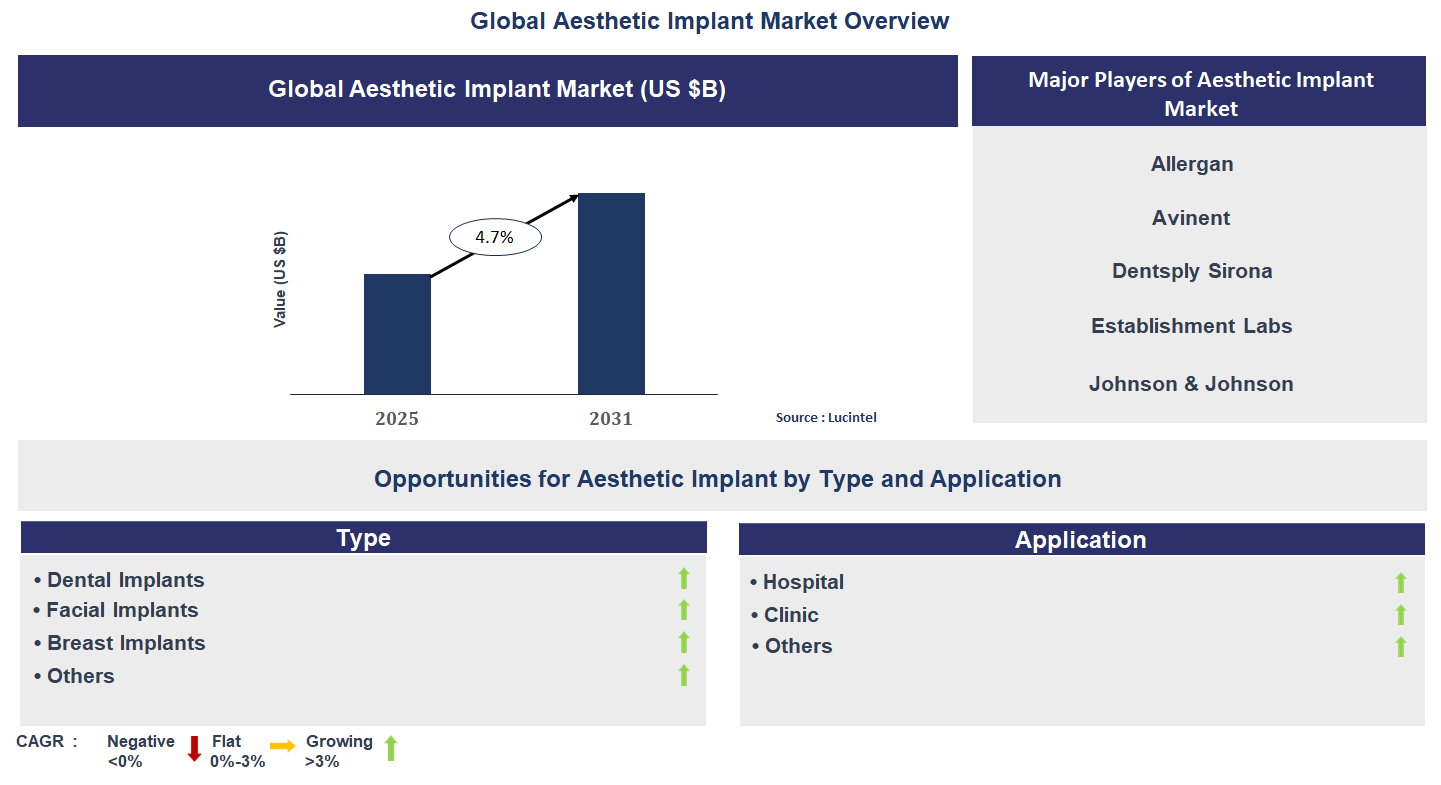
Key data points: The growth forecast = 4.7% annually for the next 7 years. Scroll below to get more insights. This market report covers trends, opportunities and forecasts in aesthetic implant market to 2031 by type (dental implants, facial implants, breast implants, and others), application (hospital, clinic, and others), and region (North America, Europe, Asia Pacific, and the Rest of the World)
We'll send your sample report shortly.
• Lucintel forecasts that, within the type category, dental implant is expected to witness the highest growth over the forecast period.
• Within the application category, clinic is expected to witness higher growth.
• In terms of region, APAC is expected to witness the highest growth over the forecast period. Gain valuable insights for your business decisions with our comprehensive 150+ page report. Sample figures with some insights are shown below.
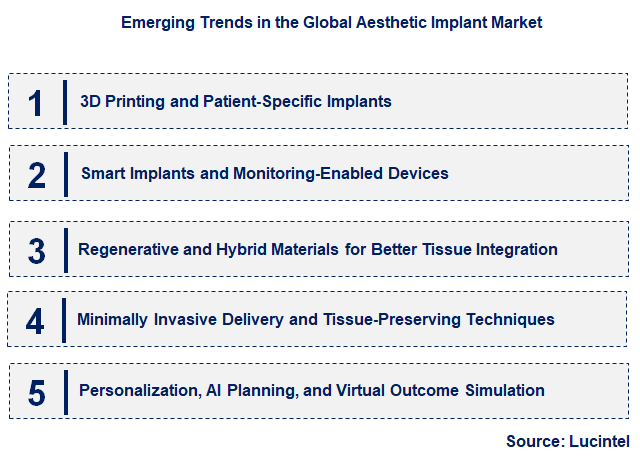
• 3D Printing and Patient-specific Implants: Additive manufacturing allows clinicians and manufacturers to create implants that perfectly match the anatomy of a particular patient. This reduces intraoperative modifications, with better fit and symmetry. Three-dimensional printed implants and patient-specific guides shorten lead times for complex reconstructions and enable rapid iteration during preoperative planning. Technology also supports lighter lattice-structured implants mimicking the mechanics of tissues more closely and thus less palpable and more comfortable.
• Smart Implants and Monitoring-enabled Devices: This refers to the integration of micro sensors and telemetry within implants, enabling continuous or periodic monitoring of local tissue conditions such as pressure and temperature. Smart implants have the capability to flag early signs of complications, guide postoperative care, and reduce revision surgeries by availing real-time clinician visibility into implant status. Convergence of low-power electronics, biocompatible encapsulation, and remote analytics is mobilizing a new category of intelligent aesthetic devices aimed at improving safety and patient reassurance while creating fresh clinical service models.
• Regenerative and Hybrid Materials for Better Tissue Integration: New implant designs incorporate synthetic shells or frames with regenerative scaffolds and bioactive surface treatments to promote tissue in-growth and long-term stability. These hybrid constructs reduce foreign body sensation and lower rejection risk by promoting the native tissue remodeling around the implant. Further evolution of nanocoating’s and porous architectures supports vascularization and reduces capsular contracture risk for soft tissue implants of the breast and face.
• Minimally Invasive Delivery and Tissue-Preserving Techniques: Surgical workflows minimizing incision size, preserving the native tissue planes, and using guided pocket creation are widening the eligible patient base through reduced recovery times and complication rates. New delivery tools, ultrasound guidance, and atraumatic pocket expansion methods allow surgeons to place implants with less disruption of the surrounding tissues, supporting faster return to activities and lower postoperative pain. This patient-friendly approach expands demand among younger and time-constrained patients while supporting clinics in offering lower downtime aesthetic pathways that sit between injectable and traditional surgical categories.
• Personalization, AI planning, and Virtual Outcome Simulation: Artificial intelligence and simulation platforms improve preoperative planning through predictive aesthetic outcome models and optimized implant selection. AI-powered tools provide recommendations on implant geometry and placement strategy in harmony with the patients goals, focusing their analyses on facial proportions, skin quality, and biomechanical factors. Virtual outcome simulation enhances patient engagement and consent by offering realistic postoperative expectations. Taken together, these trends are moving aesthetic implants from mass-produced fixtures to intelligent, personalized, and tissue-friendly solutions that integrate digital planning and advanced materials. 3D printing and AI raise the bar for customization, while smart monitoring and regenerative surfaces improve safety and long-term outcomes. Minimally invasive delivery broadens appeal and shortens recovery, while sustainability and local manufacturing enhance market access. The net effect is a market moving toward higher quality, patient-centric offerings that better match anatomical diversity and lifestyle expectations, creating a pathway for steady growth and clinical improvement across regions.
• Shift to Smooth Surface Breast Implants: Regulators and surgeons are favoring smooth surface breast implants over textured variants due to safety concerns and reduced risks of complications such as Breast Implant-Associated Anaplastic Large Cell Lymphoma (BIA-ALCL). This shift improves patient trust and lowers revision surgery rates, positively impacting market growth.
• Rapid Growth in Dental Implants: Driven by technological progress in bioactive materials and osseointegration, dental implants are increasingly used for cosmetic dental restoration. Rising cosmetic dentistry awareness encourages broader adoption, especially among younger demographics seeking aesthetic enhancement.
• Facial Implant Innovations: Advances focusing on jawline, chin, and cheek implants address growing demand for natural facial contouring. These implant options are gaining popularity due to their ability to enhance symmetry and facial expression subtly and effectively.
• Expansion of Specialty Clinics: An increasing number of standalone aesthetic clinics and specialized centers offering implants improve accessibility, convenience, and affordability for patients. This growth promotes market penetration, especially in emerging regions.
• Customizable Implant Options: Product launches emphasize diverse sizes, shapes, and ethnic-specific designs, enabling personalized aesthetics that cater to a broader consumer base. Customization enhances satisfaction rates and clinical outcomes. These developments collectively enhance safety, patient satisfaction, and accessibility, broadening market appeal and diversifying applications. The trend toward personalized, natural-looking implants combined with improved procedural safety is a key driver of the aesthetic implant markets sustained expansion.
• Breast Augmentation and Reconstruction: Increasing breast cancer survivor support and elective cosmetic augmentations create demand for safer, advanced implant technologies. Growth in reconstructive applications expands market scope.
• Dental Aesthetic Restoration: With rising oral health awareness and aesthetic demands, dental implants represent a lucrative growth area driven by technological innovations and increasing acceptance.
• Facial Contouring: Implants for jaw, chin, and cheek enhancement respond to consumer desires for subtle yet impactful facial reshaping, expanding cosmetic and reconstructive indications.
• Body Contouring: Buttock and calf implants continue to gain traction alongside fitness and body image trends, offering additional avenues for market growth.
• Specialty Clinics and Cosmetic Tourism: Growth of specialized clinics and rising cosmetic tourism improve market reach by offering cost-effective, quality procedures in accessible settings. These applications not only diversify market offerings but also enable companies to target multiple patient demographics and geographical regions. The expansion of specialty clinics and cosmetic tourism supports affordability and accessibility, further propelling market growth.
• Allergan
• Avinent
• Dentsply Sirona
• Establishment Labs
• Johnson & Johnson
• GC Aesthetics
• Institut Straumann
• Dental Implants
• Facial Implants
• Breast Implants
• Others
• Hospital
• Clinic
• Others
• North America
• Europe
• Asia Pacific
• The Rest of the World
• United States: The United States remains a technology and clinical leader in aesthetic implants with rapid adoption of next generation implant systems, ultrasound guided and minimally invasive placement techniques, and expanded use of 3D planning for customization. New surgical workflows and device launches emphasize tissue preservation and faster recovery, with manufacturers bringing incremental safety and ergonomics improvements to market. Innovations aimed at reducing operative trauma, such as balloon or atraumatic pocket creation for breast placement, are gaining attention while clinical research continues to support refined implant profiles and materials for more natural outcomes.
• China: China continues to develop as a major demand center and manufacturing hub for aesthetic implants, driven by increases in disposable income and strong consumer interest in facial contouring and breast procedures. Domestic producers continue to scale production and are improving quality, while global manufacturers partner locally as they seek to negotiate price-sensitive procurement and distribution changes. Shifting policies and volume procurement programs have lowered the cost of some implant categories and driven procedural volumes, while innovation in AI-enabled consultation platforms and digital patient engagement expands reach to younger urban consumers.
• Germany: The German market focuses on engineering quality, clinical evidence and regulatory compliance, with a strong emphasis on biocompatibility of materials and precision of manufacture for both facial and body implants. German clinics are early adopters of digital workflows and 3D printed, patient-specific implants for reconstructive and aesthetic indications; research institutions partner with industry to advance surface technology and soft tissue integration. High regulatory standards and requirements for documented safety profiles at home favor premium, clinically validated products and drive the export of German medical device expertise into other European markets.
• India: India is fast emerging as a key growth market for aesthetic implants driven by rising middle-class spending, increasing medical tourism, and greater clinical training and infrastructure. Clinics are starting to adopt digital imaging and computer-aided implant planning as local manufacturers and importers expand their product portfolios to cover cosmetic augmentation and reconstructive applications. Cost competitiveness, coupled with growing surgeon expertise, attracts international patients for more complex procedures.
• Japan: Japan continues to focus on unobtrusive natural-look aesthetics and safety, which continues to drive the demand for smaller profile and highly biocompatible implants tailored to local anatomy. Manufacturers based in Japan are also investing heavily in biomaterial research and precision production. For their part, surgeons in this market emphasize minimally invasive approaches with keen attention to proportion and harmony. Clinical centers collaborate with device developers on incremental innovations in implant surface design and placement techniques that reduce risk of complication, yet deliver the natural movement and texture favored by patients.


• Allergan
• Avinent
• Dentsply Sirona
• Establishment Labs
• Johnson & Johnson
• GC Aesthetics
• Institut Straumann Q5. Which aesthetic implant market segment will be the largest in future? Answer: Lucintel forecasts that, within the type category, dental implant is expected to witness the highest growth over the forecast period. Q6. In aesthetic implant market, which region is expected to be the largest in next 5 years? Answer: In terms of region, APAC is expected to witness the highest growth over the forecast period. Q7. Do we receive customization in this report? Answer: Yes, Lucintel provides 10% customization without any additional cost.


Choose a license that fits your team. Instant PDF delivery.
Prices exclude taxes. Instant delivery. Custom licensing available on request.
Market Report · July 22, 2026
Market Report · July 22, 2026
Market Report · July 22, 2026
Trusted partner for strategic intelligence and business growth


Receive a complimentary market analysis tailored to your industry. Our analysts will identify key growth opportunities and competitive dynamics specific to your business.

Market size, growth rate, and key trend analysis for your specific sector.

Top competitor positioning and market share analysis.

Strategic recommendations backed by data-driven insights.
Get curated market intelligence and competitive moves straight to your inbox.
By subscribing, you agree to receive our monthly insights. Unsubscribe anytime.
Receive a complimentary market analysis tailored to your industry. Our analysts will identify key growth opportunities and competitive dynamics specific to your business.
Market size, growth rate, and key trend analysis for your specific sector.
Top competitor positioning and market share analysis.
Strategic recommendations backed by data-driven insights.
Get curated market intelligence, emerging trends, and competitive moves straight to your inbox each month.
By subscribing, you agree to receive our monthly insights. Unsubscribe anytime.
We'll send your sample report shortly.