
Aerospace Titanium Market
The future of the global aerospace titanium market looks promising with opportunities in the structure (Airframe) and engine markets. The global aerospace titanium market is expected to reach an estimated $6.5 billion by 2035 with a CAGR of 6.5% from 2026 to 2035. The major drivers for this market are the increasing aircraft production boosting titanium demand, the rising defense aircraft procurement driving adoption and the growing lightweight material usage enhancing performance.
• Lucintel forecasts that, within the aircraft type category, commercial aircraft will remain the largest segment over the forecast period as the increasing commercial aircraft production boosting titanium demand.
• Within the application category, structure (Airframe) will remain the largest segment due to the the increasing airframe production driving titanium material consumption.
• In terms of regions, North America will remain the largest region over the forecast period due to the the growing lightweight aircraft adoption driving market expansion.
Gain valuable insights for your business decisions with our comprehensive 150+ page report.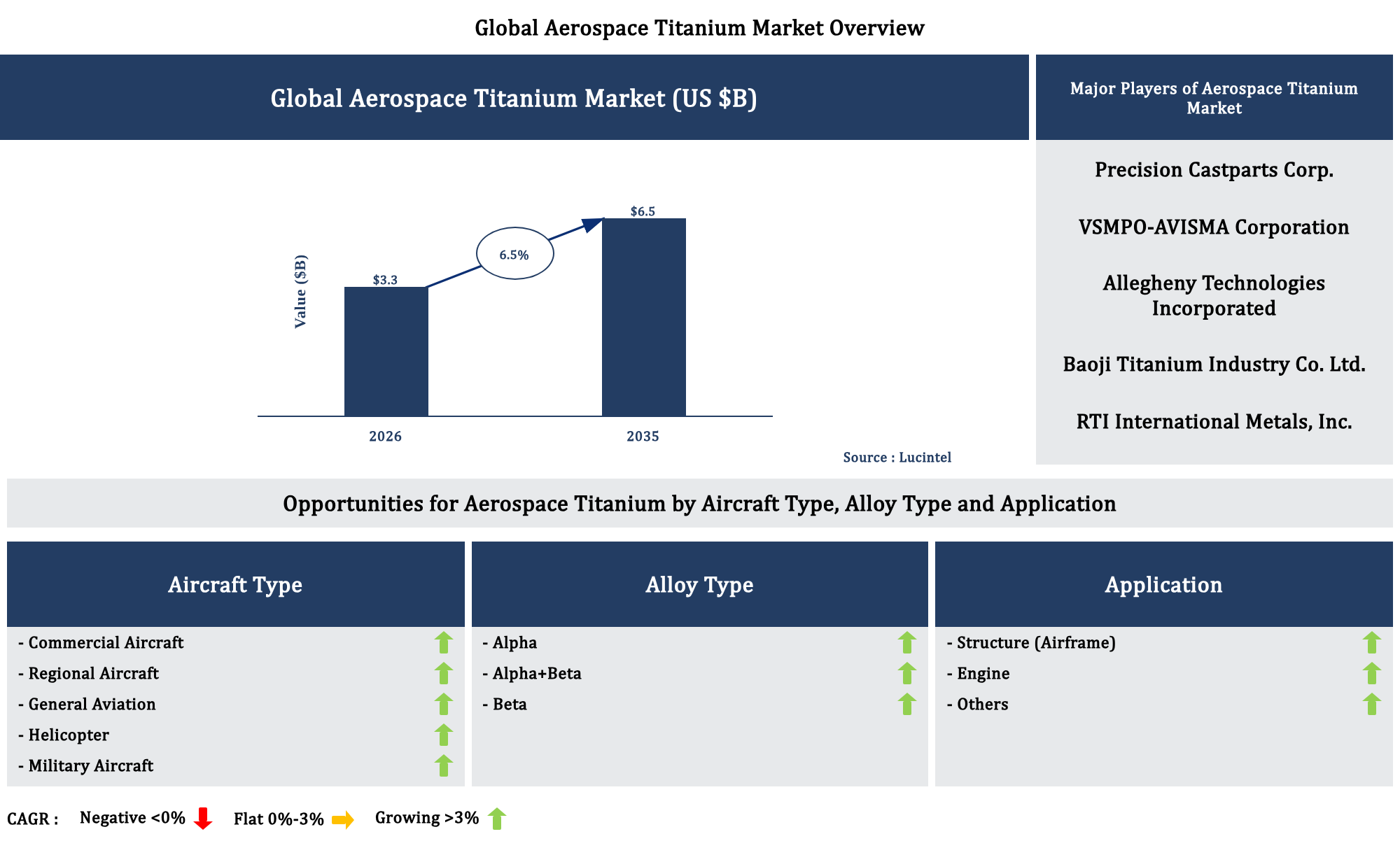
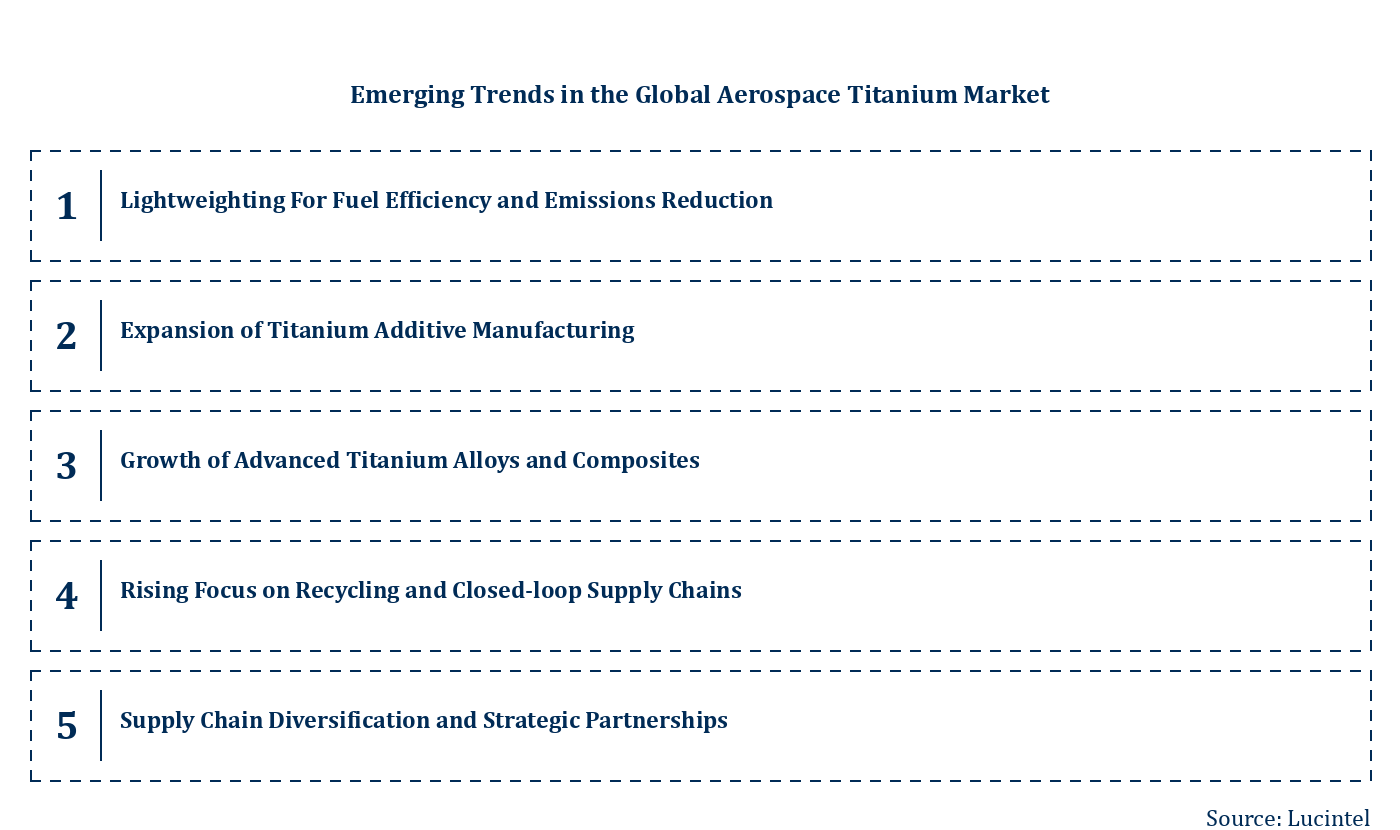
Emerging Trends in the Aerospace Titanium Market
The aerospace titanium market is undergoing significant transformation as aircraft manufacturers, engine OEMs, and defense contractors seek lighter, stronger, and more sustainable materials. Titanium’s superior strength-to-weight ratio, corrosion resistance, and high-temperature performance make it indispensable for next-generation airframes, engines, and space systems. At the same time, cost pressures and decarbonization targets are pushing the industry toward higher material efficiency, circularity, and digitalized supply chains. Advances in additive manufacturing, alloy design, and recycling technologies are reshaping sourcing strategies and production methods. These emerging trends are redefining competitiveness, risk management, and innovation pathways across the global aerospace titanium market.
Recent Developments in the Aerospace Titanium Market
The aerospace titanium market is undergoing rapid change as aircraft manufacturers, engine OEMs, and defense contractors seek lighter, stronger, and more heat‑resistant materials to boost performance and fuel efficiency. Titanium’s unique strength-to-weight ratio, corrosion resistance, and compatibility with composite structures are driving both technological and strategic shifts across the value chain. At the same time, supply security, cost volatility, and sustainability pressures are pushing stakeholders to innovate in sourcing, processing, and recycling. The following recent developments capture how new alloys, manufacturing methods, and partnerships are reshaping competitiveness and long-term growth prospects in the global aerospace titanium market.
Strategic Growth Opportunities in the Aerospace Titanium Market
The aerospace titanium market is entering a phase of strategic expansion as aircraft platforms evolve, fleets modernize, and sustainability pressures intensify. Titanium’s exceptional strength-to-weight ratio, corrosion resistance, and high-temperature performance make it indispensable in both commercial and defense aerospace programs. As original equipment manufacturers redesign airframes and engines for greater fuel efficiency and lower emissions, they are specifying more titanium-intensive components and advanced titanium alloys. Simultaneously, upgrades of legacy fleets, the rise of space commercialization, and growth in maintenance, repair, and overhaul services are opening fresh demand pools. These trends create focused growth opportunities across distinct application segments.
Aerospace Titanium Market Drivers and Challenges
The aerospace titanium market is shaped by a complex mix of technological innovation, economic dynamics, and evolving regulatory demands. Titanium’s unique properties, including high strength-to-weight ratio, corrosion resistance, and heat tolerance, make it indispensable for modern airframes, engines, and space structures. At the same time, volatile raw material prices, certification requirements, and supply chain constraints influence how quickly and widely titanium can penetrate new aerospace programs. Understanding the main growth drivers and structural challenges enables manufacturers, suppliers, and investors to position themselves effectively, capture emerging opportunities, and mitigate operational and strategic risks across the global aerospace value chain.
The factors responsible for driving the aerospace titanium market include:
The challenges facing this aerospace titanium market include:
The aerospace titanium market is shaped by powerful growth drivers such as rising demand for fuel-efficient aircraft, expanding commercial and defense fleets, and ongoing advances in engine and airframe design. At the same time, high costs, supply chain concentration, and strict certification regimes pose significant structural challenges. Together, these forces create a market characterized by strong strategic importance but careful risk management and long planning horizons. Stakeholders that invest in process innovation, diversified sourcing, and compliance capabilities are best positioned to capture long-term opportunities while navigating volatility and regulatory complexity.
List of Aerospace Titanium Market Companies
Companies in the market compete on the basis of product quality offered. Major players in this market focus on expanding their manufacturing facilities, R&D investments, infrastructural development, and leverage integration opportunities across the value chain. Through these strategies aerospace titanium market companies cater increasing demand, ensure competitive effectiveness, develop innovative products & technologies, reduce production costs, and expand their customer base. Some of the aerospace titanium market companies profiled in this report include-
Aerospace Titanium Market by Segment
The study includes a forecast for the global aerospace titanium market by aircraft type, alloy type, application, and region.
Country Wise Outlook for the Aerospace Titanium Market
The aerospace titanium market is undergoing notable change as aircraft OEMs, engine manufacturers, and space companies rebalance cost, supply security, and performance requirements. Titanium’s favorable strength‑to‑weight ratio, corrosion resistance, and compatibility with composite structures keep it central to next‑generation airframes and propulsion systems. Across the United States, China, Germany, India, and Japan, demand is being reshaped by rising defense budgets, recovery in commercial aviation, and rapid expansion of space and advanced air mobility programs. Investments in melting capacity, recycling, and additive manufacturing are emerging as critical levers to secure long‑term titanium supply and reduce exposure to geopolitical risk.
Features of the Aerospace Titanium Market
Article
Aerospace Titanium Market: Are New Alloys Redefining the Economics of Flight?
Dallas, July 17, 2026 – The aerospace titanium market is entering a pivotal phase as aircraft manufacturers, defense organizations, and space companies push for lighter, stronger, and more sustainable materials. Titanium has long been a strategic metal for aerospace, but the convergence of new alloy chemistries, additive manufacturing, and intensified supply-chain competition is changing how it is sourced, processed, and specified. This shift is not just a technical evolution; it is reshaping cost structures, competitive positioning, and innovation roadmaps across commercial aviation, defense aviation, space launch, and advanced technology sectors.
Why Is Aerospace Titanium Demand Shifting Toward Higher-Performance and Lower-Cost Alloys?
A major trend is the move from standard titanium grades toward more tailored, performance-optimized alloys that balance strength, fatigue resistance, corrosion performance, and manufacturability. Aircraft OEMs are under pressure to cut fuel burn, extend component life, and reduce maintenance downtime, and next-generation titanium alloys are becoming a critical lever.
This shift is disruptive because it alters the qualification landscape, making materials innovation a differentiator rather than a commodity play. Programs that can certify and industrialize new high-performance alloys faster will enjoy structural cost and performance advantages over competitors locked into legacy materials.
How Is Additive Manufacturing Rewiring the Aerospace Titanium Value Chain?
Another defining development is the rapid integration of additive manufacturing into titanium component production. Powder bed fusion and directed energy deposition are now moving beyond prototyping toward certified serial production of flight-critical parts.
The impact on the aerospace titanium market is profound. Demand is shifting from mill products such as plates and bars toward high-quality powders and wires, and new players focused on powders, atomization technologies, and 3D printing systems are capturing value traditionally owned by legacy mills and forgers. Lead times are shrinking, engineering change costs are decreasing, and procurement strategies are starting to privilege flexibility and rapid redesign over long-run scale economics.
Can Sustainability and Supply Security Coexist in Aerospace Titanium Sourcing?
Supply-chain resilience and sustainability are now strategic concerns for titanium users. Historically, the aerospace sector has been exposed to geopolitical concentration in titanium sponge production and to volatile energy and raw material prices. As climate and security agendas intensify, organizations are forced to rethink where and how they source titanium.
These shifts will disrupt pricing, contract structures, and the competitive landscape among primary producers, remelters, and service centers. Producers that can demonstrate verifiable low-carbon titanium with transparent traceability are likely to command premium relationships with leading aerospace customers, while high-emission, opaque supply bases face rising regulatory and reputational risk.
Which Markets Will See the Strongest Impact from Titanium Innovations?
The evolution of the aerospace titanium market is not uniform across segments. Several markets are poised to experience particularly strong impact as innovations diffuse.
As these trends play out, value will shift from pure metal tonnage toward intellectual property in alloy design, qualification processes, digital design tools, and certified additive manufacturing workflows.
Where Do Technology Industry Use Cases Link into the aerospace titanium market?
Although aerospace is the primary demand center, the technology industry increasingly intersects with aerospace titanium through shared platforms, capabilities, and applications. Titanium is emerging as a strategic material in several technology-driven domains.
This cross-pollination benefits titanium producers and processors by diversifying demand and justifying investments in new processes that serve both aerospace and technology customers, especially in high-specification, low-volume applications where performance trumps raw material cost.
What Key Challenges Could Slow or Distort Market Disruption?
Despite strong momentum, the aerospace titanium market faces material challenges that could slow adoption, distort pricing, or limit the impact of innovation.
Managing these challenges requires coordinated action across OEMs, suppliers, regulators, and investors. Collaborative frameworks for shared testing, standardized qualification pathways, and workforce development will be crucial to prevent bottlenecks from eroding the expected gains from titanium innovation.
Where Are the Most Attractive Opportunities for Stakeholders in the Aerospace Titanium Ecosystem?
Alongside challenges, the disruption of the aerospace titanium market is creating new opportunity pools for both established players and new entrants.
Capitalizing on these opportunities requires clear strategic positioning and an understanding of where in the value chain each participant can build sustainable advantage, whether through technology, scale, geographic footprint, or regulatory expertise.
What Recent Developments Signal the Future Direction of the aerospace titanium market?
Recent developments across aerospace and adjacent industries offer early signals about where the market is heading and which innovations are likely to achieve scale.
As these developments mature, they are likely to embed titanium more deeply into aerospace architectures while elevating the importance of digital design, additive manufacturing, and sustainable sourcing in procurement decisions. The aerospace titanium market is set to move from a specialty materials niche to a strategic arena where materials science, supply-chain strategy, and digital engineering converge to shape the next generation of flight and space systems.
Top 5 Companies
1. Precision Castparts Corp.
Precision Castparts Corp. is a leading manufacturer of complex metal components and products used in critical aerospace and industrial applications, with its headquarters in Portland, Oregon, USA, and roots dating back to 1953. The company operates through multiple divisions focused on investment castings, forgings, and fasteners, and it is a key supplier of aerospace-grade titanium and nickel-based components for aircraft engines, airframes, and defense platforms. While detailed current employee counts are not publicly disclosed, Precision Castparts has a substantial global workforce spread across North America, Europe, and Asia, supporting major aerospace OEMs and tier‑one suppliers. In the aerospace titanium market, Precision Castparts offers titanium castings, forgings, and machined structural parts for commercial jets, regional aircraft, business jets, and military aircraft, emphasizing high-strength, low-weight solutions optimized for fuel efficiency and performance. The company’s geographic presence includes manufacturing plants and service facilities in the USA, UK, France, Mexico, and key Asian markets, enabling local support for global aircraft programs. Over the years, Precision Castparts has expanded its aerospace titanium capabilities through targeted acquisitions of specialized forging and casting businesses, reinforcing vertical integration from raw material processing to finished components. Although no recent large-scale geographic expansion dedicated solely to aerospace titanium has been announced, the company continues to invest in capacity, machining technology, and process automation at existing aerospace-focused facilities to support next-generation engines and airframes. Historical merger and acquisition activity has been central to its strategy, including multiple bolt-on deals for titanium and superalloy forgers and fastener manufacturers that broaden its portfolio across engine discs, blades, structural frames, and critical fastener systems used extensively in titanium-intensive aircraft platforms.
2. VSMPO-AVISMA Corporation
VSMPO-AVISMA Corporation is one of the world’s largest integrated producers of titanium, with its headquarters in Verkhnyaya Salda, Sverdlovsk Region, Russia, and a corporate history that traces back to 1933. The company manages a fully integrated value chain from titanium sponge production through melting, forging, rolling, and machining, which positions it as a critical supplier of aerospace-grade titanium mill products and semi-finished parts. VSMPO-AVISMA employs a large workforce across Russia and international subsidiaries, supplying major aircraft and engine manufacturers in North America, Europe, and Asia. Within the aerospace titanium market, its portfolio includes titanium ingots, billets, slabs, plates, sheets, bars, and forgings used in airframes, landing gear, hydraulic systems, and gas turbine engine components. The company has historically maintained a broad global presence through sales offices, joint ventures, and service centers in countries such as the USA, UK, Germany, and China, supporting long-term contracts with leading OEMs and tier suppliers. VSMPO-AVISMA has pursued geographic expansion by establishing machining and service hubs closer to key aerospace clusters, enhancing just‑in‑time delivery and customized forging solutions for titanium-intensive commercial and military aircraft programs. Its strategic collaborations and joint ventures have acted as a form of merger and acquisition–driven expansion, deepening integration with global aerospace supply chains. While detailed recent M&A transactions explicitly labeled under aerospace titanium are limited, the company continues to invest in capacity upgrades, process modernization, and downstream processing capabilities to retain its competitive edge in high-specification aerospace titanium products, even as the regulatory and geopolitical environment around exports becomes more complex.
3. Allegheny Technologies Incorporated
Allegheny Technologies Incorporated (ATI) is a specialty materials and components company headquartered in Dallas, Texas, USA, formed in 1996 through the merger of Allegheny Ludlum and Teledyne’s specialty metals business. ATI employs several thousand people worldwide, with manufacturing and service facilities in the USA, Europe, and Asia, serving aerospace, defense, energy, and industrial customers. In the aerospace titanium market, ATI offers a comprehensive portfolio that includes titanium and titanium alloy ingots, billets, bar, plate, sheet, and precision components used in jet engines, airframes, landing gear, and structural applications. The company leverages advanced melting technologies, including vacuum arc remelting and electron beam processes, to produce high-purity titanium products that meet stringent aerospace standards. ATI’s geographic presence spans North America as its core production base, complemented by distribution, research, and customer service centers in the UK, Germany, China, and other strategic aerospace hubs. Recent growth initiatives have focused on expanding capacity for next‑generation aerospace alloys, including titanium used in high-thrust engines and lightweight structural parts, as well as investing in near-net-shape capabilities that reduce material waste in titanium-heavy components. ATI has historically used mergers, acquisitions, and divestitures to sharpen its portfolio, exiting lower-margin businesses while strengthening high-performance materials, titanium, and nickel-based superalloy offerings. While there have not been many headline-grabbing acquisitions purely focused on titanium in the last few years, prior deals and joint ventures have consolidated ATI’s role as a critical supplier across major global aircraft programs, providing a stable foundation for long-term contracts with engine and airframe OEMs and reinforcing its strategic position in the global aerospace titanium value chain.
4. Baoji Titanium Industry Co. Ltd.
Baoji Titanium Industry Co. Ltd., headquartered in Baoji, Shaanxi Province, China, is one of China’s leading producers of titanium and titanium alloy products, established in 1999. The company is based in the city often called the “Titanium Valley of China,” reflecting its concentration of titanium processing expertise and industrial infrastructure. Baoji Titanium Industry employs a sizeable workforce across its manufacturing plants, research centers, and sales offices, serving aerospace, chemical, marine, and medical sectors. In the aerospace titanium market, the company’s portfolio covers titanium sponge, ingots, billets, plates, sheets, bars, tubes, and forgings, as well as fabricated parts tailored for airframes, engines, landing gear, and fastener systems. Its capabilities include melting, forging, rolling, and precision machining of high-strength titanium alloys compliant with domestic and international aerospace standards. Baoji Titanium Industry has expanded its geographic presence beyond China through exports to Asia-Pacific markets, Europe, and North America, supplying both domestic aircraft programs and select international customers. Recent expansion initiatives in aerospace titanium have focused on adding melting and forging capacity, enhancing quality systems, and upgrading facilities to support higher-spec titanium alloys for next-generation commercial and military aircraft. The company actively collaborates with Chinese aerospace primes and research institutes to develop titanium alloys optimized for weight reduction and high-temperature performance. While large-scale international mergers and acquisitions directly tied to aerospace titanium have been limited, Baoji Titanium Industry has pursued strategic partnerships and investments within China’s titanium cluster to integrate upstream raw materials and downstream fabrication. These moves strengthen its competitiveness in the aerospace titanium value chain and position it as a key regional alternative to long-established Western and Russian titanium suppliers.
5. RTI International Metals, Inc. (part of Kobelco Group)
RTI International Metals, Inc., headquartered in Pittsburgh, Pennsylvania, USA, has long been recognized as a specialist in titanium and specialty metals, particularly for aerospace and defense applications. Founded in 1950, RTI built its business around titanium mill products, forgings, extrusions, and fabricated components used in airframes, engines, and space systems. The company serves global aerospace OEMs and tier suppliers, and its operations span multiple manufacturing sites and service centers in North America and Europe, employing a technically skilled workforce focused on high-spec metals. RTI’s product portfolio for the aerospace titanium market includes titanium plate, sheet, bar, forgings, and complex fabricated assemblies that support structural components, landing gear, nacelles, and engine hardware on commercial and military aircraft. The company has engaged in ongoing geographic expansion by positioning manufacturing assets and customer service operations close to key aerospace clusters in the USA and Europe, improving logistics and collaborative engineering with major customers. RTI’s role in the aerospace titanium market was significantly reshaped by merger and acquisition activity when it became part of a larger industrial group, aligning its titanium expertise with broader metals and engineering capabilities. Within the Kobelco Group’s global network, RTI contributes titanium know‑how that complements the group’s steel, aluminum, and engineering businesses, enabling more integrated solutions for aerospace customers. This combination enhances access to capital, R&D, and global sales channels, strengthening RTI’s position in long-term aerospace titanium programs and creating opportunities to develop new titanium alloys and advanced fabrication techniques targeted at weight reduction and cost efficiency in next-generation aircraft platforms.
Table of Contents
List of Figures
List of Tables
Methodology
Lucintel has been in the business of market research and management consulting since 2000 and has published over 1000 market intelligence reports in various markets / applications and served over 1,000 clients worldwide. This study is a culmination of four months of full-time effort performed by Lucintel's analyst team. The analysts used the following sources for the creation and completion of this valuable report:
- In-depth interviews of the major players in this market
- Detailed secondary research from competitors' financial statements and published data
- Extensive searches of published works, market, and database information pertaining to industry news, company press releases, and customer intentions
- A compilation of the experiences, judgments, and insights of Lucintel's professionals, who have analyzed and tracked this market over the years.
Extensive research and interviews are conducted across the supply chain of this market to estimate market share, market size, trends, drivers, challenges, and forecasts. Below is a brief summary of the primary interviews that were conducted by job function for this report.

Thus, Lucintel compiles vast amounts of data from numerous sources, validates the integrity of that data, and performs a comprehensive analysis. Lucintel then organizes the data, its findings, and insights into a concise report designed to support the strategic decision-making process. The figure below is a graphical representation of Lucintel's research process.

Buy Now
Choose a license that fits your team. Instant PDF delivery.
Prices exclude taxes. Instant delivery. Custom licensing available on request.
Frequently Asked Questions
What is the Aerospace Titanium Market size?
What is the growth forecast for Aerospace Titanium Market?
What are the major drivers influencing the growth of the Aerospace Titanium Market?
What are the major segments for Aerospace Titanium Market?
Who are the key Aerospace Titanium Market companies?
Which Aerospace Titanium Market segment will be the largest in future?
In Aerospace Titanium Market, which region is expected to be the largest in next 9 years?
Do we receive customization in this report?
Key Questions
- • What are some of the most promising, high-growth opportunities for the Aerospace Titanium Market by Aircraft Type (Commercial Aircraft, Regional Aircraft, General Aviation, Helicopter, and Military Aircraft), Alloy Type (Alpha, Alpha+Beta, and Beta), Application (Structure (Airframe), Engine, and Others), and region (North America, Europe, Asia Pacific, and the Rest of the World)?
- • Which segments will grow at a faster pace and why?
- • Which region will grow at a faster pace and why?
- • What are the key factors affecting market dynamics? What are the key challenges and business risks in this market?
- • What are the business risks and competitive threats in this market?
- • What are the emerging trends in this market and the reasons behind them?
- • What are some of the changing demands of customers in the market?
- • What are the new developments in the market? Which companies are leading these developments?
- • Who are the major players in this market? What strategic initiatives are key players pursuing for business growth?
- • What are some of the competing products in this market and how big of a threat do they pose for loss of market share by material or product substitution?
- • What M&A activity has occurred in the last 9 years, and what has its impact been on the industry?


