
Aerospace And Defense Condition Monitoring System Market Report: Trends, Forecast and Competitive Analysis to 2035

Key data points: The market size in 2035 = $722 million, growth forecast = 5.9% annually for the next 8 years. Scroll below to get more insights. This market report covers trends, opportunities and forecasts in aerospace and defense condition monitoring system market to 2035 by aircraft type (commercial aircraft, regional aircraft, general aviation, helicopter, military aircraft, UAV, and spacecraft), monitoring technique type (vibration analysis, thermography, oil analysis, and others), product type (router-based system, portable system, and sensor-based system), and region (North America, Europe, Asia Pacific, and the Rest of the World)

Publisher: Lucintel Last Updated: July 2026
See Pricing

Download Sample Report

| ✨ New Download Sample report — Get instant insights! | ✨ New Download Sample report — Get instant insights!

Aerospace And Defense Condition Monitoring System Market Report: Trends, Forecast and Competitive Analysis to 2035

Aerospace And Defense Condition Monitoring System Market

The future of the global aerospace and defense condition monitoring system market looks promising with opportunities in the router-based system, portable system, and sensor-based system markets. The global aerospace and defense condition monitoring system market is expected to reach an estimated $722 million by 2035 with a CAGR of 5.9% from 2026 to 2035. The major drivers for this market are the increasing demand for predictive maintenance systems, the rising adoption of aircraft health monitoring, and the growing investments in defense aviation technologies.

  • Lucintel forecasts that, within the aircraft type category, commercial aircraft is expected to witness the highest growth over the forecast period due to increasing maintenance efficiency requirements accelerate aircraft monitoring systems.
  • Within the product type category, sensor-based system is expected to witness the highest growth due to rising predictive maintenance demand boosts sensor-based monitoring adoption.
  • In terms of regions, North America is expected to witness the highest growth over the forecast period due to strong technological innovation, which accelerates market adoption in North America.

Gain valuable insights for your business decisions with our comprehensive 150+ page report. Sample figures with some insights are shown below.
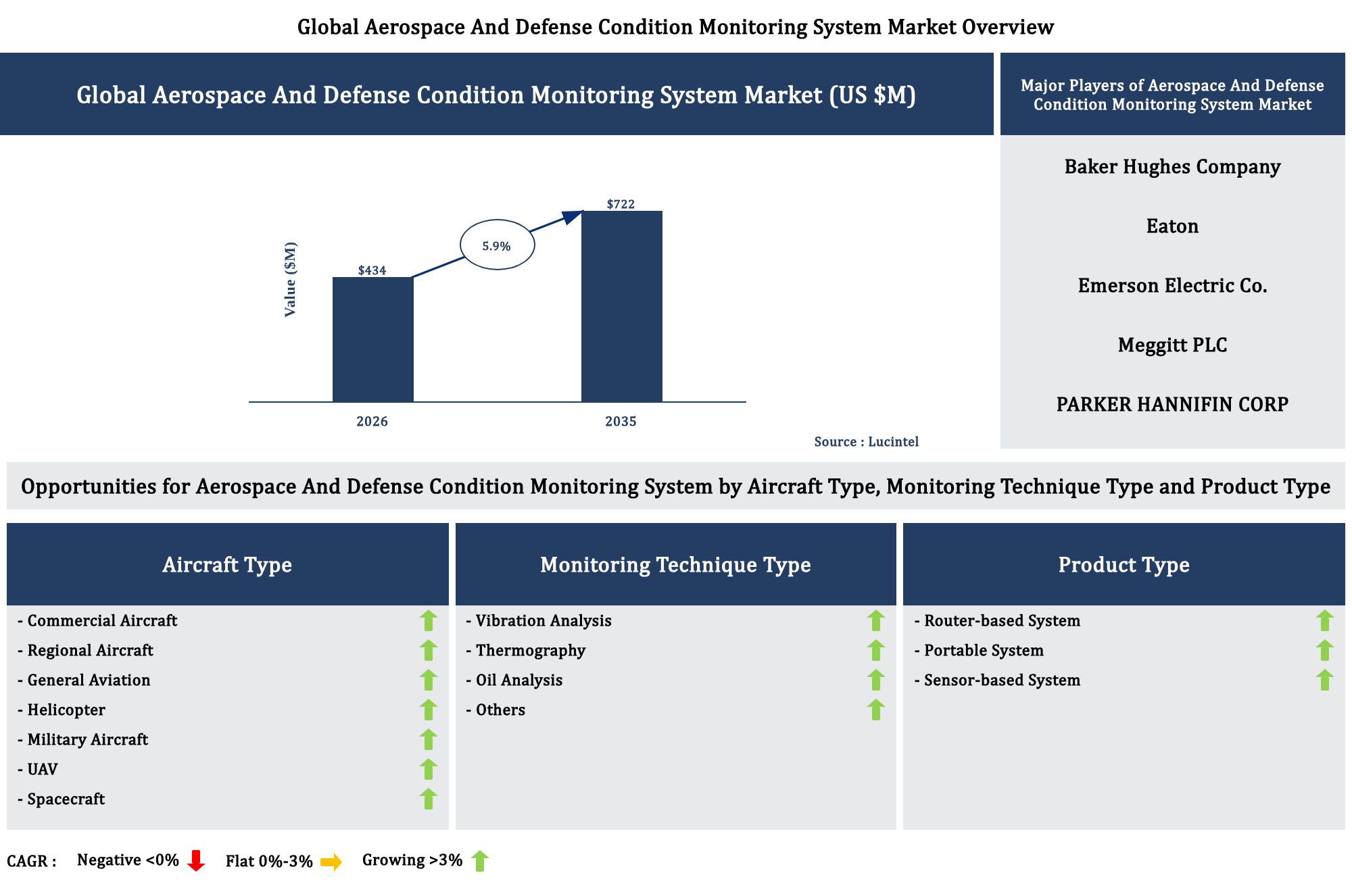
Aerospace And Defense Condition Monitoring System Market

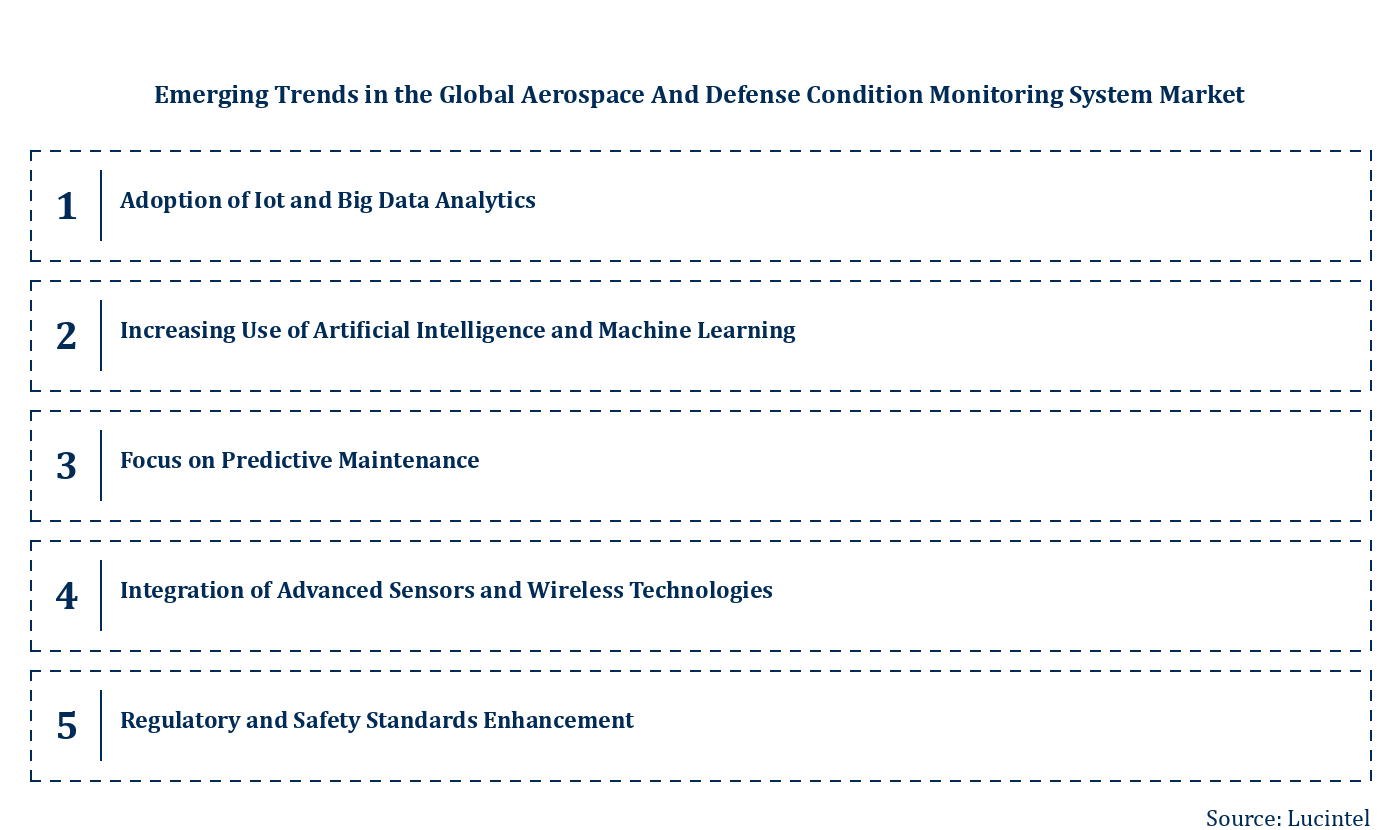
Emerging Trends in the Aerospace And Defense Condition Monitoring System Market

The aerospace and defense condition monitoring system market is experiencing rapid evolution driven by technological advancements, increasing safety regulations, and the need for operational efficiency. As aircraft and defense systems become more complex, the demand for sophisticated monitoring solutions grows. These systems help in predictive maintenance, reducing downtime, and enhancing safety standards. The market is also influenced by the integration of IoT, AI, and big data analytics, which enable real-time insights and proactive decision-making. This dynamic environment is fostering innovation and reshaping industry practices, making condition monitoring an essential component of modern aerospace and defense operations.

  • Adoption of IoT and Big Data Analytics: The integration of Internet of Things (IoT) devices and big data analytics is transforming condition monitoring. Sensors embedded in aircraft and defense equipment collect vast amounts of real-time data, which is analyzed to predict failures and optimize maintenance schedules. This trend enhances operational efficiency, reduces costs, and minimizes unexpected downtimes. The ability to process large datasets enables more accurate diagnostics and proactive interventions, leading to safer and more reliable aerospace and defense systems.
  • Increasing Use of Artificial Intelligence and Machine Learning: AI and ML algorithms are increasingly being incorporated into condition monitoring systems. These technologies facilitate advanced pattern recognition, anomaly detection, and predictive analytics. AI-driven systems can learn from historical data to improve accuracy over time, enabling early fault detection and maintenance planning. This trend significantly enhances decision-making processes, reduces human error, and supports autonomous operations, thereby improving safety and operational readiness in aerospace and defense sectors.
  • Focus on Predictive Maintenance: The shift from reactive to predictive maintenance is a key trend. Condition monitoring systems now enable continuous assessment of equipment health, predicting failures before they occur. This proactive approach minimizes unscheduled repairs, extends equipment lifespan, and reduces maintenance costs. The adoption of predictive maintenance is driven by the need for increased safety, operational efficiency, and cost savings, especially in complex aerospace and defense systems where downtime can be critical.
  • Integration of Advanced Sensors and Wireless Technologies: The deployment of advanced sensors, including fiber optic sensors and wireless sensor networks, is gaining momentum. These sensors provide high-precision data and facilitate real-time monitoring without extensive wiring, reducing installation and maintenance costs. Wireless technologies enable more flexible sensor placement and easier system upgrades. This trend improves data accuracy, system reliability, and ease of integration, supporting more comprehensive and scalable condition monitoring solutions across aerospace and defense platforms.
  • Regulatory and Safety Standards Enhancement: Stricter safety and regulatory standards are prompting the adoption of advanced condition monitoring systems. Governments and industry bodies are mandating more rigorous safety protocols, which require real-time monitoring and reporting capabilities. This trend drives innovation in monitoring technologies, ensuring compliance, and enhancing overall safety. It also encourages manufacturers to develop more robust, reliable, and certified systems, fostering market growth and technological advancement.

These emerging trends are collectively reshaping the aerospace and defense condition monitoring system market by fostering innovation, improving safety, and enhancing operational efficiency. The integration of IoT, AI, and advanced sensors is enabling smarter, more predictive systems that reduce costs and downtime. The focus on predictive maintenance and compliance with stringent safety standards is driving technological development and market expansion. As these trends continue to evolve, they will lead to more autonomous, reliable, and efficient aerospace and defense operations, setting new benchmarks for safety and performance in the industry.
Aerospace And Defense Condition Monitoring System Market by country

Recent Developments in the Aerospace And Defense Condition Monitoring System Market

The aerospace and defense condition monitoring system market is experiencing rapid technological advancements and increasing demand for safety, efficiency, and predictive maintenance. Condition monitoring systems (CMS) are becoming essential for aircraft and military equipment, enabling real-time data analysis and proactive decision-making. Recent developments focus on integrating AI, IoT, and advanced sensors to enhance system reliability and reduce operational costs. These innovations are transforming maintenance practices, improving safety standards, and opening new market opportunities globally.

  • Integration of Artificial Intelligence and Machine Learning: Enhances predictive analytics for early fault detection, reducing downtime and maintenance costs. AI-driven CMS enables real-time data processing, improving accuracy and response times. This development supports smarter maintenance schedules, minimizes unexpected failures, and extends equipment lifespan, ultimately increasing operational efficiency and safety in aerospace and defense applications.
  • Adoption of Internet of Things (IoT) Technologies: Facilitates seamless data collection from multiple sensors embedded in aircraft and military hardware. IoT connectivity allows for continuous monitoring, remote diagnostics, and faster decision-making. This advancement improves asset management, reduces maintenance costs, and enhances safety protocols, making systems more reliable and responsive to operational conditions across various aerospace and defense platforms.
  • Development of Advanced Sensor Technologies: Introduces more durable, precise, and miniaturized sensors capable of withstanding harsh environments. These sensors provide detailed insights into structural integrity, vibration, temperature, and other critical parameters. Their deployment improves early fault detection, prolongs equipment life, and ensures safety, thereby supporting more reliable and efficient aerospace and defense operations.
  • Implementation of Data Analytics and Cloud Computing: Enables centralized data storage and advanced analytics for comprehensive system health assessments. Cloud-based platforms facilitate real-time data sharing among stakeholders, improving coordination and response times. This development reduces infrastructure costs, enhances scalability, and supports predictive maintenance strategies, leading to increased operational readiness and reduced downtime in aerospace and defense sectors.
  • Focus on Cybersecurity and Data Integrity: Addresses increasing threats to digital systems by implementing robust security protocols. Ensuring data integrity and protection against cyber-attacks is critical for maintaining system reliability and safety. These measures foster trust among users, comply with regulatory standards, and safeguard sensitive information, ultimately supporting the secure deployment of condition monitoring systems in aerospace and defense environments.

These developments are significantly impacting the market by driving innovation, reducing operational costs, and enhancing safety and reliability. The integration of advanced technologies is creating new growth opportunities, expanding market reach, and fostering competitive advantages for industry players. Overall, these advancements are shaping a more efficient, secure, and sustainable future for aerospace and defense condition monitoring systems.

Strategic Growth Opportunities in the Aerospace And Defense Condition Monitoring System Market

The aerospace and defense condition monitoring system market is experiencing rapid growth driven by technological advancements, increasing safety regulations, and the need for predictive maintenance. These systems enhance operational efficiency, reduce downtime, and improve safety standards across commercial, military, and space applications. As the industry evolves, opportunities for innovation and integration with emerging technologies like IoT and AI are expanding, creating a dynamic landscape for market players to capitalize on future growth and competitive advantage.

  • Increasing Adoption of Predictive Maintenance Technologies: The shift from reactive to predictive maintenance in aerospace and defense is a key growth driver. Condition monitoring systems enable early fault detection, reducing unscheduled downtimes and maintenance costs. The integration of IoT sensors and data analytics enhances real-time monitoring capabilities, leading to improved safety and operational efficiency. This trend is particularly prominent in commercial aircraft, military vehicles, and space equipment, offering significant market expansion opportunities.
  • Growing Demand for Real-Time Data Analytics and IoT Integration: The integration of IoT devices with condition monitoring systems allows for continuous, real-time data collection and analysis. This enables proactive decision-making, enhances asset lifespan, and minimizes operational risks. The deployment of cloud-based platforms and AI-driven analytics further improves predictive accuracy. Industries are increasingly adopting these advanced solutions to optimize maintenance schedules, reduce costs, and ensure compliance with safety standards, thereby expanding the market scope.
  • Rising Focus on Safety and Regulatory Compliance: Stringent safety regulations and quality standards in aerospace and defense compel organizations to adopt advanced condition monitoring systems. These systems help meet compliance requirements by providing detailed operational data and fault diagnostics. Governments and regulatory bodies are mandating more rigorous safety protocols, which drive the adoption of monitoring solutions. This focus on safety enhances market growth, especially in military applications, commercial aviation, and space exploration sectors.
  • Technological Innovations in Sensor and Data Processing Technologies: Advances in sensor technology, such as fiber optic sensors and wireless sensors, improve the accuracy and reliability of condition monitoring systems. Additionally, developments in data processing, machine learning, and AI enable more sophisticated fault detection and predictive analytics. These innovations facilitate the deployment of compact, energy-efficient, and highly sensitive systems suitable for various aerospace and defense applications, opening new avenues for market expansion and product differentiation.
  • Expansion of Market in Emerging Economies and Defense Spending: Increasing defense budgets and infrastructure development in emerging economies like India, Brazil, and Southeast Asian countries are creating new opportunities. Governments are investing in modernizing their military and aerospace fleets, which requires advanced condition monitoring solutions. The rising demand for commercial aircraft and space missions further fuels market growth. Strategic partnerships, local manufacturing, and technology transfer are key factors driving market penetration in these regions, contributing to overall industry expansion.

The overall market outlook is positively influenced by these growth opportunities, fostering innovation, enhancing safety standards, and expanding the application scope. As technological integration and regulatory demands increase, the aerospace and defense condition monitoring system market is poised for sustained growth, offering significant benefits to industry stakeholders and end-users alike.

Aerospace And Defense Condition Monitoring System Market Drivers and Challenges

The aerospace and defense condition monitoring system market is influenced by a variety of technological, economic, and regulatory factors. Rapid advancements in sensor technology, data analytics, and IoT integration are driving innovation and adoption. Economic factors such as increasing defense budgets and the need for cost-effective maintenance solutions are also significant. Additionally, stringent regulatory standards for safety and reliability compel manufacturers to adopt advanced monitoring systems. These drivers collectively shape the markets growth trajectory, while challenges such as high implementation costs, data security concerns, and regulatory complexities pose hurdles. Understanding these factors is essential for stakeholders aiming to capitalize on emerging opportunities in this dynamic industry.

The factors responsible for driving the aerospace and defense condition monitoring system market include:

  • Technological Advancements: Rapid innovations in sensor technology, IoT, and data analytics enable real-time monitoring, predictive maintenance, and improved safety. These advancements reduce downtime and operational costs, making systems more attractive to defense agencies and aerospace companies. As technology continues to evolve, the integration of AI and machine learning further enhances system capabilities, fostering market growth. The ability to process large volumes of data efficiently is transforming maintenance practices, leading to more proactive and cost-effective strategies.
  • Increasing Defense Budgets: Governments worldwide are boosting defense spending to modernize their military capabilities. This increased budget allocation facilitates the procurement of advanced condition monitoring systems to ensure operational readiness and safety. Defense agencies recognize the importance of predictive maintenance to reduce costs and prevent failures during critical missions. As defense budgets grow, so does the demand for sophisticated monitoring solutions, creating a favorable environment for market expansion.
  • Regulatory and Safety Standards: Stringent safety and reliability standards imposed by regulatory bodies compel aerospace and defense organizations to adopt advanced condition monitoring systems. Compliance ensures safety, reduces liability, and enhances operational efficiency. These standards drive innovation and adoption of new technologies, fostering a competitive market landscape. Companies investing in compliance-focused solutions gain a strategic advantage, positioning themselves as leaders in safety and reliability.
  • Growing Focus on Predictive Maintenance: The shift from traditional reactive maintenance to predictive maintenance is a key driver. Condition monitoring systems enable early detection of faults, reducing unscheduled downtimes and maintenance costs. This proactive approach enhances aircraft and equipment lifespan, operational efficiency, and safety. The economic benefits and improved reliability are compelling reasons for industry players to adopt these systems, fueling market growth.
  • Rising Adoption of IoT and Big Data Analytics: The integration of IoT devices and big data analytics allows for comprehensive monitoring and analysis of aerospace and defense assets. These technologies facilitate real-time data collection, remote diagnostics, and predictive insights, leading to smarter maintenance decisions. The ability to leverage big data enhances operational efficiency and safety, making condition monitoring systems indispensable in modern aerospace and defense operations.

The challenges in the aerospace and defense condition monitoring system market are:

  • High Implementation and Maintenance Costs: Deploying advanced condition monitoring systems involves significant capital investment in sensors, data processing units, and integration infrastructure. Ongoing maintenance and updates further add to costs, which can be prohibitive for smaller organizations or budget-constrained agencies. These expenses may slow down adoption rates, especially in regions with limited budgets, impacting overall market growth.
  • Data Security and Privacy Concerns: The extensive use of IoT and data analytics raises concerns about cybersecurity threats and data breaches. Sensitive military and aerospace data require robust security measures, which can be complex and costly to implement. Data vulnerabilities could lead to operational disruptions or compromise national security, making security a critical challenge for market participants.
  • Regulatory and Certification Complexities: Navigating the complex regulatory landscape and obtaining necessary certifications can delay deployment and increase costs. Compliance with international standards and evolving regulations demands significant effort and resources. These complexities can hinder rapid adoption and innovation, posing a barrier for new entrants and slowing market expansion.

The aerospace and defense condition monitoring system market is driven by technological innovations, increased defense spending, regulatory requirements, a focus on predictive maintenance, and IoT integration. However, high costs, data security issues, and regulatory hurdles present notable challenges. These factors collectively influence the markets growth potential, requiring stakeholders to balance innovation with risk management. Overall, the market is poised for significant expansion, provided that these drivers are harnessed effectively and challenges are addressed strategically.

List of Aerospace And Defense Condition Monitoring System Market Companies

Companies in the market compete on the basis of product quality offered. Major players in this market focus on expanding their manufacturing facilities, R&D investments, infrastructural development, and leverage integration opportunities across the value chain. Through these strategies aerospace and defense condition monitoring system market companies cater increasing demand, ensure competitive effectiveness, develop innovative products & technologies, reduce production costs, and expand their customer base. Some of the aerospace and defense condition monitoring system market companies profiled in this report include-

  • Baker Hughes Company
  • Eaton
  • Emerson Electric Co.
  • Meggitt PLC
  • PARKER HANNIFIN CORP
  • SKF
  • Siemens

Aerospace And Defense Condition Monitoring System Market by Segment

The study includes a forecast for the global aerospace and defense condition monitoring system market by aircraft type, monitoring technique type, product type, and region.

  • Aerospace and Defense Condition Monitoring System Market by Aircraft Type [Value from 2019 to 2035]:
    • Commercial Aircraft
    • Regional Aircraft
    • General Aviation
    • Helicopter
    • Military Aircraft
    • UAV
    • Spacecraft
  • Aerospace and Defense Condition Monitoring System Market by Monitoring Technique Type [Value from 2019 to 2035]:
    • Vibration Analysis
    • Thermography
    • Oil Analysis
    • Others
  • Aerospace and Defense Condition Monitoring System Market by Product Type [Value from 2019 to 2035]:
    • Router-based System
    • Portable System
    • Sensor-based System
  • Aerospace And Defense Condition Monitoring System Market by Region [Value ($M) from 2019 to 2035]:
    • North America
    • Europe
    • Asia Pacific
    • The Rest of the World

Country Wise Outlook for the Aerospace And Defense Condition Monitoring System Market

The aerospace and defense condition monitoring system market has experienced significant growth driven by technological advancements, increased defense budgets, and the need for enhanced safety and operational efficiency. Countries are investing heavily in innovative solutions to improve aircraft reliability, reduce maintenance costs, and ensure safety standards. The market is characterized by the integration of IoT, AI, and big data analytics, which enable real-time monitoring and predictive maintenance. As the aerospace sector continues to evolve, these developments are shaping the future landscape of defense and commercial aviation worldwide, with each country adopting tailored strategies to meet their specific needs and technological capabilities.

  • United States: The US market has seen rapid adoption of AI-powered condition monitoring systems, driven by major defense contractors and aerospace companies. There is a focus on integrating IoT sensors into aircraft to enable predictive maintenance, reducing downtime and costs. The government’s increased defense spending and emphasis on cybersecurity have further propelled market growth. Additionally, collaborations between tech firms and aerospace giants are fostering innovation in sensor technology and data analytics, making the US a leader in this sector.
  • China: China is rapidly expanding its aerospace capabilities, with significant investments in indigenous defense and commercial aircraft. The country is adopting advanced condition monitoring systems to enhance aircraft safety and operational efficiency. Government initiatives aim to develop domestic technology, reducing reliance on foreign suppliers. Chinese companies are increasingly integrating AI and big data analytics into their systems, and partnerships with international firms are fostering knowledge transfer and technological advancements.
  • Germany: Germany’s aerospace industry is focusing on high-precision condition monitoring solutions, emphasizing reliability and safety. The country is leveraging its strong engineering expertise to develop sophisticated sensor systems and data processing tools. The German government and industry players are investing in R&D to improve predictive maintenance capabilities, especially for commercial aircraft and military applications. The integration of Industry 4.0 principles is also driving innovation in this market.
  • India: India is witnessing rapid growth in aerospace and defense, with a focus on modernizing its fleet and developing indigenous technology. The adoption of condition monitoring systems is increasing to improve aircraft maintenance and safety standards. Government initiatives like Make in India are encouraging local manufacturing of sensors and monitoring solutions. Collaborations with international aerospace firms are helping transfer technology and build domestic expertise in advanced condition monitoring systems.
  • Japan: Japan’s aerospace sector is emphasizing reliability and safety, with a strong focus on integrating advanced sensor technologies and AI for condition monitoring. The country’s defense and commercial aviation markets are adopting innovative solutions to enhance aircraft performance and maintenance efficiency. Japan’s emphasis on quality and precision engineering is driving the development of highly reliable systems, supported by government and industry collaborations aimed at maintaining technological leadership in aerospace monitoring solutions.

Features of the Aerospace And Defense Condition Monitoring System Market

  • Market Size Estimates: Aerospace and defense condition monitoring system market size estimation in terms of value ($M).
  • Trend and Forecast Analysis: Market trends (2019 to 2025) and forecast (2026 to 2035) by various segments and regions.
  • Segmentation Analysis: Aerospace and defense condition monitoring system market size by aircraft type, monitoring technique type, product type, and region in terms of value ($M).
  • Regional Analysis: Aerospace and defense condition monitoring system market breakdown by North America, Europe, Asia Pacific, and Rest of the World.
  • Growth Opportunities: Analysis of growth opportunities in different aircraft type, monitoring technique type, product type, and regions for the aerospace and defense condition monitoring system market.
  • Strategic Analysis: This includes M&A, new product development, and competitive landscape of the aerospace and defense condition monitoring system market.
  • Analysis of competitive intensity of the industry based on Porter’s Five Forces model.

Top 5 Companies

  • Baker Hughes Company
  • Eaton
  • Emerson Electric Co.
  • Meggitt PLC
  • PARKER HANNIFIN CORP

Table of Contents

1. Executive Summary
14.1 Competitive Analysis Overview

List of Figures

Figure 9.1: Trends and Forecast for the European Aerospace and Defense Condition Monitoring System Market (2019-2035) Figure 9.2: European Aerospace and Defense Condition Monitoring System Market by Aircraft Type in 2019, 2025, and 2035 Figure 9.3: Trends of the European Aerospace and Defense Condition Monitoring System Market ($M) by Aircraft Type (2019-2025) Figure 9.4: Forecast for the European Aerospace and Defense Condition Monitoring System Market ($M) by Aircraft Type (2026-2035) Figure 9.5: European Aerospace and Defense Condition Monitoring System Market by Monitoring Technique Type in 2019, 2025, and 2035 Figure 9.6: Trends of the European Aerospace and Defense Condition Monitoring System Market ($M) by Monitoring Technique Type (2019-2025) Figure 9.7: Forecast for the European Aerospace and Defense Condition Monitoring System Market ($M) by Monitoring Technique Type (2026-2035) Figure 9.8: Trends and Forecast for the German Aerospace and Defense Condition Monitoring System Market ($M) (2019-2035) Figure 9.9: Trends and Forecast for the French Aerospace and Defense Condition Monitoring System Market ($M) (2019-2035) Figure 9.10: Trends and Forecast for the Spanish Aerospace and Defense Condition Monitoring System Market ($M) (2019-2035) Figure 9.11: Trends and Forecast for the Italian Aerospace and Defense Condition Monitoring System Market ($M) (2019-2035) Figure 9.12: Trends and Forecast for the United Kingdom Aerospace and Defense Condition Monitoring System Market ($M) (2019-2035)
Figure 10.1: Trends and Forecast for the APAC Aerospace and Defense Condition Monitoring System Market (2019-2035) Figure 10.2: APAC Aerospace and Defense Condition Monitoring System Market by Aircraft Type in 2019, 2025, and 2035 Figure 10.3: Trends of the APAC Aerospace and Defense Condition Monitoring System Market ($M) by Aircraft Type (2019-2025) Figure 10.4: Forecast for the APAC Aerospace and Defense Condition Monitoring System Market ($M) by Aircraft Type (2026-2035) Figure 10.5: APAC Aerospace and Defense Condition Monitoring System Market by Monitoring Technique Type in 2019, 2025, and 2035 Figure 10.6: Trends of the APAC Aerospace and Defense Condition Monitoring System Market ($M) by Monitoring Technique Type (2019-2025) Figure 10.7: Forecast for the APAC Aerospace and Defense Condition Monitoring System Market ($M) by Monitoring Technique Type (2026-2035) Figure 10.8: Trends and Forecast for the Japanese Aerospace and Defense Condition Monitoring System Market ($M) (2019-2035) Figure 10.9: Trends and Forecast for the Indian Aerospace and Defense Condition Monitoring System Market ($M) (2019-2035) Figure 10.10: Trends and Forecast for the Chinese Aerospace and Defense Condition Monitoring System Market ($M) (2019-2035) Figure 10.11: Trends and Forecast for the South Korean Aerospace and Defense Condition Monitoring System Market ($M) (2019-2035) Figure 10.12: Trends and Forecast for the Indonesian Aerospace and Defense Condition Monitoring System Market ($M) (2019-2035)

List of Tables

Table 4.1: Attractiveness Analysis for the Global Aerospace and Defense Condition Monitoring System Market by Aircraft Type Table 4.2: Market Size and CAGR of Various Aircraft Type in the Global Aerospace and Defense Condition Monitoring System Market (2019-2025) Table 4.3: Market Size and CAGR of Various Aircraft Type in the Global Aerospace and Defense Condition Monitoring System Market (2026-2035) Table 4.4: Trends of Commercial Aircraft in the Global Aerospace and Defense Condition Monitoring System Market (2019-2025) Table 4.5: Forecast for Commercial Aircraft in the Global Aerospace and Defense Condition Monitoring System Market (2026-2035) Table 4.6: Trends of Regional Aircraft in the Global Aerospace and Defense Condition Monitoring System Market (2019-2025) Table 4.7: Forecast for Regional Aircraft in the Global Aerospace and Defense Condition Monitoring System Market (2026-2035) Table 4.8: Trends of General Aviation in the Global Aerospace and Defense Condition Monitoring System Market (2019-2025) Table 4.9: Forecast for General Aviation in the Global Aerospace and Defense Condition Monitoring System Market (2026-2035) Table 4.10: Trends of Helicopter in the Global Aerospace and Defense Condition Monitoring System Market (2019-2025) Table 4.11: Forecast for Helicopter in the Global Aerospace and Defense Condition Monitoring System Market (2026-2035) Table 4.12: Trends of Military Aircraft in the Global Aerospace and Defense Condition Monitoring System Market (2019-2025) Table 4.13: Forecast for Military Aircraft in the Global Aerospace and Defense Condition Monitoring System Market (2026-2035) Table 4.14: Trends of UAV in the Global Aerospace and Defense Condition Monitoring System Market (2019-2025) Table 4.15: Forecast for UAV in the Global Aerospace and Defense Condition Monitoring System Market (2026-2035) Table 4.16: Trends of Spacecraft in the Global Aerospace and Defense Condition Monitoring System Market (2019-2025) Table 4.17: Forecast for Spacecraft in the Global Aerospace and Defense Condition Monitoring System Market (2026-2035)

Methodology

Lucintel has been in the business of market research and management consulting since 2000 and has published over 1000 market intelligence reports in various markets / applications and served over 1,000 clients worldwide. This study is a culmination of four months of full-time effort performed by Lucintel's analyst team. The analysts used the following sources for the creation and completion of this valuable report:

  • In-depth interviews of the major players in this market
  • Detailed secondary research from competitors' financial statements and published data
  • Extensive searches of published works, market, and database information pertaining to industry news, company press releases, and customer intentions
  • A compilation of the experiences, judgments, and insights of Lucintel's professionals, who have analyzed and tracked this market over the years.

Extensive research and interviews are conducted across the supply chain of this market to estimate market share, market size, trends, drivers, challenges, and forecasts. Below is a brief summary of the primary interviews that were conducted by job function for this report.

Lucintel's methodology for market research

Thus, Lucintel compiles vast amounts of data from numerous sources, validates the integrity of that data, and performs a comprehensive analysis. Lucintel then organizes the data, its findings, and insights into a concise report designed to support the strategic decision-making process. The figure below is a graphical representation of Lucintel's research process.

Primary interviews by job function

Buy Now

Choose a license that fits your team. Instant PDF delivery.

Market Report

1 User PDF

$4,850
Buy Now

Market Report

2-5 Users PDF

$6,700
Buy Now

Market Report

Corporate PDF

$8,850
Buy Now

Market Report

Global PDF

$10,000
Buy Now

Prices exclude taxes. Instant delivery. Custom licensing available on request.

Frequently Asked Questions

What is the aerospace and defense condition monitoring system market size?
The global aerospace and defense condition monitoring system market is expected to reach an estimated $722 million by 2035.
What is the growth forecast for aerospace and defense condition monitoring system market?
The global aerospace and defense condition monitoring system market is expected to grow with a CAGR of 5.9% from 2026 to 2035.
What are the major drivers influencing the growth of the aerospace and defense condition monitoring system market?
The major drivers for this market are the increasing demand for predictive maintenance systems, the rising adoption of aircraft health monitoring, and the growing investments in defense aviation technologies.
What are the major segments for aerospace and defense condition monitoring system market?
The future of the aerospace and defense condition monitoring system market looks promising with opportunities in the router-based system, portable system, and sensor-based system markets.
Who are the key aerospace and defense condition monitoring system market companies?

Some of the key aerospace and defense condition monitoring system companies are as follows:

  • Baker Hughes Company
  • Eaton
  • Emerson Electric Co.
  • Meggitt PLC
  • PARKER HANNIFIN CORP
  • SKF
  • Siemens
Which aerospace and defense condition monitoring system market segment will be the largest in future?
Lucintel forecasts that, within the aircraft type category, commercial aircraft is expected to witness the highest growth over the forecast period.
In aerospace and defense condition monitoring system market, which region is expected to be the largest in next 8 years?
In terms of region, North America is expected to witness the highest growth over the forecast period.
Do we receive customization in this report?
Yes, Lucintel provides 10% customization without any additional cost.

Key Questions

  • What are some of the most promising, high-growth opportunities for the aerospace and defense condition monitoring system market by aircraft type (commercial aircraft, regional aircraft, general aviation, helicopter, military aircraft, UAV, and spacecraft), monitoring technique type (vibration analysis, thermography, oil analysis, and others), product type (router-based system, portable system, and sensor-based system), and region (North America, Europe, Asia Pacific, and the Rest of the World)?
  • Which segments will grow at a faster pace and why?
  • Which region will grow at a faster pace and why?
  • What are the key factors affecting market dynamics? What are the key challenges and business risks in this market?
  • What are the business risks and competitive threats in this market?
  • What are the emerging trends in this market and the reasons behind them?
  • What are some of the changing demands of customers in the market?
  • What are the new developments in the market? Which companies are leading these developments?
  • Who are the major players in this market? What strategic initiatives are key players pursuing for business growth?
  • What are some of the competing products in this market and how big of a threat do they pose for loss of market share by material or product substitution?
  • What M&A activity has occurred in the last 5 years and what has its impact been on the industry?
Why Choose Us

The Lucintel Advantage

Trusted partner for strategic intelligence and business growth

25+ Years Excellence

25+ Years Excellence

Quarter century of proven expertise in management consulting and market research across global markets.
Game-Changer Ideas

Game-Changer Ideas

Innovative strategies and actionable insights that help clients become the smartest in their industry.
Global Reach

Global Reach

Extensive coverage across 50+ industries and markets worldwide with localized expertise.
Start Your Growth Journey

Get Your Free
Market Intelligence
Briefing

Receive a complimentary market analysis tailored to your industry. Our analysts will identify key growth opportunities and competitive dynamics specific to your business.

Custom Market Snapshot

Market size, growth rate, and key trend analysis for your specific sector.

Competitive Landscape Overview

Top competitor positioning and market share analysis.

Growth Opportunity Identification

Strategic recommendations backed by data-driven insights.

Subscribe

Subscribe to our Newsletter

Get curated market intelligence and competitive moves straight to your inbox.

By subscribing, you agree to receive our monthly insights. Unsubscribe anytime.

Industry Trends Market Signals Opportunities Competitor Moves