
Market Report · July 31, 2026

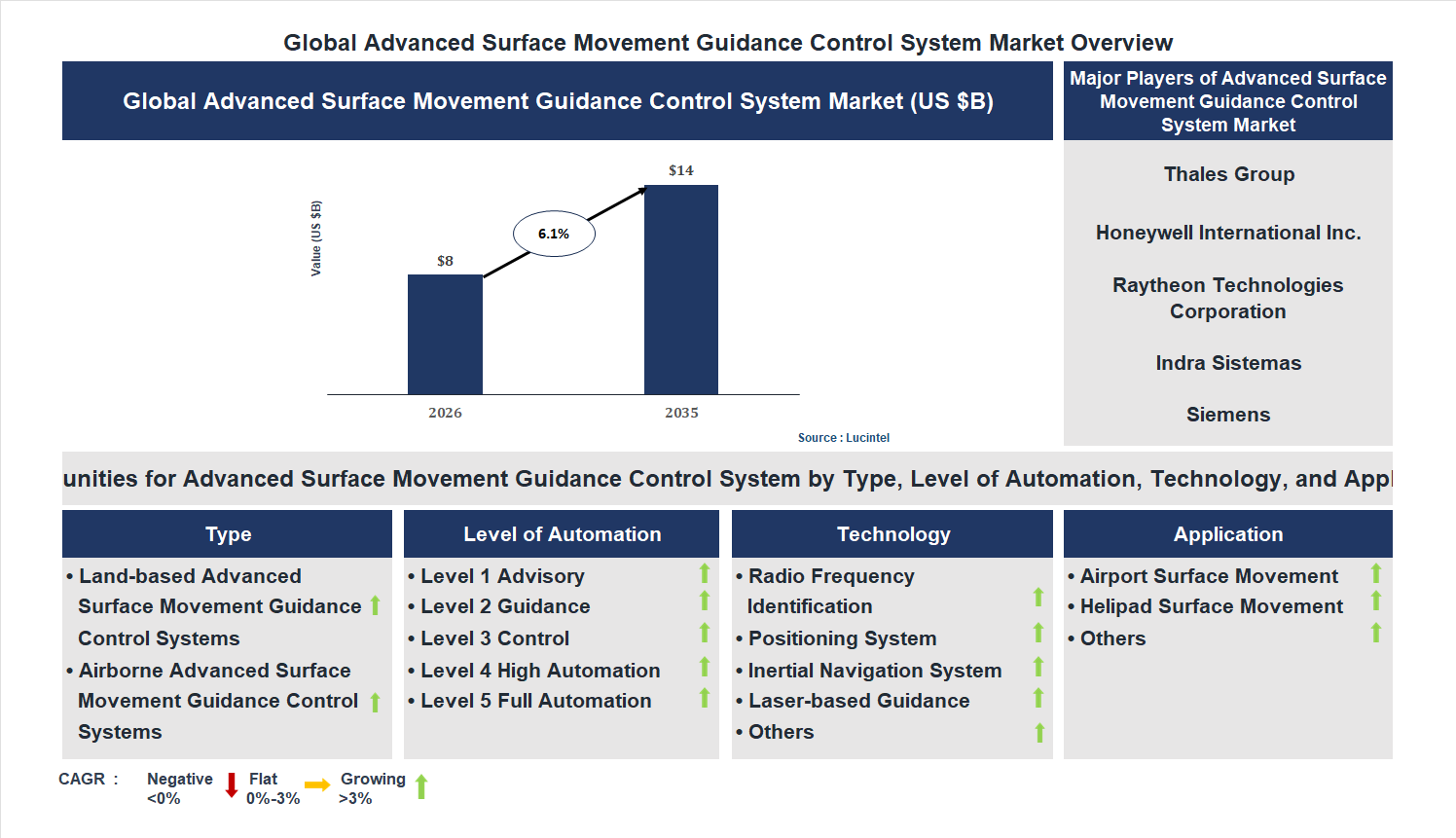
Key data points: The market size in 2035 = $14 billion, growth forecast = 6.1% annually for the next 8 years. Scroll below to get more insights. This market report covers trends, opportunities and forecasts in advanced surface movement guidance control system market to 2035 by type (land-based advanced surface movement guidance control systems and airborne advanced surface movement guidance control systems), level of automation (level 1 advisory, level 2 guidance, level 3 control, level 4 high automation, and level 5 full automation), technology (radio frequency identification, positioning system, inertial navigation system, laser-based guidance, and others), application (airport surface movement, helipad surface movement, and others), and region (North America, Europe, Asia Pacific, and the Rest of the World)
We'll send your sample report shortly.
• Lucintel forecasts that, within the type category, land-based advanced surface movement guidance control system is expected to witness higher growth over the forecast period.
• Within the application category, airport surface movement is expected to witness higher growth.
• In terms of region, APAC is expected to witness the highest growth over the forecast period. Gain valuable insights for your business decisions with our comprehensive 150+ page report. Sample figures with some insights are shown below.
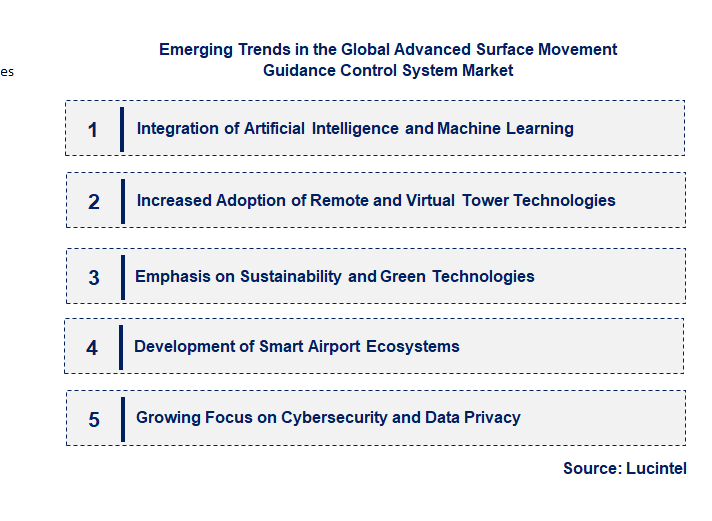
• Integration of Artificial Intelligence and Machine Learning: The adoption of AI and ML technologies is revolutionizing surface movement management by enabling predictive analytics, real-time decision-making, and automated control. These systems can analyze vast data sets to forecast traffic patterns, identify potential conflicts, and optimize routing, thereby reducing delays and enhancing safety. AI-driven solutions also facilitate adaptive responses to dynamic airport conditions, improving overall efficiency and safety standards.
• Increased Adoption of Remote and Virtual Tower Technologies: Remote tower operations are gaining popularity, allowing controllers to manage multiple airports from centralized locations using high-definition cameras and sensors. This trend reduces infrastructure costs, enhances operational flexibility, and improves situational awareness. Virtual towers enable better coordination, especially in congested or remote airports, leading to safer and more efficient surface movements.
• Emphasis on Sustainability and Green Technologies: Environmental concerns are prompting the integration of eco-friendly solutions within surface movement systems. This includes the deployment of electric and hybrid vehicles for ground support, energy-efficient lighting, and systems that minimize fuel consumption and emissions. These sustainable practices not only comply with regulations but also reduce operational costs and carbon footprints, aligning with global efforts to promote greener aviation.
• Development of Smart Airport Ecosystems: The market is witnessing a shift towards fully integrated smart airport ecosystems where surface movement guidance systems are interconnected with other airport operations such as baggage handling, security, and passenger services. This integration facilitates seamless data sharing, real-time monitoring, and coordinated decision-making, leading to improved operational efficiency, enhanced passenger experience, and better resource management.
• Growing Focus on Cybersecurity and Data Privacy: As surface movement systems become more digital and interconnected, the risk of cyber threats increases. Market players are investing heavily in cybersecurity measures to protect critical infrastructure from hacking, data breaches, and malicious attacks. Ensuring data privacy and system integrity is crucial for maintaining safety standards and operational reliability in increasingly digitalized airport environments. These emerging trends are fundamentally reshaping the advanced surface movement guidance control system market by fostering smarter, safer, and more sustainable airport operations. The integration of advanced technologies, emphasis on sustainability, and focus on cybersecurity are driving innovation and efficiency, positioning the market for continued growth and modernization in the coming years.
• Growing Adoption of Automation Technologies: The integration of automation in surface movement systems is revolutionizing airport operations. Automated guidance and control systems reduce human error, increase precision, and improve safety. Airports are investing heavily in these technologies to streamline aircraft movements, minimize delays, and optimize runway utilization. The shift towards automation also supports the development of smart airports, enhancing overall operational efficiency and passenger experience. This trend is expected to accelerate as technology becomes more affordable and reliable.
• Increasing Focus on Safety and Regulatory Compliance: Stringent safety regulations worldwide are driving the adoption of advanced surface movement systems. Governments and aviation authorities mandate the implementation of sophisticated guidance and control solutions to prevent accidents and ensure smooth ground operations. These systems help monitor aircraft movements in real-time, providing alerts for potential conflicts. Compliance with international standards like ICAOs guidelines boosts market growth, encouraging airports to upgrade their infrastructure. Enhanced safety measures also reduce liability and operational risks for airlines and ground handlers.
• Technological Innovations in Real-Time Data Analytics: The deployment of real-time data analytics is transforming surface movement management. Advanced sensors, AI, and machine learning enable predictive maintenance, congestion management, and efficient resource allocation. These innovations facilitate proactive decision-making, reducing turnaround times and fuel consumption. Airports leveraging data analytics can better anticipate operational bottlenecks, improve scheduling, and enhance safety protocols. The integration of IoT devices further enriches data collection, supporting smarter, more responsive ground operations, and fostering a competitive edge in the market.
• Expansion of Airport Infrastructure and Capacity: Growing air traffic demands are prompting airports to expand and modernize their infrastructure with advanced surface movement systems. New terminals, runways, and taxiways are being equipped with state-of-the-art guidance solutions to handle increased aircraft movements efficiently. Upgrading existing facilities with modern control systems reduces congestion and delays, improving overall capacity. This expansion supports regional connectivity and economic growth, attracting investments. The focus on infrastructure development aligns with global aviation expansion plans, creating substantial opportunities for system providers and integrators.
• Integration of Artificial Intelligence and Machine Learning: AI and machine learning are increasingly integrated into surface movement systems to enhance decision-making and operational efficiency. These technologies enable autonomous aircraft guidance, predictive analytics, and adaptive control strategies. AI-driven systems can detect anomalies, optimize routing, and improve safety protocols dynamically. The adoption of these innovations reduces operational costs and enhances safety margins. As AI technology matures, its integration into surface movement control systems is expected to become standard, significantly transforming airport ground operations and market dynamics. The overall impact of these developments is a more efficient, safer, and technologically advanced market. Airports are better equipped to handle increasing traffic, reduce operational costs, and improve passenger experiences. The market is poised for continued growth driven by innovation, regulatory support, and infrastructure expansion, shaping the future of airport surface management globally.
• Increasing Adoption of Automation in Airport Operations: The integration of automated surface guidance systems improves aircraft movement efficiency, reduces delays, and enhances safety. Airports worldwide are investing in advanced sensors, AI-driven control systems, and real-time data analytics to streamline ground operations. This trend is driven by rising air traffic, the need for cost-effective solutions, and the push for sustainable airport management. The deployment of automated systems across major hubs signifies a substantial growth opportunity in both mature and emerging markets.
• Growing Demand for Real-Time Data and Connectivity Solutions: The need for seamless communication between aircraft, ground vehicles, and control towers is propelling the development of connected surface movement systems. These solutions enable real-time tracking, predictive maintenance, and efficient resource allocation. The integration of IoT, 5G, and cloud computing enhances operational transparency and safety. As airports seek to optimize throughput and minimize risks, investments in advanced data connectivity solutions are expected to surge, creating lucrative opportunities for technology providers.
• Expansion of Smart Airport Infrastructure Projects: Governments and private stakeholders are investing heavily in smart airport initiatives to modernize infrastructure. These projects incorporate advanced surface movement guidance systems to improve aircraft turnaround times and reduce congestion. The deployment of intelligent signage, automated vehicle guidance, and integrated control centers are key components. The focus on sustainability and passenger experience further accelerates these investments, opening avenues for system vendors to deliver comprehensive, scalable solutions tailored to diverse airport sizes and complexities.
• Increasing Focus on Military and Defense Applications: The defense sector is adopting advanced surface movement systems for military airbases and strategic operations. These systems enhance security, operational readiness, and aircraft maneuverability in complex environments. The demand for rugged, secure, and autonomous guidance solutions is rising, driven by modernization programs and national security priorities. This segment offers significant growth potential through customized solutions, integration with defense communication networks, and expansion into remote or hostile terrains.
• Rising Investment in Cargo and Logistics Sector: The surge in e-commerce and global trade is boosting demand for efficient cargo handling and aircraft movement systems. Advanced surface guidance solutions facilitate faster turnaround times, reduce operational costs, and improve safety in busy cargo hubs. Innovations such as automated guided vehicles (AGVs) and integrated control systems are transforming logistics operations. As freight volumes grow, especially in emerging markets, the market for specialized guidance systems tailored to cargo operations is poised for substantial expansion. These growth opportunities collectively drive the evolution of the advanced surface movement guidance control system market, fostering innovation, safety, and efficiency across aviation sectors. The increasing adoption of automation, connectivity, and smart infrastructure will shape future market dynamics. Stakeholders investing in these areas can capitalize on expanding applications, technological advancements, and evolving regulatory landscapes, ensuring sustained growth and competitive advantage in the global aviation industry.
• Technological Innovation: The continuous development of automation, AI, and sensor technologies enhances system accuracy and efficiency. These innovations enable airports to optimize ground movements, reduce delays, and improve safety standards. As technology becomes more sophisticated and affordable, adoption rates increase globally, fostering market expansion. The integration of real-time data analytics and machine learning further refines operational capabilities, making systems more reliable and responsive. This technological evolution is crucial for meeting the growing demands of modern airports and ensuring seamless ground operations.
• Increasing Airport Traffic: The global rise in air travel has led to congested airports and increased ground handling requirements. To manage the surge efficiently, airports are adopting advanced guidance systems to streamline aircraft movements on runways and taxiways. This growth in air traffic necessitates scalable and reliable surface management solutions, directly fueling market demand. Additionally, expanding airport infrastructure in emerging markets presents new opportunities for deploying these systems, supporting overall industry growth and modernization efforts.
• Regulatory and Safety Standards: Stringent safety regulations and environmental policies compel airports to implement advanced surface management systems. These systems help in minimizing ground accidents, reducing emissions, and ensuring compliance with international standards. Governments and aviation authorities are increasingly mandating the adoption of such technologies to enhance safety and operational efficiency. This regulatory push acts as a catalyst for market growth, encouraging airports worldwide to upgrade their surface movement control systems to meet compliance requirements and improve overall safety.
• Cost Efficiency and Operational Optimization: Airlines and airports are under constant pressure to reduce operational costs while maintaining high safety standards. Advanced surface guidance systems contribute to this by decreasing turnaround times, optimizing taxi routes, and reducing fuel consumption. These efficiencies translate into significant cost savings and improved service quality. As economic pressures mount, stakeholders are more inclined to invest in technologies that offer long-term financial benefits, thereby driving market growth and encouraging widespread adoption across various regions. The challenges facing the advanced surface movement guidance control system market include:
• High Implementation and Maintenance Costs: Deploying advanced surface movement guidance systems requires substantial capital investment in infrastructure, equipment, and training. Ongoing maintenance and upgrades further add to operational expenses, which can be prohibitive for smaller airports or those with limited budgets. These costs can delay or deter adoption, especially in emerging markets where financial constraints are more pronounced. Balancing the benefits of improved safety and efficiency against the high costs remains a key challenge for market growth.
• Technological Integration and Compatibility Issues: Integrating new guidance systems with existing airport infrastructure and legacy systems can be complex and time-consuming. Compatibility issues may lead to operational disruptions, increased downtime, and additional costs. Ensuring seamless interoperability between different technologies and vendors is critical but challenging, requiring extensive planning and technical expertise. Overcoming these integration hurdles is essential for smooth deployment and maximizing system benefits.
• Regulatory and Compliance Barriers: While regulations promote safety and environmental standards, they can also pose hurdles due to varying international requirements and lengthy approval processes. Navigating complex regulatory landscapes can delay project implementation and increase costs. Additionally, frequent updates to standards necessitate continuous system modifications, complicating compliance efforts. These regulatory challenges can slow down market growth and limit rapid adoption, especially in regions with stringent or evolving standards. The advanced surface movement guidance control system market is driven by technological advancements, increasing air traffic, regulatory mandates, and operational efficiencies. However, high costs, integration complexities, and regulatory barriers pose significant challenges. These factors collectively influence the pace and scope of market growth, requiring stakeholders to strategically address obstacles while leveraging technological and regulatory opportunities. Overall, the markets evolution hinges on balancing innovation with practical implementation considerations to achieve safer, more efficient airport operations worldwide.
• Thales Group
• Honeywell International Inc.
• Raytheon Technologies Corporation
• Indra Sistemas
• Siemens
• Northrop Grumman Corporation
• Boeing Company
• Land-based Advanced Surface Movement Guidance Control Systems
• Airborne Advanced Surface Movement Guidance Control Systems
• Level 1 Advisory
• Level 2 Guidance
• Level 3 Control
• Level 4 High Automation
• Level 5 Full Automation
• Radio Frequency Identification
• Positioning System
• Inertial Navigation System
• Laser-based Guidance
• Others
• Airport Surface Movement
• Helipad Surface Movement
• Others
• North America
• Europe
• Asia Pacific
• The Rest of the World
• United States: The U.S. market is witnessing significant investments in upgrading existing A-SMGCS infrastructure, driven by major airports seeking to improve safety and operational efficiency. Adoption of AI-powered systems and real-time data analytics is increasing, with a focus on automation and integration with other air traffic management systems. The Federal Aviation Administration (FAA) is actively promoting modernization initiatives, leading to widespread deployment of advanced guidance systems at key hubs. Additionally, collaborations between government agencies and private firms are fostering innovation, resulting in more sophisticated, scalable solutions tailored to large, busy airports.
• China: China is rapidly expanding its A-SMGCS capabilities to support its booming air travel industry. The government is heavily investing in airport infrastructure, with a focus on automation and intelligent surface management. Recent developments include deploying sensor-rich systems and AI-driven control solutions at major airports like Beijing and Shanghai. These advancements aim to reduce congestion, enhance safety, and streamline operations amid increasing passenger volumes. China’s emphasis on smart airport initiatives aligns with its broader goals of becoming a global aviation hub, encouraging domestic and international investments in advanced surface movement systems.
• Germany: Germany’s market is characterized by a focus on integrating A-SMGCS with existing European air traffic management frameworks. The country is adopting cutting-edge sensor technology and automation tools to improve surface movement safety and efficiency at major airports such as Frankfurt and Munich. Germany emphasizes sustainability and energy efficiency in its upgrades, incorporating eco-friendly solutions into new systems. Collaborative efforts within the European Union are fostering cross-border interoperability, ensuring seamless surface management across borders. The country’s investments aim to enhance operational reliability and safety standards while supporting the EU’s broader air traffic modernization goals.
• India: India is experiencing rapid growth in its aviation sector, prompting significant investments in advanced surface movement systems. The government and private sector are deploying modern A-SMGCS solutions to manage increasing air traffic at major airports like Delhi and Mumbai. Recent developments include implementing sensor-based guidance, automation, and real-time monitoring to reduce delays and improve safety. India’s focus on modernization aligns with its broader vision of becoming a major global aviation hub. The adoption of innovative technologies is also aimed at supporting regional connectivity and boosting economic growth through improved airport efficiency and safety standards.
• Japan: Japan is advancing its A-SMGCS infrastructure to enhance safety and operational efficiency at its key airports, including Tokyo Haneda and Narita. The country is integrating AI, sensor technology, and automation to optimize surface movement management amid rising passenger numbers. Japan emphasizes reliability and precision, with recent upgrades focusing on reducing delays and preventing accidents. The government collaborates with international partners to adopt best practices and ensure interoperability within the Asia-Pacific region. Japan’s investments reflect its commitment to maintaining high safety standards and leveraging technological innovation to support its evolving aviation industry.


• Thales Group
• Honeywell International Inc.
• Raytheon Technologies Corporation
• Indra Sistemas
• Siemens
• Northrop Grumman Corporation
• Boeing Company Q6. Which advanced surface movement guidance control system market segment will be the largest in future? Answer: Lucintel forecasts that, within the type category, land-based advanced surface movement guidance control system is expected to witness higher growth over the forecast period. Q7. In advanced surface movement guidance control system market, which region is expected to be the largest in next 8 years? Answer: In terms of region, APAC is expected to witness the highest growth over the forecast period. Q8. Do we receive customization in this report? Answer: Yes, Lucintel provides 10% customization without any additional cost.


Choose a license that fits your team. Instant PDF delivery.
Prices exclude taxes. Instant delivery. Custom licensing available on request.
Market Report · July 31, 2026
Market Report · July 31, 2026
Market Report · July 31, 2026
Trusted partner for strategic intelligence and business growth


Receive a complimentary market analysis tailored to your industry. Our analysts will identify key growth opportunities and competitive dynamics specific to your business.

Market size, growth rate, and key trend analysis for your specific sector.

Top competitor positioning and market share analysis.

Strategic recommendations backed by data-driven insights.
Get curated market intelligence and competitive moves straight to your inbox.
By subscribing, you agree to receive our monthly insights. Unsubscribe anytime.
Receive a complimentary market analysis tailored to your industry. Our analysts will identify key growth opportunities and competitive dynamics specific to your business.
Market size, growth rate, and key trend analysis for your specific sector.
Top competitor positioning and market share analysis.
Strategic recommendations backed by data-driven insights.
Get curated market intelligence, emerging trends, and competitive moves straight to your inbox each month.
By subscribing, you agree to receive our monthly insights. Unsubscribe anytime.
We'll send your sample report shortly.