
Market Report · July 29, 2026

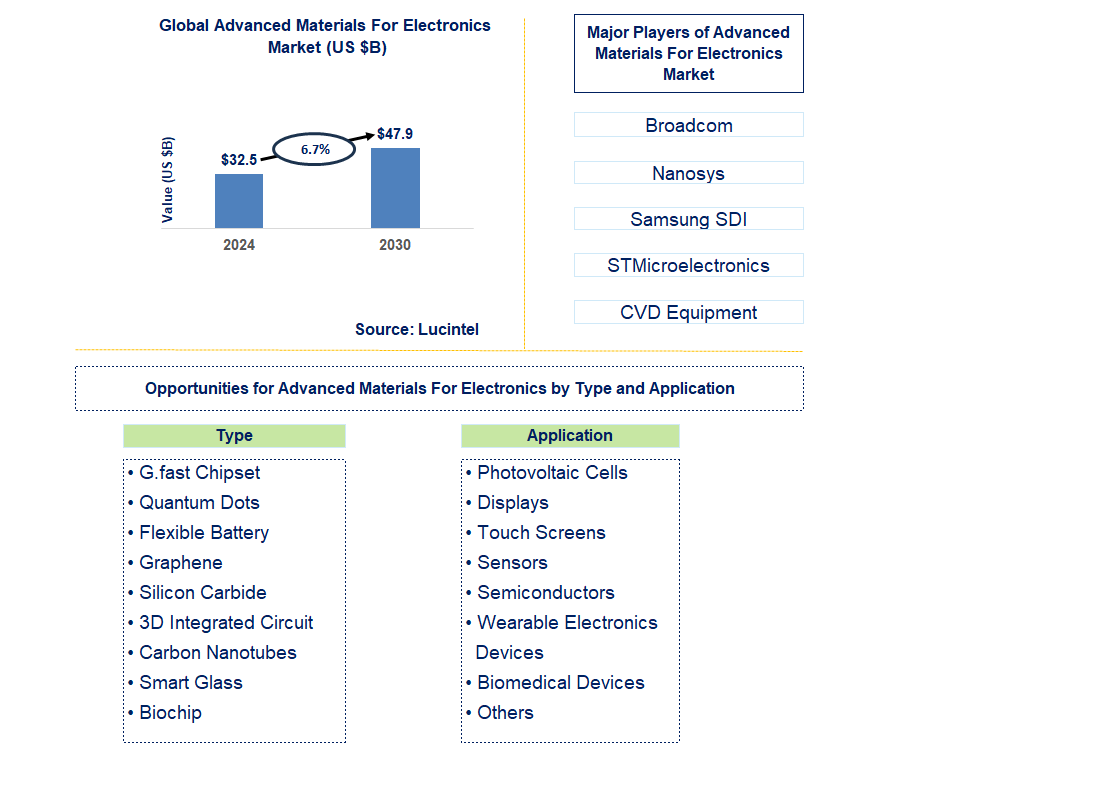
Key data points: The market size in 2030 = $47.9 billion, growth forecast = 6.7% annually next 6 years. Scroll below to get more insights. This market report covers trends, opportunities, and forecast in the global advanced materials for electronics market to 2030 by type (G.fast chipset, quantum dots, flexible battery, graphene, silicon carbide, 3D integrated circuit, carbon nanotubes, smart glass, and biochip), application (photovoltaic cells, displays, touch screens, sensors, semiconductors, wearable electronics devices, biomedical devices, and others), and region (North America, Europe, Asia Pacific, and the Rest of the World)
We'll send your sample report shortly.
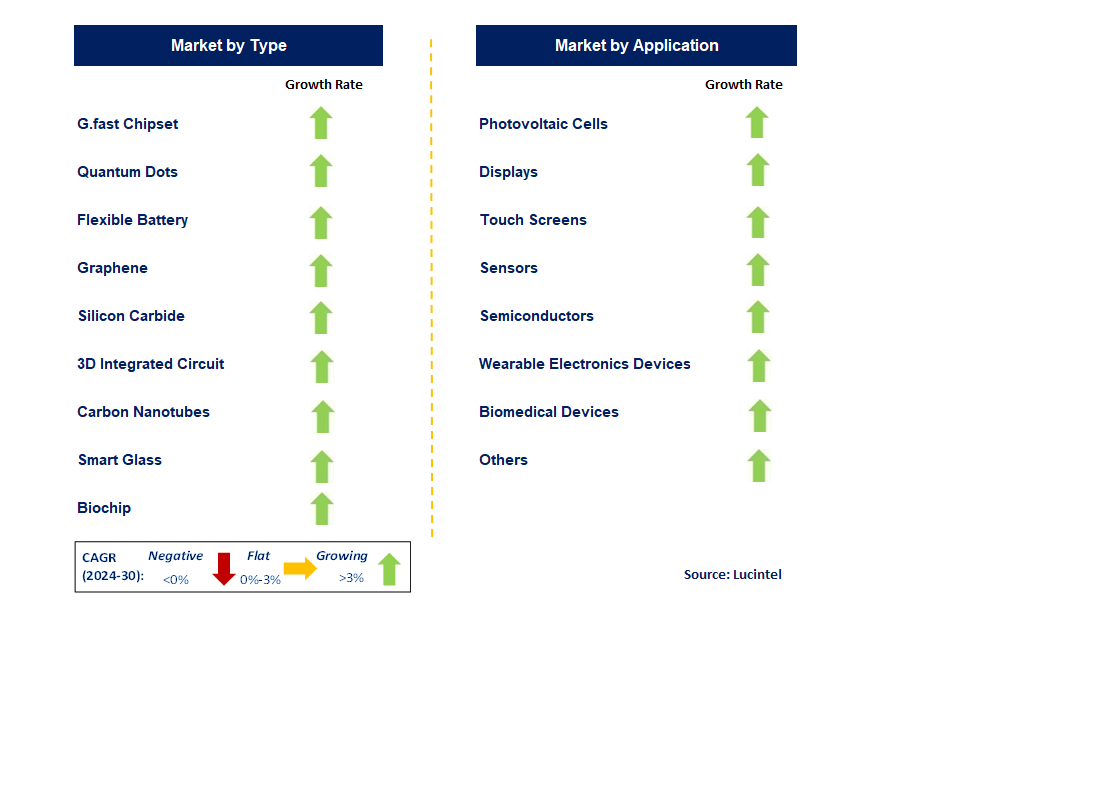
• Lucintel forecasts that silicon carbide is expected to witness highest growth over the forecast period because it provides higher efficiency, smaller form factors with lower gaps, and the semiconductor material exhibits superior properties that enables the functioning of power devices at high voltages.
• Europe will remain the largest region over the forecast period because of growing demand in electronic devices in various sectors, as well as, existence of major electronic markets such as, Germany, Italy, and France in the Region. A more than 150-page report is developed to help in your business decisions.
• United States: Recent development in the U.S., for advanced electronic material, includes steep investments in semiconductor research and development with a particular emphasis on 2D materials and quantum dot technologies. The government of the United States supported initiatives aimed at reducing dependence on foreign suppliers by enhancing domestic production capacity. Companies are developing integrated advanced materials, including graphene and silicon-carbide for efficiency and performance improvements in chips. There is also more emphasis on sustainable materials and processes for achieving larger ecological goals.
• China: The Chinese are rapidly advancing the state of the art in advanced electronic material enabled by its policy known as "Made in China 2025". The country has invested heavily in developing new semiconductor materials and technologies as part of the effort towards self-sufficiency in cutting-edge industries. To this end, specifically, high-performance ceramics and flexible electronics material development has occurred. In addition, China is ramping up its manufacturing facilities to produce such state-of-the-art materials as gallium nitride (GaN) and indium gallium zinc oxide (IGZO) in order to meet the major demands of its exponentially expanding domestic market for electronic equipment.
• Germany: This is coupled with the fact that, in the course of developing advanced materials for electronics, Germany has been advancing through emphasis on research and innovation. German institutions and companies lead regarding the development of high-efficiency photovoltaic materials and also advanced insulating materials for electronic devices. Notable progress includes breakthroughs in organic electronics and applications of nanotechnology to improve performance and miniaturization of electronic components. There is also remarkable focus by Germany in integrating advanced materials into automotive electronics and industrial automation.
• India: India is gradually gaining momentum within the advanced material for electronics market due to the resurgence of its electronic manufacturing sector. It has recently involved various works on materials for cheap sensors and energy-efficient electronic parts. The country is investing in research for alternative materials catering to cost-effective and scalable production methods. India will continue to contribute increasingly to the global electronics market as efforts are being made to create a good semiconductor ecosystem and to improve material science education. In the coming years, India's contribution to the global electronics market will be fast-growing.
• Japan: Still, with recent developments in material science and manufacturing technology, Japan is one of the most important countries for the advanced materials for electronics market. The latest highly efficient ceramics and display materials include OLEDs and microLEDs. Japanese companies are also at the forefront in developing new semiconductor materials and technologies, which involve developments on 3D NAND flash memory and high-k dielectrics. Continued research investment by Japan, coupled with cooperation with global partners, is promoting its rise within the frontier areas of electronics materials.
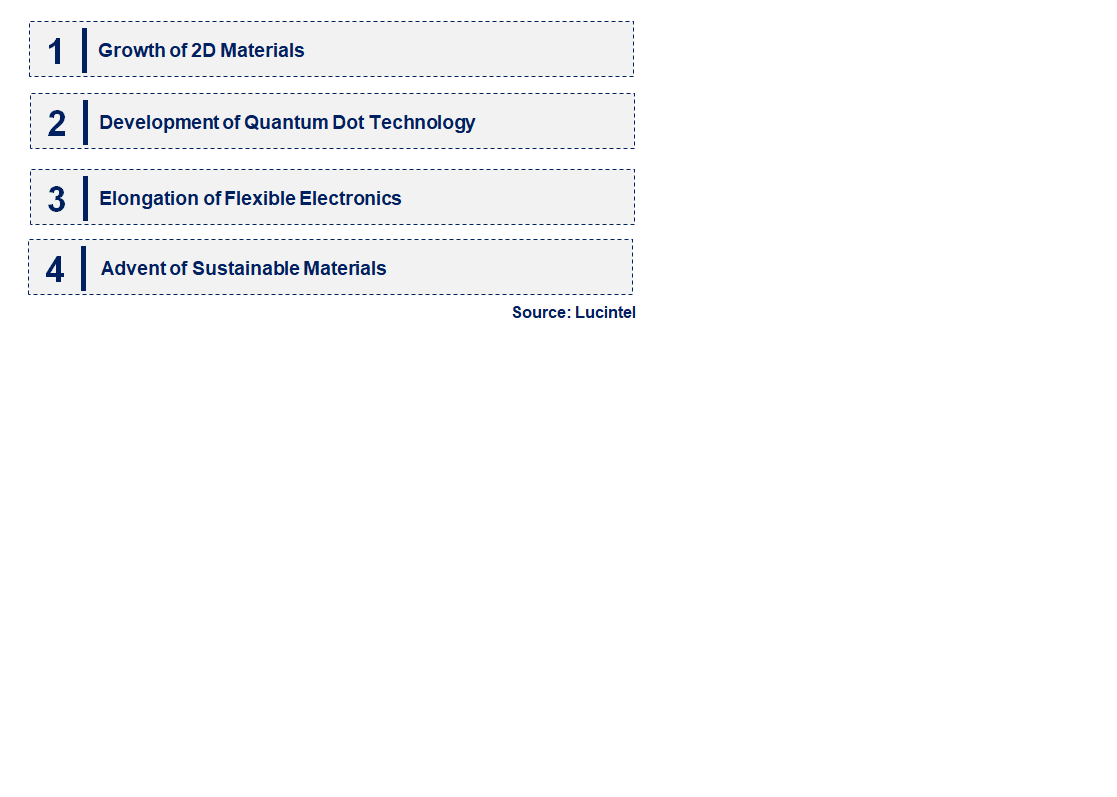
• Growth of 2D Materials: At the heart of an electronics revolution are 2D materials, including graphene and TMDs. These materials outperform their predecessors in electrical, thermal, and mechanical performance. Envisioned applications range from high-speed transistors and flexible electronics to sophisticated sensors. The most recent focus on the 2D material class targets an agenda for device miniaturization and performance by meeting the growing demand for innovation of electronic components.
• Development of Quantum Dot Technology: Quantum dot technology, from display to biomedical imaging, is fast developing. These nanoscale semiconductor particles have exclusive optical characteristics, including tunable emission spectra and high brightness, assisting in achieving higher performances and efficiencies in displays. Ongoing research on quantum dot synthesis and integration techniques propels the advance into high-resolution displays, lighting solutions, and optical sensors.
• Elongation of Flexible Electronics: Organic semiconductor-based flexible electronics, along with substrates, are finding more and more applications in various fields, wearable devices, and displays. Using such materials, one can fabricate light, bendable, and, sometimes, even stretchable components of electronics. This development is stimulated by the potential of flexible electronics to transform consumer electronics, medical devices, and smart textiles by enabling functionality and improving user experience.
• Advent of Sustainable Materials: Sustainability now is one prime focus in the advances related to materials for electronics. In such a context, ecological materials along with methods are being considered by researchers to reduce environmental impact in electronic manufacturing. Various developments involve biodegradable electronics, recyclable materials, and energy-efficient techniques for manufacturing. Thus, the use of sustainable materials reflects an industrial commitment to respond to environmental concerns and also to global sustainability objectives. These emerging trends are a realignment factor in the Advanced Materials for Electronics market for innovation and pushing the boundaries of new electronic devices. Increased emphasis on 2D materials, quantum dots, flexible electronics, sustainability, and integration with AI establishes how much effort the industry is putting into enhancing performance, ensuring sustainability, and overall functional improvement of electronics.
• Development of High-Performance Semiconductors: Recent development in semiconductor materials such as SiC and GaN has increased performance and efficiency in electronic devices. These materials allow for superior electrical characteristics to those of traditional silicon, enabling them to switch faster and support higher power densities. All these reasons also extend their adoption in the area of power electronics and high-frequency devices that have even more been made possible by efficient energy management, hence overall performance enhancement in most of the electronic systems.
• Organic Electronics Innovation: Organic electronics represent one of the fastest-developing areas, supported by the latest advances with OLEDs and OPVs. Certain latest advances are related to material formulation and fabrication techniques that improve the performance and lifetime of organic electronic devices. These advances will drive the growth in flexible displays, wearable electronics, and low-power lighting solutions, thereby expanding the scope for organic electronics.
• Photonic Materials: Photonic materials are developing with the coming of material that manipulates light in new ways, metamaterials, and photonic crystals. These are helping in the development of devices that help in the enhancement about optical properties: improving sensing and high-resolution imaging. Innovations in photonic materials are driving developments in telecommunications, imaging systems, and optical data storage technologies.
• Breakthroughs in Energy Storage Materials: Recent breakthroughs in energy storage material development include advanced lithium-ion batteries and solid-state batteries, greatly improving performance and safety for energy storage systems. This includes new electrode material and electrolyte development to further increase the capacity, charge rate, and life of a battery. These component developments are crucial to continuing to meet the growing demand for more energy-efficient electronic devices and electric vehicles.
• Advances in Nanoelectronics: Nanoelectronics will continue to forge ahead with the research and development of nanoscale materials and devices that really extend the conventional limits of electronics. The main development areas are nanoscale transistors, memory devices, and sensors with better performance and miniaturization. Nanotechnology in the area of electronics allows for the manufacture of electronic parts smaller, quicker, and more effective. These latest developments are driving innovation in the Advanced Materials for Electronics market, thereby improving the performance, efficiency, and applications radically. The directed focus on high-performance semiconductors, organic electronics, photonic materials, energy storage, and nanoelectronics is now rewiring this industry and paving the route to the future.
• Wearable Electronics: Wearable electronics give an enormous opportunity to advanced materials. Innovations in flexible and lightweight materials make it possible to build smartwatches, fitness trackers, and health-monitoring devices. Correspondingly, the emphasis on material durability, comfort, and performance stirs developments in this sector, from healthcare and sport to personal entertainment.
• Flexible Displays: The demand for flexible displays opens new opportunities for advanced materials such as organic semiconductors and flexible substrates. These new materials allow the manufacturing of bendable, foldable, and rollable displays for smartphones, tablets, and TVs. It is expected that emerging display technologies will continue to enable new consumer electronics device categories and offer users new experiences enabled by innovative form factors.
• Electric Vehicles (EVs): The adoption of EVs is creating demand for advanced materials in batteries, power electronics, and lightweight components. To improve the performance and range of EVs further, additional development of high-energy-density batteries and efficient thermal management materials is paramount. The emphasis on materials for extending battery life and minimizing vehicle weight opens great avenues of growth in the automotive segment.
• Energy Harvesting: Energy harvesting technologies create the necessity for new advanced materials to convert light, heat, and vibration into useful energy. Innovation in materials used in energy-harvesting devices, such as piezoelectric materials and thermoelectric generators, has enabled self-powered electronics and lessened the burden on conventional power sources. This segment is also seeing uptakes because of increasing demand from sustainable and autonomous systems for energy solutions.
• Advanced Computing: New materials with unique electronic properties are developed, considering advanced computing technologies such as quantum computing and neuromorphic computing. Development of superconducting materials and topological insulators will be crucial toward creating the next generation of computing systems with high processing power and greater efficiency than ever. Given the growth in this area, there is immense opportunity for innovation and technological leadership. These emerging opportunities and strategic growth opportunities underline the impact of advanced materials on new technology development in various applications within the electronics market. Indeed, wearables, flexible displays, electric vehicles, energy harvesting, and advanced computing are among those areas which are instrumental to material innovations driving future growth and technologies.
• Broadcom
• Nanosys
• Samsung SDI
• STMicroelectronics
• CVD Equipment Corporation
• Renesas Electronics Corporation
• Toshiba Materials
• Taiwan Semiconductor Manufacturing Company Limited
• Universal Display
• BASF SE
• G.fast Chipset
• Quantum Dots
• Flexible Battery
• Graphene
• Silicon Carbide
• 3D Integrated Circuit
• Carbon Nanotubes
• Smart Glass
• Biochip
• Photovoltaic Cells
• Displays
• Touch Screens
• Sensors
• Semiconductors
• Wearable Electronics Devices
• Biomedical Devices
• Others
• North America
• Europe
• Asia Pacific
• The Rest of the World
• Lucintel forecasts that silicon carbide is expected to witness highest growth over the forecast period because it provides higher efficiency, smaller form factors with lower gaps, and the semiconductor material exhibits superior properties that enables the functioning of power devices at high voltages.
• Europe will remain the largest region over the forecast period because of growing demand in electronic devices in various sectors, as well as, existence of major electronic markets such as, Germany, Italy, and France in the Region.


• Broadcom
• Nanosys
• Samsung SDI
• STMicroelectronics
• CVD Equipment Corporation
• Renesas Electronics Corporation
• Toshiba Materials
• Taiwan Semiconductor Manufacturing Company Limited
• Universal Display
• BASF SE Q6. Which advanced materials for electronics market segment will be the largest in future? Answer: Lucintel forecasts that silicon carbide is expected to witness highest growth over the forecast period because it provides higher efficiency, smaller form factors with lower gaps, and the semiconductor material exhibits superior properties that enables the functioning of power devices at high voltages. Q7. In advanced materials for electronics market, which region is expected to be the largest in next 5 years? Answer: Europe will remain the largest region over the forecast period because of growing demand in electronic devices in various sectors, as well as, existence of major electronic markets such as, Germany, Italy, and France in the Region. Q.8 Do we receive customization in this report? Answer: Yes, Lucintel provides 10% customization without any additional cost.


Choose a license that fits your team. Instant PDF delivery.
Prices exclude taxes. Instant delivery. Custom licensing available on request.
Market Report · July 29, 2026
Market Report · July 20, 2026
Market Report · July 20, 2026
Trusted partner for strategic intelligence and business growth


Receive a complimentary market analysis tailored to your industry. Our analysts will identify key growth opportunities and competitive dynamics specific to your business.

Market size, growth rate, and key trend analysis for your specific sector.

Top competitor positioning and market share analysis.

Strategic recommendations backed by data-driven insights.
Get curated market intelligence and competitive moves straight to your inbox.
By subscribing, you agree to receive our monthly insights. Unsubscribe anytime.
Receive a complimentary market analysis tailored to your industry. Our analysts will identify key growth opportunities and competitive dynamics specific to your business.
Market size, growth rate, and key trend analysis for your specific sector.
Top competitor positioning and market share analysis.
Strategic recommendations backed by data-driven insights.
Get curated market intelligence, emerging trends, and competitive moves straight to your inbox each month.
By subscribing, you agree to receive our monthly insights. Unsubscribe anytime.
We'll send your sample report shortly.