
Market Report · May 18, 2026

This market report covers trends, opportunities, and forecasts in the global ad converter integrated circuit market to 2031 by technology (delta-sigma modulation, successive approximation register (sar), flash adc, pipelined adc, and others ), application (consumer electronics, communications, automotive, and industrials), and region (North America, Europe, Asia Pacific, and the Rest of the World)
We'll send your sample report shortly.
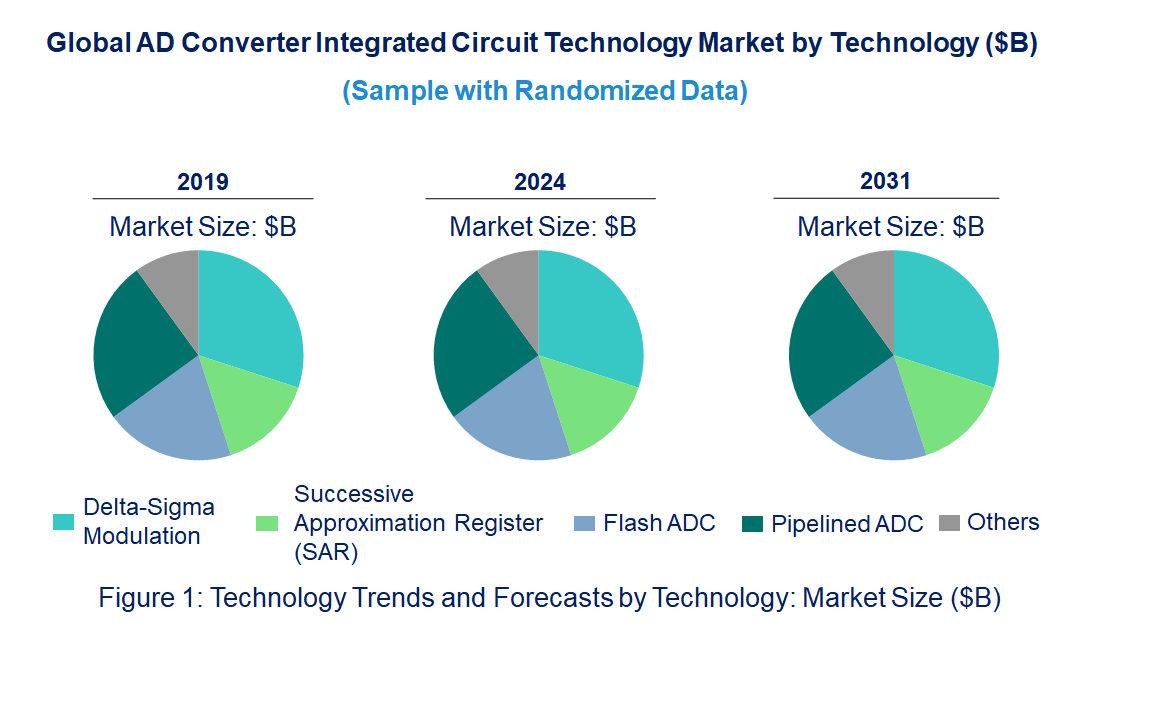
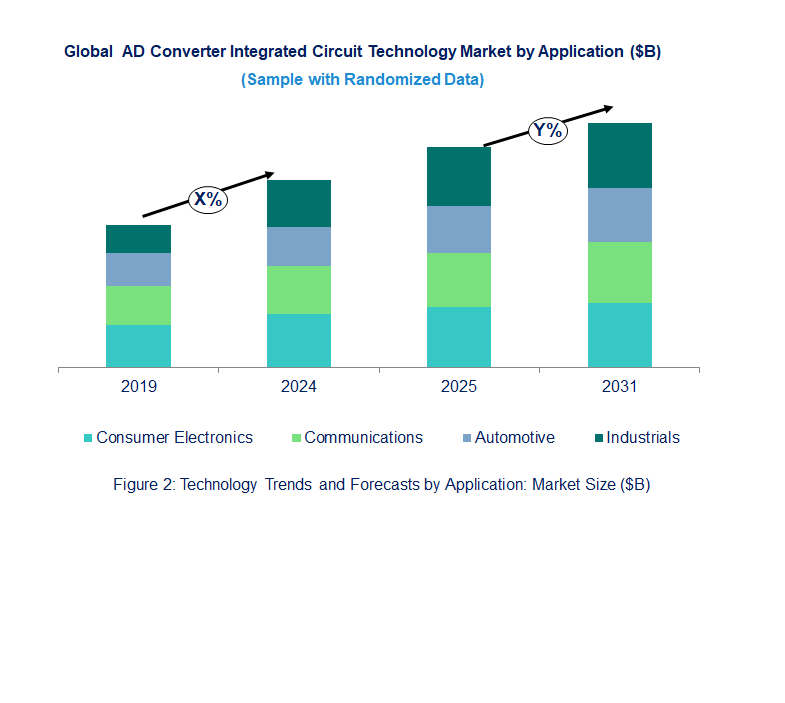
• High-Resolution ADC for Specific Applications: The resolution of today’s ADCs is increasing due to the growing need for converters across industries. This need is particularly pronounced in medical imaging, industrial automation, and high-end stereo systems. High-resolution ADCs capture finer details, promoting performance enhancement in accuracy-critical applications.
• Low Power and Energy Efficiency: The demand for low-wattage ADCs is rising as portable and battery-operated devices become more common worldwide. Consumer electronics, IoT devices, and wearables use low-power ADCs without compromising on standards. Consequently, new energy-conserving ADC architectures have been developed that are effective in both power and signal speed requirements.
• SoC ADC Integration: There is marked growth in integrating ADCs in System on Chips (SoCs), offering a functional solution at an affordable price at the expense of space. The single-chip SoC approach integrates different functional blocks, making various electronic components ADC-compatible, thereby reducing space and cost while improving efficiency. This trend is particularly prominent in mobile and automotive devices.
• Higher Sampling Rates at Affordable Costs: With the emergence of real-time applications in areas such as communications, radar systems, and real-time signal processing, there is a growing need for higher ADC sampling rates. Success in fields like 5G communication, autonomous driving, and high-speed data acquisition systems is only achievable with fast-functioning, high-frequency signal processing.
• Multi-Channel Analog-to-Digital Converters: As multi-input ADCs expand, the number of channels will increase, improving ADC efficiency to meet the requirements of multi-input systems. This is particularly useful in multi-sensor systems or audio recording and is often shipped in a single chip, enabling better system integration and lowering costs. The emerging trends in the ADC integrated circuit market indicate a shift toward more precise, efficient, decentralized, and real-time capable technologies. Industries today are striving to become more advanced and efficient, thus, ADCs must remain optimized to meet these demands. One thing is clear – the ADC market is set to be transformed by higher resolution, lower power consumption, SoC integration, faster sampling rates, and multichannel capabilities. These enhanced features will facilitate the development of more sophisticated, high-performance applications across various industries.
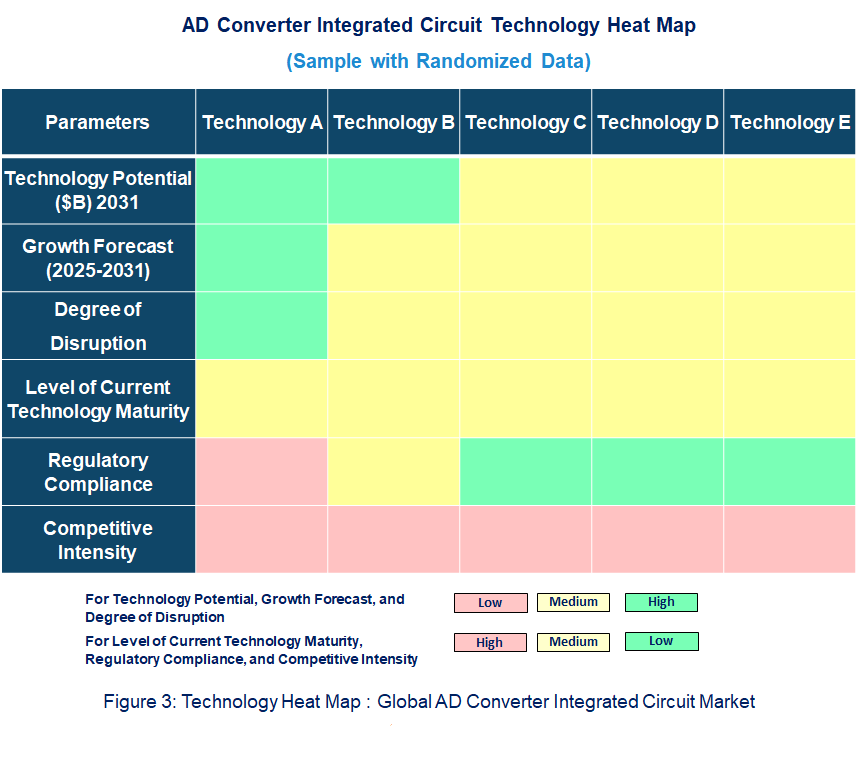
• Potential in Technology: There is significant technological potential in this field, particularly with the increasing applications of signal processing, instrumentation, and sensor interfacing, which require ADCs. They enable miniaturization, lower power consumption, and better performance, such as in sigma-delta, successive approximation, and pipeline ADC architectures.
• Degree of Disruption: The disruption brought by ADC ICs is substantial, given their critical role in products like 5G, IoT, autonomous vehicles, and medical devices. These products require high-efficiency data conversion with high accuracy, so there will be a need for the latest ADC technologies. New applications, especially in high-speed communication and data acquisition, make ADC IC technology even more critical.
• Current Technology Maturity Level: Regarding technology advancement, ADC ICs are mature, but there continue to be improvements in speed, resolution, and integration. The reliability of these technologies is high, with several trusted architecture vendors providing solutions. However, ongoing R&D is essential to overcome limitations such as power consumption, linearity, and noise reduction.
• Regulatory Compliance: In sectors like healthcare and automotive, where accuracy and safety are paramount, regulatory compliance is a critical factor. For ADC ICs to be used in these applications, various standards, such as ISO and IEC, must be met.
• The AD4000 integrates high-speed and precision converters into smaller, more power-efficient designs, improving various systems. These improvements in signal integrity, system performance, and data acquisition are crucial for industrial and defense applications, aiding in instrumentation, automotive applications, and communication systems.
• Texas Instruments leads the ADC market by continuously improving its product range with ultra-low power, high-performance products. These are commonly used in industrial automation or medical instrumentation. The company launched the ADS126x series, featuring high-resolution, low-noise, ultra-low power ADCs that are highly accurate. This is expected to align with the expansion of TI’s rechargeable battery-powered portable systems.
• Microchip Technology has added new products to its existing range of low-power, high-precision ADCs. The MCP320x and MCP33x families are good examples. Microchip plans to integrate these ADCs into motor vehicles, home electronics, and industrial devices, focusing on size, cost, and energy efficiency. Additionally, Microchip combines programmable inputs with differential amplifiers to reduce component count and system complexity.
• According to Renesas Electronics, ADC development is focused on automotive and industrial applications requiring high reliability and robust performance. Renesas’ range of 12, 16, and 18-bit ADCs is ideal for real-time control and monitoring operations, which demand high-speed conversion with low latency. These ADCs are particularly useful in automotive systems such as ADAS and in industrial automation, where accurate data and real-time processing for speed and safety are crucial.
• STMicroelectronics has proposed improvements in integrating ADCs with microcontrollers and other on-chip peripherals, increasing system integration and minimizing device size. Their STM32 series of MCUs, which integrate high-performance ADCs, are already used in consumer electronics, robotics, and IoT devices, where fast data and low latency are essential. With high-performance ADCs and highly integrated system solutions, STMicroelectronics is addressing the complexity of design for manufacturers while optimizing system performance. The ADC circuit market is currently experiencing growth as major players like Microchip and Renesas Electronics introduce technological advancements to meet the growing demand in various industries. With a focus on improving power efficiency, speed, resolution, and system integration, these advancements form the backbone of the future of automotive, industrial, and consumer electronics data acquisition and processing. The future of technology-based solutions looks promising as they are set to unlock new possibilities and sophistication, allowing the existing ADC market in the electronics world to expand further with a variety of options and solutions.
• Rising Need for High-Resolution and High-Speed ADCs: The demand for digitization is increasing across various applications, from ADAS to telecom equipment, with a steady rise in the need for high-resolution and high-speed ADCs (16-bit to 24-bit and high GHz). Improvements in data acquisition techniques lead to better system performance and the creation of smarter systems.
• Expansion of IoT: The surge in IoT devices will significantly increase the demand for AC-DC converters, as they are used in sensors measuring temperature, humidity, motion, and other factors. This is critical because for IoT to grow in industries like smart homes and medical IoT, it needs ADCs to convert signals from analog sensors into digital signals understood by microcontrollers.
• Increased Need for Energy Efficiency: The demand for portable and battery-operated devices has surged, increasing the need for energy-efficient, low-power ADCs. Extending battery life for mobile devices, wearables, and other portable devices is critical, making low-power ADCs vital for growth in these areas.
• Emerging Trends in the Automotive Sector: In autonomous vehicles, battery-powered cars, and ADAS technology, ADCs are essential as analog circuits are replaced with more complex digital systems. A high-performance ADC is crucial in these systems to ensure operational safety and reliability through real-time data processing.
• Interconnection of ADCs with Other Components: Another key factor driving market growth is the increasing demand for embedding ADCs with microcontrollers and FPGAs. Such integration saves space, improves efficiency, simplifies the design process, and benefits sectors like consumer electronics, robotics, and automation. Challenges:
• Design Challenges: With the rise of stricter standards, the complexity of designing ICs has increased. Designers struggle to achieve speed and resolution targets without compromising on power requirements, while ensuring hardware fits within budget and time constraints.
• Cost Pressures: Ultra-high speeds and increased resolution demand significant investment. In low-margin environments, this translates into limited market penetration, especially in cost-sensitive sectors like automotive and consumer electronics, where balancing cost and performance is crucial.
• Thermal Challenges: High-speed ADC chips face demanding thermal conditions. As performance requirements increase, so does the heat generated, which affects ADC performance, especially in modern, high-density designs.
• Competing Technologies: Components like field-programmable gate arrays (FPGAs) and digital signal processors (DSPs) are emerging as alternatives to ADCs. While these technologies offer more options, they often come with high power consumption and complexity, making them less convenient for many applications.
• Supply Chain and Manufacturing Limitations: Semiconductor supply chains faced delays in manufacturing and chip shortages, which impacted the pricing and availability of ADCs. This was especially problematic for advanced ADCs required for high-end applications. Various factors are driving the ADC Integrated Circuit market, such as the growing need for multi-function signal converters, the Internet of Things (IoT), low-power requirements, the automotive industry, and enhanced interfacing with other components. However, the industry faces challenges like competition from other technologies, thermal issues, and cost. Despite these obstacles, ADC technology continues to create new opportunities and shape the market. Innovations are leading to better, more efficient systems globally, with industries improving their capabilities. If businesses can leverage emerging trends while addressing these challenges, they will define the growth trajectory of the ADC IC market over the next decade.
• Analog Devices
• Texas Instruments
• Microchip
• Renesas Electronics
• STMicroelectronics
• Technology Readiness by Technology Type: Delta-Sigma ADCs are mature and dominate high-resolution applications like audio and sensor interfaces. SAR ADCs are highly ready and used in wearables, industrial control, and power-sensitive devices. Flash ADCs, though power-hungry, are ready for ultra-high-speed applications like oscilloscopes and radar. Pipelined ADCs are commercially robust, serving communications and medical imaging. Emerging architectures, like time-interleaved and hybrid ADCs, are gaining readiness with tailored applications in 5G, autonomous vehicles, and AI systems. Each technology competes on performance, energy efficiency, and regulatory adaptability.
• Competitive Intensity and Regulatory Compliance: The ADC IC market faces high competitive intensity, with players innovating across resolution, speed, power, and cost. Delta-Sigma ADCs dominate precision segments; SAR ADCs lead in portable and industrial automation. Flash and Pipelined ADCs compete in bandwidth-critical applications. Regulatory compliance, especially for medical, automotive, and communication standards (e.g., ISO 26262, FCC), governs design constraints and performance thresholds. The market is further shaped by compliance with RoHS and WEEE directives in electronics manufacturing, encouraging eco-friendly and safe design across geographies.
• Disruption Potential by Technology Type: Delta-Sigma Modulation offers high resolution and noise shaping, disrupting precision audio and instrumentation markets. SAR ADCs enable energy-efficient performance ideal for battery-powered and IoT devices. Flash ADCs are extremely fast, revolutionizing high-speed data acquisition in telecom and radar. Pipelined ADCs combine speed and resolution, enhancing medical imaging and communications. Other hybrid or specialized architectures are emerging to balance trade-offs, enabling broad market adaptability and innovation in signal processing. The varied strengths of each architecture make ADC technology highly disruptive across sectors, from automotive to industrial automation.
• Delta-Sigma Modulation
• Successive Approximation Register (SAR)
• Flash ADC
• Pipelined ADC
• Others
• Consumer Electronics
• Communications
• Automotive
• Industrials
• North America
• Europe
• Asia Pacific
• The Rest of the World
• Latest Developments and Innovations in the AD Converter Integrated Circuit Technologies
• Companies / Ecosystems
• Strategic Opportunities by Technology Type


Choose a license that fits your team. Instant PDF delivery.
Prices exclude taxes. Instant delivery. Custom licensing available on request.
Market Report · May 18, 2026
Market Report · May 18, 2026
Market Report · May 18, 2026
Trusted partner for strategic intelligence and business growth


Receive a complimentary market analysis tailored to your industry. Our analysts will identify key growth opportunities and competitive dynamics specific to your business.

Market size, growth rate, and key trend analysis for your specific sector.

Top competitor positioning and market share analysis.

Strategic recommendations backed by data-driven insights.
Get curated market intelligence and competitive moves straight to your inbox.
By subscribing, you agree to receive our monthly insights. Unsubscribe anytime.
Receive a complimentary market analysis tailored to your industry. Our analysts will identify key growth opportunities and competitive dynamics specific to your business.
Market size, growth rate, and key trend analysis for your specific sector.
Top competitor positioning and market share analysis.
Strategic recommendations backed by data-driven insights.
Get curated market intelligence, emerging trends, and competitive moves straight to your inbox each month.
By subscribing, you agree to receive our monthly insights. Unsubscribe anytime.
We'll send your sample report shortly.