
Report Feature
Access Control Hardware Market Trends and Forecast
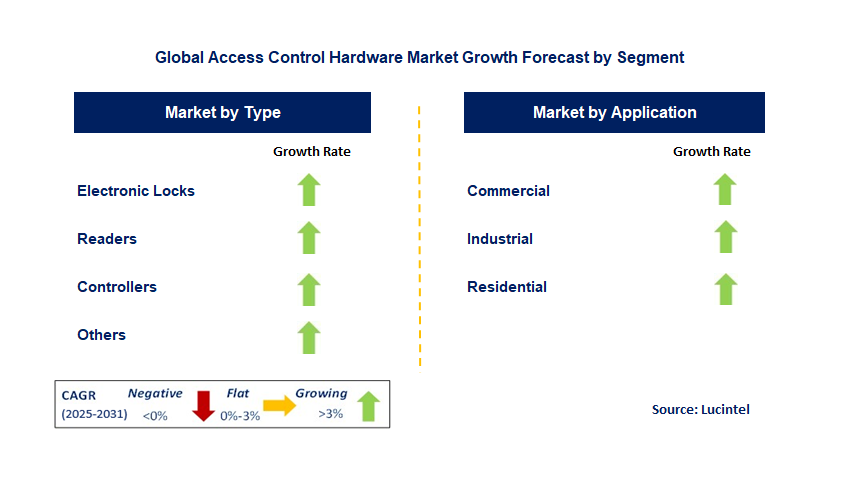
The future of the global access control hardware market looks promising with opportunities in the commercial, industrial, and residential markets. The global access control hardware market is expected to grow with a CAGR of 8.5% from 2025 to 2031. The major drivers for this market are growing adoption of smart homes and buildings, increased demand for seamless user experiences, and demand for remote management and monitoring. Lucintel forecasts that, within the type category, electronic lock is expected to witness the highest growth over the forecast period due to their convenience, security features, and integration with smart technologies like mobile apps. Within the application category, commercial is expected to witness the highest growth due to need to manage the access of a large number of people (employees, visitors, contractors). In terms of region, North America is expected to witness the highest growth over the forecast period due to driven by the demand for high-security solutions in commercial, industrial, and government sectors. Gain valuable insights for your business decisions with our comprehensive 150+ page report. Sample figures with some insights are shown below.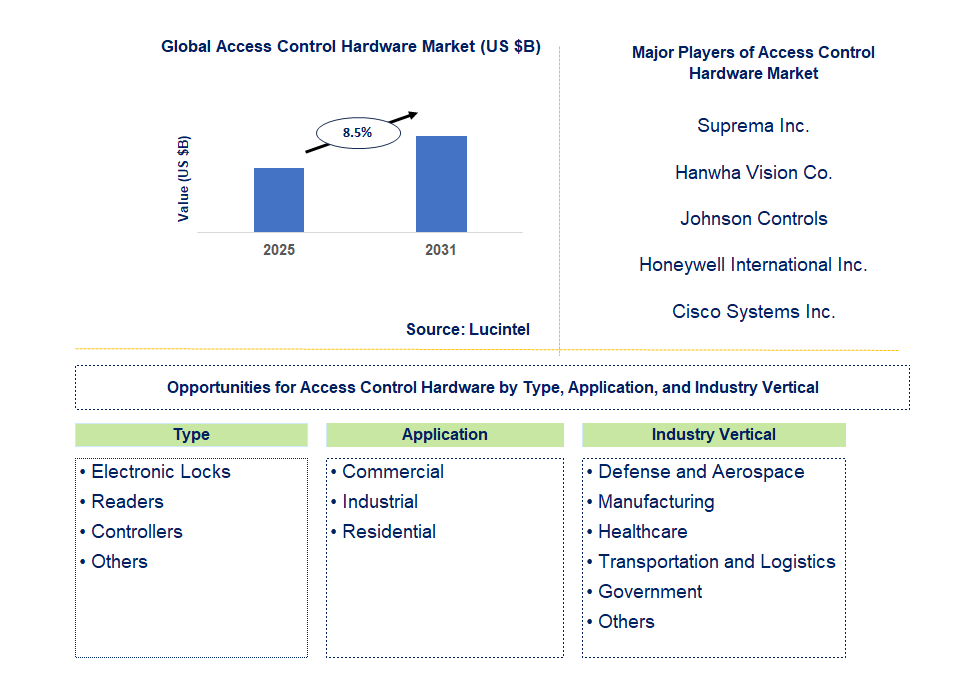
Emerging Trends in the Access Control Hardware Market
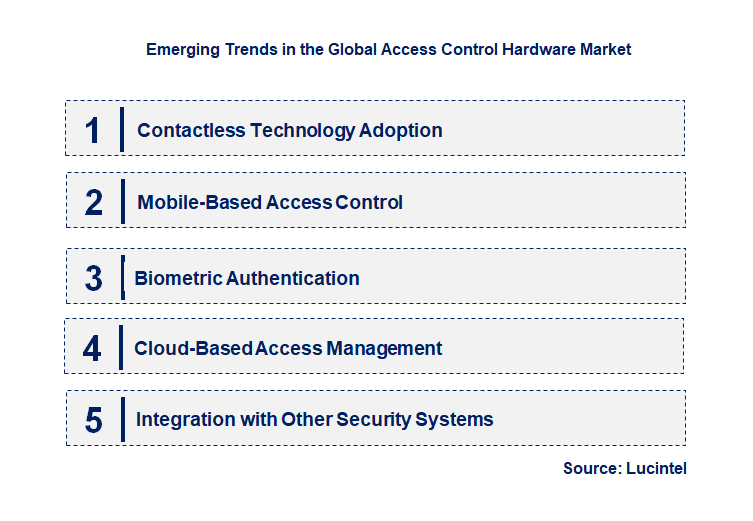
The access control hardware market is in rapid growth, propelled by the advancement of new technologies and shifting consumer demands. Improvements in security solutions, increased convenience to the users, and increased interoperability with other systems have triggered immense innovations within the industry. New trends in the industry are emerging contactless access systems, mobile-based solutions, and advanced biometrics, among others. The pace at which businesses evolve is being changed with new methods for dealing with security in more streamlined, efficient, and responsive ways.• Contactless Technology Adoption: Contactless access control systems are gaining popularity as organizations move toward more hygienic and efficient security solutions. These systems allow users to gain access by simply approaching a reader with a smart card, fob, or smartphone, reducing physical contact. This trend is being driven by health concerns, the need for faster processing, and the demand for touch-free solutions in environments like healthcare, hospitality, and corporate offices.
• Mobile-Based Access Control: Mobile access control systems are becoming the preferred choice because smartphones are convenient and secure means of managing entry. These systems use Bluetooth, NFC, or QR codes to allow users to unlock doors or gain access, adding a layer of flexibility and convenience. Mobile solutions also enable remote management and real-time updates, which appeal to businesses seeking seamless control and monitoring.
• Biometric Authentication: In this regard, there is integration of biometrics like fingerprint, facial recognition, and iris scanning with the access control system for stronger authentication. They are more difficult to bypass than old keycards or PINs and hence provide more secure access for sensitive areas. Advances in technology along with reduced costs will make it available for use on a larger scale for diverse applications, especially within high-security domains such as government and finance.
• Cloud-Based Access Management: Cloud-based systems have revolutionized the access control hardware market since they introduce centralized, scalable, and remote access control. Organizations are able to check and manage their security systems from any location in the world to an extent that reduces the on-site hardware and maintenance requirements. Cloud systems are also more easily updatable and integrative and collect data as compared to an on-premises system. Such features can attract the operations of any business looking to make operations streamlined.
• Integration with Other Security Systems: There has been a rapid growth trend toward integrating access control hardware with other security-related systems like surveillance cameras, alarm systems, and building management systems. This integration offers an all-inclusive approach to security where organizations can respond to these threats properly. Smart buildings and IoT devices have led to the fact that integrated systems are increasingly becoming the basis of security across multiple platforms. Emerging trends are changing the access control hardware market by providing better security, efficiency, and user convenience. Contactless, mobile, and biometric solutions and cloud-based management and system integration are changing how organizations secure their premises. As these technologies continue to advance, they will become even more pervasive across industries, driving greater demand for innovative access control solutions.
Recent Development in the Access Control Hardware Market
The access control hardware market has seen tremendous growth in recent years, driven by both technological advancements and the evolving security needs of businesses and institutions. New systems and solutions have been introduced, aimed at providing enhanced convenience, stronger security, and better integration with existing infrastructure. This has led to the rise of more sophisticated, user-friendly, and scalable access control solutions that cater to a wide range of sectors.• Enhanced Biometric System: The integration of advanced biometric systems has changed security standards altogether. Highly sensitive fingerprint recognition, facial recognition, and even scanning the veins on a person‘s palms have begun to be applied to access control devices. It delivers greater authenticity as a matter of verification and can ensure a less possible event of unlawful entrance with identity deception. These may work very effectively at such security-intensive regions where other kinds of access system tend to lose ground.
• Integration with AI and Machine Learning: Access control hardware is now being integrated with AI and machine learning capabilities to enhance security and operational efficiency. These technologies enable systems to learn from past data and adapt to emerging threats, providing predictive security measures. AI-powered systems can analyze patterns of behavior to identify potential security breaches, offering a more proactive approach to managing access and ensuring safety.
• Edge Computing for Faster Response Times: Edge computing, in fact, is increasingly being used in access control systems for near-the-point of entry processing of data to reduce latency and improve real-time decision-making. This makes the cloud servers lighter and opens up possibilities of faster processing times, which is important especially in high-traffic areas where speed and accuracy are needed most. It is fast becoming an industry buzzword, especially in the retail and manufacturing business, where access and control need to happen promptly.
• Mobile Credentials and Smart Locks: The use of mobile credentials and smart locks for access control has emerged as a key development. Today, through smartphones, RFID cards, or Bluetooth-enabled devices, users can unlock doors. This completely eliminates the need for physical keys and keycards, providing convenience, scalability, and enhancing features such as time-based access and remote unlocking.
• Cloud-Based Security Management Solutions: The cloud-based security solutions are finding more and more acceptance among businesses because they cost less, provide scalability, and permit remote access to control management. Cloud platforms are enabling businesses to manage their access control system from anywhere to provide real-time monitoring, analytics, and management in a central location. That reduces the use of on-site infrastructure, thereby eliminating maintenance costs as well as granting flexibility to rapidly expanding businesses. These recent advancements in the access control hardware market have greatly enhanced security, flexibility, and efficiency. The integration of biometrics, AI, edge computing, mobile credentials, and cloud management is changing the way organizations approach access control. As these technologies advance, the market is becoming highly competitive, with businesses competing to stay ahead in offering the most advanced and secure solutions for their clients.
Strategic Growth Opportunites in the Access Control Hardware Market
As more people around the world demand greater sophistication, efficiency, and security in access control systems, new growth opportunities will emerge across different market segments. These opportunities are driven by changes in consumer preferences, improvements in technology, and an increased need for security in several sectors. Strategic growth initiatives can unlock new sources of revenue for companies in the access control hardware market.• Smart Homes and Residential Applications: In response to the surge of smart homes, the demand for more sophisticated and seamless integration-based access control systems that work alongside other home automation appliances is on the rise. Access control systems offer the ability for homeowners to have full control of entry points while also monitoring the operation of security cameras and granting remote access through smart assistants or smartphones. The demand for residential access control will grow with the ever-increasing implementation of IoT-based devices in a house.
• Commercial and Office Spaces: Commercial buildings and office spaces are increasingly adopting modern access control systems to improve security and streamline operations. Integration with building management systems, mobile credentials, and remote monitoring capabilities are offering businesses a more flexible and efficient way to manage access. As companies move toward hybrid and remote work models, ensuring secure, seamless access to office spaces is becoming crucial.
• Healthcare and Hospitals: The healthcare sector offers significant growth opportunities for access control providers. Healthcare facilities need very strong security, such as pharmacies, medical record rooms, and emergency departments. Advanced biometric systems and mobile access solutions are being used to provide secure, touchless, and highly scalable access, thereby enhancing both security and operational efficiency.
• Education and Campus Security: Campus protection and building access control are now being emphasized in educational institutions. As the need for safety grows with significant concerns in large campus settings, schools and universities shift toward more advanced access control through facial recognition and mobile-based systems. Such technologies bolster the security of students and employees and offer real-time monitoring capabilities for campus security.
• Retail and Commercial Buildings: Retailers and commercial properties are using access control hardware to protect high-traffic areas, limit access to sensitive zones, and prevent theft. Mobile access control and smart locks are increasingly being used in retail environments to provide security and convenience for employees and customers. These systems also provide valuable data analytics to improve operational efficiency. These growth opportunities indicate the various applications for access control hardware across different industries. Growing needs for security, convenience, and integration with other systems across residential, commercial, healthcare, education, and retail sectors drive innovations in access control hardware. As organizations in all these sectors strive to increase security and efficiency in their operations, the demand for access control hardware is expected to see increased growth.
Access Control Hardware Market Driver and Challenges
The access control hardware market is influenced by a variety of factors, including technological advancements, economic conditions, and regulatory requirements. Understanding the drivers and challenges impacting the market can help businesses navigate the changing landscape and identify growth opportunities. Technological, economic, and regulatory changes are driving innovation, while certain challenges need to be addressed for continued market growth. The factors responsible for driving the access control hardware market include: 1. Technological Advancements: Technological innovation remains one of the leading drivers for access control hardware. Newer and more advanced systems such as biometric solutions, mobile access, cloud-based management, and artificial intelligence are redefining how access control systems are operated. This makes access control systems seem safer, efficient, and more user-friendly. According to this, market demand is expected to increase significantly. 2. Rising Security Needs: The increasing requirement of increased security within industries is the prime driver for the access control market. With businesses and institutions being constantly attacked by cyber threats, theft, and unauthorized access, there is more emphasis on securing these places through robust security measures. Advanced access control systems, including biometrics and mobile-based solutions, are offering necessary security to secure sensitive areas. 3. Increased Demand for Contactless Solutions: Health and hygiene concerns have accelerated the adoption of contactless access control systems. Touchless technology, including RFID cards, mobile credentials, and biometric systems, is gaining popularity in various industries, particularly in response to the COVID-19 pandemic. These systems provide faster and more hygienic methods of access while enhancing overall security. 4. Regulatory Compliance: With increased security standards and data protection regulations, organizations are increasingly opting for advanced access control systems to meet the requirements. The demand for secure access control solutions is on the rise across industries such as healthcare, finance, and government, driven by the implementation of security measures that meet legal and regulatory requirements, such as GDPR or HIPAA. 5. Integration with Other Systems: With a growing need for integrated security solutions, the trend in recent times is that more access control solutions integrate with video surveillance, alarm systems, and building management systems. The integration will help organizations streamline their security, enabling real-time responses to threats. Therefore, this type of access control system becomes attractive to many other industries. Challenges in the access control hardware market are: 1. Initial Investment Costs Are Highly High: One of the biggest challenges organizations face is the upfront costs associated with the implementation of advanced access control systems. Though long-term benefits include better security and efficiency, the high cost often is too much for small and medium-sized businesses to bear. 2. Data Privacy Concerns: As access control systems increasingly rely on biometrics and personal data, there is growing concern about data privacy. It is essential that data is kept safe and secure from breaches; mishandling or exposure of personal information can cause legal and reputational issues for organizations. 3. Complexity in Integration: The integration process of new access control systems into existing infrastructure could be very lengthy and complicated. Compatibility issues, legacy systems, and non-standardization between different technologies will make system integration a challenging affair, requiring further resources and expertise. While both high-powered drivers and challenges drive the access control hardware market, these high-priced and integrated data security challenges along with integration are among them, thus providing some headwind that companies are struggling with, whereas technology and high-security issues coupled with increasing demands for contactless solutions form major drivers of the industry. By handling challenges and using these drivers as sources for improvement in their security and efficiency of their operation, the firms continue.List of Access Control Hardware Companies
Companies in the market compete on the basis of product quality offered. Major players in this market focus on expanding their manufacturing facilities, R&D investments, infrastructural development, and leverage integration opportunities across the value chain. With these strategies access control hardware companies cater increasing demand, ensure competitive effectiveness, develop innovative products & technologies, reduce production costs, and expand their customer base. Some of the access control hardware companies profiled in this report include-• Suprema Inc.
• Hanwha Vision Co.
• Johnson Controls
• Honeywell International Inc.
• Cisco Systems Inc.
• Siemens AG
• Southco
• Schneider Electric SE.
• Thales Group (Gemalto NV)
• Bosch Security Systems
Access Control Hardware Market by Segment
The study includes a forecast for the global access control hardware market by type, application, industry vertical, and region.Access Control Hardware Market by Type [Value from 2019 to 2031]:
• Electronic Locks
• Readers
• Controllers
• Others
Access Control Hardware Market by Application [Value from 2019 to 2031]:
• Commercial
• Industrial
• Residential
Access Control Hardware Market by Region [Value from 2019 to 2031]:
• North America
• Europe
• Asia Pacific
• The Rest of the World
Country Wise Outlook for the Access Control Hardware Market
The access control hardware market is undergoing a rapid pace of change, thanks to technological advancements and the demand for more effective security solutions. The more sophisticated the systems adopted by businesses and government institutions to safeguard physical spaces, the more flexible the key players must become in order to deliver cutting-edge solutions that meet diverse needs across different industries worldwide. Some of the driving factors are digitalization, automation, and the regulatory framework for the increasing focus on cybersecurity. This evolution is more pronounced in the major markets such as the United States, China, Germany, India, and Japan, which are witnessing different yet connected developments in access control technologies.• United States: In the United States, access control hardware developments are focused on biometric technologies, mobile access, and integration with IoT systems. A significant shift toward cloud-based solutions is also in place, thus enhancing the scalability and flexibility of security systems. The constant threat of cyberattacks and breaching of physical security has caused severe investment among private firms as well as government entities into advanced access control systems. Major players in the United States are getting together with technology majors to ensure more ergonomic and efficient solutions, which further fuel the market growth.
• China: This fast-paced growth in China in smart access control is attributed to the government‘s push for modernized infrastructure and smart city initiatives. The focus lies in developing AI-powered facial recognition systems and fingerprint scanners with mobile access control, providing upgraded security and convenience. Besides, integration of access control systems into national identity databases assists the authorities in enhancing public safety. As the growth of China‘s economy steers the country toward growth and challenges because of security are rising, the demand for advanced access control hardware among various sectors transportation, governments, and commercial properties rises further.
• Germany: Interest in contactless access control solutions such as RFID cards and biometrics is increasing in Germany. Current interest is in the light of focusing on data privacy and efficiency. The country‘s strong manufacturing sector and advanced technological capabilities have ensured that access control systems remain of high quality and reliable. Besides, German companies are embracing integration with building management systems (BMS) and automation, which makes the security solutions more comprehensive and cohesive. Regulatory compliance with the EU‘s General Data Protection Regulation (GDPR) has contributed to product development and its deployment in Germany.
• India: Access control hardware is seeing significant growth in the Indian market because of growing urbanization, increased security concerns, and digitalization in most industries. Biometric systems are also integrated in most of these areas, such as fingerprint and iris recognition. Further, digital India initiatives are gaining much support from the government and thereby promoting the acceptance of mobile-based access systems in the public and private sectors. As Indian businesses begin to look toward upgrading their security systems, there are increasing needs for effective and affordable options that can also scale up the needs of a small to a medium-sized organization.
• Japan: Advancements in Biometric technologies as well as robotics make up the thrust in Japan‘s access control hardware market. However, there remains a strong integration focus between smart building systems with access control to generally improve operational efficiencies. In addition, aging is another population pressure that propels the need for user-friendly access systems in Japan, with more popular biometric recognition and mobile-based solutions. With these factors combined, the demand will continue to rise as Japan is looking to advance its infrastructure, specifically transportation, retail, and health.

Features of the Global Access Control Hardware Market
Market Size Estimates: Access control hardware market size estimation in terms of value ($B). Trend and Forecast Analysis: Market trends (2019 to 2024) and forecast (2025 to 2031) by various segments and regions. Segmentation Analysis: Access control hardware market size by type, application, industry vertical, and region in terms of value ($B). Regional Analysis: Access control hardware market breakdown by North America, Europe, Asia Pacific, and Rest of the World. Growth Opportunities: Analysis of growth opportunities in different type, application, industry vertical, and regions for the access control hardware market. Strategic Analysis: This includes M&A, new product development, and competitive landscape of the access control hardware market. Analysis of competitive intensity of the industry based on Porter’s Five Forces model.
FAQ
Q1. What is the growth forecast for access control hardware market? Answer: The global access control hardware market is expected to grow with a CAGR of 8.5% from 2025 to 2031. Q2. What are the major drivers influencing the growth of the access control hardware market? Answer: The major drivers for this market are growing adoption of smart homes and buildings, increased demand for seamless user experiences, and demand for remote management and monitoring. Q3. What are the major segments for access control hardware market? Answer: The future of the access control hardware market looks promising with opportunities in the commercial, industrial, and residential markets. Q4. Who are the key access control hardware market companies? Answer: Some of the key access control hardware companies are as follows:• Suprema Inc.
• Hanwha Vision Co.
• Johnson Controls
• Honeywell International Inc.
• Cisco Systems Inc.
• Siemens AG
• Southco
• Schneider Electric SE.
• Thales Group (Gemalto NV)
• Bosch Security Systems Q5. Which access control hardware market segment will be the largest in future? Answer: Lucintel forecasts that electronic lock is expected to witness the highest growth over the forecast period due to their convenience, security features, and integration with smart technologies like mobile apps. Q6. In access control hardware market, which region is expected to be the largest in next 5 years? Answer: North America is expected to witness the highest growth over the forecast period due to driven by the demand for high-security solutions in commercial, industrial, and government sectors. Q7. Do we receive customization in this report? Answer: Yes, Lucintel provides 10% customization without any additional cost.
Table of Contents
Methodology
- In-depth interviews of the major players in this market
- Detailed secondary research from competitors’ financial statements and published data
- Extensive searches of published works, market, and database information pertaining to industry news, company press releases, and customer intentions
- A compilation of the experiences, judgments, and insights of Lucintel’s professionals, who have analyzed and tracked this market over the years.


Buy Now
Choose a license that fits your team. Instant PDF delivery.
Prices exclude taxes. Instant delivery. Custom licensing available on request.
Key Questions
- • What are some of the most promising, high-growth opportunities for the access control hardware market by type (electronic locks, readers, controllers, and others), application (commercial, industrial, and residential), industry vertical (defense and aerospace, manufacturing, healthcare, transportation and logistics, government, and others), and region (North America, Europe, Asia Pacific, and the Rest of the World)?
- • Which segments will grow at a faster pace and why?
- • Which region will grow at a faster pace and why?
- • What are the key factors affecting market dynamics? What are the key challenges and business risks in this market?
- • What are the business risks and competitive threats in this market?
- • What are the emerging trends in this market and the reasons behind them?
- • What are some of the changing demands of customers in the market?
- • What are the new developments in the market? Which companies are leading these developments?
- • Who are the major players in this market? What strategic initiatives are key players pursuing for business growth?
- • What are some of the competing products in this market and how big of a threat do they pose for loss of market share by material or product substitution?
- • What M&A activity has occurred in the last 5 years and what has its impact been on the industry? For any questions related to Access Control Hardware Market, Access Control Hardware Market Size, Access Control Hardware Market Growth, Access Control Hardware Market Analysis, Access Control Hardware Market Report, Access Control Hardware Market Share, Access Control Hardware Market Trends, Access Control Hardware Market Forecast, Access Control Hardware Companies, write Lucintel analyst at email: helpdesk@lucintel.com. We will be glad to get back to you soon.


