
Report Feature
Absorbable Nerve Conduit Market Trends and Forecast
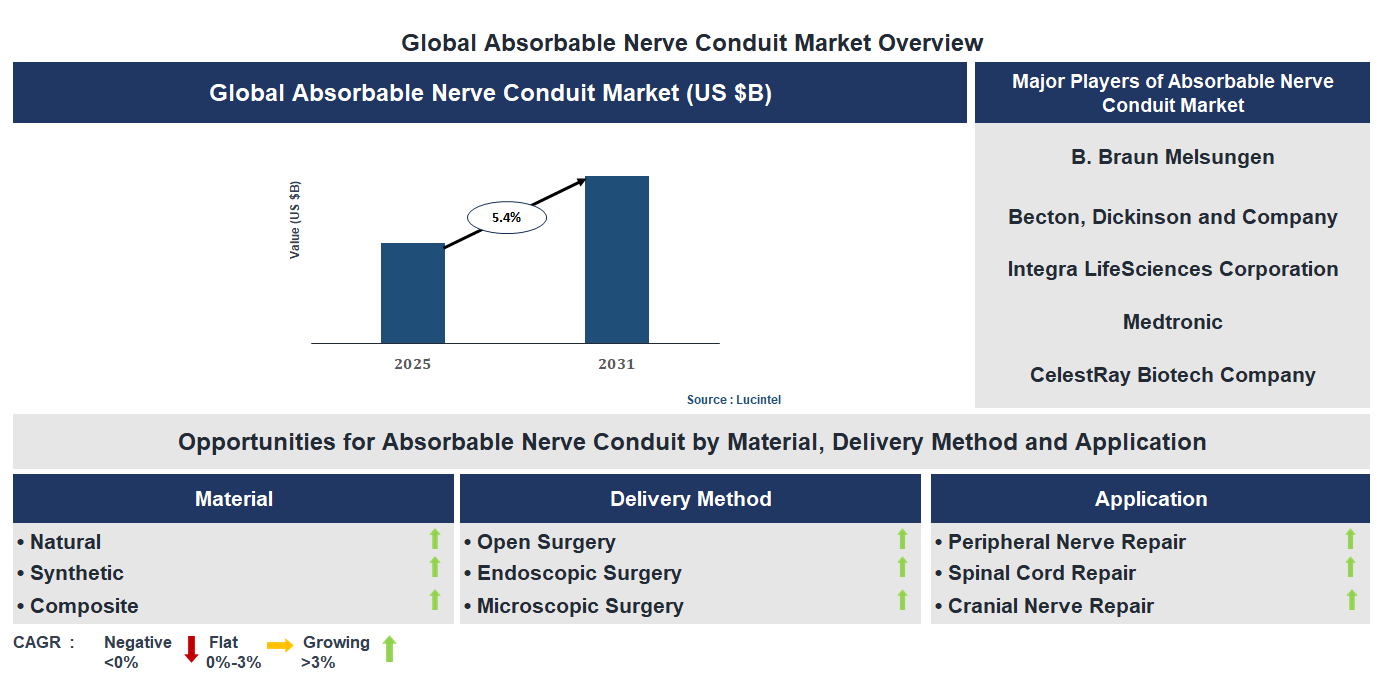
The future of the global absorbable nerve conduit market looks promising with opportunities in the peripheral nerve repair, spinal cord repair, and cranial nerve repair markets. The global absorbable nerve conduit market is expected to grow with a CAGR of 5.4% from 2025 to 2031. The major drivers for this market are the increasing demand for nerve regeneration solutions, the rising prevalence of peripheral nerve injuries, and the growing adoption of bioabsorbable medical devices.• Lucintel forecasts that, within the material category, composite is expected to witness the highest growth over the forecast period.
• Within the application category, peripheral nerve repair is expected to witness the highest growth.
• In terms of region, North America is expected to witness the highest growth over the forecast period. Gain valuable insights for your business decisions with our comprehensive 150+ page report. Sample figures with some insights are shown below.
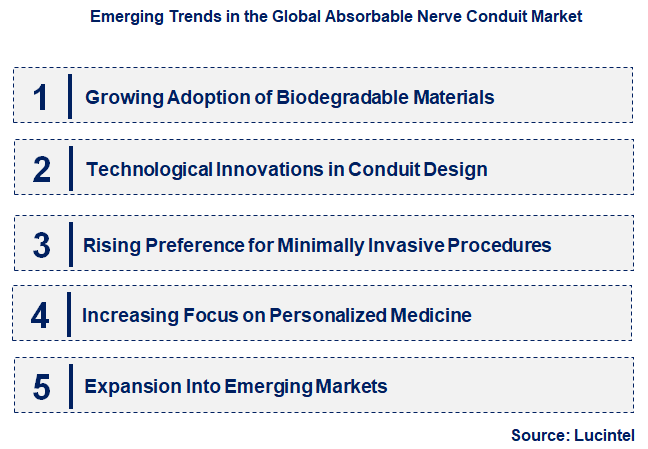
Emerging Trends in the Absorbable Nerve Conduit Market
The absorbable nerve conduit market is experiencing rapid growth driven by advancements in regenerative medicine, increasing demand for minimally invasive procedures, and a focus on improving patient outcomes. As healthcare providers seek innovative solutions for nerve repair, the market is evolving with new materials, technologies, and applications. These developments are not only expanding the scope of treatment options but also enhancing the efficiency and safety of nerve repair procedures. The following key trends highlight the major shifts shaping this market, reflecting its dynamic nature and promising future prospects.• Growing Adoption of Biodegradable Materials: The market is increasingly utilizing biodegradable polymers such as polyglycolic acid and collagen, which naturally degrade in the body. These materials reduce the need for secondary surgeries, minimize immune responses, and promote natural nerve regeneration. The shift towards biocompatible, absorbable materials enhances patient safety and improves clinical outcomes, making these conduits more attractive for surgeons and patients alike.
• Technological Innovations in Conduit Design: Advances in nanotechnology and bioengineering are leading to the development of smarter, more effective nerve conduits. These include conduits with embedded growth factors, electrical stimulation capabilities, and customizable structures that mimic natural nerve tissue. Such innovations improve nerve regeneration rates, facilitate faster recovery, and expand the potential applications of absorbable nerve conduits in complex nerve injuries.
• Rising Preference for Minimally Invasive Procedures: The trend toward less invasive surgical techniques is driving demand for absorbable nerve conduits that can be easily implanted through smaller incisions. These conduits reduce surgical trauma, decrease recovery times, and lower complication rates. As surgeons and patients prioritize minimally invasive options, the market for ready-to-use, easy-to-handle conduits is expanding rapidly.
• Increasing Focus on Personalized Medicine: Customizable nerve conduits tailored to individual patient needs are gaining prominence. Advances in 3D printing and imaging technologies enable the creation of patient-specific conduits that match the size and shape of the injury site. This personalization enhances the effectiveness of nerve repair, reduces complications, and improves functional recovery, thereby transforming treatment paradigms.
• Expansion into Emerging Markets: Developing regions are witnessing increased adoption of absorbable nerve conduits due to rising healthcare infrastructure and awareness. Market players are focusing on affordable, easy-to-use products to tap into these markets. This expansion broadens access to advanced nerve repair solutions, accelerates market growth, and fosters innovation tailored to diverse healthcare settings. In summary, these trends are collectively reshaping the absorbable nerve conduit market by fostering innovation, improving patient outcomes, and expanding global access. The integration of new materials, technologies, and personalized approaches is driving the market toward more effective, safe, and accessible nerve repair solutions, promising a robust future for this evolving sector.
Recent Development in the Absorbable Nerve Conduit Market
The absorbable nerve conduit market has experienced significant growth driven by advancements in regenerative medicine, increasing demand for minimally invasive procedures, and rising awareness of nerve repair options. Technological innovations and regulatory approvals have further accelerated market expansion, making nerve repair solutions more accessible and effective. The market’s evolution reflects a shift towards biodegradable materials that promote natural healing while reducing complications associated with traditional nerve repair methods. As healthcare providers and patients seek improved outcomes, these developments are shaping the future landscape of nerve regeneration therapies, fostering innovation, and expanding market opportunities globally.• Technological Innovations: Development of advanced biodegradable materials has improved nerve regeneration outcomes. New materials like collagen and synthetic polymers enhance biocompatibility and degradation rates, leading to better patient recovery and fewer complications. These innovations have increased the efficacy of nerve conduits, attracting more clinical adoption and expanding market size.
• Regulatory Approvals: Recent approvals from regulatory bodies such as the FDA have validated the safety and effectiveness of absorbable nerve conduits. These approvals facilitate market entry for new products, boost clinician confidence, and accelerate adoption in surgical procedures, thereby driving market growth.
• Rising Prevalence of Nerve Injuries: An increase in traumatic injuries and surgical procedures has heightened the demand for nerve repair solutions. The need for effective, minimally invasive options has propelled the adoption of absorbable nerve conduits, expanding the market across hospitals and clinics.
• Strategic Collaborations and Partnerships: Companies are forming alliances with research institutions and healthcare providers to develop innovative products. These collaborations foster technological advancements, improve product pipelines, and enhance market reach, contributing to overall industry growth.
• Market Expansion in Emerging Regions: Growing healthcare infrastructure and awareness in regions like Asia-Pacific and Latin America have opened new markets. Local manufacturing and distribution are making absorbable nerve conduits more accessible, supporting regional market expansion. In summary, these developments are significantly impacting the absorbable nerve conduit market by enhancing product efficacy, increasing adoption, and expanding geographical reach. The market is poised for continued growth driven by technological progress, regulatory support, and rising global healthcare needs, ultimately improving patient outcomes and fostering innovation in nerve repair therapies.
Strategic Growth Opportunities in the Absorbable Nerve Conduit Market
The absorbable nerve conduit market is experiencing rapid growth driven by advancements in regenerative medicine and increasing demand for minimally invasive surgical solutions. As healthcare providers seek effective nerve repair options, key applications are emerging as significant growth drivers. These opportunities are transforming patient outcomes and expanding market reach across various medical fields. The integration of innovative materials and techniques is further fueling this expansion, making the market highly dynamic and competitive. Understanding these growth opportunities is essential for stakeholders aiming to capitalize on emerging trends and improve clinical practices in nerve repair.• Peripheral Nerve Injury Repair: This application is witnessing increased adoption due to the rising incidence of traumatic injuries. Absorbable nerve conduits facilitate nerve regeneration without the need for secondary surgeries, reducing patient recovery time and complications. The demand for effective, biocompatible solutions is boosting market growth and encouraging innovation in conduit design.
• Cranial Nerve Regeneration: Growing cases of cranial nerve damage from trauma or surgical procedures are driving demand for absorbable conduits. These conduits offer a biodegradable alternative to traditional repair methods, minimizing long-term complications and improving functional recovery. This application is expected to see significant technological advancements, expanding its market share.
• Spinal Cord Injury Repair: The need for advanced nerve repair solutions in spinal cord injuries is increasing. Absorbable nerve conduits provide a promising approach for bridging nerve gaps and promoting regeneration. Their biocompatibility and reduced risk of rejection are making them a preferred choice, thus opening new avenues for market growth.
• Surgical Nerve Repair: Surgeons are increasingly adopting absorbable nerve conduits for intraoperative nerve repair procedures. These conduits simplify surgical techniques, reduce operative time, and eliminate the need for removal surgeries. The convenience and safety offered are expected to boost their adoption across various surgical disciplines.
• Pediatric Nerve Repair: The pediatric segment is gaining attention due to the need for safe, effective nerve repair options for children with congenital or traumatic nerve injuries. Absorbable conduits are ideal as they eliminate the need for future surgeries, reducing trauma and improving long-term outcomes. This application is poised for substantial growth as pediatric surgical techniques evolve. In summary, these key applications are significantly impacting the absorbable nerve conduit market by expanding its scope and enhancing clinical outcomes. The increasing adoption across diverse medical fields is driving innovation, improving patient care, and fueling market growth. As technological advancements continue, these opportunities will further shape the future landscape of nerve repair solutions.
Absorbable Nerve Conduit Market Driver and Challenges
The absorbable nerve conduit market is influenced by a variety of technological, economic, and regulatory factors that shape its growth trajectory. Advances in biomaterials and tissue engineering are driving innovation, making nerve repair more effective and less invasive. Economic factors such as increasing healthcare expenditure and rising prevalence of nerve injuries are expanding market opportunities. Regulatory frameworks and approval processes also play a crucial role in bringing new products to market, ensuring safety and efficacy. However, challenges such as high development costs, stringent regulatory requirements, and competition from alternative treatments pose significant hurdles. Understanding these drivers and challenges is essential for stakeholders aiming to capitalize on market potential and address existing barriers effectively. The factors responsible for driving the absorbable nerve conduit market include:• Technological Advancements: The development of novel biomaterials and improved manufacturing techniques has led to more effective absorbable nerve conduits. Innovations such as biodegradable polymers and bioactive coatings enhance nerve regeneration and reduce complications. These technological improvements increase the success rate of nerve repair surgeries, encouraging adoption among healthcare providers. As research continues, the market benefits from a steady pipeline of advanced products, fostering growth and expanding applications in nerve injury treatments.
• Rising Prevalence of Nerve Injuries: An increase in traumatic injuries, surgical procedures, and chronic conditions like diabetes has led to a higher incidence of nerve damage worldwide. This growing patient population creates a substantial demand for effective nerve repair solutions. Absorbable nerve conduits offer advantages such as reduced need for secondary surgeries and minimized long-term complications, making them a preferred choice. The expanding prevalence directly correlates with increased market demand, driving manufacturers to innovate and scale production.
• Regulatory Approvals and Support: Stringent regulatory frameworks ensure the safety and efficacy of absorbable nerve conduits, fostering trust among clinicians and patients. Approval from agencies like the FDA and EMA facilitates market entry and adoption. Supportive policies and clear guidelines encourage companies to invest in research and development, accelerating product launches. Regulatory endorsements also enhance product credibility, boosting sales and market penetration across regions.
• Increasing Healthcare Expenditure: Rising healthcare budgets and insurance coverage improvements enable more patients to access advanced nerve repair treatments. Hospitals and clinics are more willing to adopt innovative solutions like absorbable nerve conduits due to their clinical benefits and long-term cost savings. This economic support fuels market growth by expanding the customer base and encouraging investment in new technologies, ultimately leading to broader availability and adoption.
• Growing Awareness and Adoption: Increased awareness among healthcare professionals and patients about the benefits of absorbable nerve conduits has led to higher adoption rates. Educational initiatives, clinical research, and positive treatment outcomes contribute to this trend. As more practitioners become familiar with these products, their usage becomes standard practice in nerve repair surgeries, further expanding the market and encouraging manufacturers to develop tailored solutions for specific nerve injuries. The challenges in the absorbable nerve conduit market are:
• High Development and Manufacturing Costs: Developing innovative absorbable nerve conduits involves extensive research, clinical trials, and regulatory compliance, which are costly and time-consuming. Manufacturing biodegradable materials with consistent quality and performance adds to expenses. These high costs can limit product affordability and slow market penetration, especially in emerging regions. Companies must balance innovation with cost management to remain competitive, which can hinder rapid growth and limit access for some patient populations.
• Stringent Regulatory Requirements: Navigating complex approval processes across different regions poses a significant challenge. Regulatory agencies demand comprehensive safety and efficacy data, which prolongs product development timelines and increases costs. Delays in approvals can result in missed market opportunities and financial losses. Additionally, evolving regulatory standards require continuous updates and compliance efforts, adding to the complexity and resource burden faced by manufacturers.
• Competition from Alternative Treatments: The market faces competition from traditional nerve repair methods such as autografts and allografts, which are well-established and trusted. Emerging technologies like nerve allografts, synthetic conduits, and stem cell therapies also compete for market share. These alternatives may offer comparable or superior outcomes, challenging the growth of absorbable nerve conduits. Market players must demonstrate clear advantages and cost-effectiveness to gain clinician and patient acceptance amid this competitive landscape. In summary, the absorbable nerve conduit market is driven by technological innovations, increasing nerve injury cases, supportive regulatory environments, rising healthcare investments, and growing awareness. However, high development costs, regulatory hurdles, and competition from alternative therapies present notable challenges. These factors collectively influence market dynamics, requiring stakeholders to innovate strategically, navigate regulatory landscapes efficiently, and address cost concerns to sustain growth. Overall, the market holds significant potential, but success depends on overcoming these barriers through continued research, collaboration, and strategic planning.
List of Absorbable Nerve Conduit Companies
Companies in the market compete on the basis of product quality offered. Major players in this market focus on expanding their manufacturing facilities, R&D investments, infrastructural development, and leverage integration opportunities across the value chain. With these strategies absorbable nerve conduit companies cater increasing demand, ensure competitive effectiveness, develop innovative products & technologies, reduce production costs, and expand their customer base. Some of the absorbable nerve conduit companies profiled in this report include-• B. Braun Melsungen
• Becton, Dickinson and Company
• Integra LifeSciences Corporation
• Medtronic
• CelestRay Biotech Company
• Salvia BioElectronics
• Axogen Corporation
Absorbable Nerve Conduit Market by Segment
The study includes a forecast for the global absorbable nerve conduit market by material, delivery method, application, and region.Absorbable Nerve Conduit Market by Material [Value from 2019 to 2031]:
• Natural
• Synthetic
• Composite
Absorbable Nerve Conduit Market by Delivery Method [Value from 2019 to 2031]:
• Open Surgery
• Endoscopic Surgery
• Microscopic Surgery
Absorbable Nerve Conduit Market by Application [Value from 2019 to 2031]:
• Peripheral Nerve Repair
• Spinal Cord Repair
• Cranial Nerve Repair
Absorbable Nerve Conduit Market by Region [Value from 2019 to 2031]:
• North America
• Europe
• Asia Pacific
• The Rest of the World
Country Wise Outlook for the Absorbable Nerve Conduit Market
The absorbable nerve conduit market has experienced significant growth driven by advancements in regenerative medicine, increasing demand for minimally invasive procedures, and rising awareness of nerve repair solutions. Technological innovations and regulatory approvals have accelerated market expansion across key regions. Countries are investing in research and development to improve conduit materials, enhance biocompatibility, and reduce recovery times. The market’s evolution reflects a focus on personalized medicine and improved patient outcomes, with government initiatives supporting innovation. As the global healthcare landscape shifts, these developments are shaping the future of nerve repair therapies, making them more accessible and effective worldwide.• United States: The US market has seen rapid growth due to technological innovations and increased funding for regenerative medicine research. Key players are developing advanced biodegradable nerve conduits with improved biocompatibility and functionality. Regulatory approvals from the FDA have facilitated market expansion, and collaborations between biotech firms and academic institutions are driving innovation. The rising prevalence of nerve injuries and neurological disorders has further boosted demand. Additionally, the adoption of minimally invasive surgical techniques has contributed to market growth, with a focus on personalized nerve repair solutions tailored to patient needs.
• China: China is experiencing significant market expansion driven by government initiatives supporting biotech innovation and healthcare infrastructure development. Local companies are investing heavily in R&D to develop cost-effective absorbable nerve conduits, making advanced treatments more accessible. The increasing incidence of nerve injuries due to industrialization and traffic accidents has heightened demand. Moreover, collaborations with international firms are bringing advanced technologies into the Chinese market. The government’s focus on healthcare reform and innovation policies is expected to sustain growth, with a rising number of clinical trials and product launches in the region.
• Germany: Germany remains a key player in the European absorbable nerve conduit market, with a strong emphasis on research and development. The country’s advanced healthcare system and regulatory framework support the introduction of innovative nerve repair products. German companies are focusing on biocompatible, biodegradable materials that promote nerve regeneration. The aging population and rising prevalence of neurological conditions have increased demand for effective nerve repair solutions. Additionally, collaborations between academia and industry are fostering technological advancements. The market benefits from strong reimbursement policies and a focus on minimally invasive procedures, positioning Germany as a leader in nerve conduit innovation.
• India: India’s market is rapidly growing due to increasing awareness of nerve injury treatments and expanding healthcare infrastructure. Local manufacturers are developing affordable absorbable nerve conduits to meet the needs of a large population. The rising incidence of trauma-related nerve injuries, especially in rural areas, is driving demand. Government initiatives aimed at improving healthcare access and promoting medical research are supporting market growth. Additionally, the increasing adoption of advanced surgical techniques and rising investments in biotech startups are fostering innovation. The market is expected to continue expanding as awareness and affordability improve across the country.
• Japan: Japan’s market is characterized by high technological adoption and a focus on advanced biomaterials for nerve repair. The country’s aging population has led to increased cases of neurological disorders, boosting demand for effective nerve regeneration solutions. Japanese companies are investing in R&D to develop next-generation absorbable nerve conduits with enhanced biocompatibility and regenerative properties. Regulatory support and a strong healthcare infrastructure facilitate product development and commercialization. Collaborations between industry and academia are common, fostering innovation. The market is also driven by a focus on minimally invasive procedures and personalized treatments, positioning Japan as a leader in nerve conduit technology.

Features of the Global Absorbable Nerve Conduit Market
Market Size Estimates: Absorbable nerve conduit market size estimation in terms of value ($B). Trend and Forecast Analysis: Market trends (2019 to 2024) and forecast (2025 to 2031) by various segments and regions. Segmentation Analysis: Absorbable nerve conduit market size by material, delivery method, application, and region in terms of value ($B). Regional Analysis: Absorbable nerve conduit market breakdown by North America, Europe, Asia Pacific, and Rest of the World. Growth Opportunities: Analysis of growth opportunities in different materials, delivery method, applications, and regions for the absorbable nerve conduit market. Strategic Analysis: This includes M&A, new product development, and competitive landscape of the absorbable nerve conduit market. Analysis of competitive intensity of the industry based on Porter’s Five Forces model.
FAQ
Q1. What is the growth forecast for absorbable nerve conduit market? Answer: The global absorbable nerve conduit market is expected to grow with a CAGR of 5.4% from 2025 to 2031. Q2. What are the major drivers influencing the growth of the absorbable nerve conduit market? Answer: The major drivers for this market are the increasing demand for nerve regeneration solutions, the rising prevalence of peripheral nerve injuries, and the growing adoption of bioabsorbable medical devices. Q3. What are the major segments for absorbable nerve conduit market? Answer: The future of the absorbable nerve conduit market looks promising with opportunities in the peripheral nerve repair, spinal cord repair, and cranial nerve repair markets. Q4. Who are the key absorbable nerve conduit market companies? Answer: Some of the key absorbable nerve conduit companies are as follows:• B. Braun Melsungen
• Becton, Dickinson and Company
• Integra LifeSciences Corporation
• Medtronic
• CelestRay Biotech Company
• Salvia BioElectronics
• Axogen Corporation Q5. Which absorbable nerve conduit market segment will be the largest in future? Answer: Lucintel forecasts that, within the material category, composite is expected to witness the highest growth over the forecast period. Q6. In absorbable nerve conduit market, which region is expected to be the largest in next 5 years? Answer: In terms of region, North America is expected to witness the highest growth over the forecast period. Q7. Do we receive customization in this report? Answer: Yes, Lucintel provides 10% customization without any additional cost.
Table of Contents
List of Figures
List of Tables
Methodology
- In-depth interviews of the major players in this market
- Detailed secondary research from competitors’ financial statements and published data
- Extensive searches of published works, market, and database information pertaining to industry news, company press releases, and customer intentions
- A compilation of the experiences, judgments, and insights of Lucintel’s professionals, who have analyzed and tracked this market over the years.


Buy Now
Choose a license that fits your team. Instant PDF delivery.
Prices exclude taxes. Instant delivery. Custom licensing available on request.
Key Questions
- • What are some of the most promising, high-growth opportunities for the absorbable nerve conduit market by material (natural, synthetic, and composite), delivery method (open surgery, endoscopic surgery, and microscopic surgery), application (peripheral nerve repair, spinal cord repair, and cranial nerve repair), and region (North America, Europe, Asia Pacific, and the Rest of the World)?
- • Which segments will grow at a faster pace and why?
- • Which region will grow at a faster pace and why?
- • What are the key factors affecting market dynamics? What are the key challenges and business risks in this market?
- • What are the business risks and competitive threats in this market?
- • What are the emerging trends in this market and the reasons behind them?
- • What are some of the changing demands of customers in the market?
- • What are the new developments in the market? Which companies are leading these developments?
- • Who are the major players in this market? What strategic initiatives are key players pursuing for business growth?
- • What are some of the competing products in this market and how big of a threat do they pose for loss of market share by material or product substitution?
- • What M&A activity has occurred in the last 5 years and what has its impact been on the industry? For any questions related to Absorbable Nerve Conduit Market, Absorbable Nerve Conduit Market Size, Absorbable Nerve Conduit Market Growth, Absorbable Nerve Conduit Market Analysis, Absorbable Nerve Conduit Market Report, Absorbable Nerve Conduit Market Share, Absorbable Nerve Conduit Market Trends, Absorbable Nerve Conduit Market Forecast, Absorbable Nerve Conduit Companies, write Lucintel analyst at email: helpdesk@lucintel.com. We will be glad to get back to you soon.


