
Report Feature
8K Ultra HD TV Market Trends and Forecast
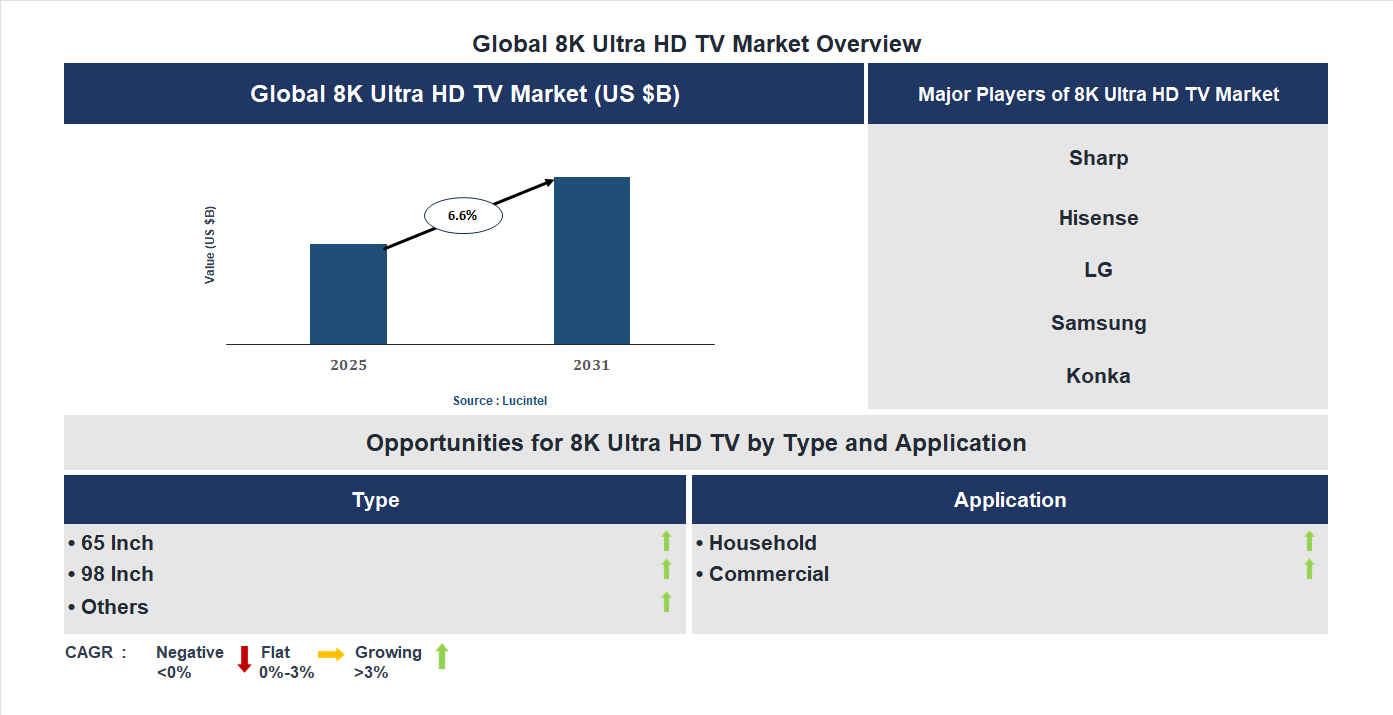
The future of the global 8K ultra HD TV market looks promising with opportunities in the household and commercial markets. The global 8K ultra HD TV market is expected to grow with a CAGR of 6.6% from 2025 to 2031. The major drivers for this market are the increasing demand for ultra high resolution displays, the rising adoption of premium home entertainment, and the growing availability of 8K content platforms.• Lucintel forecasts that, within the type category, 65 inch is expected to witness higher growth over the forecast period.
• Within the application category, household is expected to witness higher growth.
• In terms of region, APAC is expected to witness the highest growth over the forecast period. Gain valuable insights for your business decisions with our comprehensive 150+ page report. Sample figures with some insights are shown below.
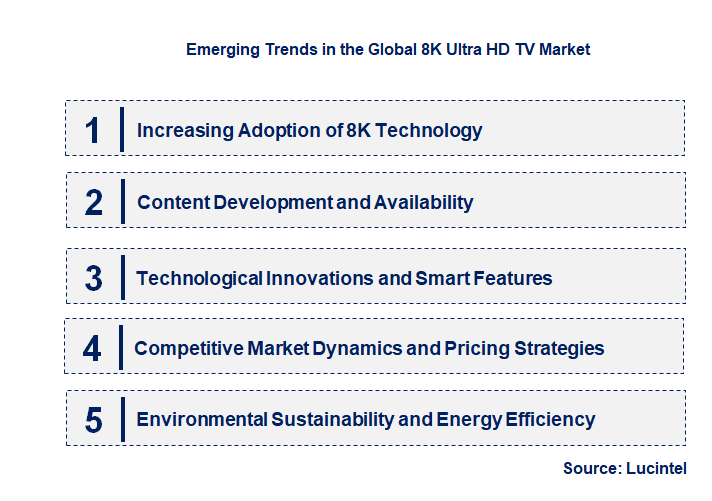
Emerging Trends in the 8K Ultra HD TV Market
The 8K ultra HD TV market is experiencing rapid growth driven by technological advancements, consumer demand for higher quality visuals, and increasing competition among manufacturers. As consumers seek more immersive viewing experiences, manufacturers are innovating to meet these expectations. The market is also influenced by the decreasing costs of 8K technology, expanding content availability, and the integration of smart features. These developments are not only transforming consumer experiences but also reshaping industry strategies and supply chains. Understanding these emerging trends is crucial for stakeholders aiming to capitalize on the markets potential and navigate its evolving landscape effectively.• Increasing Adoption of 8K Technology: As prices decrease and technology matures, more consumers are adopting 8K TVs. This trend is driven by the desire for superior image quality and future-proofing devices. Manufacturers are launching more models with 8K resolution, making it accessible to a broader audience. The adoption is also supported by advancements in processing power and display technology, which enhance picture clarity and color accuracy. This widespread adoption is expected to accelerate market growth, pushing the industry toward mainstream acceptance of 8K displays.
• Content Development and Availability: The growth of 8K content is crucial for market expansion. Content creators and broadcasters are beginning to produce and distribute 8K content, including streaming services, sports events, and cinematic productions. This development encourages consumers to upgrade their TVs to access high-quality content. Additionally, technological improvements in compression and transmission are making 8K content more feasible over existing networks. As content availability increases, consumer interest and demand for 8K TVs are expected to rise significantly, fueling further market growth.
• Technological Innovations and Smart Features: Integration of advanced technologies such as AI, voice control, and enhanced connectivity is transforming 8K TVs into smart entertainment hubs. Manufacturers are incorporating features like improved user interfaces, personalized content recommendations, and seamless device integration. These innovations enhance user experience and make 8K TVs more appealing. Moreover, advancements in display technology, such as OLED and MicroLED, are improving picture quality and energy efficiency. The combination of smart features and cutting-edge display tech is setting new standards in the high-end TV market.
• Competitive Market Dynamics and Pricing Strategies: The market is witnessing intense competition among global manufacturers, leading to aggressive pricing and feature differentiation. Companies are offering more affordable 8K models with advanced features to attract a wider customer base. Strategic partnerships and marketing campaigns are also boosting brand visibility. This competitive environment is driving innovation and reducing prices, making 8K TVs more accessible. As a result, market penetration is increasing, and consumers are gaining more options, which is expected to accelerate overall market growth and diversify product offerings.
• Environmental Sustainability and Energy Efficiency: Growing consumer awareness and regulatory pressures are pushing manufacturers to develop eco-friendly and energy-efficient 8K TVs. Innovations include the use of sustainable materials, energy-saving display technologies, and recyclable packaging. These efforts not only reduce environmental impact but also appeal to environmentally conscious consumers. Energy-efficient models help consumers save on electricity costs, adding value. As sustainability becomes a key purchasing criterion, manufacturers are integrating eco-friendly practices into their product development, influencing market trends and encouraging responsible consumption. In summary, these emerging trends are collectively reshaping the 8K ultra HD TV market by enhancing technological capabilities, expanding content ecosystems, fostering competitive pricing, and emphasizing sustainability. These developments are driving market growth, broadening consumer adoption, and setting new standards for high-resolution entertainment experiences.
Recent Development in the 8K Ultra HD TV Market
The 8K ultra HD TV market has experienced rapid growth driven by technological advancements, increasing consumer demand for higher resolution displays, and expanding content availability. As manufacturers compete to deliver superior picture quality, the market is witnessing significant innovations and strategic shifts. These developments are shaping the future landscape of home entertainment, influencing consumer preferences, and impacting global sales. The following key developments highlight the current trajectory of this dynamic market.• Technological Advancements: Integration of AI and Quantum Dot Technology : Recent innovations have enhanced picture quality, color accuracy, and energy efficiency, making 8K TVs more appealing to consumers and increasing their adoption rate.
• Content Ecosystem Expansion: Streaming Services and Broadcast Support : Major streaming platforms and broadcasters are beginning to support 8K content, boosting consumer interest and encouraging manufacturers to develop compatible devices.
• Price Reduction Strategies: Competitive Pricing and Economies of Scale : As production scales up, prices for 8K TVs are decreasing, making them more accessible to a broader consumer base and accelerating market penetration.
• Strategic Partnerships and Collaborations: Tech Giants and Content Creators : Collaborations between technology companies and content providers are fostering the development of 8K content and innovative display technologies, further driving market growth.
• Market Entry of New Players: Emerging Brands and Regional Expansion : New entrants and regional brands are entering the market with affordable options, increasing competition and expanding the global footprint of 8K TVs. In summary, these developments are collectively propelling the 8K ultra HD TV market toward broader adoption and technological maturity. Enhanced content support, decreasing prices, and strategic collaborations are making 8K TVs more mainstream, while innovations continue to elevate consumer experience. As a result, the market is poised for sustained growth, with increased competition and evolving consumer preferences shaping its future trajectory.
Strategic Growth Opportunities in the 8K Ultra HD TV Market
The 8K ultra HD TV market is experiencing rapid growth driven by technological advancements, increasing consumer demand for superior visual experiences, and expanding content availability. As consumers seek higher resolution displays for immersive entertainment, manufacturers are exploring strategic opportunities to capture market share across various applications. These growth avenues are shaping the future landscape of the 8K TV industry, offering significant potential for innovation and revenue generation. By focusing on key applications, companies can leverage emerging trends to enhance their competitive edge and meet evolving consumer preferences.• Consumer Electronics: Expanding 8K TV adoption in homes boosts sales and brand loyalty. As consumers demand ultra-high-definition content, manufacturers focus on developing affordable, feature-rich 8K models, driving market penetration and consumer engagement.
• Content Creation & Broadcasting: Increasing investments in 8K content production and broadcasting infrastructure create new revenue streams. This development encourages content providers and broadcasters to adopt 8K technology, enhancing viewing experiences and expanding content libraries.
• Hospitality & Commercial Spaces: Integration of 8K TVs in hotels, malls, and corporate settings enhances visual appeal and customer experience. This application offers opportunities for premium installations, attracting high-end clients and elevating brand positioning.
• Gaming & Virtual Reality: The rise of 8K displays in gaming consoles and VR devices offers immersive experiences. This growth opportunity attracts gamers and tech enthusiasts, fostering innovation in gaming content and hardware.
• Medical Imaging & Education: 8K technology improves clarity and detail in medical imaging and educational displays. This application enhances diagnostic accuracy and learning experiences, opening avenues for specialized markets and professional use. In summary, these strategic growth opportunities are significantly impacting the 8K ultra HD TV market by expanding its application scope, increasing consumer engagement, and fostering technological innovation. As these opportunities develop, they are expected to drive market growth, diversify revenue streams, and solidify the 8K TVs position as a premium display solution across multiple sectors.
8K Ultra HD TV Market Driver and Challenges
The 8K ultra HD TV market is influenced by a variety of technological, economic, and regulatory factors that shape its growth trajectory. Rapid advancements in display technology and increasing consumer demand for higher resolution content are primary drivers. Economic factors such as falling manufacturing costs and rising disposable incomes enable wider adoption. Regulatory standards and industry collaborations also play a role in shaping market dynamics. However, challenges such as high production costs, limited content availability, and technological limitations pose significant hurdles. Understanding these drivers and challenges is essential for stakeholders to navigate the evolving landscape and capitalize on emerging opportunities. The factors responsible for driving the 8K ultra HD TV market include:• Technological Innovation: The continuous development of display technologies like OLED and QLED has significantly improved 8K TV quality, making these products more appealing to consumers. Enhanced processing capabilities and better upscaling algorithms ensure higher picture clarity, driving consumer interest. As technology becomes more affordable, manufacturers can offer advanced features at competitive prices, fueling market growth. The rapid pace of innovation also encourages early adoption among tech enthusiasts and premium consumers, further expanding the market.
• Increasing Consumer Demand for High-Resolution Content: Consumers are increasingly seeking immersive viewing experiences, which 8K Ultra HD TVs provide. The proliferation of streaming platforms and content providers offering 8K content, along with the desire for superior visual quality, propels demand. Additionally, the rise of gaming and virtual reality applications requiring high-resolution displays contributes to this trend. As consumers become more aware of the benefits of 8K resolution, their willingness to invest in such technology grows, supporting market expansion.
• Falling Manufacturing and Component Costs: Advances in manufacturing processes and economies of scale have led to a reduction in the costs of producing 8K panels and related components. This cost decline makes 8K TVs more accessible to a broader consumer base, moving beyond early adopters. Competitive pricing strategies by manufacturers further stimulate sales, encouraging market penetration across different regions and income groups. Lower costs also enable brands to incorporate advanced features without significantly increasing retail prices, boosting overall demand.
• Strategic Industry Collaborations and Standards Development: Industry players are forming alliances to develop standardized 8K content formats and transmission protocols, which facilitate broader adoption. These collaborations help streamline manufacturing processes and ensure compatibility across devices, enhancing consumer confidence. Regulatory bodies and industry consortia are working to establish guidelines that promote interoperability and content distribution, reducing barriers to market entry. Such initiatives foster a more cohesive ecosystem, accelerating the growth of the 8K TV market.
• Growing Investment in 8K Content and Infrastructure: Significant investments are being made in creating 8K content libraries and upgrading broadcasting infrastructure. Content providers and broadcasters are experimenting with 8K streaming and live broadcasts, which incentivizes consumers to upgrade their displays. Infrastructure enhancements, such as faster internet speeds and 8K-compatible transmission systems, support seamless content delivery. These developments not only increase consumer interest but also create a sustainable ecosystem for 8K technology, ensuring long-term market growth. The challenges facing this 8K ultra HD TV market include:
• High Production and Retail Costs: Despite declining component prices, the overall cost of manufacturing 8K TVs remains high due to advanced technology requirements and limited economies of scale. These costs translate into higher retail prices, which can deter price-sensitive consumers. Additionally, the expense of developing compatible content and infrastructure adds to the financial burden for manufacturers and service providers. Overcoming these cost barriers is crucial for wider market penetration and mainstream adoption.
• Limited Availability of 8K Content: The scarcity of native 8K content remains a significant obstacle. Most current content is upscaled from lower resolutions, which may not fully showcase the benefits of 8K displays. The lack of diverse, high-quality 8K content limits consumer motivation to upgrade. Content creation and distribution require substantial investment, and the slow pace of content development hampers the market’s growth potential. Without a robust content ecosystem, consumer interest may plateau.
• Technological Limitations and Infrastructure Challenges: Delivering true 8K content requires high bandwidth and advanced transmission infrastructure, which are not yet universally available. Streaming 8K videos demands significant internet speeds, limiting accessibility in regions with inadequate connectivity. Additionally, technological issues such as screen burn-in, color accuracy, and processing power need ongoing refinement. These limitations hinder the seamless adoption of 8K TVs and restrict their performance in real-world scenarios, posing a barrier to widespread acceptance. In summary, the 8K ultra HD TV market is driven by rapid technological advancements, increasing consumer demand, decreasing manufacturing costs, industry collaborations, and infrastructure investments. However, high production costs, limited native content, and technological infrastructure challenges pose significant hurdles. These factors collectively influence the market’s growth trajectory, requiring strategic efforts to overcome barriers and leverage opportunities. As technology matures and content ecosystems expand, the market is poised for substantial growth, provided these challenges are effectively addressed.
List of 8K Ultra HD TV Companies
Companies in the market compete on the basis of product quality offered. Major players in this market focus on expanding their manufacturing facilities, R&D investments, infrastructural development, and leverage integration opportunities across the value chain. With these strategies 8K ultra HD TV companies cater increasing demand, ensure competitive effectiveness, develop innovative products & technologies, reduce production costs, and expand their customer base. Some of the 8K ultra HD TV companies profiled in this report include-• Sharp
• Hisense
• LG
• Samsung
• Konka
• Changhong
• Skyworth
8K Ultra HD TV Market by Segment
The study includes a forecast for the global 8K ultra HD TV market by type, application, and region.8K Ultra HD TV Market by Type [Value from 2019 to 2031]:
• 65 Inch
• 98 Inch
• Others
8K Ultra HD TV Market by Application [Value from 2019 to 2031]:
• Household
• Commercial
8K Ultra HD TV Market by Region [Value from 2019 to 2031]:
• North America
• Europe
• Asia Pacific
• The Rest of the World
Country Wise Outlook for the 8K Ultra HD TV Market
The 8K ultra HD TV market has experienced rapid growth driven by technological advancements, increasing consumer demand for higher resolution displays, and expanding content availability. As manufacturers compete to deliver superior picture quality, the market landscape is evolving with innovations in display technology, affordability, and smart features. Countries like the United States, China, Germany, India, and Japan are key players, each contributing uniquely to this dynamic industry. Their developments reflect regional technological strengths, consumer preferences, and strategic investments, shaping the future of 8K TV adoption worldwide.• United States: The US market has seen significant advancements with major brands launching 8K models featuring improved processing chips and smart functionalities. Consumer interest is rising due to enhanced content streaming options and partnerships with content providers. Retailers are expanding 8K display sections, and there is a growing trend toward integrating AI and IoT features for smarter home entertainment systems. Additionally, US-based tech companies are investing heavily in R&D to improve affordability and picture quality, fostering broader adoption.
• China: China remains a dominant force in the 8K TV market, with leading manufacturers like TCL and Hisense introducing affordable, high-quality 8K models. The country has made substantial progress in display technology, including quantum dot and mini-LED backlighting, to enhance picture clarity and color accuracy. Chinese firms are also focusing on local content development and partnerships to boost 8K content consumption. Government support for technological innovation and export expansion has further accelerated market growth, making China a key global hub for 8K TV production.
• Germany: The German market emphasizes high-end, premium 8K TVs with advanced display technologies such as OLED and micro-LED. Consumer demand for superior image quality and energy efficiency drives innovation. German manufacturers are integrating sophisticated smart features, including voice control and seamless connectivity with other smart home devices. The focus on sustainability and eco-friendly manufacturing processes is also prominent. Additionally, Germanys strong retail network and consumer electronics sector facilitate the adoption of 8K technology among affluent consumers seeking top-tier entertainment experiences.
• India: In India, the 8K TV market is emerging, with increasing affordability and expanding distribution channels fueling growth. Local brands are launching competitively priced 8K models tailored to Indian consumers preferences for larger screens and smart features. The rise of digital content platforms and improved internet infrastructure are boosting 8K content consumption. E-commerce platforms and regional retail chains are playing a vital role in making 8K TVs accessible to a broader demographic. Market players are also exploring partnerships to develop localized content and enhance user experience, aiming to capture the growing middle-class segment.
• Japan: Japan continues to be a leader in display technology innovation, with companies like Sony and Sharp developing cutting-edge 8K TVs featuring OLED and advanced processing capabilities. The focus is on delivering exceptional picture quality, color accuracy, and immersive viewing experiences. Japans strong content ecosystem, including 8K broadcasting trials and partnerships with media companies, supports market growth. Consumer interest is driven by a preference for premium, technologically advanced products. Additionally, Japan invests in research to improve affordability and energy efficiency, ensuring that 8K TVs remain a desirable choice among tech-savvy consumers.

Features of the Global 8K Ultra HD TV Market
Market Size Estimates: 8K ultra HD TV market size estimation in terms of value ($B). Trend and Forecast Analysis: Market trends (2019 to 2024) and forecast (2025 to 2031) by various segments and regions. Segmentation Analysis: 8K ultra HD TV market size by type, application, and region in terms of value ($B). Regional Analysis: 8K ultra HD TV market breakdown by North America, Europe, Asia Pacific, and Rest of the World. Growth Opportunities: Analysis of growth opportunities in different types, applications, and regions for the 8K ultra HD TV market. Strategic Analysis: This includes M&A, new product development, and competitive landscape of the 8K ultra HD TV market. Analysis of competitive intensity of the industry based on Porter’s Five Forces model.
FAQ
Q1. What is the growth forecast for 8K ultra HD TV market? Answer: The global 8K ultra HD TV market is expected to grow with a CAGR of 6.6% from 2025 to 2031. Q2. What are the major drivers influencing the growth of the 8K ultra HD TV market? Answer: The major drivers for this market are the increasing demand for ultra high resolution displays, the rising adoption of premium home entertainment, and the growing availability of 8K content platforms. Q3. What are the major segments for 8K ultra HD TV market? Answer: The future of the 8K ultra HD TV market looks promising with opportunities in the household and commercial markets. Q4. Who are the key 8K ultra HD TV market companies? Answer: Some of the key 8K ultra HD TV companies are as follows:• Sharp
• Hisense
• LG
• Samsung
• Konka
• Changhong
• Skyworth Q5. Which 8K ultra HD TV market segment will be the largest in future? Answer: Lucintel forecasts that, within the type category, 65 inch is expected to witness higher growth over the forecast period. Q6. In 8K ultra HD TV market, which region is expected to be the largest in next 5 years? Answer: In terms of region, APAC is expected to witness the highest growth over the forecast period. Q7. Do we receive customization in this report? Answer: Yes, Lucintel provides 10% customization without any additional cost.
Table of Contents
List of Figures
List of Tables
Methodology
- In-depth interviews of the major players in this market
- Detailed secondary research from competitors’ financial statements and published data
- Extensive searches of published works, market, and database information pertaining to industry news, company press releases, and customer intentions
- A compilation of the experiences, judgments, and insights of Lucintel’s professionals, who have analyzed and tracked this market over the years.


Buy Now
Choose a license that fits your team. Instant PDF delivery.
Prices exclude taxes. Instant delivery. Custom licensing available on request.
Key Questions
- • What are some of the most promising, high-growth opportunities for the 8K ultra HD TV market by type (65 inch, 98 inch, and others), application (household and commercial), and region (North America, Europe, Asia Pacific, and the Rest of the World)?
- • Which segments will grow at a faster pace and why?
- • Which region will grow at a faster pace and why?
- • What are the key factors affecting market dynamics? What are the key challenges and business risks in this market?
- • What are the business risks and competitive threats in this market?
- • What are the emerging trends in this market and the reasons behind them?
- • What are some of the changing demands of customers in the market?
- • What are the new developments in the market? Which companies are leading these developments?
- • Who are the major players in this market? What strategic initiatives are key players pursuing for business growth?
- • What are some of the competing products in this market and how big of a threat do they pose for loss of market share by material or product substitution?
- • What M&A activity has occurred in the last 5 years and what has its impact been on the industry? For any questions related to 8K Ultra HD TV Market, 8K Ultra HD TV Market Size, 8K Ultra HD TV Market Growth, 8K Ultra HD TV Market Analysis, 8K Ultra HD TV Market Report, 8K Ultra HD TV Market Share, 8K Ultra HD TV Market Trends, 8K Ultra HD TV Market Forecast, 8K Ultra HD TV Companies, write Lucintel analyst at email: helpdesk@lucintel.com. We will be glad to get back to you soon.


