
Report Feature
802.15.4 Chipset Market Trends and Forecast
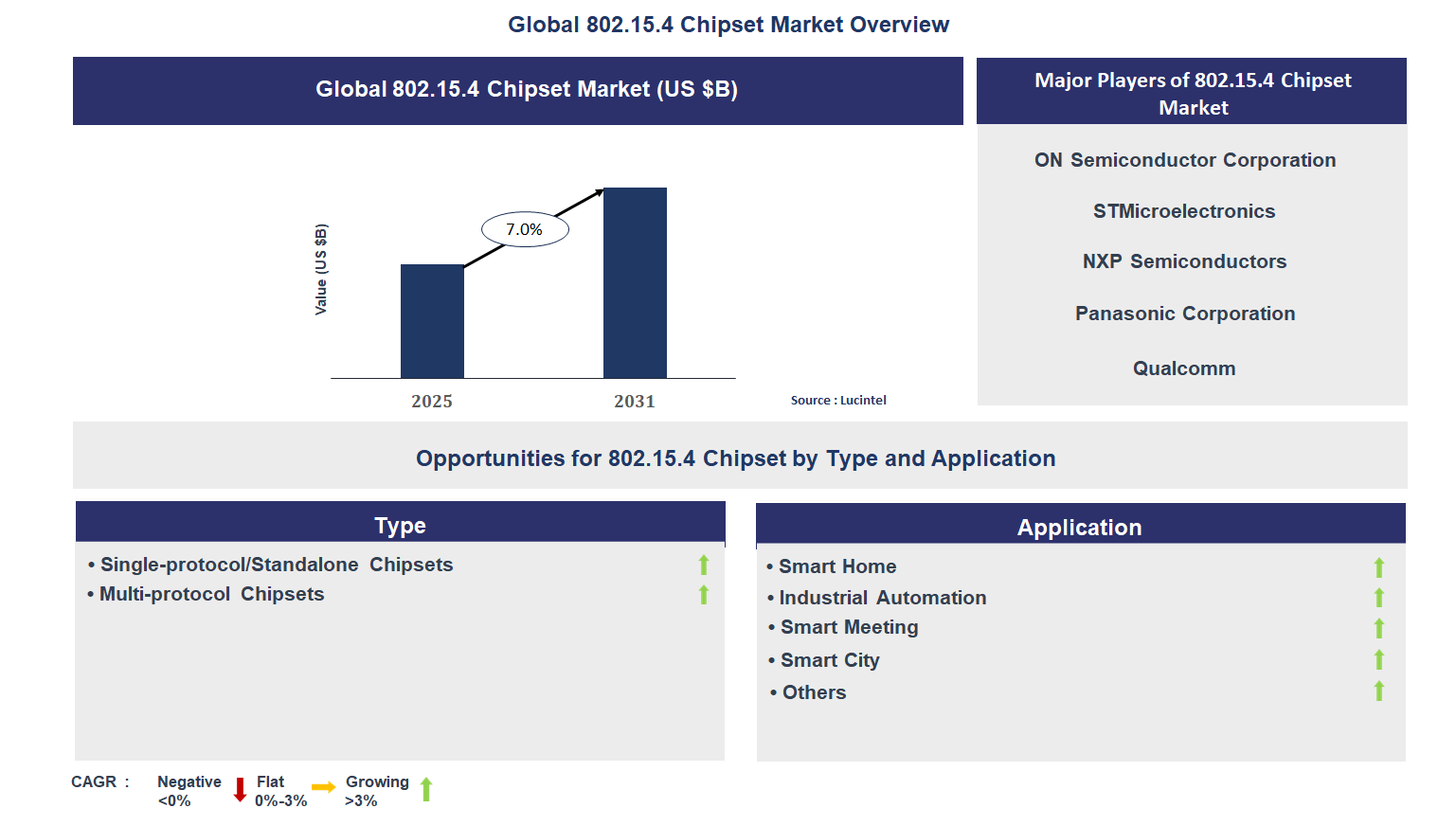
The future of the global 802.15.4 chipset market looks promising with opportunities in the smart home, industrial automation, smart meeting, and smart city markets. The global 802.15.4 chipset market is expected to grow with a CAGR of 7% from 2025 to 2031. The major drivers for this market are the increasing adoption of IoT devices in industries, the rising demand for low-power wireless communication, and the growing need for smart home automation solutions.• Lucintel forecasts that, within the type category, multi-protocol chipset is expected to witness higher growth over the forecast period.
• Within the application category, smart home is expected to witness the highest growth.
• In terms of region, APAC is expected to witness the highest growth over the forecast period. Gain valuable insights for your business decisions with our comprehensive 150+ page report. Sample figures with some insights are shown below.
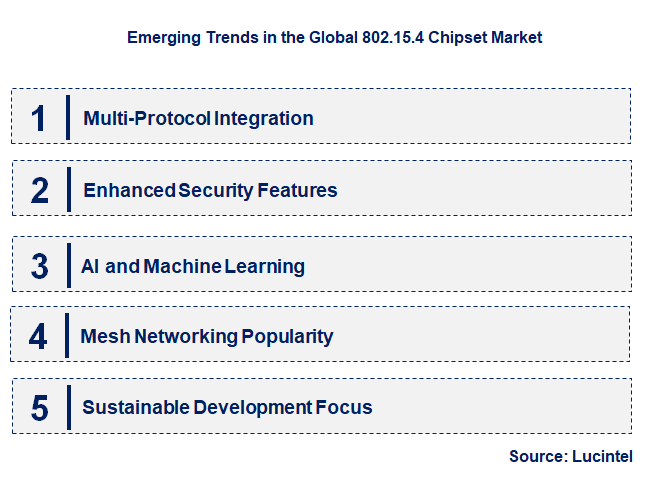
Emerging Trends in the 802.15.4 Chipset Market
The 802.15.4 chipset market is shaped by trends including integration of multi-protocol support, enhanced security, AI-enabled optimization, mesh networking expansion, and sustainability. These trends foster greater energy efficiency, reliability, and broader application adoption.• Multi-Protocol Integration: Chipsets supporting Zigbee, Thread, and Bluetooth enable seamless device interoperability, simplifying network management and expanding use cases in connected environments.
• Enhanced Security Features: Advanced encryption, secure boot, and intrusion detection improve data protection, essential for healthcare and industrial IoT applications.
• AI and Machine Learning: Integration of AI optimizes power consumption and network traffic, enhancing device longevity and communication efficiency.
• Mesh Networking Popularity: Self-healing, scalable mesh networks extend coverage and reliability, crucial for large-scale smart city and industrial deployments.
• Sustainable Development Focus: Adoption of energy-efficient chipsets and eco-friendly manufacturing aligns with environmental regulations and cost-saving goals. These trends collectively drive the 802.15.4 chipset market towards robust, secure, and flexible wireless solutions, essential for the expanding IoT ecosystem.
Recent Development in the 802.15.4 Chipset Market
Recent 802.15.4 chipset market developments focus on technology integration, manufacturing scale, security enhancements, network expansion, and collaborative innovation to meet growing IoT demands.• Scaling Production Capacities: Expansion of fab capacities, especially in Asia Pacific, alleviates supply constraints and supports rising demand.
• Advanced Security Implementations: Chipsets now embed sophisticated security layers to address emerging cyber threats in critical applications.
• Multi-Protocol Chipset Launches: New products enable versatile deployments supporting diverse communication protocols, enhancing interoperability.
• AI-Driven Network Management: On-chip AI capabilities improve efficiency and self-optimization in dense device networks.
• Strategic Industry Partnerships: Alliances between chipset manufacturers and IoT solution providers accelerate technology adoption and market penetration. These developments enhance product capabilities and availability, facilitating wider market penetration and application diversity.
Strategic Growth Opportunities in the 802.15.4 Chipset Market
Expanding IoT, industrial automation, smart homes, healthcare, and smart city applications present key growth avenues for 802.15.4 chipset market worldwide.• Industrial Automation: Demand for robust, secure wireless sensors and controllers boosts chipset adoption for manufacturing efficiency.
• Smart Home Devices: Growing smart lighting, security, and energy management systems drive consumer-level chipset demand.
• Healthcare Monitoring: Wearables and remote patient monitoring systems require low-power, secure wireless communication chips.
• Smart Cities: Infrastructure applications like street lighting and environmental sensors create large-scale deployment opportunities.
• Consumer Electronics: Connected appliances and small gadgets increasingly embed 802.15.4 chipsets for networked functionality. Targeting these applications accelerates market growth by diversifying usage scenarios and fostering technological innovations.
802.15.4 Chipset Market Driver and Challenges
The 802.15.4 chipset market’s growth is driven by IoT expansion, technological advancements, and security demands but faces challenges from supply chain volatility, competition, and interoperability issues. The factors responsible for driving the 802.15.4 chipset market include: 1. Proliferation of IoT Applications: Rapid smart device adoption expands chipset market size. 2. Advancements in Low-Power Technologies: Enhanced efficiency makes chipsets suitable for battery-powered devices. 3. Rising Security Focus: Increased cyber threats drive demand for secure chipset solutions. 4. Government and Industry Initiatives: Support for smart city and industrial IoT infrastructure boosts adoption. 5. Multi-Protocol Flexibility: Chips supporting multiple standards attract broader customer bases. Challenges in the 802.15.4 chipset market are: 1. Supply Chain Disruptions: Raw material shortages and geopolitical issues affect production continuity. 2. Market Competition: Presence of alternative wireless technologies increases pressure on 802.15.4 chipsets. 3. Interoperability Complexities: Ensuring seamless device communication across heterogeneous networks remains a hurdle. Strong demand and innovation prospects uphold market growth; overcoming supply and interoperability challenges is vital for sustained success.List of 802.15.4 Chipset Companies
Companies in the market compete on the basis of product quality offered. Major players in this market focus on expanding their manufacturing facilities, R&D investments, infrastructural development, and leverage integration opportunities across the value chain. With these strategies 802.15.4 chipset companies cater increasing demand, ensure competitive effectiveness, develop innovative products & technologies, reduce production costs, and expand their customer base. Some of the 802.15.4 chipset companies profiled in this report include-• ON Semiconductor Corporation
• STMicroelectronics
• NXP Semiconductors
• Panasonic Corporation
• Qualcomm
• Qorvo
• Marvell International
• Nordic Semiconductor
• Microchip Technology
• Silicon Laboratories
802.15.4 Chipset Market by Segment
The study includes a forecast for the global 802.15.4 chipset market by type, application, and region.802.15.4 Chipset Market by Type [Value from 2019 to 2031]:
• Single-protocol/Standalone Chipsets
• Multi-protocol Chipsets
802.15.4 Chipset Market by Application [Value from 2019 to 2031]:
• Smart Home
• Industrial Automation
• Smart Meeting
• Smart City
• Others
802.15.4 Chipset Market by Region [Value from 2019 to 2031]:
• North America
• Europe
• Asia Pacific
• The Rest of the World
Country Wise Outlook for the 802.15.4 Chipset Market
The 802.15.4 chipset market is experiencing robust growth globally, fueled by the expansion of low-power wireless technologies used in IoT, smart homes, industrial automation, and healthcare. Key regions such as the United States, China, Germany, India, and Japan are advancing the market through technological innovation, capacity expansion, and increased adoption across various sectors.• United States: The US market leads with significant R&D investments by key players focusing on improving power efficiency, security, and multi-protocol support in 802.15.4 chipsets. Major emphasis is on smart home and industrial IoT adoption, with innovations enhancing interoperability and network scalability. Federal support for smart city projects further accelerates chipset deployment.
• China: China dominates in volume production and capacity expansion of 802.15.4 chipsets, backed by strong government incentives and rapidly growing domestic IoT infrastructure. Manufacturers prioritize cost-effective, multi-protocol chipsets for smart cities, consumer electronics, and industrial automation, positioning China as a global manufacturing hub and innovation leader in the market.
• Germany: Germany focuses on high-quality, secure, and energy-efficient 802.15.4 chipsets suited for industrial automation, automotive, and smart building applications. Collaboration between manufacturers and automotive OEMs drives adoption for connected vehicles and factory automation. Compliance with stringent EU regulations shapes development and manufacturing standards.
• India: India’s 802.15.4 chipset market is rapidly growing due to increased IoT device adoption, government initiatives promoting digital infrastructure, and rising consumer awareness. Domestic manufacturing and import substitution efforts support affordable chipset production for smart homes, agriculture, and industrial sectors, bolstering local ecosystem growth.
• Japan: Japan emphasizes miniaturized, low-power, and secure 802.15.4 chipsets targeting wearables, medical devices, and automotive connectivity. Strong focus on R&D accelerates development of multi-protocol chipsets integrated with AI capabilities. Government-backed programs for smart city deployments fuel demand in urban infrastructure.

Features of the Global 802.15.4 Chipset Market
Market Size Estimates: 802.15.4 chipset market size estimation in terms of value ($B). Trend and Forecast Analysis: Market trends (2019 to 2024) and forecast (2025 to 2031) by various segments and regions. Segmentation Analysis: 802.15.4 chipset market size by type, application, and region in terms of value ($B). Regional Analysis: 802.15.4 chipset market breakdown by North America, Europe, Asia Pacific, and Rest of the World. Growth Opportunities: Analysis of growth opportunities in different types, applications, and regions for the 802.15.4 chipset market. Strategic Analysis: This includes M&A, new product development, and competitive landscape of the 802.15.4 chipset market. Analysis of competitive intensity of the industry based on Porter’s Five Forces model.
FAQ
Q1. What is the growth forecast for 802.15.4 chipset market? Answer: The global 802.15.4 chipset market is expected to grow with a CAGR of 7% from 2025 to 2031. Q2. What are the major drivers influencing the growth of the 802.15.4 chipset market? Answer: The major drivers for this market are the increasing adoption of iot devices in industries, the rising demand for low-power wireless communication, and the growing need for smart home automation solutions. Q3. What are the major segments for 802.15.4 chipset market? Answer: The future of the 802.15.4 chipset market looks promising with opportunities in the smart home, industrial automation, smart meeting, and smart city markets. Q4. Who are the key 802.15.4 chipset market companies? Answer: Some of the key 802.15.4 chipset companies are as follows:• ON Semiconductor Corporation
• STMicroelectronics
• NXP Semiconductors
• Panasonic Corporation
• Qualcomm
• Qorvo
• Marvell International
• Nordic Semiconductor
• Microchip Technology
• Silicon Laboratories Q5. Which 802.15.4 chipset market segment will be the largest in future? Answer: Lucintel forecasts that, within the type category, multi-protocol chipset is expected to witness higher growth over the forecast period. Q6. In 802.15.4 chipset market, which region is expected to be the largest in next 5 years? Answer: In terms of region, APAC is expected to witness the highest growth over the forecast period. Q7. Do we receive customization in this report? Answer: Yes, Lucintel provides 10% customization without any additional cost.
Table of Contents
List of Figures
List of Tables
Methodology
- In-depth interviews of the major players in this market
- Detailed secondary research from competitors’ financial statements and published data
- Extensive searches of published works, market, and database information pertaining to industry news, company press releases, and customer intentions
- A compilation of the experiences, judgments, and insights of Lucintel’s professionals, who have analyzed and tracked this market over the years.


Buy Now
Choose a license that fits your team. Instant PDF delivery.
Prices exclude taxes. Instant delivery. Custom licensing available on request.
Key Questions
- • What are some of the most promising, high-growth opportunities for the 802.15.4 chipset market by type (single-protocol/standalone chipsets and multi-protocol chipsets), application (smart home, industrial automation, smart meeting, smart city, and others), and region (North America, Europe, Asia Pacific, and the Rest of the World)?
- • Which segments will grow at a faster pace and why?
- • Which region will grow at a faster pace and why?
- • What are the key factors affecting market dynamics? What are the key challenges and business risks in this market?
- • What are the business risks and competitive threats in this market?
- • What are the emerging trends in this market and the reasons behind them?
- • What are some of the changing demands of customers in the market?
- • What are the new developments in the market? Which companies are leading these developments?
- • Who are the major players in this market? What strategic initiatives are key players pursuing for business growth?
- • What are some of the competing products in this market and how big of a threat do they pose for loss of market share by material or product substitution?
- • What M&A activity has occurred in the last 5 years and what has its impact been on the industry? For any questions related to 802.15.4 Chipset Market, 802.15.4 Chipset Market Size, 802.15.4 Chipset Market Growth, 802.15.4 Chipset Market Analysis, 802.15.4 Chipset Market Report, 802.15.4 Chipset Market Share, 802.15.4 Chipset Market Trends, 802.15.4 Chipset Market Forecast, 802.15.4 Chipset Companies, write Lucintel analyst at email: helpdesk@lucintel.com. We will be glad to get back to you soon.


