
Report Feature
6G Core Network Market Trends and Forecast
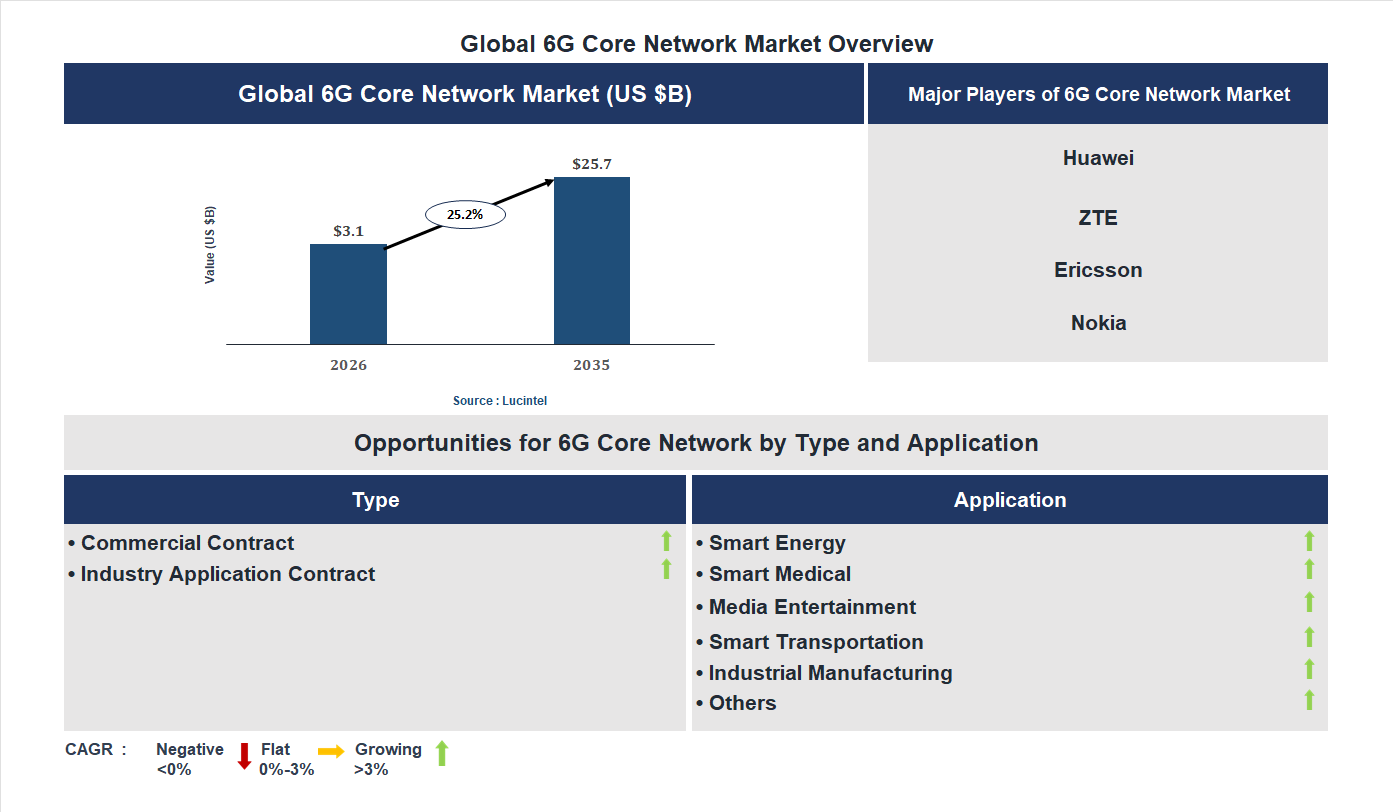
The future of the global 6G core network market looks promising with opportunities in the smart energy, smart medical, media entertainment, smart transportation, and industrial manufacturing markets. The global 6G core network market is expected to reach an estimated $25.7 billion by 2035 with a CAGR of 25.2% from 2026 to 2035. The major drivers for this market are the increasing demand for high-speed connectivity, the rising adoption of IoT technologies, and the growing need for advanced network infrastructure.• Lucintel forecasts that, within the type category, commercial contract is expected to witness higher growth over the forecast period.
• Within the application category, smart medical is expected to witness the highest growth.
• In terms of region, APAC is expected to witness the highest growth over the forecast period. Gain valuable insights for your business decisions with our comprehensive 150+ page report. Sample figures with some insights are shown below.
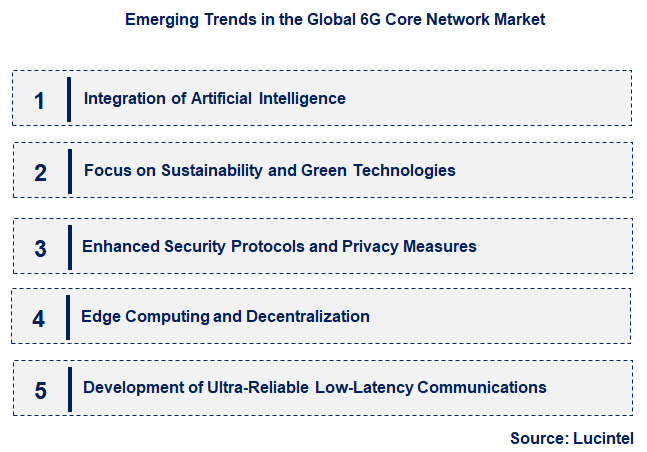
Emerging Trends in the 6G Core Network Market
The 6G core network market is on the cusp of transformative change, driven by rapid technological advancements and increasing demand for faster, more reliable connectivity. As industries and consumers alike seek seamless digital experiences, the development of 6G technology promises to revolutionize communication infrastructure. This evolution is characterized by innovations in AI integration, enhanced security protocols, and sustainable network solutions. These emerging trends are not only shaping the future of telecommunications but also redefining how data is transmitted, processed, and secured across global networks. Understanding these key trends is essential for stakeholders aiming to stay ahead in this competitive landscape.• Integration of Artificial Intelligence: AI is becoming central to 6G core networks, enabling smarter network management, predictive maintenance, and personalized services. AI-driven automation reduces latency, enhances network efficiency, and improves user experience by dynamically optimizing resource allocation. This trend facilitates real-time decision-making and supports the deployment of complex applications like autonomous vehicles and smart cities. As AI becomes more embedded, networks will become more adaptive, resilient, and capable of handling massive data volumes with minimal human intervention, significantly transforming network operations and service delivery.
• Focus on Sustainability and Green Technologies: Environmental concerns are prompting the adoption of eco-friendly network solutions in the 6G landscape. Green technologies such as energy-efficient hardware, renewable energy sources, and optimized network architectures aim to reduce carbon footprints. These initiatives are crucial for meeting global sustainability goals while maintaining high performance. The shift towards sustainable networks not only minimizes environmental impact but also reduces operational costs, making 6G networks more economically viable and appealing to environmentally conscious stakeholders. This trend underscores the importance of eco-conscious innovation in future network development.
• Enhanced Security Protocols and Privacy Measures: As 6G networks handle more sensitive data and support critical applications, security becomes paramount. Advanced encryption, blockchain integration, and AI-powered threat detection are being incorporated to safeguard data integrity and user privacy. These security enhancements are designed to counter increasingly sophisticated cyber threats, ensuring trust and reliability in 6G services. The emphasis on security protocols will foster greater confidence among users and enterprises, facilitating widespread adoption of 6G technology. Strengthening security measures is essential for the sustainable growth of the 6G core network market.
• Edge Computing and Decentralization: The proliferation of IoT devices and data-intensive applications necessitates decentralized processing capabilities. 6G networks are expected to heavily leverage edge computing, bringing data processing closer to the source to reduce latency and bandwidth usage. This decentralization enhances real-time responsiveness and supports applications like augmented reality, virtual reality, and autonomous systems. By distributing computational loads, networks become more scalable and resilient. The integration of edge computing into 6G core networks is reshaping data architecture, enabling more efficient and innovative service delivery across various sectors.
• Development of Ultra-Reliable Low-Latency Communications: The demand for mission-critical applications such as remote surgery, autonomous vehicles, and industrial automation drives the focus on URLLC in 6G networks. These networks aim to deliver near-instantaneous data transmission with minimal errors, ensuring high reliability and low latency. This trend is vital for enabling real-time control and safety-critical operations, transforming industries and enhancing user experiences. The advancement of URLLC capabilities in 6G will set new standards for network performance, fostering innovation in sectors that require absolute dependability and speed. In summary, these emerging trends—AI integration, sustainability efforts, enhanced security, edge computing, and URLLC—are collectively reshaping the 6G core network market. They are driving innovation, improving efficiency, and ensuring that future networks are more intelligent, secure, and environmentally sustainable. These developments will enable a new era of connectivity, supporting the growth of smart cities, autonomous systems, and immersive digital experiences worldwide.
Recent Development in the 6G Core Network Market
The 6G core network market is rapidly evolving, driven by advancements in technology and increasing demand for faster, more reliable connectivity. As industries and consumers seek seamless digital experiences, the development of 6G infrastructure promises transformative impacts across sectors. These innovations are shaping the future of communication, enabling smarter cities, enhanced IoT integration, and unprecedented data speeds. Stakeholders are investing heavily to capitalize on these opportunities, positioning 6G as a pivotal element in the next-generation digital ecosystem.• Development of Ultra-Low Latency Networks: The focus on reducing latency to sub-millisecond levels will revolutionize real-time applications, including autonomous vehicles and remote surgeries. This advancement enhances user experience and operational efficiency, fostering new business models and services. The market benefits from increased demand for high-speed, reliable connectivity, attracting investments and accelerating deployment timelines. Overall, ultra-low latency networks will set new standards for digital communication, boosting competitiveness and innovation.
• Integration of AI and Machine Learning in Network Management: Incorporating AI and ML into 6G core networks enables smarter, more adaptive infrastructure. These technologies optimize resource allocation, improve security, and predict network failures proactively. The impact includes reduced operational costs and enhanced user experiences, making networks more resilient and efficient. As AI-driven management becomes standard, the market will see increased adoption, fostering a new wave of intelligent network solutions that support complex applications and services.
• Expansion of Quantum Communication Technologies: Quantum communication offers unparalleled security and data transfer capabilities, critical for sensitive information exchange. Its integration into 6G networks will address growing cybersecurity concerns and enable secure, high-speed data transmission. This development attracts government and enterprise investments, positioning quantum tech as a key differentiator. The market will benefit from increased trust and new security paradigms, facilitating the adoption of 6G in sectors requiring stringent data protection.
• Development of Sustainable and Energy-Efficient Networks: Emphasizing green technology, 6G networks aim to reduce energy consumption and carbon footprint. Innovations include energy-efficient hardware and optimized network architectures. This focus aligns with global sustainability goals, appealing to environmentally conscious stakeholders. The market will experience growth driven by regulatory incentives and corporate responsibility initiatives, fostering a sustainable digital future. These developments will also lower operational costs and enhance corporate reputation.
• Deployment of Integrated Satellite and Terrestrial Networks: Combining satellite and terrestrial infrastructure ensures ubiquitous coverage, especially in remote and underserved areas. This integration enhances connectivity resilience and supports global IoT expansion. It enables seamless communication across diverse environments, opening new markets and applications. The market impact includes increased inclusivity, reduced digital divides, and expanded service offerings. This holistic approach will accelerate 6G adoption worldwide, transforming how and where connectivity is delivered. The overall impact of these developments is a more robust, secure, and sustainable 6G core network market. They drive innovation, expand market reach, and improve user experiences, positioning 6G as a cornerstone of future digital transformation. As these opportunities mature, they will foster economic growth, technological leadership, and global connectivity.
Strategic Growth Opportunities in the 6G Core Network Market
The 6G core network market is poised for significant expansion driven by advancements in technology, increasing data demands, and the need for ultra-reliable, low-latency connectivity. As industries adopt 6G for innovative applications, opportunities arise across various sectors, including healthcare, automotive, and smart cities. Strategic investments and technological breakthroughs will shape the competitive landscape, enabling new services and enhancing user experiences. This evolving market offers substantial growth potential for stakeholders willing to innovate and adapt to future connectivity needs.• Expanding IoT and Smart City Infrastructure: The proliferation of IoT devices and smart city initiatives will drive demand for 6G core networks, which can support massive device connectivity, real-time data processing, and enhanced security. 6G’s ultra-low latency and high bandwidth capabilities will enable seamless integration of sensors, autonomous systems, and urban infrastructure, fostering smarter, more efficient cities. This growth opportunity will attract investments from governments and the private sectors aiming to modernize urban environments and improve the quality of life.
• Enabling Ultra-reliable, Low-latency Communications for Autonomous Vehicles: The automotive industry’s shift toward autonomous vehicles relies heavily on 6G’s capabilities for instant data exchange and minimal latency. 6G core networks will facilitate vehicle-to-everything (V2X) communication, ensuring safety, coordination, and real-time decision-making. This opportunity will accelerate the deployment of autonomous transportation systems, reduce accidents, and transform mobility services, attracting automotive manufacturers and technology providers to develop specialized 6G solutions.
• Supporting Advanced Healthcare Applications through Remote Diagnostics and Telemedicine: 6G core networks will revolutionize healthcare by enabling high-quality, real-time remote diagnostics, telemedicine, and robotic surgeries. The ultra-reliable, high-capacity connectivity will facilitate seamless data transfer of medical images, patient records, and live video feeds. This growth opportunity will improve healthcare access, especially in remote areas, and foster innovations in personalized medicine, attracting healthcare providers, technology firms, and government agencies investing in next-generation medical infrastructure.
• Facilitating Immersive AR/VR Experiences for Entertainment and Enterprise: The demand for immersive augmented reality (AR) and virtual reality (VR) applications will surge with 6G’s high bandwidth and low latency. These networks will support seamless, high-quality streaming for gaming, virtual meetings, and training simulations. This opportunity will open new revenue streams for entertainment companies and enterprise training providers, while also enabling innovative applications in education, retail, and remote collaboration, thus transforming user engagement and operational efficiency.
• Accelerating Industrial Automation and Smart Manufacturing Processes: 6G core networks will enable real-time data exchange, predictive analytics, and autonomous control in manufacturing environments. This will lead to highly efficient, flexible, and intelligent production lines, reducing downtime and operational costs. The opportunity for industrial automation will attract manufacturers and technology providers seeking to optimize supply chains, improve product quality, and implement Industry 4.0 standards, ultimately transforming manufacturing ecosystems into highly connected, autonomous systems. The overall impact of these growth opportunities will significantly shape the 6G core network market, fostering innovation, enhancing connectivity, and enabling new business models across multiple sectors. Stakeholders investing in these areas will be positioned to capitalize on the transformative potential of 6G technology, driving market expansion and technological leadership in the coming years.
6G Core Network Market Driver and Challenges
The 6G core network market is influenced by a multitude of technological, economic, and regulatory factors that shape its development and adoption. Rapid advancements in wireless technology, increasing demand for higher data speeds, and the proliferation of connected devices are key technological drivers. Economic factors such as investments in infrastructure and the growing need for digital transformation further propel the market. Regulatory policies around spectrum allocation, security standards, and international cooperation also play a significant role. However, the market faces challenges, including high deployment costs, technological uncertainties, and regulatory complexities that could hinder growth. Understanding these drivers and challenges is essential for stakeholders to navigate the evolving landscape effectively. The factors responsible for driving the 6G core network market include:• Technological Innovation: The push for faster, more reliable wireless communication fuels the development of 6G technology. Innovations in AI, machine learning, and quantum computing are integrated into network architecture, enabling ultra-low latency, enhanced security, and massive connectivity. These advancements meet the increasing demand for immersive experiences like augmented reality and holography, positioning 6G as a transformative technology. The continuous evolution of hardware and software accelerates deployment timelines, attracting investments from telecom operators and tech giants eager to lead the next-generation network race.
• Growing Data Traffic and Connectivity Needs: The exponential rise in data consumption driven by IoT devices, smart cities, autonomous vehicles, and cloud computing necessitates more robust network infrastructure. 6G aims to support unprecedented data rates and device densities, ensuring seamless connectivity across diverse sectors. This demand encourages telecom providers to upgrade their networks, fostering innovation in network slicing, edge computing, and integrated AI solutions. As industries increasingly rely on real-time data exchange, the markets expansion is driven by the imperative to meet these escalating connectivity requirements.
• Economic Investments and Strategic Partnerships: Governments and private enterprises are investing heavily in 6G research and development to secure technological leadership. Strategic collaborations between academia, industry, and policymakers facilitate the sharing of knowledge, resources, and infrastructure. Funding initiatives and public-private partnerships accelerate standardization efforts and pilot projects, creating a conducive environment for commercialization. These investments not only stimulate market growth but also foster innovation ecosystems that can adapt to future technological shifts, ensuring competitive advantage in the global digital economy.
• Regulatory Frameworks and Spectrum Allocation: Effective regulatory policies are crucial for the deployment of 6G networks. Governments are establishing spectrum allocation strategies to accommodate the high-frequency bands required for 6G, balancing spectrum sharing and licensing. Standards development organizations are working on security, privacy, and interoperability guidelines to facilitate global adoption. Clear regulatory frameworks reduce uncertainties for investors and operators, enabling smoother deployment and commercialization. As policies evolve, they will significantly influence the pace and scope of 6G network rollouts worldwide. The challenges facing this 6G core network market include:
• High Deployment and Infrastructure Costs: Implementing 6G networks requires significant capital expenditure on new hardware, spectrum licenses, and infrastructure upgrades. The high costs pose barriers for telecom operators, especially in emerging markets with limited financial resources. Additionally, the need for dense small cell deployments and advanced backhaul solutions increases complexity and expenses. These financial challenges could slow down the adoption rate and limit initial coverage, impacting the overall market growth trajectory.
• Technological Uncertainties and Standardization: As 6G is still in the research phase, many technological aspects remain unproven or undefined. The lack of established standards creates uncertainty for manufacturers and service providers, potentially leading to compatibility issues and delayed deployment. Rapid technological evolution may also render early solutions obsolete, necessitating continuous innovation and investment. This uncertainty hampers investor confidence and complicates strategic planning, posing a significant challenge to timely market realization.
• Regulatory and Security Concerns: The deployment of 6G involves complex regulatory considerations, including spectrum management, data privacy, and cybersecurity. Differing international policies can create barriers to global interoperability and market entry. Security vulnerabilities associated with ultra-connected networks pose risks of cyberattacks and data breaches, raising concerns among consumers and regulators. Addressing these issues requires comprehensive frameworks and international cooperation, which can be time-consuming and politically sensitive, potentially delaying widespread adoption. In summary, the 6G core network market is driven by rapid technological innovation, increasing data demands, strategic investments, and evolving regulatory frameworks. However, high deployment costs, technological uncertainties, and security concerns present significant hurdles. These factors collectively shape the markets growth trajectory, requiring stakeholders to navigate complex challenges while leveraging emerging opportunities. The interplay of these drivers and challenges will determine the pace and scope of 6G adoption, influencing the future landscape of global telecommunications.
List of 6G Core Network Companies
Companies in the market compete on the basis of product quality offered. Major players in this market focus on expanding their manufacturing facilities, R&D investments, infrastructural development, and leverage integration opportunities across the value chain. With these strategies 6G core network companies cater increasing demand, ensure competitive effectiveness, develop innovative products & technologies, reduce production costs, and expand their customer base. Some of the 6G core network companies profiled in this report include-• Huawei
• ZTE
• Ericsson
• Nokia
6G Core Network Market by Segment
The study includes a forecast for the global 6G core network market by type, application, and region.6G Core Network Market by Type [Value from 2019 to 2035]:
• Commercial Contract
• Industry Application Contract
6G Core Network Market by Application [Value from 2019 to 2035]:
• Smart Energy
• Smart Medical
• Media Entertainment
• Smart Transportation
• Industrial Manufacturing
• Others
6G Core Network Market by Region [Value from 2019 to 2035]:
• North America
• Europe
• Asia Pacific
• The Rest of the World
Country Wise Outlook for the 6G Core Network Market
The 6G core network market is rapidly evolving as countries invest heavily in next-generation telecommunications infrastructure. With the promise of ultra-high speeds, low latency, and enhanced connectivity, nations are competing to lead in 6G technology development. Governments, tech giants, and telecom providers are collaborating to establish standards, conduct research, and deploy pilot projects. The race for 6G dominance is driven by the need for smarter cities, autonomous systems, and advanced IoT applications. As the market matures, regulatory frameworks and international cooperation will play crucial roles in shaping the global 6G landscape.• United States: The US has made significant investments in 6G research, with major tech companies like Qualcomm and Apple leading development efforts. The government has launched initiatives to explore 6G standards and spectrum allocation, aiming to maintain technological leadership. Several universities are conducting pioneering research on 6G applications, including AI integration and satellite connectivity. The US also emphasizes cybersecurity and privacy in 6G deployment, ensuring a secure infrastructure. Pilot projects are underway in cities like San Francisco and Austin, focusing on ultra-reliable low-latency communications for autonomous vehicles and smart city solutions.
• China: China is aggressively advancing its 6G research, with the government prioritizing 6G as a national strategic goal. Major telecom operators such as China Mobile and Huawei are conducting extensive trials on 6G prototypes, focusing on high-frequency millimeter-wave and terahertz technologies. The country aims to lead in global standards and has established dedicated research institutes for 6G development. China is also investing in satellite-based 6G connectivity to enhance rural and remote areas. The government’s support includes funding, policy incentives, and international collaborations to accelerate deployment and commercialization.
• Germany: Germany is focusing on integrating 6G into its Industry 4.0 initiatives, emphasizing industrial automation and smart manufacturing. The country’s research institutions, including Fraunhofer and Deutsche Telekom, are exploring 6G use cases such as holographic communications and tactile internet. Germany is also active in European Union efforts to develop 6G standards and coordinate cross-border research projects. The government is investing in 6G pilot networks and fostering partnerships between academia and industry to ensure technological sovereignty and economic competitiveness in the emerging market.
• India: India is rapidly progressing in 6G research, with the government and private sector collaborating on pilot projects and trials. The Department of Telecommunications has launched initiatives to explore 6G use cases like rural connectivity, telemedicine, and smart agriculture. Indian tech firms are partnering with global companies to develop 6G prototypes, focusing on affordability and scalability. The country aims to leverage 6G to bridge digital divides and support its digital economy. Policy frameworks are being drafted to facilitate spectrum allocation and standardization, with a focus on inclusive growth and technological self-reliance.
• Japan: Japan is investing heavily in 6G research, with a focus on integrating advanced AI and quantum technologies. Major corporations like NTT and Sony are conducting experimental trials on 6G networks, emphasizing high-capacity data transmission and low latency. The government has announced strategic plans to develop 6G infrastructure by 2030, aiming to support smart cities and autonomous transportation. Japan is also collaborating internationally to establish global standards and promote innovation. The country’s research centers are exploring new materials and antenna technologies to enhance 6G performance, positioning Japan as a key player in the global 6G race.

Features of the Global 6G Core Network Market
Market Size Estimates: 6G core network market size estimation in terms of value ($B). Trend and Forecast Analysis: Market trends (2019 to 2025) and forecast (2026 to 2035) by various segments and regions. Segmentation Analysis: 6G core network market size by type, application, and region in terms of value ($B). Regional Analysis: 6G core network market breakdown by North America, Europe, Asia Pacific, and Rest of the World. Growth Opportunities: Analysis of growth opportunities in different type, application, and regions for the 6G core network market. Strategic Analysis: This includes M&A, new product development, and competitive landscape of the 6G core network market. Analysis of competitive intensity of the industry based on Porter’s Five Forces model.
FAQ
Q1. What is the market size and growth forecast for 6G core network market? Answer: The global 6G core network market is expected to reach an estimated $25.7 billion by 2035 and grow with a CAGR of 25.2% from 2026 to 2035. Q2. What are the major drivers influencing the growth of the 6G core network market? Answer: The major drivers for this market are the increasing demand for high-speed connectivity, the rising adoption of iot technologies, and the growing need for advanced network infrastructure. Q3. What are the major segments for 6G core network market? Answer: The future of the 6G core network market looks promising with opportunities in the smart energy, smart medical, media entertainment, smart transportation, and industrial manufacturing markets. Q4. Who are the key 6G core network market companies? Answer: Some of the key 6G core network companies are as follows:• Huawei
• ZTE
• Ericsson
• Nokia Q5. Which 6G core network market segment will be the largest in future? Answer: Lucintel forecasts that, within the type category, commercial contract is expected to witness higher growth over the forecast period. Q6. In 6G core network market, which region is expected to be the largest in next 5 years? Answer: In terms of region, APAC is expected to witness the highest growth over the forecast period. Q7. Do we receive customization in this report? Answer: Yes, Lucintel provides 10% customization without any additional cost.
Table of Contents
List of Figures
List of Tables
Methodology
- In-depth interviews of the major players in this market
- Detailed secondary research from competitors’ financial statements and published data
- Extensive searches of published works, market, and database information pertaining to industry news, company press releases, and customer intentions
- A compilation of the experiences, judgments, and insights of Lucintel’s professionals, who have analyzed and tracked this market over the years.


Buy Now
Choose a license that fits your team. Instant PDF delivery.
Prices exclude taxes. Instant delivery. Custom licensing available on request.
Key Questions
- • What are some of the most promising, high-growth opportunities for the 6G core network market by type (commercial contract and industry application contract), application (smart energy, smart medical, media entertainment, smart transportation, industrial manufacturing, and others), and region (North America, Europe, Asia Pacific, and the Rest of the World)?
- • Which segments will grow at a faster pace and why?
- • Which region will grow at a faster pace and why?
- • What are the key factors affecting market dynamics? What are the key challenges and business risks in this market?
- • What are the business risks and competitive threats in this market?
- • What are the emerging trends in this market and the reasons behind them?
- • What are some of the changing demands of customers in the market?
- • What are the new developments in the market? Which companies are leading these developments?
- • Who are the major players in this market? What strategic initiatives are key players pursuing for business growth?
- • What are some of the competing products in this market and how big of a threat do they pose for loss of market share by material or product substitution?
- • What M&A activity has occurred in the last 7 years and what has its impact been on the industry? For any questions related to 6G Core Network Market, 6G Core Network Market Size, 6G Core Network Market Growth, 6G Core Network Market Analysis, 6G Core Network Market Report, 6G Core Network Market Share, 6G Core Network Market Trends, 6G Core Network Market Forecast, 6G Core Network Companies, write Lucintel analyst at email: helpdesk@lucintel.com. We will be glad to get back to you soon.


