
Report Feature
5G Telemedicine Market Trends and Forecast
The future of the global 5g telemedicine market looks promising with opportunities in the hospital, home healthcare, and educational institution markets. The global 5g telemedicine market is expected to grow with a CAGR of 16.5% from 2025 to 2031. The major drivers for this market are growing demand for sophisticated healthcare services, increasing awareness about early disease diagnosis, and growing prevalence of chronic and infectious diseases. Lucintel forecasts that, within the type category, patient monitoring will remain the largest segment over the forecast period due to reliable transmission of large amounts of data. Within the application category, hospital will remain the largest segment due to advanced use of 5g technology to improve patient care, remote monitoring. In terms of region, North America will remain the largest region over the forecast period due to high adoption of new technologies, investment in telemedicine solution. Gain valuable insights for your business decisions with our comprehensive 150+ page report. Sample figures with some insights are shown below.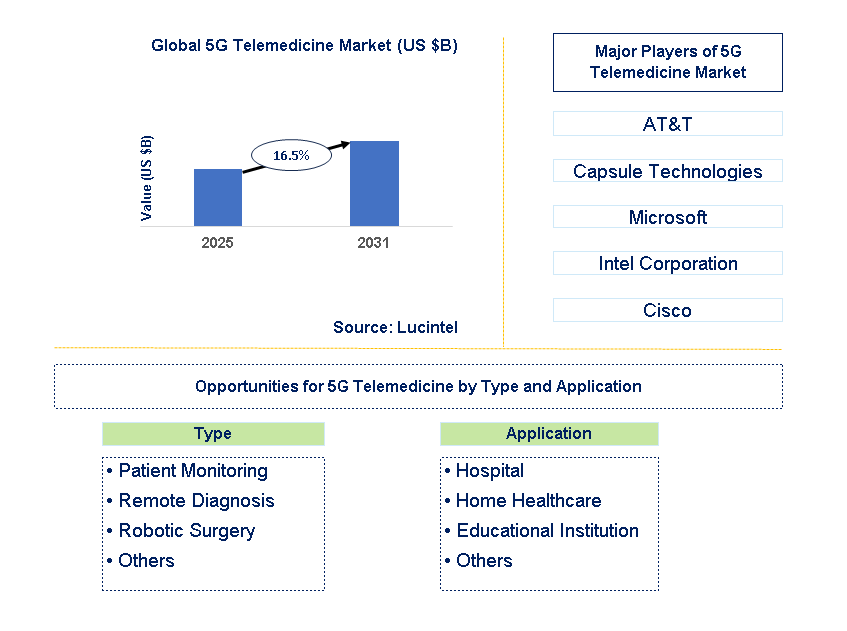
5G Telemedicine Market by Segment
• AI and Data Analytics for Diagnostics: 5G enables the rapid transmission of large data sets, allowing AI-driven tools to analyze patient information more efficiently. This results in quicker and more accurate diagnoses, especially in complex cases such as cancer detection or chronic disease management.
• Robotic Surgery: 5G connectivity facilitates real-time, remote-controlled surgeries. Surgeons can operate robots from different locations, enabling high-precision surgeries in areas with limited medical expertise, thus expanding access to advanced surgical interventions.
• Augmented Reality (AR) in Healthcare: AR technologies supported by 5G are enhancing medical training, remote consultations, and even surgeries. Surgeons can overlay digital images onto a patient’s body, providing better visualization during procedures, which improves accuracy and patient outcomes.
• Telehealth for Mental Health Services: As telemedicine becomes more integrated with 5G, mental health services are also expanding. 5G technology is enabling real-time video therapy sessions, online counseling, and better access to mental health care, especially in underserved regions. These emerging trends are not just technological advancements—they are transforming how healthcare is delivered and accessed. From enabling faster diagnoses to providing remote access to specialist care, 5G is breaking down geographical and resource-based barriers, ensuring more people can receive high-quality medical attention." src="Emerging Trends in the 5G Telemedicine Market" style="height: auto;width: auto;" title="As 5G technology continues to evolve, several trends are emerging that are reshaping the telemedicine landscape. These trends include innovations in remote patient monitoring, AI-driven diagnostics, augmented reality (AR) in healthcare, the use of robotic surgery, and the growing emphasis on mental health services. Each of these developments is contributing to improved patient outcomes, cost efficiencies, and access to healthcare services across the globe.
• Remote Patient Monitoring (RPM): The ability to monitor patients in real time, even from remote locations, is revolutionizing telemedicine. With 5G’s low latency and high speed, devices such as wearable sensors can continuously track patient vitals and send data to healthcare providers, enabling timely interventions.
• AI and Data Analytics for Diagnostics: 5G enables the rapid transmission of large data sets, allowing AI-driven tools to analyze patient information more efficiently. This results in quicker and more accurate diagnoses, especially in complex cases such as cancer detection or chronic disease management.
• Robotic Surgery: 5G connectivity facilitates real-time, remote-controlled surgeries. Surgeons can operate robots from different locations, enabling high-precision surgeries in areas with limited medical expertise, thus expanding access to advanced surgical interventions.
• Augmented Reality (AR) in Healthcare: AR technologies supported by 5G are enhancing medical training, remote consultations, and even surgeries. Surgeons can overlay digital images onto a patient’s body, providing better visualization during procedures, which improves accuracy and patient outcomes.
• Telehealth for Mental Health Services: As telemedicine becomes more integrated with 5G, mental health services are also expanding. 5G technology is enabling real-time video therapy sessions, online counseling, and better access to mental health care, especially in underserved regions. These emerging trends are not just technological advancements—they are transforming how healthcare is delivered and accessed. From enabling faster diagnoses to providing remote access to specialist care, 5G is breaking down geographical and resource-based barriers, ensuring more people can receive high-quality medical attention." />
Emerging Trends in the 5G Telemedicine Market
Recent Development in the 5G Telemedicine Market
Recent developments in the 5G telemedicine market have been pivotal in enhancing the scope and efficiency of healthcare delivery. Key advancements include the expansion of 5G infrastructure, integration of AI in diagnostics, growth of mobile health apps, government policy changes, and the development of 5G-powered wearable devices. These developments have had a profound impact on healthcare systems globally, especially by increasing access, improving treatment outcomes, and reducing costs.• Expansion of 5G Infrastructure: The global rollout of 5G networks is one of the most significant developments. By improving connectivity speeds, 5G is enabling real-time, high-quality telehealth services, ensuring reliable access to healthcare resources, even in rural or remote areas.
• AI Integration in Diagnostics: The use of AI and machine learning in diagnostics is becoming more prominent. With 5G’s ability to handle large datasets quickly, AI tools are more effective in identifying diseases early, predicting treatment outcomes, and offering personalized healthcare plans.
• Growth of Mobile Health Apps: The development and adoption of mobile health applications have surged with 5G technology. These apps allow patients to monitor their health status, access remote consultations, and receive personalized care plans, improving overall health outcomes and patient satisfaction.
• Government Policy Changes: Governments worldwide are recognizing the potential of 5G in telemedicine and have implemented policies to encourage its growth. This includes regulatory changes that make it easier to access telehealth services, particularly in underserved regions, and support for healthcare digitalization.
• Development of Wearable Devices: Wearable healthcare devices, supported by 5G, have become more advanced, allowing continuous monitoring of patient vitals. These devices provide healthcare providers with real-time data, helping to detect health issues early and offering better treatment and preventative care. These developments are reshaping the landscape of healthcare. From enabling the expansion of telemedicine services to enhancing diagnostic accuracy, 5G technology is increasing access to quality healthcare and improving patient outcomes.
Strategic Growth Opportunities in the 5G Telemedicine Market
Strategic growth opportunities in the 5G telemedicine market span a wide range of applications, from remote diagnostics to enhanced surgical capabilities. These opportunities are poised to reshape the healthcare sector, particularly in areas where access to specialists and timely care is limited.• Remote Diagnostics: The ability to conduct remote diagnostics, facilitated by 5G, is a significant growth opportunity. This allows healthcare providers to evaluate a patient’s condition without requiring physical visits, reducing the strain on healthcare facilities and making healthcare more accessible.
• Teleconsultations and Virtual Care: The increasing acceptance of teleconsultations, particularly for non-emergency situations, offers an opportunity for growth. With 5G, the quality of video consultations improves, enabling doctors to diagnose and treat patients more effectively from a distance.
• Robotic Surgery: 5G technology’s ultra-low latency makes robotic surgery more feasible. Surgeons can perform complex operations remotely with greater precision, expanding access to high-quality surgical care in underserved areas.
• Chronic Disease Management: With 5G-powered wearable devices and remote monitoring, there is a growing opportunity to manage chronic diseases such as diabetes or hypertension more effectively. These tools allow for continuous monitoring and timely interventions, improving patient outcomes.
• Mental Health Telemedicine: The demand for mental health services is growing, and 5G is enabling more effective tele psychiatry. Real-time consultations and therapy sessions are more feasible with 5G, expanding access to mental health services and reducing the stigma associated with seeking help. These growth opportunities are enhancing the accessibility, quality, and efficiency of healthcare services, particularly in underserved areas. By expanding the use of telemedicine across these applications, the 5G telemedicine market is expected to continue growing rapidly, reshaping how healthcare is delivered worldwide.
5G Telemedicine Market Driver and Challenges
The 5G telemedicine market is influenced by several drivers and challenges, each playing a crucial role in shaping its future. Technological advancements, economic factors, and regulatory frameworks are key drivers, while security concerns, infrastructure limitations, and regulatory hurdles remain challenges to overcome. The factors responsible for driving the 5G Telemedicinemarket include: 1. Technological Advancements: The rapid advancements in AI, machine learning, and 5G infrastructure are major drivers of the telemedicine market. These technologies enable real-time data transmission, remote diagnostics, and AI-powered decision-making, making telemedicine more effective and accessible. 2. Government Support: Government initiatives and policy reforms are fueling growth. Many countries have implemented regulations that encourage telemedicine adoption, including funding for digital health infrastructure and the removal of legal barriers that previously limited telehealth services. 3. Aging Population: The increasing elderly population in many countries, especially in Japan and Europe, is a major driver. Telemedicine provides essential services to this demographic, such as remote health monitoring and virtual consultations, improving healthcare accessibility. 4. Cost-Effectiveness: Telemedicine offers significant cost savings, both for healthcare providers and patients. By reducing hospital visits and improving efficiency, it enables better resource management, making it an attractive option for healthcare systems looking to reduce expenditures. 5. Increased Healthcare Access: 5G telemedicine increases access to healthcare, particularly in underserved and rural areas. This is crucial in regions where healthcare infrastructure is limited, allowing patients to receive care remotely. Challenges in the 5G Telemedicinemarket are: 1. Security and Privacy Concerns: One of the biggest challenges in the 5G telemedicine market is ensuring data security. With the large amounts of sensitive health data being transmitted over 5G networks, maintaining privacy and preventing data breaches is a critical concern. 2. Infrastructure Limitations: While 5G is rapidly expanding, its availability in rural or underserved areas is still limited. The lack of reliable 5G networks in certain regions poses a challenge to the widespread adoption of telemedicine. 3. Regulatory Barriers: Regulatory challenges, including the lack of standardization and issues with reimbursement policies for telemedicine services, can slow market growth. Governments need to create consistent frameworks to encourage adoption and integration into healthcare systems. These drivers and challenges are creating a dynamic environment for the 5G telemedicine market. While the technology holds immense potential to improve healthcare outcomes, addressing the challenges surrounding security, infrastructure, and regulation will be key to its sustained growth.List of 5G Telemedicine Companies
Companies in the market compete on the basis of product quality offered. Major players in this market focus on expanding their manufacturing facilities, R&D investments, infrastructural development, and leverage integration opportunities across the value chain. With these strategies 5g telemedicine companies cater increasing demand, ensure competitive effectiveness, develop innovative products & technologies, reduce production costs, and expand their customer base. Some of the 5g telemedicine companies profiled in this report include-• AT&T
• Capsule Technologies
• Microsoft
• Intel Corporation
• Cisco
• Accenture
• Verizon Communications
• Ericsson
• Oracle
• Juniper Networks
5G Telemedicine Market by Segment
The study includes a forecast for the global 5g telemedicine market by type, application, and region.5G Telemedicine Market by Type [Value from 2019 to 2031]:
• Patient Monitoring
• Remote Diagnosis
• Robotic Surgery
• Others
5G Telemedicine Market by Application [Value from 2019 to 2031]:
• Hospital
• Home Healthcare
• Educational Institution
• Others
5G Telemedicine Market by Region [Value from 2019 to 2031]:
• North America
• Europe
• Asia Pacific
• The Rest of the World
Country Wise Outlook for the 5G Telemedicine Market
The 5G telemedicine market is experiencing significant growth and transformation as it leverages the capabilities of high-speed, low-latency networks. This evolution is particularly relevant in countries like the United States, China, Germany, India, and Japan, where digital healthcare innovations are accelerating. The integration of 5G technology into telemedicine is enhancing remote patient monitoring, teleconsultations, robotic surgeries, and AI-driven diagnostics. These advancements are poised to improve access to healthcare, reduce costs, and improve patient outcomes. As these countries invest in the infrastructure and technologies necessary to support 5G, each is seeing unique trends and developments in telemedicine.• United States: The United States has been at the forefront of integrating 5G into telemedicine, particularly in urban and rural healthcare systems. With the ongoing expansion of 5G networks, the U.S. is focusing on improving rural healthcare access through telemedicine. 5G-enabled remote consultations and health monitoring devices are becoming more widespread, reducing the burden on hospitals and clinics. Leading tech companies and healthcare providers are partnering to innovate and improve patient experiences. Virtual healthcare models are expanding, with AI and machine learning driving data analytics and diagnostics. Additionally, the U.S. government has been supportive through policy reforms to incentivize telehealth adoption.
• China: China has made remarkable strides in 5G telemedicine, particularly in urban healthcare centers and rural areas. The country’s aggressive rollout of 5G infrastructure is enabling the use of advanced telemedicine technologies like virtual consultations, robotic surgery, and remote monitoring. Public and private sector collaboration is key, with large tech companies like Huawei and ZTE playing a major role in building the 5G networks that support telemedicine services. Telemedicine is being integrated into China’s national healthcare system to reach underserved populations. Moreover, China is focusing on AI-driven telehealth tools for improved diagnostics, medical imaging, and chronic disease management.
• Germany: Germany has also embraced 5G telemedicine, with a focus on enhancing healthcare delivery and reducing waiting times. 5G technology allows for improved remote patient monitoring, making it easier for doctors to manage chronic conditions, such as diabetes, in real-time. Teleconsultations are becoming more common, especially in rural areas where healthcare access is limited. Germany’s healthcare system is investing in AI-based tools to improve diagnostic accuracy, as well as leveraging robotic surgery supported by 5G connectivity. The German government is implementing regulatory changes that promote telemedicine usage, enhancing patient care and reducing the strain on hospitals and healthcare professionals.
• India: India’s 5G telemedicine market is seeing rapid growth, driven by the country’s large population and increasing demand for healthcare services. The adoption of 5G technology is enabling remote consultations and diagnostic services, especially in rural and remote regions where access to specialists is limited. Healthcare providers in India are focusing on improving maternal care, emergency services, and chronic disease management using 5G-enabled telemedicine solutions. The Indian government’s initiatives to improve digital health infrastructure, such as the National Digital Health Mission (NDHM), are providing a conducive environment for 5G-enabled healthcare solutions to thrive.
• Japan: Japan’s 5G telemedicine developments are primarily focused on expanding access to advanced healthcare in both urban and rural regions. The country’s aging population is a major driver, with telemedicine providing an essential solution for elderly patients in need of regular medical monitoring. 5G networks are facilitating real-time health monitoring, teleconsultations, and robot-assisted surgeries. Japan’s healthcare providers are increasingly using AI-powered tools for predictive diagnostics, patient management, and data analytics. Additionally, the government is promoting telemedicine policy reforms to accelerate adoption, including reducing regulatory barriers and encouraging the integration of 5G networks across healthcare institutions.

Features of the Global 5G Telemedicine Market
Market Size Estimates: 5g telemedicine market size estimation in terms of value ($B). Trend and Forecast Analysis: Market trends (2019 to 2024) and forecast (2025 to 2031) by various segments and regions. Segmentation Analysis: 5g telemedicine market size by type, application, and region in terms of value ($B). Regional Analysis: 5g telemedicine market breakdown by North America, Europe, Asia Pacific, and Rest of the World. Growth Opportunities: Analysis of growth opportunities in different type, application, and regions for the 5g telemedicine market. Strategic Analysis: This includes M&A, new product development, and competitive landscape of the 5g telemedicine market. Analysis of competitive intensity of the industry based on Porter’s Five Forces model.
FAQ
Q1. What is the growth forecast for 5g telemedicine market? Answer: The global 5g telemedicine market is expected to grow with a CAGR of 16.5% from 2025 to 2031. Q2. What are the major drivers influencing the growth of the 5g telemedicine market? Answer: The major drivers for this market are growing demand for sophisticated healthcare services, increasing awareness about early disease diagnosis, and growing prevalence of chronic and infectious diseases. Q3. What are the major segments for 5g telemedicine market? Answer: The future of the 5g telemedicine market looks promising with opportunities in the hospital, home healthcare, and educational institution markets. Q4. Who are the key 5g telemedicine market companies? Answer: Some of the key 5g telemedicine companies are as follows:• AT&T
• Capsule Technologies
• Microsoft
• Intel Corporation
• Cisco
• Accenture
• Verizon Communications
• Ericsson
• Oracle
• Juniper Networks Q5. Which 5g telemedicine market segment will be the largest in future? Answer: Lucintel forecasts that patient monitoring will remain the largest segment over the forecast period due to reliable transmission of large amounts of data. Q6. In 5g telemedicine market, which region is expected to be the largest in next 5 years? Answer: North America will remain the largest region over the forecast period due to high adoption of new technologies, investment in telemedicine solution. Q7. Do we receive customization in this report? Answer: Yes, Lucintel provides 10% customization without any additional cost.
Table of Contents
Methodology
- In-depth interviews of the major players in this market
- Detailed secondary research from competitors’ financial statements and published data
- Extensive searches of published works, market, and database information pertaining to industry news, company press releases, and customer intentions
- A compilation of the experiences, judgments, and insights of Lucintel’s professionals, who have analyzed and tracked this market over the years.


Buy Now
Choose a license that fits your team. Instant PDF delivery.
Prices exclude taxes. Instant delivery. Custom licensing available on request.
Key Questions
- • What are some of the most promising, high-growth opportunities for the 5g telemedicine market by type (patient monitoring, remote diagnosis, robotic surgery , and others), application (hospital, home healthcare, educational institution, and others), and region (North America, Europe, Asia Pacific, and the Rest of the World)?
- • Which segments will grow at a faster pace and why?
- • Which region will grow at a faster pace and why?
- • What are the key factors affecting market dynamics? What are the key challenges and business risks in this market?
- • What are the business risks and competitive threats in this market?
- • What are the emerging trends in this market and the reasons behind them?
- • What are some of the changing demands of customers in the market?
- • What are the new developments in the market? Which companies are leading these developments?
- • Who are the major players in this market? What strategic initiatives are key players pursuing for business growth?
- • What are some of the competing products in this market and how big of a threat do they pose for loss of market share by material or product substitution?
- • What M&A activity has occurred in the last 5 years and what has its impact been on the industry? For any questions related to 5G Telemedicine Market, 5G Telemedicine Market Size, 5G Telemedicine Market Growth, 5G Telemedicine Market Analysis, 5G Telemedicine Market Report, 5G Telemedicine Market Share, 5G Telemedicine Market Trends, 5G Telemedicine Market Forecast, 5G Telemedicine Companies, write Lucintel analyst at email: helpdesk@lucintel.com. We will be glad to get back to you soon.


