
Market Report · September 7, 2026

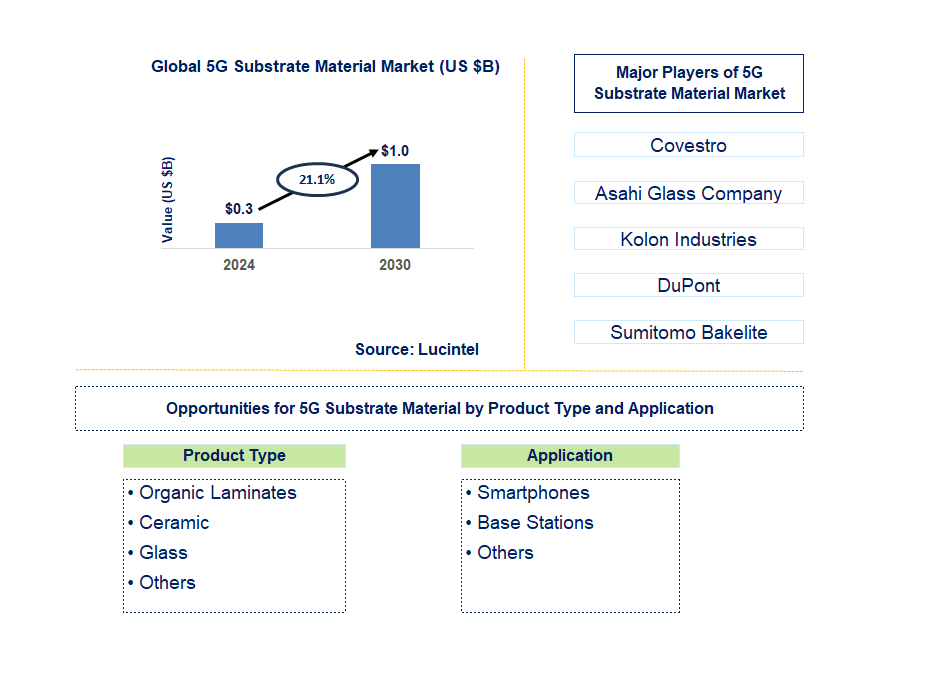
Key data points: The market size in 2030 = $1 billion, growth forecast = 21.1% annually for the next 6 years. Scroll below to get more insights. This market report covers trends, opportunities, and forecasts in the global 5g substrate material market to 2030 by product type (organic laminates, ceramic, glass, and others), application (smartphones, base stations, and others), and region (North America, Europe, Asia Pacific, and the Rest of the World)
We'll send your sample report shortly.
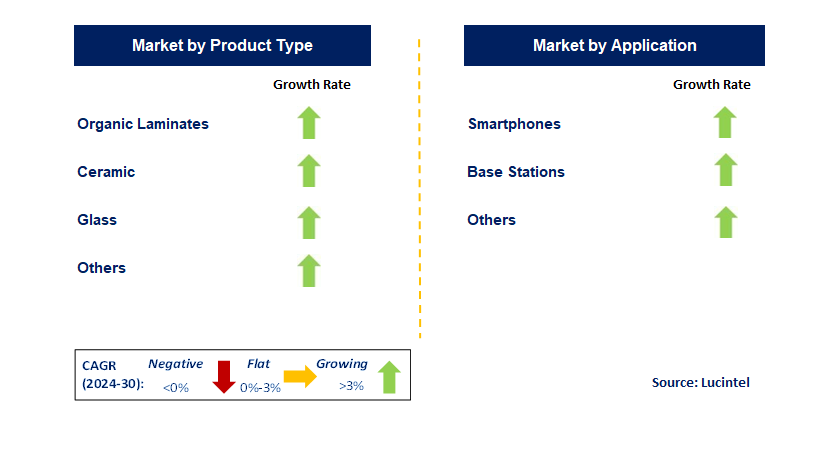
• Lucintel forecast, within product type, organic laminates will remain the largest segment over the forecast period because of thermosetting insulating materials that are employed as circuit board raw materials in both rigid and flexible copper-clad laminates, as well as, rising need for improved antennas with higher bandwidth and extremely reliable connectivity.
• In terms of regions, APAC will remain the largest region over the forecast period due to active 5G rollout in the telecom and automobile industries, among other sectors, as well as, increasing quantity of 5G base stations and the existence of several smartphone manufacturers, including apple and huawei in the region. A more than 150-page report is developed to help in your business decisions.
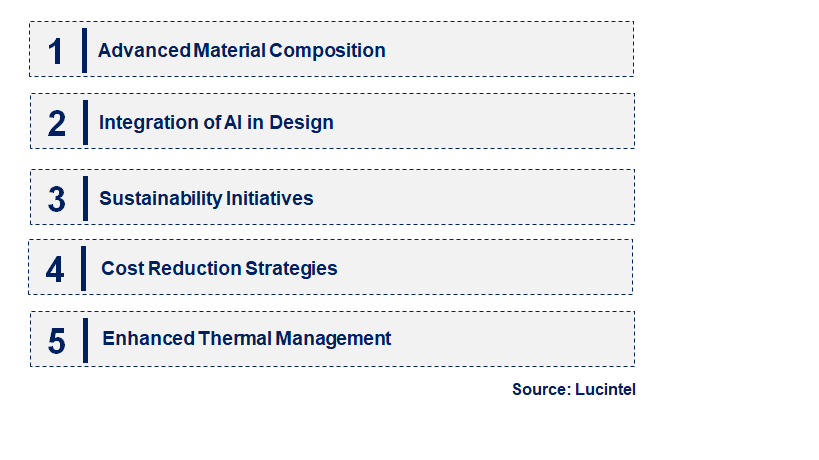
• Advanced Material Composition: The use of advanced materials such as low-loss ceramics and high-dielectric polymers is increasing. These materials offer improved performance at high frequencies and temperatures, essential for 5G applications. Innovations in material science are leading to substrates that provide better signal integrity and lower attenuation, critical for efficient 5G networks.
• Integration of AI in Design: Artificial intelligence is being integrated into the design and optimization of 5G substrate materials. AI algorithms are used to predict material properties and performance, leading to faster development cycles and more precise material specifications. This trend is accelerating the pace of innovation and reducing time to market for new substrate materials.
• Sustainability Initiatives: There is a growing emphasis on sustainability in the production of 5G substrate materials. Companies are exploring eco-friendly materials and manufacturing processes to reduce the environmental impact of substrate production. This trend reflects broader industry efforts to address environmental concerns while meeting the high-performance demands of 5G technology.
• Cost Reduction Strategies: As the 5G market grows, there is a concerted effort to reduce substrate material costs. Companies are focusing on optimizing production techniques and exploring alternative materials that offer a balance between performance and affordability. This trend is crucial for making 5G technology more accessible and accelerating its adoption across various applications.
• Enhanced Thermal Management: Improved thermal management solutions are becoming a critical focus due to the high power densities in 5G devices. New substrate materials are being developed with better thermal conductivity to manage heat dissipation more effectively. This trend is essential for maintaining device reliability and performance under demanding 5G conditions. These emerging trends are reshaping the 5G substrate material market by driving innovation, enhancing performance, and addressing cost and environmental challenges. The integration of advanced materials and technologies is essential for meeting the high demands of 5G networks, while sustainability and cost efficiency remain key considerations.
• Breakthrough in Low-Loss Materials: Recent advancements in low-loss dielectric materials have significantly enhanced 5G performance. These materials offer reduced signal attenuation, which is crucial for maintaining signal integrity over long distances. Innovations in this area are helping to overcome the challenges of high-frequency signal transmission in 5G networks.
• Development of High Thermal Conductivity Substrates: New substrate materials with high thermal conductivity are being developed to manage the increased heat generated by 5G devices. These materials improve the thermal management of electronic components, ensuring reliability and performance in high-power applications. This development is key to sustaining the efficiency of 5G infrastructure.
• Emergence of Flexible Substrates: Flexible substrate materials are gaining traction, particularly for applications in wearable technology and Internet of Things devices. These substrates offer greater versatility and integration possibilities, allowing for the development of innovative 5G-enabled devices. The flexibility of these materials supports new form factors and designs in the 5G ecosystem.
• Enhanced Manufacturing Techniques: Advancements in manufacturing techniques, such as precision coating and advanced lithography, are improving the quality and consistency of 5G substrates. These techniques enable the production of more reliable and high-performance materials, reducing defects and enhancing overall product performance in 5G applications.
• Focus on Cost Reduction and Localization: Efforts to reduce substrate material costs and increase local production capabilities are becoming more pronounced. Companies are investing in technologies that lower production costs and exploring domestic supply chains to mitigate geopolitical risks and reduce dependency on foreign suppliers. These developments are driving the evolution of the 5G substrate material market, focusing on improving performance, managing thermal challenges, and addressing cost and supply chain issues. The continuous innovation in substrate materials is critical for the advancement and widespread adoption of 5G technology.
• Automotive Industry: The automotive sector is a significant growth area for 5G substrate materials, driven by the increasing integration of 5G technology in connected vehicles and autonomous driving systems. High-performance substrates are needed to support advanced in-car communications and sensor systems, offering substantial growth potential in this application.
• Consumer Electronics: With the rise of 5G-enabled smartphones, tablets, and wearable devices, there is a growing demand for advanced substrate materials. Innovations in substrate technology can enhance device performance, reduce costs, and enable new features, creating substantial opportunities in the consumer electronics market.
• Telecommunications Infrastructure: The expansion of 5G network infrastructure, including base stations and antennas, presents significant opportunities for substrate materials. High-performance substrates are essential for ensuring the efficiency and reliability of telecommunications equipment, driving growth in this sector as 5G networks continue to roll out globally.
• Internet of Things Applications: The Internet of Things is a rapidly growing field where 5G substrates play a crucial role. Flexible and low-cost substrates are required for a wide range of IoT devices, from smart home appliances to industrial sensors. The growth of IoT applications presents a major opportunity for substrate material suppliers.
• Medical Devices: 5G technology is increasingly being integrated into medical devices for telemedicine and advanced diagnostics. High-performance substrates are needed to ensure the reliability and accuracy of these devices. This application area offers significant growth potential as the healthcare sector adopts more 5G-enabled technologies. These strategic growth opportunities highlight the diverse applications of 5G substrate materials, emphasizing the potential for market expansion across automotive, consumer electronics, telecommunications, Internet of Things, and medical sectors. Capitalizing on these opportunities will be key for stakeholders in the 5G substrate material market.
• Technological Advancements: The rapid evolution of 5G technology drives demand for advanced substrate materials. Innovations in material science, such as low-loss and high-dielectric materials, are essential for meeting the performance requirements of 5G networks. Technological advancements enable the development of substrates that can handle higher frequencies and data rates, fueling market growth.
• Increasing 5G Deployment: The global expansion of 5G networks is a major driver of substrate material demand. As countries invest in building 5G infrastructure, the need for high-quality substrates to support base stations, antennas, and other components grows. This increased deployment creates significant opportunities for substrate material suppliers.
• Rising Demand for Consumer Electronics: The proliferation of 5G-enabled consumer electronics, such as smartphones and wearables, drives the need for advanced substrates. As consumers adopt 5G technology at an accelerating pace, the demand for high-performance substrates that enhance device capabilities and performance continues to rise.
• Government Support and Investments: Government initiatives and investments in 5G technology are driving the growth of the substrate material market. Supportive policies, funding for research and development, and strategic investments in infrastructure contribute to the expansion of the market and encourage innovation in substrate materials.
• Enhanced Research and Development: Ongoing research and development efforts are leading to the discovery of new materials and technologies that improve substrate performance. Research and development activities are focused on developing substrates with better thermal management, signal integrity, and cost efficiency, driving market growth and technological advancements. Challenges in the 5G substrate material market include:
• High Material Costs: The cost of advanced substrate materials can be a significant challenge. High-performance materials often come with higher production costs, which can impact the affordability of 5G devices and infrastructure. Managing these costs while maintaining performance is a key challenge for stakeholders in the market.
• Supply Chain Disruptions: The global supply chain for substrate materials can be affected by geopolitical tensions, trade restrictions, and raw material shortages. These disruptions can impact the availability and cost of materials, posing challenges for manufacturers and affecting the overall stability of the market.
• Material Limitations: Existing materials may have limitations in terms of performance, such as thermal management, signal loss, and durability. Overcoming these limitations requires ongoing research and development to identify and develop new materials that can meet the demanding requirements of 5G technology. The 5G substrate material market is driven by technological advancements, increased deployment of 5G networks, and rising demand for consumer electronics. However, it faces challenges related to material costs, supply chain disruptions, and limitations of existing materials. Addressing these drivers and challenges is crucial for market growth and sustainability.
• Covestro
• Asahi Glass Company
• Kolon Industries
• DuPont
• Sumitomo Bakelite
• Shoe Denka Materials
• Hitachi Chemical
• Kaneka Corporation
• Panasonic Corporation
• Solvay
• Organic Laminates
• Ceramic
• Glass
• Others
• Smartphones
• Base Stations
• Others
• North America
• Europe
• Asia Pacific
• The Rest of the World
• United States: The US 5G substrate material market has seen significant investments in research and development, focusing on improving material performance for high-frequency applications. Major tech firms and semiconductor companies are advancing innovations in low-loss dielectric materials and high thermal conductivity substrates. This push aligns with the US government's goal to enhance 5G infrastructure, which is expected to drive substantial growth in the sector.
• China: China's 5G substrate material market is expanding rapidly due to extensive governmental support and ambitious 5G rollout plans. The country is focusing on developing advanced ceramic substrates and integrating artificial intelligence in substrate material design to enhance performance and reduce costs. China's strategy also includes scaling up local production capabilities to meet domestic demand and reduce reliance on foreign suppliers.
• Germany: Germany is leveraging its strong industrial base to advance 5G substrate materials, particularly in the automotive and telecommunications sectors. The country is investing in high-performance substrates that can support the demanding requirements of automotive 5G applications. Collaboration between research institutions and industry players is driving innovation in materials that offer improved reliability and efficiency for 5G networks.
• India: India's 5G substrate material market is in an early growth phase but is accelerating due to increased government initiatives and private sector investment. The focus is on developing cost-effective substrates that can support affordable 5G infrastructure expansion. Emerging local players are starting to establish their presence, aiming to meet the growing demand driven by rapid urbanization and digitalization.
• Japan: Japan is at the forefront of 5G substrate material innovation, emphasizing advanced materials that support high-speed and high-frequency applications. The Japanese market is notable for its emphasis on precision and reliability, with significant investments in research aimed at developing substrates with enhanced thermal management and signal integrity. Japanese firms are also exploring new materials like low-loss organic substrates to improve 5G device performance.


• Covestro
• Asahi Glass Company
• Kolon Industries
• DuPont
• Sumitomo Bakelite
• Shoe Denka Materials
• Hitachi Chemical
• Kaneka Corporation
• Panasonic Corporation
• Solvay Q6. Which 5G substrate material market segment will be the largest in future? Answer: Lucintel forecasts that organic laminates will remain the largest segment over the forecast period because of thermosetting insulating materials that are employed as circuit board raw materials in both rigid and flexible copper-clad laminates, as well as, rising need for improved antennas with higher bandwidth and extremely reliable connectivity. Q7. In 5G substrate material market, which region is expected to be the largest in next 5 years? Answer: APAC will remain the largest region over the forecast period due to active 5G rollout in the telecom and automobile industries, among other sectors, as well as, increasing quantity of 5G base stations and the existence of several smartphone manufacturers, including apple and huawei in the region. Q.8 Do we receive customization in this report? Answer: Yes, Lucintel provides 10% customization without any additional cost.


Choose a license that fits your team. Instant PDF delivery.
Prices exclude taxes. Instant delivery. Custom licensing available on request.
Market Report · September 7, 2026
Market Report · July 22, 2026
Market Report · July 22, 2026
Trusted partner for strategic intelligence and business growth


Receive a complimentary market analysis tailored to your industry. Our analysts will identify key growth opportunities and competitive dynamics specific to your business.

Market size, growth rate, and key trend analysis for your specific sector.

Top competitor positioning and market share analysis.

Strategic recommendations backed by data-driven insights.
Get curated market intelligence and competitive moves straight to your inbox.
By subscribing, you agree to receive our monthly insights. Unsubscribe anytime.
Receive a complimentary market analysis tailored to your industry. Our analysts will identify key growth opportunities and competitive dynamics specific to your business.
Market size, growth rate, and key trend analysis for your specific sector.
Top competitor positioning and market share analysis.
Strategic recommendations backed by data-driven insights.
Get curated market intelligence, emerging trends, and competitive moves straight to your inbox each month.
By subscribing, you agree to receive our monthly insights. Unsubscribe anytime.
We'll send your sample report shortly.