
Market Report · July 29, 2026

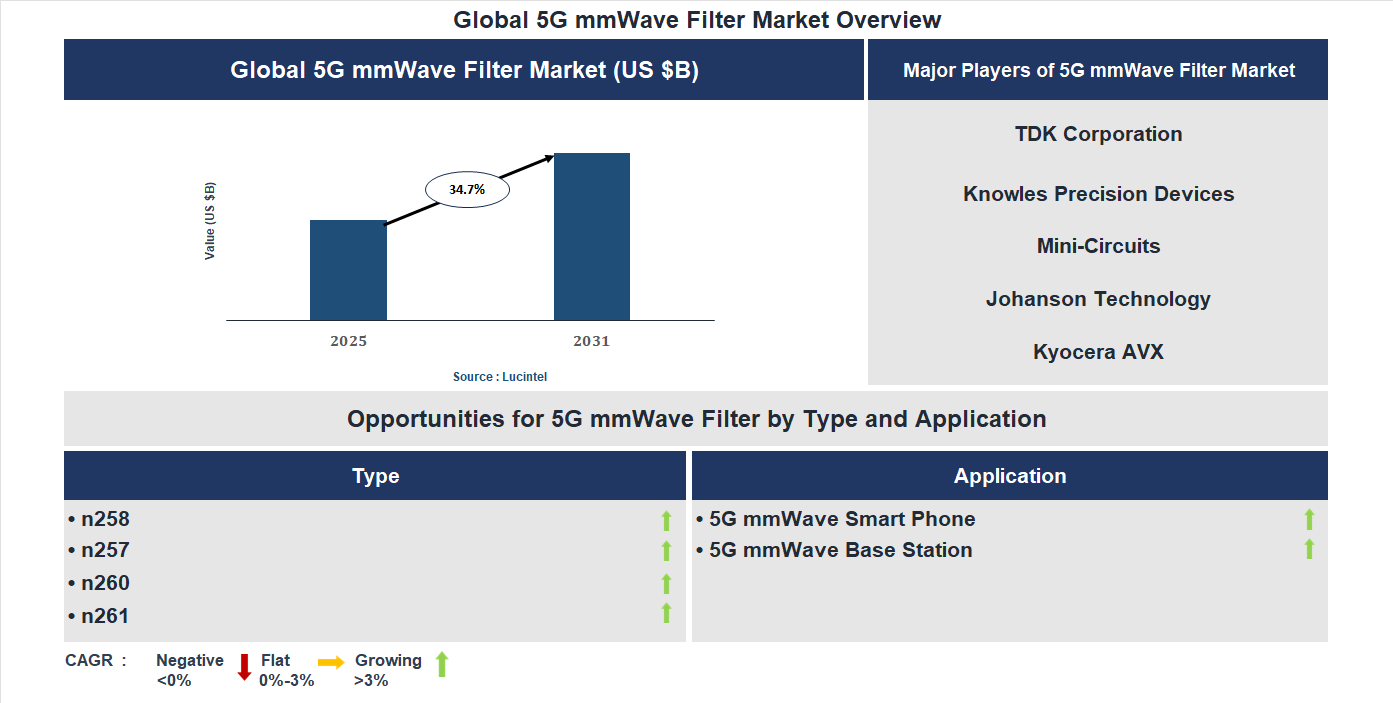
Key data points: The growth forecast = 34.7% annually for the next 7 years. Scroll below to get more insights. This market report covers trends, opportunities and forecasts in 5G mmWave filter market to 2031 by type (n258, n257, n260, and n261), application (5G mmWave smart phone and 5G mmWave base station), and region (North America, Europe, Asia Pacific, and the Rest of the World)
We'll send your sample report shortly.
• Lucintel forecasts that, within the type category, n260 is expected to witness the highest growth over the forecast period.
• Within the application category, 5G mmWave smart phone is expected to witness higher growth.
• In terms of region, APAC is expected to witness the highest growth over the forecast period. Gain valuable insights for your business decisions with our comprehensive 150+ page report. Sample figures with some insights are shown below.
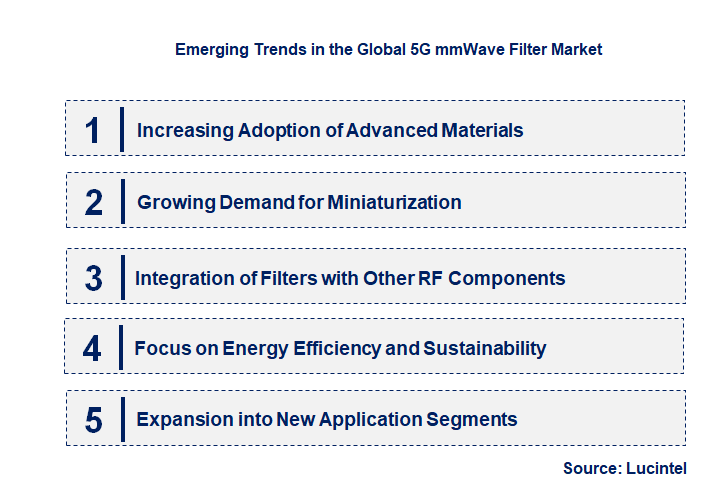
• Increasing adoption of advanced materials: The market is witnessing a shift towards using novel materials like ceramic and gallium arsenide for filters, which offer higher performance and better thermal stability. These materials enable filters to operate efficiently at higher frequencies with minimal signal loss, crucial for 5G mmWave applications. Companies like qorvo and skyworks are investing in research to develop such high-performance filters, which are essential for improving network reliability and capacity. This trend enhances overall network performance and supports the deployment of more robust 5G infrastructure.
• Growing demand for miniaturization: As devices become more compact, there is a significant push towards developing smaller, more integrated filters. Miniaturization allows for easier integration into smartphones, IoT devices, and other wireless gadgets without compromising performance. This trend is driven by the need for space-saving solutions that do not sacrifice signal quality. Companies such as amphenol and taiwan semiconductor manufacturing company are focusing on innovative design techniques to produce smaller filters, which facilitate the proliferation of 5G-enabled devices and expand market reach.
• Integration of filters with other RF components: The trend towards integrated RF front-end modules is gaining momentum, where filters are combined with amplifiers, switches, and duplexers into a single compact unit. This integration reduces size, power consumption, and manufacturing costs while improving overall system performance. Leading firms like broadcom and murata are developing integrated solutions that streamline 5G device design. This approach enhances device efficiency, simplifies supply chains, and accelerates time-to-market, making 5G devices more accessible and affordable.
• Focus on energy efficiency and sustainability: As 5G networks expand, there is increasing emphasis on developing energy-efficient filters to reduce power consumption and environmental impact. Companies are exploring low-loss materials and innovative designs to minimize energy use without compromising performance. This trend aligns with global sustainability goals and helps telecom operators lower operational costs. Firms like skyworks and qorvo are investing in eco-friendly manufacturing processes and materials, which not only support environmental initiatives but also appeal to eco-conscious consumers and regulators.
• Expansion into new application segments: Beyond traditional telecommunications, 5G mmWave filters are increasingly being adopted in sectors such as automotive, healthcare, and industrial automation. These applications require high-frequency, reliable filters to support emerging technologies like autonomous vehicles, remote diagnostics, and smart factories. Companies like amphenol and broadcom are developing specialized filters tailored for these sectors, opening new revenue streams and diversifying market opportunities. This expansion is driving innovation and fostering cross-industry collaborations, further accelerating the adoption of 5G mmWave technology. In summary, these emerging trends are fundamentally reshaping the 5G mmWave filter market by enhancing device performance, enabling miniaturization, promoting sustainability, and expanding application horizons. As these developments continue, they will drive faster network deployment, improve user experiences, and open new avenues for technological innovation across various industries.
• technological advancements: companies like qorvo and skyworks solutions are developing next-generation mmWave filters with higher selectivity and lower insertion loss, improving overall network performance and reliability.
• material innovations: research into new materials such as ceramic composites and liquid crystal polymers by firms like broadcom is enabling filters to operate efficiently at higher frequencies, enhancing signal clarity and reducing interference.
• integration techniques: manufacturers are adopting monolithic integration methods, allowing filters to be embedded directly onto chips, which reduces size and power consumption, as seen in products from nxp semiconductors.
• manufacturing process improvements: companies like amphenol are refining fabrication processes to increase yield and reduce costs, making high-performance filters more accessible for mass-market applications.
• market expansion and applications: the adoption of 5G mmWave filters in automotive radar, IoT devices, and industrial automation is accelerating, driven by companies such as huawei and ericsson, broadening the market scope and application diversity. These developments are significantly impacting the 5G mmWave filter market by enhancing device performance, reducing costs, and enabling broader application adoption. As technology continues to evolve, the market is poised for sustained growth, driven by increasing demand for faster, more reliable wireless communication across multiple sectors.
• Telecommunications Infrastructure: Expansion of 5G networks requires advanced mmWave filters to ensure high-quality signal transmission. These filters improve network efficiency and reduce interference, supporting the deployment of dense 5G small cells. This growth enhances connectivity, boosts network capacity, and accelerates the rollout of 5G services globally.
• Consumer Electronics: The proliferation of 5G-enabled smartphones, tablets, and wearables demands compact, high-performance mmWave filters. These filters enable devices to handle higher data rates and improve user experience. As consumer demand for faster connectivity rises, manufacturers like samsung and apple are investing heavily in integrating advanced filters.
• Automotive: 5G connectivity in vehicles relies on mmWave filters to facilitate vehicle-to-everything (V2X) communication, autonomous driving, and infotainment systems. These filters ensure reliable, high-speed data transfer, improving safety and driving experience. The automotive sectors adoption of 5G is expected to significantly boost filter demand.
• Healthcare: 5G-enabled medical devices and remote healthcare solutions require precise filtering to ensure secure and reliable data transmission. mmWave filters support high-resolution imaging, telemedicine, and real-time monitoring, transforming healthcare delivery and enabling new medical innovations.
• Industrial Automation: The deployment of 5G in factories and industrial settings enhances automation, robotics, and IoT applications. mmWave filters facilitate high-speed, low-latency communication essential for real-time control and data processing, leading to increased efficiency and productivity in manufacturing processes. In summary, these growth opportunities are significantly impacting the 5G mmWave filter market by driving innovation, expanding application scope, and accelerating adoption across diverse sectors. The increasing demand for high-speed, reliable wireless communication is fostering technological advancements and creating new revenue streams for industry players. This evolution is poised to reshape the telecommunications landscape and enable smarter, more connected environments worldwide.
• Technological Innovation: The rapid evolution of 5G technology necessitates advanced mmWave filters capable of handling higher frequencies with minimal loss. Innovations in materials and design improve filter performance, enabling better signal quality and network reliability. As telecom operators upgrade infrastructure, the demand for sophisticated filters increases, fostering market growth. Continuous R&D efforts are focused on miniaturization and enhanced selectivity, which are critical for supporting dense network deployments and IoT applications. This technological progression ensures the market remains competitive and aligned with future connectivity needs.
• Growing 5G Infrastructure Investment: Governments and private telecom companies are investing heavily in 5G infrastructure to meet rising consumer and enterprise demands. These investments include deploying new base stations, upgrading existing networks, and expanding coverage areas. The need for high-performance filters in base stations and user devices directly correlates with these investments, fueling market expansion. As 5G adoption accelerates globally, the demand for reliable, high-frequency filters becomes more pronounced, creating a robust growth environment for manufacturers.
• Increasing Demand for High-Speed Data Services: The surge in data consumption driven by streaming, cloud computing, and IoT devices necessitates faster and more reliable wireless communication. 5G mmWave filters are essential for supporting high data rates and low latency requirements. This demand encourages telecom operators to deploy advanced filters to enhance network performance and user experience. The proliferation of connected devices and digital services further amplifies this trend, making high-speed data services a key driver for the market’s expansion.
• Regulatory Spectrum Allocation: Governments worldwide are allocating specific spectrum bands for 5G deployment, which influences the development and deployment of mmWave filters. Favorable regulatory policies facilitate smoother spectrum licensing and reduce barriers for market players. Conversely, spectrum scarcity or restrictive policies can hinder growth. Clear and supportive regulations are crucial for ensuring efficient use of spectrum resources, enabling manufacturers to develop targeted filters and expand their market reach.
• Technological Advancements in Filter Materials: The development of new materials such as ceramic composites and advanced dielectrics enhances filter performance by reducing insertion loss and improving selectivity. These innovations enable filters to operate efficiently at higher frequencies, which is vital for 5G mmWave applications. Material advancements also contribute to miniaturization and cost reduction, making filters more accessible for various devices. As research progresses, these technological improvements are expected to further drive market growth by enabling more compact and efficient filter solutions. The challenges facing this 5G mmWave filter market include:
• High Manufacturing Costs: Producing high-frequency mmWave filters involves complex processes and precision engineering, leading to elevated manufacturing expenses. Advanced materials, stringent quality control, and miniaturization requirements add to costs, which can limit profitability and price competitiveness. These high costs may also restrict adoption in cost-sensitive markets or applications, slowing overall market growth. Manufacturers need to balance performance with affordability, which remains a significant challenge in scaling production and meeting global demand.
• Integration Complexity: Incorporating mmWave filters into compact devices such as smartphones and IoT gadgets presents significant technical challenges. Ensuring compatibility with existing components, maintaining signal integrity, and managing thermal dissipation require sophisticated design solutions. Integration issues can delay product development cycles and increase costs, hindering market penetration. Overcoming these complexities is essential for widespread adoption of 5G-enabled devices and infrastructure.
• Spectrum and Regulatory Uncertainty: Despite spectrum allocations, regulatory policies vary across regions and are subject to change, creating uncertainty for market players. Delays in licensing, restrictions on spectrum use, or policy shifts can impede deployment timelines and increase compliance costs. This unpredictability complicates strategic planning and investment decisions, potentially slowing market growth. Clear, stable regulatory frameworks are vital for fostering confidence and encouraging innovation within the 5G mmWave filter industry. In summary, the 5G mmWave filter market is driven by rapid technological innovation, substantial infrastructure investments, and increasing demand for high-speed connectivity. However, high manufacturing costs, integration challenges, and regulatory uncertainties pose significant hurdles. These factors collectively shape the market landscape, requiring stakeholders to navigate complex technological and regulatory environments. While growth prospects remain promising due to ongoing advancements and expanding 5G deployment, addressing these challenges is crucial for sustained market development. Overall, the markets evolution will depend on technological breakthroughs, supportive policies, and cost-effective manufacturing solutions, shaping the future of high-frequency wireless communication.
• TDK Corporation
• Knowles Precision Devices
• Mini-Circuits
• Johanson Technology
• Kyocera AVX
• Wainwright Instruments
• Anhui Yunta Electronic Technology
• n258
• n257
• n260
• n261
• 5G mmWave Smart Phone
• 5G mmWave Base Station
• North America
• Europe
• Asia Pacific
• The Rest of the World
• United States: The US market is witnessing significant advancements with companies like skyworks solutions and qorvo leading innovation in mmWave filters. The focus is on developing compact, high-performance filters to support 5G infrastructure and mobile devices. The government’s investments in 5G deployment and research initiatives are accelerating market growth, with a strong emphasis on integrating filters into 5G-enabled devices and base stations.
• China: China is rapidly expanding its 5G network infrastructure, with companies such as smic and huawei investing heavily in mmWave filter technology. The market is driven by domestic demand for 5G smartphones and industrial applications. Chinese firms are focusing on cost-effective manufacturing and local R&D to enhance filter performance, aiming to achieve self-sufficiency and global competitiveness.
• Germany: The German market is characterized by a focus on high-quality, reliable filters, with companies like infineon and lpkf playing key roles. The emphasis is on integrating filters into automotive and industrial applications, aligning with Germany’s strong manufacturing sector. Innovations are centered around improving filter selectivity and power handling to meet stringent European standards.
• India: India’s 5G rollout is in its early stages but is rapidly gaining momentum, with local companies such as vishay and microchip manufacturing firms investing in mmWave filter development. The market is driven by increasing demand for affordable 5G smartphones and infrastructure. R&D efforts are focused on creating cost-effective, efficient filters suitable for diverse Indian applications.
• Japan: Japan’s market is marked by advanced research and development, with companies like murata and tdk leading innovations in mmWave filters. The focus is on miniaturization, high performance, and integration into consumer electronics and automotive sectors. Japan’s emphasis on quality and technological excellence is driving the development of next-generation filters to support 5G and beyond.


• TDK Corporation
• Knowles Precision Devices
• Mini-Circuits
• Johanson Technology
• Kyocera AVX
• Wainwright Instruments
• Anhui Yunta Electronic Technology Q5. Which 5G mmWave filter market segment will be the largest in future? Answer: Lucintel forecasts that, within the type category, n260 is expected to witness the highest growth over the forecast period. Q6. In 5G mmWave filter market, which region is expected to be the largest in next 5 years? Answer: In terms of region, APAC is expected to witness the highest growth over the forecast period. Q7. Do we receive customization in this report? Answer: Yes, Lucintel provides 10% customization without any additional cost.


Choose a license that fits your team. Instant PDF delivery.
Prices exclude taxes. Instant delivery. Custom licensing available on request.
Market Report · July 29, 2026
Market Report · July 20, 2026
Market Report · July 20, 2026
Trusted partner for strategic intelligence and business growth


Receive a complimentary market analysis tailored to your industry. Our analysts will identify key growth opportunities and competitive dynamics specific to your business.

Market size, growth rate, and key trend analysis for your specific sector.

Top competitor positioning and market share analysis.

Strategic recommendations backed by data-driven insights.
Get curated market intelligence and competitive moves straight to your inbox.
By subscribing, you agree to receive our monthly insights. Unsubscribe anytime.
Receive a complimentary market analysis tailored to your industry. Our analysts will identify key growth opportunities and competitive dynamics specific to your business.
Market size, growth rate, and key trend analysis for your specific sector.
Top competitor positioning and market share analysis.
Strategic recommendations backed by data-driven insights.
Get curated market intelligence, emerging trends, and competitive moves straight to your inbox each month.
By subscribing, you agree to receive our monthly insights. Unsubscribe anytime.
We'll send your sample report shortly.