Close Lucintel Chat
Didn't Find What You're Looking for?
Call us at +1972 636 5056 or write at helpdesk@Lucintel.com
Ask an Expert Provide Custom Requirements Download Sample Report Search Available Reports
  • helpdesk@Lucintel.com
  • |
  • Call Lucintel +1 972 636 5056
  • |
  • Login
  • |
  • Register
  • |
  • Search
  • |
'
...

The Impact of COVID-19 is included in 5G Infrastructure Market Report. Buy it today to get an advantage.

Request the impact of COVID-19 on your product or industry


5G Infrastructure Trends and Forecast

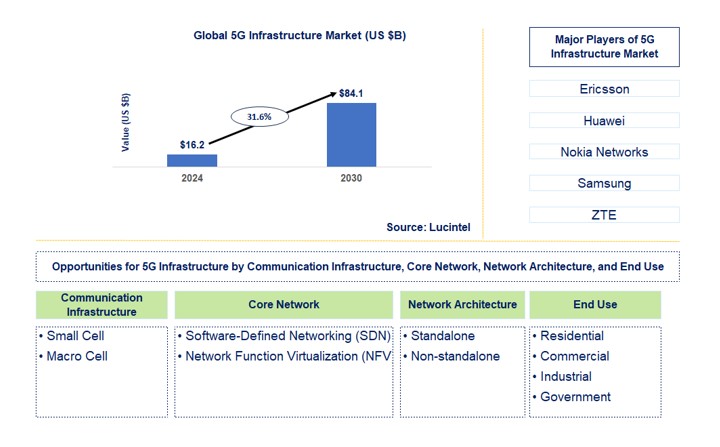
The future of the global 5G infrastructure market looks promising with opportunities in the residential, commercial, government, and industrial markets. The global 5G infrastructure market is expected to reach an estimated $84.1 billion by 2030 with a CAGR of 32.0% from 2024 to 2030. The major drivers for this market are the growing use of virtual networking architecture in telecommunication, the rapid expansion of smart cities, and increasing demand for self-driving cars with integrated 5G wireless networks.

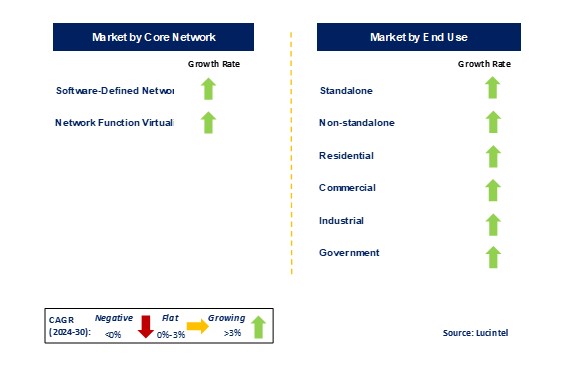
• Lucintel forecasts that, within the network architecture category, non-standalone is expected to witness the highest growth over the forecast period due to its considerable use of this 5G network in various applications, including UHD videos and cloud-based AR/VR gaming.
• Within the end use industry category, commercial will remain the largest segment due to the significant use of 5G network in this setting to enable real-time tracking and monitoring of products, continuous connectivity during cloud computing, uninterrupted virtual meetings, and massive data transfer at higher speeds.
• In terms of regions, APAC is expected to witness the highest growth over the forecast period due to encouraging initiatives to improve the digital and network infrastructure, growing internet penetration, and expanding number of 5G base stations in the region.

Gain valuable insights for your business decisions with our 150+ page report.
5G Infrastructure Trends and Forecast

5G Infrastructure by Segment

Emerging Trends in the 5G Infrastructure Market

There are significant changes taking place in the 5G infrastructure market due to emerging trends that affect network design, deployment, and applications. These trends are changing how 5G networks are created and used in different domains.
• Edge Computing Integration: 5G networks are integrating edge computing, which lowers latency and enhances real-time processing capabilities. With edge computing, data is processed closer to the source, supporting autonomous vehicles and IoT, thus improving performance and responsiveness.
• Private 5G Networks: There is an increasing trend toward deploying private 5G networks in specific industries. These networks provide customized solutions for improved security, reliability, and control, facilitating applications in industries such as manufacturing, logistics, and smart cities.
• Network Slicing: Network slicing is now a major characteristic of 5G, allowing operators to create multiple virtual networks on a single physical network. This capability enables customization of services and performance levels for different applications, making them more flexible and efficient.
• AI-Driven Network Management: AI-based management tools have been developed to automate network processes, optimizing operations. AI-driven tools offer predictive analytics, automated troubleshooting, and dynamic resource allocation, all aimed at boosting network efficiency and reducing operational costs.

Edge computing integration, private networks, network slicing, AI-based management, and improved spectrum usage are reshaping the 5G infrastructure market. These trends drive innovation, allowing modern connectivity demands to be met with enhanced network capacities.
Emerging Trends in the 5G Infrastructure Market

Recent Developments in the 5G Infrastructure Market

Recent developments in the 5G infrastructure market indicate important technological and deployment milestones. These developments reflect ongoing efforts to improve network capabilities and sustain emerging applications.
• Massive MIMO Technology Deployment: The adoption of Massive MIMO (Multiple Input, Multiple Output) technology is widespread, expanding network capacity and efficiency. Large antenna arrays improve data rates and coverage, enhancing overall network performance.
• Expansion of 5G Networks in Urban Areas: Major telecom operators are expanding 5G networks in densely populated urban areas by installing small cells and enhancing infrastructure for high-speed connectivity to meet growing data service needs.
• Network Virtualization Advancements: 5G infrastructures now integrate with network virtualization technologies such as Network Functions Virtualization (NFV) and Software-Defined Networking (SDN). These advancements support new services and applications through more flexible and efficient network management.
• Integration of 5G with IoT Platforms: The integration of 5G with IoT platforms continues to progress, providing stronger connections for numerous IoT devices. This fosters growth in smart cities, industrial automation, and healthcare applications, thus supporting connected ecosystems.

These developments have advanced the 5G infrastructure market by using technologies like MIMO, expanding in urban areas, improving network virtualization, and integrating IoT, while also receiving supportive government actions. Together, these contribute to building more powerful networks for 5G application growth.

Strategic Growth Opportunities for 5G Infrastructure Market

Several strategic growth opportunities exist in the 5G infrastructure market across a range of applications. Seizing these opportunities can foster innovation and address emerging connectivity needs in various sectors.

• Smart Cities: 5G infrastructure supports smart city development, enabling high-speed, reliable connections for urban management systems, smart lighting, and public safety. Demand is growing for improved data collection and real-time analysis to enhance city operations and services.
• Industrial Automation: 5G facilitates transformational industrial automation with ultra-reliable, low-latency communication connecting sensors, machines, and systems. This enables improved manufacturing processes, predictive maintenance, and operational efficiency, fueling innovation in industrial domains.
• Healthcare: Telemedicine, remote patient monitoring, and advanced medical imaging benefit from 5G’s large bandwidth and low latency, enabling real-time data transfer and communications that improve patient care and foster healthcare innovation.
• Retail: 5G enhances the retail sector by supporting augmented reality (AR), virtual reality (VR), and intelligent inventory management, which improves customer satisfaction and operational efficiency, driving retail trade expansion.

Strategic growth areas in smart cities, industrial automation, healthcare, retail, and automotive sectors showcase diverse applications of 5G infrastructure. These opportunities drive industry-specific developments and changes through 5G’s unique capabilities.

5G Infrastructure Market Driver and Challenges

The 5G infrastructure sector is influenced by various factors affecting its growth and development, including technological advancements, economic considerations, and regulatory environments.

Drivers in the 5G infrastructure market include:
• Technological Advancements: Continuous 5G technology advancements, such as massive MIMO and network slicing, drive market growth. These innovations enhance performance, capacity, and flexibility, supporting a wide range of applications.
• Increasing Demand for High-Speed Connectivity: Growing demand for high-speed, low-latency connectivity to support data-intensive applications is a major driver, fueled by the rise of IoT devices, smart cities, and advanced technologies.
• Government Support and Investment: Spectrum auctions, funding, and favorable regulations are key ways governments support 5G infrastructure, accelerating deployment and fostering innovation in a conducive environment.
• Expansion of Mobile Broadband Services: Investments in 5G infrastructure are driven by the need for better coverage in urban and rural areas. Operators are focused on expanding network coverage to handle rising data consumption.

Challenges in the 5G infrastructure market include:
• High Deployment Costs: High costs associated with deploying and maintaining 5G infrastructure, including base stations and small cells, pose significant challenges, making large-scale deployments financially demanding.
• Spectrum Allocation Issues: Regulatory obstacles and competition for available frequencies make securing and managing spectrum for 5G networks challenging. Efficient spectrum allocation is essential for optimal network performance and coverage.

While technological advancements, growing connectivity demands, government support, and mobile broadband expansion drive the 5G infrastructure market, challenges such as high deployment costs, spectrum allocation issues, and technical complexities must be addressed to support market growth and development.

List of 5G Infrastructure Companies

Companies in the market compete on the basis of product quality offered. Major players in this market focus on expanding their manufacturing facilities, R&D investments, infrastructural development, and leverage integration opportunities across the value chain. With these strategies 5G infrastructure companies cater increasing demand, ensure competitive effectiveness, develop innovative products & technologies, reduce production costs, and expand their customer base. Some of the 5G infrastructure companies profiled in this report include-
• Altiostar
• Huawei Technologies
• Nokia
• Samsung Electronics
• Telefonaktiebolaget LM Ericsson
• ZTE
• Airspan Networks Holdings
• Fujitsu
• CommScope
• Corning

5G Infrastructure by Segment

The study includes a forecast for the global 5G infrastructure by component, spectrum, network architecture, end use industry, and region

5G Infrastructure Market by Component [Analysis by Value from 2018 to 2030]:


• Hardware
• Services

5G Infrastructure Market by Spectrum [Analysis by Value from 2018 to 2030]:


• Sub-6 GH
• mmWave

5G Infrastructure Market by Network Architecture [Analysis by Value from 2018 to 2030]:


• Standalone
• Non-Standalone

5G Infrastructure Market by End Use Industry [Analysis by Value from 2018 to 2030]:


• Residential
• Commercial
• Industrial
• Government

5G Infrastructure Market by Region [Analysis by Value from 2018 to 2030]:


• North America
• Europe
• Asia Pacific
• The Rest of the World

Country Wise Outlook for the 5G Infrastructure Market

The 5G infrastructure market is evolving as countries invest in next-generation networks to support advanced applications and enhance connectivity. Notable countries making strides include the United States, China, Germany, India, and Japan, each with distinct strategic priorities and achievements.

• United States: The US is progressing in 5G rollout by investing in spectrum auctions and private 5G networks. Major carriers like Verizon and AT&T are expanding 5G coverage using high-bandwidth millimeter-wave spectrum and deploying 5G on mid-bands to enhance urban connectivity and support emerging technologies like autonomous vehicles and smart cities.
• China: China leads 5G infrastructure development with strong government support and large-scale deployment. The country aims for comprehensive 5G network coverage across urban and rural areas, with significant investments in base stations supporting industrial automation and consumer electronics.
• Germany: Germany focuses on 5G for industrial applications and smart manufacturing. The government collaborates with telecom operators to promote 5G adoption in sectors like automotive and logistics, enhancing efficiency and connectivity.
• India: In India, the 5G rollout is accelerating, with a focus on network expansion and affordability. Government-led spectrum auctions and partnerships between telecom companies and tech firms drive 5G adoption, supporting sectors like education, healthcare, and agriculture.
• Japan: Japan is investing in 5G infrastructure to support smart city initiatives and strengthen disaster response. Major telecommunications companies are rolling out 5G networks to improve urban connectivity and support IoT, augmented reality, and other emerging applications.
Lucintel Analytics Dashboard

Features of the Global 5G Infrastructure Market

Market Size Estimates: 5G infrastructure market size estimation in terms of value ($B).
Trend and Forecast Analysis: Market trends (2018 to 2023) and forecast (2024 to 2030) by various segments and regions.
Segmentation Analysis: 5G infrastructure market size by various segments, such as by component, spectrum, network architecture, end use industry, and region in terms of value ($B).
Regional Analysis: 5G infrastructure market breakdown by North America, Europe, Asia Pacific, and Rest of the World.
Growth Opportunities: Analysis of growth opportunities in different components, spectrums, network architectures, end use industries, and regions for the 5G infrastructure market.
Strategic Analysis: This includes M&A, new product development, and competitive landscape of the 5G infrastructure market.
Analysis of competitive intensity of the industry based on Porter’s Five Forces model.

If you are looking to expand your business in this market or adjacent markets, then contact us. We have done hundreds of strategic consulting projects in market entry, opportunity screening, due diligence, supply chain analysis, M & A, and more.
Lucintel Consulting Services

FAQ

Q.1 What is the 5G infrastructure market size?
Answer: The global 5G infrastructure market is expected to reach an estimated $84.1 billion by 2030.
Q.2 What is the growth forecast for 5G infrastructure market?
Answer: The global 5G infrastructure market is expected to grow with a CAGR of 32.0% from 2024 to 2030.
Q.3 What are the major drivers influencing the growth of the 5G infrastructure market?
Answer: The major drivers for this market are growing use of virtual networking architecture in telecommunication, rapid expansion of smart cities, and increasing demand for self-driving cars with integrated 5G wireless networks.
Q4. What are the major segments for 5G infrastructure market?
Answer: The future of the 5G infrastructure market looks promising with opportunities in the residential, commercial, government, and industrial markets.
Q5. Who are the key 5G infrastructure market companies?
Answer: Some of the key 5G infrastructure companies are as follows:
• Altiostar
• Huawei Technologies
• Nokia
• Samsung Electronics
• Telefonaktiebolaget LM Ericsson
• ZTE
• Airspan Networks Holdings
• Fujitsu
• CommScope
• Corning
Q6. Which 5G infrastructure market segment will be the largest in future?
Answer: Lucintel forecasts that non-standalone is expected to witness highest growth over the forecast period due to its considerable use this 5G network in various applications, including uhd videos and cloud-based AR/VR gaming.
Q7. In 5G infrastructure market, which region is expected to be the largest in next 5 years?
Answer: APAC is expected to witness highest growth over the forecast period due to encouraging intiative to improve the digital and network infrastructure, growing internet penetration, and expanding number of 5G base stations in the region.
Q.8 Do we receive customization in this report?
Answer: Yes, Lucintel provides 10% customization without any additional cost.

This report answers following 11 key questions:

Q.1. What are some of the most promising, high-growth opportunities for the 5G infrastructure market by component (hardware and services), spectrum (sub-6 GH and mmWave), network architecture (standalone and non-standalone), end use industry (residential, commercial, industrial, and government), and region (North America, Europe, Asia Pacific, and the Rest of the World)?
Q.2. Which segments will grow at a faster pace and why?
Q.3. Which region will grow at a faster pace and why?
Q.4. What are the key factors affecting market dynamics? What are the key challenges and business risks in this market?
Q.5. What are the business risks and competitive threats in this market?
Q.6. What are the emerging trends in this market and the reasons behind them?
Q.7. What are some of the changing demands of customers in the market?
Q.8. What are the new developments in the market? Which companies are leading these developments?
Q.9. Who are the major players in this market? What strategic initiatives are key players pursuing for business growth?
Q.10. What are some of the competing products in this market and how big of a threat do they pose for loss of market share by material or product substitution?
Q.11. What M&A activity has occurred in the last 5 years and what has its impact been on the industry?
For any questions related to 5G infrastructure market or related to 5G infrastructure companies, 5G infrastructure market size, 5G infrastructure market share, 5G infrastructure market growth, 5G infrastructure market research, write Lucintel analyst at email: helpdesk@lucintel.com we will be glad to get back to you soon.

                                                            Table of Contents

            1. Executive Summary

            2. Global 5G Infrastructure Market : Market Dynamics
                        2.1: Introduction, Background, and Classifications
                        2.2: Supply Chain
                        2.3: Industry Drivers and Challenges

            3. Market Trends and Forecast Analysis from 2018 to 2030
                        3.1. Macroeconomic Trends (2018-2023) and Forecast (2024-2030)
                        3.2. Global 5G Infrastructure Market Trends (2018-2023) and Forecast (2024-2030)
                        3.3: Global 5G Infrastructure Market by Component
                                    3.3.1: Hardware
                                    3.3.2: Services
                        3.4: Global 5G Infrastructure Market by Spectrum
                                    3.4.1: Sub-6 GH
                                    3.4.2: mmWave
                        3.5: Global 5G Infrastructure Market by Network Architecture
                                    3.5.1: Standalone
                                    3.5.2: Non-Standalone
                                    3.6: Global 5G Infrastructure Market by End Use Industry
                                    3.6.1: Residential
                                    3.6.2: Commercial
                                    3.6.3: Industrial
                                    3.6.4: Government

            4. Market Trends and Forecast Analysis by Region from 2018 to 2030
                        4.1: Global 5G Infrastructure Market by Region
                        4.2: North American 5G Infrastructure Market
                                    4.2.1: North American Market by Network Architecture: Standalone and Non-Standalone
                                    4.2.2: North American Market by End Use Industry: Residential, Commercial, Industrial, and Government
                        4.3: European 5G Infrastructure Market
                                    4.3.1: European Market by Network Architecture: Standalone and Non-Standalone
                                    4.3.2: European Market by End Use Industry: Residential, Commercial, Industrial, and Government
                        4.4: APAC 5G Infrastructure Market
                                    4.4.1: APAC Market by Network Architecture: Standalone and Non-Standalone
                                    4.4.2: APAC Market by End Use Industry: Residential, Commercial, Industrial, and Government
                        4.5: ROW 5G Infrastructure Market
                                    4.5.1: ROW Market by Network Architecture: Standalone and Non-Standalone
                                    4.5.2: ROW Market by End Use Industry: Residential, Commercial, Industrial, and Government

            5. Competitor Analysis
                        5.1: Product Portfolio Analysis
                        5.2: Operational Integration
                        5.3: Porter’s Five Forces Analysis

            6. Growth Opportunities and Strategic Analysis
                        6.1: Growth Opportunity Analysis
                                    6.1.1: Growth Opportunities for the Global 5G Infrastructure Market by Component
                                    6.1.2: Growth Opportunities for the Global 5G Infrastructure Market by Spectrum
                                    6.1.3: Growth Opportunities for the Global 5G Infrastructure Market by Network Architecture
                                    6.1.4: Growth Opportunities for the Global 5G Infrastructure Market by End Use Industry
                                    6.1.5: Growth Opportunities for the Global 5G Infrastructure Market Region
                        6.2: Emerging Trends in the Global 5G Infrastructure Market
                        6.3: Strategic Analysis
                                    6.3.1: New Product Development
                                    6.3.2: Capacity Expansion of the Global 5G Infrastructure Market
                                    6.3.3: Mergers, Acquisitions, and Joint Ventures in the Global 5G Infrastructure Market
                                    6.3.4: Certification and Licensing

            7. Company Profiles of Leading Players
                        7.1: Altiostar
                        7.2: Huawei Technologies
                        7.3: Nokia
                        7.4: Samsung Electronics
                        7.5: Telefonaktiebolaget LM Ericsson
                        7.6: ZTE
                        7.7: Airspan Networks Holdings
                        7.8: Fujitsu
                        7.9: CommScope
                        7.10: Corning
.

Buy full report or by chapter as follows

Limited Time Offer

Price by License Type:
[-] Hide Chapter Details
[Chapter Number] [Chapter Name] [Chapter Number Of Pages] [Chapter Price]
Title/Chapter Name Pages Price
Full Report: 5G Infrastructure Market Report: Trends, Forecast and Competitive Analysis to 2030 Full Report $ 2,990
Lucintel has been in the business of market research and management consulting since 2000 and has published over 1000 market intelligence reports in various markets / applications and served over 1,000 clients worldwide. This study is a culmination of four months of full-time effort performed by Lucintel's analyst team. The analysts used the following sources for the creation and completion of this valuable report:
  • In-depth interviews of the major players in this market
  • Detailed secondary research from competitors’ financial statements and published data 
  • Extensive searches of published works, market, and database information pertaining to industry news, company press releases, and customer intentions
  • A compilation of the experiences, judgments, and insights of Lucintel’s professionals, who have analyzed and tracked this market over the years.
Extensive research and interviews are conducted across the supply chain of this market to estimate market share, market size, trends, drivers, challenges, and forecasts. Below is a brief summary of the primary interviews that were conducted by job function for this report.
 
Thus, Lucintel compiles vast amounts of data from numerous sources, validates the integrity of that data, and performs a comprehensive analysis. Lucintel then organizes the data, its findings, and insights into a concise report designed to support the strategic decision-making process. The figure below is a graphical representation of Lucintel’s research process. 
 

Please sign in below to get report brochure - 5G Infrastructure Market Report.

At Lucintel, we respect your privacy and maintain the confidentiality of information / data provided by you
(Please enter your corporate email. * These fields are mandatory )

Follow us on