
Market Report · July 31, 2026

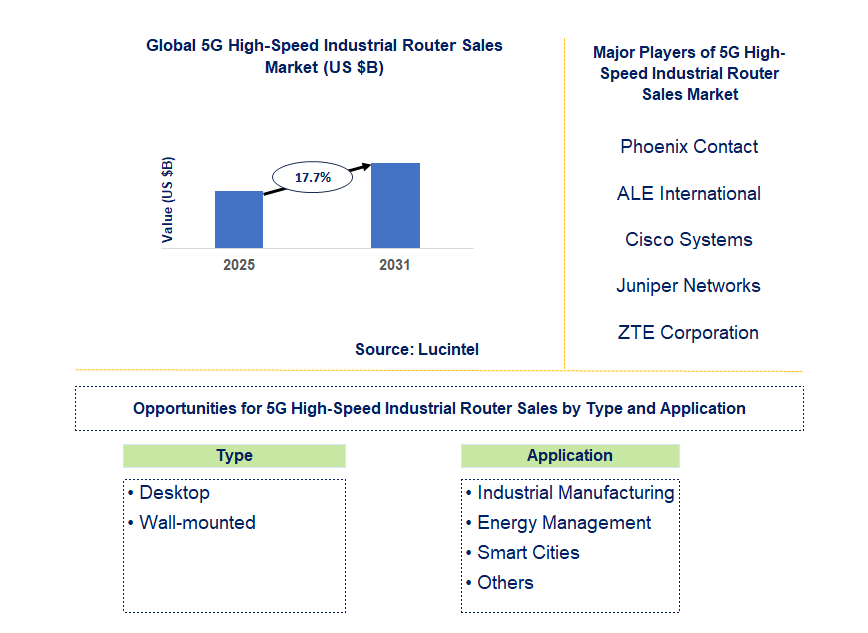
Key data points: The growth forecast = 17.7% annually for the next 7 years. Scroll below to get more insights. This market report covers Trends, opportunities and forecasts in 5G high-speed industrial router sales market to 2031 by type (desktop and wall-mounted), application (industrial manufacturing, energy management, smart cities, and others), and region (North America, Europe, Asia Pacific, and the Rest of the World)
We'll send your sample report shortly.
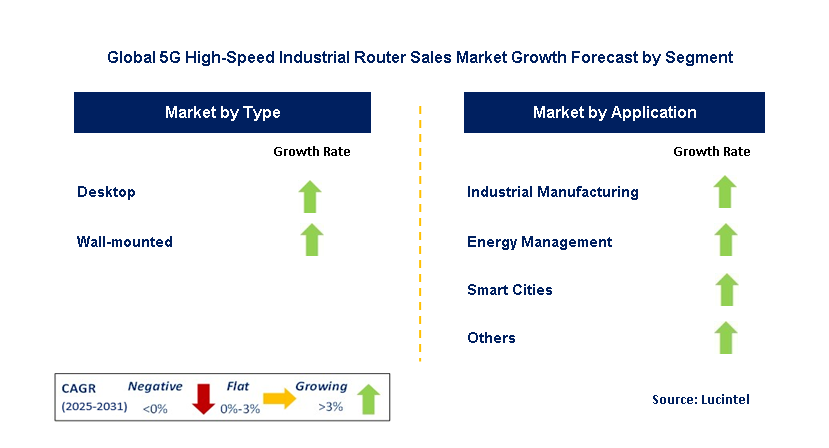
• Lucintel forecasts that, within the type category, wall-mounted is expected to witness higher growth over the forecast period.
• Within the application category, smart city is expected to witness the highest growth due to the increasing investment in smart infrastructure.
• In terms of region, APAC is expected to witness the highest growth over the forecast period due to the growing adoption of industrial automation.
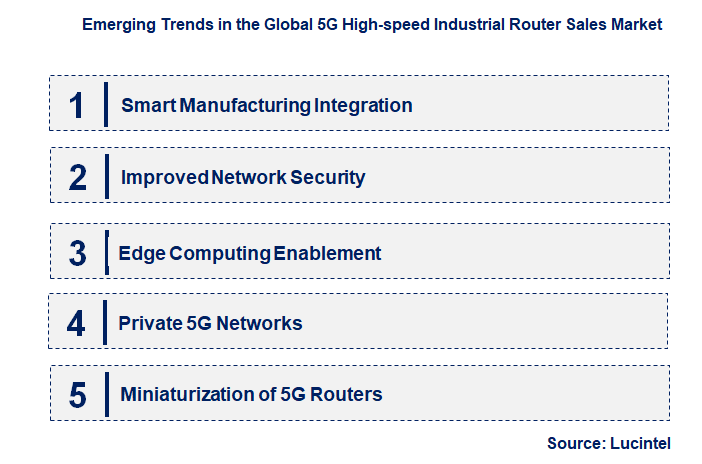
• Smart Manufacturing Integration: Smart manufacturing is quickly turning into a leading trend, as businesses strive to use 5G routers to connect devices, machines, and sensors in real-time. This trend allows companies to streamline their production lines, increase automation, and enhance predictive maintenance. Manufacturers can collect data from different sources and process it more effectively by incorporating smart routers into industrial systems. This transition to smart manufacturing has brought 5G routers into the limelight, as they play a vital role in providing reliable, low-latency communication between devices and systems.
• Improved Network Security: With industrial systems becoming increasingly interconnected, the demand for strong security protocols has grown. 5G industrial routers are being fitted with enhanced security features, including end-to-end encryption and intrusion detection systems, to guard against cyberattacks. This is a reaction to the escalating threats of industrial IoT networks, where weaknesses can cause serious operational downtime. Improved security on the network allows firms to run their smart factories and connected devices securely, shielding important data and ensuring regulatory compliance.
• Edge Computing Enablement: Edge computing is increasingly becoming popular in the industrial world, with 5G routers taking the central role in facilitating it. Edge computing minimizes latency and the usage of bandwidth by processing data at a closer location to the source, making it perfect for instantaneous decision-making. This is especially true for sectors like manufacturing, where slowness in data transmission may cause inefficiencies or system failures in automation. 5G high-speed routers are making edge computing possible by offering the infrastructure needed for localized, fast data processing, leading to more responsive and automated industrial operations.
• Private 5G Networks: Private 5G network adoption is growing as businesses seek more control over their connectivity and data. Private networks provide better security, dependability, and customization, enabling businesses to adapt their network architecture to suit particular industrial demands. The trend is particularly notable among industries with sensitive or critical operations, including manufacturing, logistics, and healthcare. The transition to private 5G networks is fueling the need for high-performance industrial routers that can accommodate the special needs of these networks, including low latency and high data capacity.
• Miniaturization of 5G Routers: With industries requiring smaller, more versatile, and efficient solutions, the miniaturization trend of routers becomes more visible. Small, high-performance 5G routers are being used more in confined spaces or mobile applications. This trend is facilitating the integration of 5G connectivity in space-constrained environments like warehouses, robots, and transport vehicles. Miniature routers are created to deliver the same performance as their larger counterparts with greater flexibility in industrial use. This trend accommodates the growing need for mobility and flexibility in industrial processes. These developments are transforming the 5G high-speed industrial router market by calling for intelligent, secure, and efficient solutions. As industries increasingly embrace cutting-edge technologies, the market for high-performance routers will keep expanding. Organizations that embrace these developments and invest in innovative solutions will be well-placed to lead in the future 5G industrial landscape.
• Multi-Protocol Router development: The advent of multi-protocol routers is a key breakthrough in the industrial router space. The routers are capable of supporting multiple communication protocols such as 5G, Wi-Fi, and Ethernet, giving industries more flexibility. This breakthrough enables companies to implement a single network that is capable of supporting multiple devices and communication standards. With higher interoperability, multi-protocol routers increase the scalability and efficiency of industrial operations.
• 5G-Enabled Automation Systems: 5G-enabled automation systems are also pushing the need for industrial routers with high-speed and low-latency communication capabilities. With the capability to send data at speeds up to 10 times higher than 4G, 5G routers are empowering automation systems in factories, warehouses, and other industrial settings. The routers are making more advanced automated processes possible, such as robotic arms, self-driving cars, and AI-based predictive maintenance.
• Artificial Intelligence Integration in Routers: AI implementation in industrial routers is revolutionary, as it increases the routers' processing and data analysis capability in real-time. AI-enabled routers can identify network problems automatically, optimize traffic patterns, and forecast upcoming failures prior to their occurrence. This technology is pushing the use of AI-enabled routers in sectors where uptime needs to be constant and response speed high, including manufacturing, logistics, and energy.
• Industrial 5G Testbed Growth: A number of nations and firms are rolling out industrial 5G testbeds to discover the capabilities of 5G technology in practical industrial uses. The testbeds are crucial for testing the performance of 5G routers and other infrastructure in settings such as smart factories, logistics centers, and energy networks. Information collected from the testbeds is fine-tuning router technology and making 5G-enabled solutions compatible with the unique demands of industries.
• Router Customization in Industry-Specific Requirements: As the demand for 5G routers picks up, organizations are providing more customized solutions meeting specific industry requirements. From automotive to healthcare and logistics, routers are being developed to suit the special connectivity and data management requirements of various industries. Customization is helping organizations deploy 5G routers that seamlessly integrate into their current setup and provide performance that is optimized. The recent innovations in the 5G high-speed industrial router market are making operations more efficient, encouraging automation, and supporting real-time processing of data. As industries use more advanced technologies, these innovations are supporting the transition to more intelligent, more connected industrial environments.
• Smart Manufacturing: The growth of smart manufacturing is one of the most significant growth prospects for the 5G industrial router market. 5G routers support real-time data processing and machine-to-machine communication, which is essential for the success of smart factories. Companies can use automated systems for predictive maintenance, quality control, and inventory management, leading to increased efficiency and cost savings.
• Logistics and Supply Chain Optimization: The logistics industry is increasingly using 5G routers to streamline supply chain management. With the requirement for real-time monitoring of goods and assets, 5G routers offer the required speed and dependability for logistics. By enhancing communication among vehicles, warehouses, and inventory systems, 5G routers minimize delays, enhance route planning, and increase overall logistics efficiency.
• Autonomous Vehicles: With the development of autonomous vehicle technology, dependable 5G connectivity is essential. Industrial 5G routers are now a crucial enabler for the smooth communication between autonomous vehicles, infrastructure, and remote control centers. This use case is especially important for industries such as mining, construction, and agriculture where autonomous machinery has the potential to enhance safety and efficiency.
• Energy and Utility Sector: The energy and utility industries are making greater use of 5G routers to support smart grids and remote monitoring of the infrastructure. Through real-time data collection and analysis, firms can maximize energy distribution and minimize downtime. 5G routers are critical in ensuring the security, reliability, and efficiency of these infrastructural systems.
• Healthcare Industry: The health sector is leveraging 5G routers to make telemedicine, remote surgeries, and patient tracking possible. 5G routers, with low-latency high-speed communication, are making the delivery of healthcare more efficient. 5G routers are being implemented by clinics and hospitals for enhancing the diagnosis and treatment pace and accuracy and for making healthcare more efficient and accessible. These strategic growth opportunities are propelling the growth of the 5G high-speed industrial router market. With industries increasingly using 5G technologies to establish greater connectivity and automation, these applications will be key to shaping the future of industrial processes.
• Phoenix Contact
• ALE International
• Cisco Systems
• Juniper Networks
• ZTE Corporation
• Netgear
• Inseego Corporation
• Micromax Technology
• TP-Link Technologies
• Advantech
• Desktop
• Wall-mounted
• Industrial Manufacturing
• Energy Management
• Smart Cities
• Others
• North America
• Europe
• Asia Pacific
• The Rest of the World
• United States: There has been notable growth in the 5G high-speed industrial router industry in the U.S. owing to significant investment in industrial automation as well as the development of smart cities. Giants such as Cisco and Ericsson are constantly in collaboration with regional businesses for rolling out 5G networks. The support given by the government to develop 5G also supported the development of industrial use across all business sectors, like manufacturing and farming. Apart from this, the U.S. is also emphasizing network security, with industrial routers now aligning to strict standards of cybersecurity. These developments are assisting U.S. businesses in adopting 5G technology for operational efficiency.
• China: China continues to be a world leader in 5G technology, and its industrial router market has grown at a speedy rate. Aggressive promotion by the Chinese government for massive adoption of 5G, especially in manufacturing, is further fueling the growth of the market. Businesses are incorporating sophisticated industrial routers in their operations to enhance automation and processing of real-time data. Additionally, China's Belt and Road Initiative is promoting the rollout of 5G infrastructure, which is offering businesses new prospects to boost connectivity across regions. China's emphasis on high-tech industrial solutions has transformed it into a major 5G router player in the world.
• Germany: Germany is among the leading countries in the European 5G industrial router market, focusing on Industry 4.0 and automation. German industries are incorporating more and more 5G routers to facilitate real-time tracking, predictive maintenance, and improved production efficiency. The government's efforts towards supporting industries' digital transformation are driving the demand for high-speed industrial routers. Businesses such as Bosch and Siemens are leading the adoption of 5G technology, with a goal to build smarter factories. Germany's robust industrial sector places the country well to continue its stronghold on the 5G industrial router market in Europe.
• India: India is undergoing swift digitalization, and the 5G high-speed industrial router market is also reaping benefits from this phenomenon. The government initiative of 'Digital India' and smart cities is driving demand for industrial routers with latest technology. Major sectors like manufacturing, logistics, and agriculture are going for 5G technology to enhance operational efficiency and make processes more streamlined. Indian players are targeting low-cost but high-performance routers to address the growing demand. The growth of e-commerce and logistics in India is also contributing to the growth in the market for 5G-enabled industrial routers.
• Japan: Japan is yet another nation where 5G high-speed industrial routers are adopting at a rapid pace, especially in the automobile and robotics sectors. The nation is heavily investing in developing intelligent manufacturing ecosystems wherein real-time data processing and remote control of machinery are critical. The government in Japan has been keen on investing in 5G infrastructure, and partnerships between tech titans such as Sony and Panasonic are contributing towards breaking the barriers of 5G connectivity in industry applications. Japan's focus on high-tech industries remains strong in driving the demand for high-end industrial routers.


• Phoenix Contact
• ALE International
• Cisco Systems
• Juniper Networks
• ZTE Corporation
• Netgear
• Inseego Corporation
• Micromax Technology
• TP-Link Technologies
• Advantech Q5. Which 5G high-speed industrial router sales market segment will be the largest in future? Answer: Lucintel forecasts that, within the type category, wall-mounted is expected to witness higher growth over the forecast period. Q6. In 5G high-speed industrial router sales market, which region is expected to be the largest in next 5 years? Answer: In terms of region, APAC is expected to witness the highest growth over the forecast period due to the growing adoption of industrial automation. Q7. Do we receive customization in this report? Answer: Yes, Lucintel provides 10% customization without any additional cost.


Choose a license that fits your team. Instant PDF delivery.
Prices exclude taxes. Instant delivery. Custom licensing available on request.
Market Report · July 31, 2026
Market Report · July 22, 2026
Market Report · July 20, 2026
Trusted partner for strategic intelligence and business growth


Receive a complimentary market analysis tailored to your industry. Our analysts will identify key growth opportunities and competitive dynamics specific to your business.

Market size, growth rate, and key trend analysis for your specific sector.

Top competitor positioning and market share analysis.

Strategic recommendations backed by data-driven insights.
Get curated market intelligence and competitive moves straight to your inbox.
By subscribing, you agree to receive our monthly insights. Unsubscribe anytime.
Receive a complimentary market analysis tailored to your industry. Our analysts will identify key growth opportunities and competitive dynamics specific to your business.
Market size, growth rate, and key trend analysis for your specific sector.
Top competitor positioning and market share analysis.
Strategic recommendations backed by data-driven insights.
Get curated market intelligence, emerging trends, and competitive moves straight to your inbox each month.
By subscribing, you agree to receive our monthly insights. Unsubscribe anytime.
We'll send your sample report shortly.