
Market Report · July 31, 2026

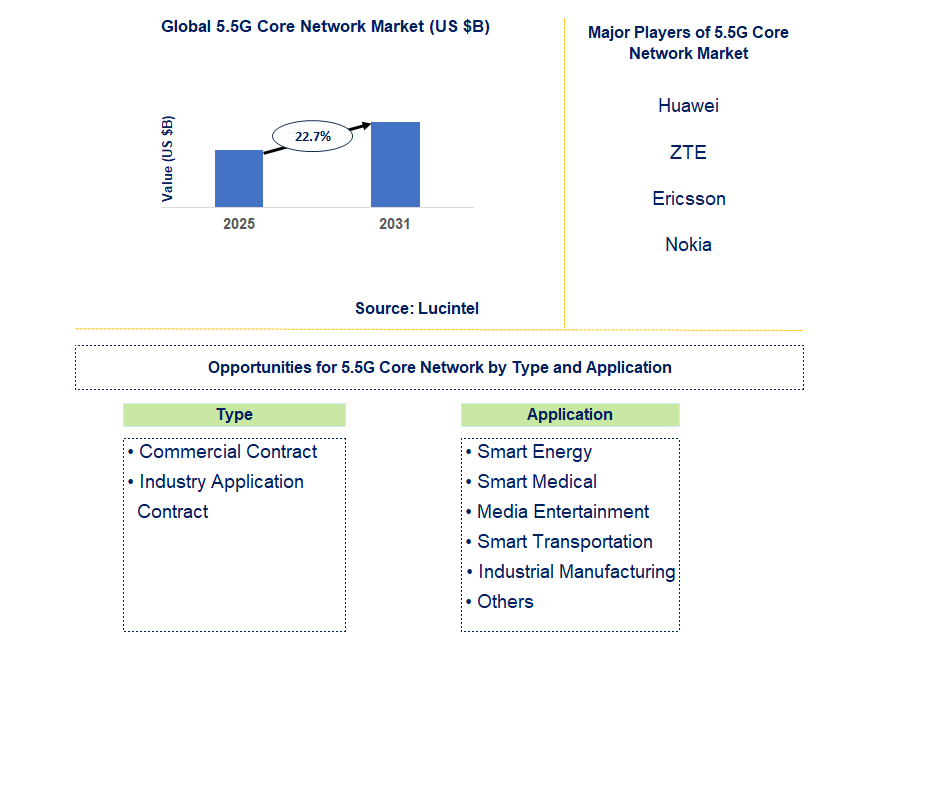
Key data points: The growth forecast = 0.227 annually for the next 7 years. Scroll below to get more insights. This market report covers Trends, opportunities and forecasts in 5.5g core network market to 2031 by type (commercial contract and industry application contract), application (smart energy, smart medical, media entertainment, smart transportation, industrial manufacturing, and others), and region (North America, Europe, Asia Pacific, and the Rest of the World)
We'll send your sample report shortly.
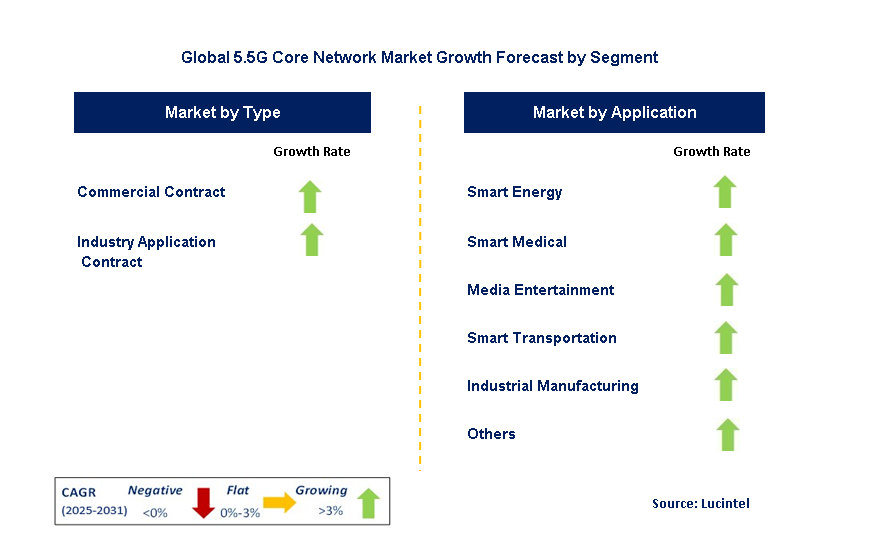
• Lucintel forecasts that, within the type category, commercial contracts will remain a larger segment over the forecast period due to they involve large-scale network infrastructure deployments and long-term agreements.
• Within the application category, smart transportation is expected to witness the highest growth due to it encompasses widespread applications like autonomous vehicles.
• In terms of region, APAC is expected to witness the highest growth over the forecast period due to large-scale 5g deployments.
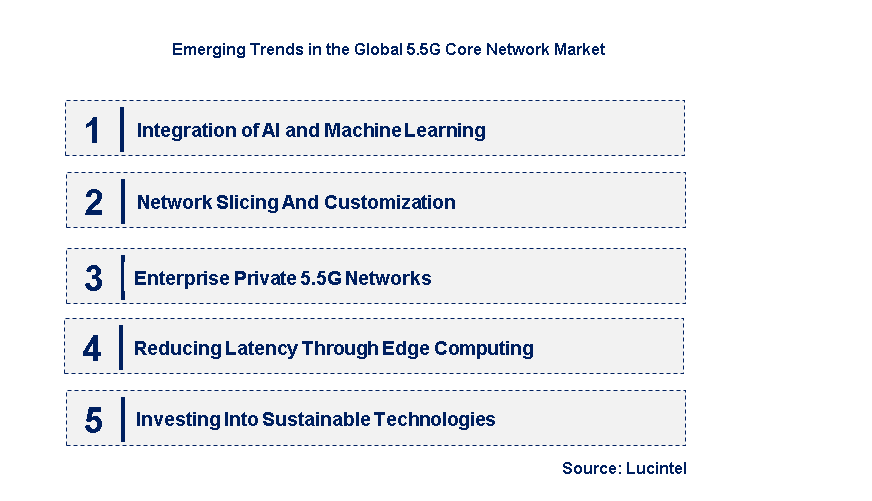
• Integration of AI and Machine Learning: Telecom service providers now incorporate AI and machine learning technologies into the core network infrastructure. These advancements foster greater automation, decision-making during network operation, and maintenance. Telecommunication AI algorithms adjust the system depending on network states. This leads to fewer network failures, less system down time, and better call quality for users. Also, AI will optimize slicing of the network and will manage traffic flows in 5.5G networks.
• Network Slicing And Customization: The 5.5G Core Networks enables operators to provide customized connectivity for specific deployed use cases. An operator can customize the connectivity parameters for different virtual networks using network slicing. Certain industries will always benefit, such as healthcare, autonomous driving, and smart cities that all depend on unique levels of connection and performance.
• Enterprise Private 5.5G Networks: More businesses are starting to look for private 5.5G networks, which will help them with their particular security, reliability, and performance needs. Private Networks enable businesses to have greater control over their connection and make sure critical applications function without hiccups. Companies in manufacturing, logistics, and healthcare are rapidly deploying private 5.5G networks to cater to their business-specific high demands.
• Reducing Latency Through Edge Computing: Edge computing is becoming an increasingly important part of the 5.5G Core Networks because of the demands of latency-critical applications such as self-driving cars. Edge computing entails performing computations at the network's edge, decreasing latency because data does not have to travel as far within the center. This trend backs industries like robotics, smart cities, and IoT that require instantaneous actions.
• Investing Into Sustainable Technologies: With sustainability becoming a key focus, telecom operators are looking for green technologies to support the 5.5G network. These eco-friendly solutions target a reduction of energy use, diminished carbon footprints, and green civic works construction. 5.5G core networks are getting new energy saving hardware, renewable energy, and new super cooling systems, which builds a sustainable telecom ecosystem. These new technologies are modifying the 5.5G Core Network Market by building new market segments, improving overall experience, and providing quicker and more dependable connections. Network efficiency with the adoption of AI, edge computing, and private networks is also improving. At the same time, the sustainability initiatives are helping the industry go green. All of these factors will enable further advancement in 5.5G commercial and network deployment.
• Roll Out of the 5.5G Infrastructure: Telecom companies throughout the United States, China, and Europe are rapidly working towards deploying 5.5G network infrastructure. The deployment of cloud-native architectures, network slicing, and edge computing are pivotal to supporting 5.5G use cases. Telcom Corporations are also working towards upgrading the existing 4G and 5G networks to support the low latency and high bandwidth demands of 5.5G networks.
• Incorporation of AI and Automation in Network Operations: People are currently adopting AI technology and automation to optimize network performance, reduce manual intervention, and ensure reliable and consistent connectivity. AI is assisting the operators in predicting traffic patterns, network management automation, and user serviced tailoring. The increase in interconnected devices coupled with the scale and complexity of 5.5G networks make automation essential.
• Expansion of Network Slicing in 5.5G: One of the main objectives of 5.5G networks, network slicing, empowers operators to virtually construct networks and customize them according to particular industry requirements. Steps have been taken to deploy Advanced Network Slicing in categories like health industry, smart cities, and autonomous driving industries providing greater flexibility and optimization A company has completely changed the way telecom operators utilize and distribute connectivity.
• Within Industry Use Private 5.5G Networks: The adoption of Private 5.5G networks, especially for large businesses, is on the rise. Enterprises are using these types of networks due to their heightened security, governance, and performance capabilities. Manufacturing, logistics, and automotive industries are increasingly utilizing private 5.5G networks to facilitate mission-critical processes. This is likely to foster new business models and opportunities for telecom companies within the B2B domain.
• Government Investment in the 5.5G Network Infrastructure Development: The 5.5G global competition is forcing governments around the world to pour capital into 5.5G infrastructure development and research. Investments are focused on enabling countries to compete within the global digital economy. Some notable ones are funding 5.5G trials, updating the regulations, and public-private collaborations to boost the commercialization of 5.5G technologies. These changes will set the stage for rapid growth of the 5.5G Core Network Market. The implementation of newer technologies along with pouring funds into research and infrastructure will enhance adoption rates of 5.5G networks in conjunction with improving the credibility of the network and broadening the scope of use cases. These innovations will harness the next stage of transformation across the globe.
• Smart Cities: The concept of smart cities brings with it the opportunity to expand the capabilities of 5.5G networks. The growing need for reliable and advanced 5.5G networks for wide range traffic management applications, energy optimizations, low latency, and high speed connectivity integrations will allow for a plethora of new applications. Telecom providers have the opportunity to partner with governments to build the necessary infrastructure for smart city services.
• Industrial IoT (IIoT): The growth of the IIOT sector segment stands to greatly benefit from ultra reliable and low latency 5.5G network connections. 5.5G networks are set to promote effective digital transformation of supply chains, manufacturing, and logistics. Telecom providers can work with industrial enterprises to provide purpose built 5.5G connectivity solutions that enable operational excellence and higher degrees of automation.”
• Self-driving cars: Cars that are driverless: these vehicles require swift and low latency communication in order to ensure that real-time decision making is possible, which makes the shift to 5.5G core networks essential. As more self-driving cars come into market, the need for dependable and safe connections will rise. Telecommunication service providers can use this opportunity to build bespoke solutions that assist in the development of this fast-paced sector.
• Medical care and virtual Health: Largely, this industry will see the most benefits with the implementation of 5.5G Core Networks due to its ability to support complex telemedicine services, virtual surgeries, and constant health monitoring. With 5.5G smoother AI and IoT-based patient management systems can be implemented which greatly improves the quality of care given. Telecommunication companies can serve hospitals, clinics, and even doctors with the reliable connection that facilitates better care for patients.
• Employers and Gamers using Augmented Reality/ Virtual Reality (AR/VR): The implementation of 5.5 core network is going to revolutionize the AR/VR market as there is expected to be a massive expansion. These technologies heavily rely on high bandwidth streaming and almost instant responsiveness. As AR and VR technology penetrates new markets like gaming, education, and even remote working, telecom service providers have the chance to invest in new infrastructure for these highly active markets. These strategic growth prospects reveal the breadth of potential these 5.5G networks can offer across multiple industries. The telecom providers can foster innovation, enhance customer engagement, and create new revenue streams by developing customized connectivity solutions for these applications. The adoption of 5.5G technologies will accelerate the creation of new services and business models leading to increased growth in the market.
• Huawei
• ZTE
• Ericsson
• Nokia
• Commercial Contract
• Industry Application Contract
• Smart Energy
• Smart Medical
• Media Entertainment
• Smart Transportation
• Industrial Manufacturing
• Others
• North America
• Europe
• Asia Pacific
• The Rest of the World
• United State: In United States, greater telecom operators are trying to strategize development and deployment of 5.5G Core Networks to address rising demand for high speed connectivity, which means an increase in focus on latency, network reliability, and scalability. Increasing partnerships between telecoms and tech companies eased the rollout of the 5.5G technologies. Edge computing, automation and AI are also flourishing with the already active investment initiatives to enhance network infrastructure, enabling the US to maintain competitiveness within the 5.5G system.
• China: China has maintained its position as a world leader in the 5.5G space as it continues to improve its technology and infrastructure. The country’s urban and industrial areas are expected to have greater coverage, which will enable low latency service and ultra-reliable communication. The Chinese government is keen on developing 5G and 5.5G networks and aims to gain technical supremacy over other nations. China has telecom behemoths like Huawei and ZTE that are working on the core network of 5.5 which enhances already existing 5G capabilities automation and AI. Additionally, China is also using private 5G networks for smart cities which will further aid demand growth in the market.
• Germany: Germany has swiftly moved towards the development of a 5.5G Core Network with the intention of enabling new applications associated with manufacturing, automobiles, and other industrial activities. Integration of several operators with the government and academic institutions aims to improve the supply side of the infrastructure by introducing new products in ultra-high speed internet and low latency service. The country is now also paying attention to the application of AI and ML for network optimization. 5.5G deployment will facilitate the use of more advanced technologies such as autonomous automobiles, Industry 4.0, and other advanced use cases. Germany is projected to increase its market share with the introduction of 5.5G and its trials alongside actual implementation by other major telecommunications companies.
• India: India is working on developing a 5.5G Core Network for its fast-growing digital ecosystem. The enormous population and the rising need for digital services technologically advanced network infrastructure. Indian telecom operators are working with international technology firms to develop 5.5G networks that will focus on IoT, AI, and the digital economy. 5.5G Networks will ensure faster broadband services are available, especially in rural and neglected regions. This will fuel economic growth and enhance digital participation. 5.5G Network services are witnessing acceleration with the help of government’s digital initiatives.
• Japan: Japan is at the forefront of innovations in the 5.5G core network development with special focus on automation, robotics, and IoT technologies. The investment in Japan for 5.5G technology is centered on the improvement of network reliability for crucial industries lines of business such as manufacturing and transportation. Japanese telecom companies alongside manufacturers are venturing into private networks and other advanced use industrial cases. The country's focus on autonomous systems and smart infrastructure makes it impossible to avoid seamless connectivity hence the shift to 5.5G cannot be ignored. The swift development and future proofing of the country towards new network supply demands in 5.5G technology is stimulated by cooperation between industry and government.


• Huawei
• ZTE
• Ericsson
• Nokia Q5. Which 5.5g core network market segment will be the largest in future? Answer: Lucintel forecasts that, within the type category, commercial contracts will remain a larger segment over the forecast period due to they involve large-scale network infrastructure deployments and long-term agreements. Q6. In 5.5g core network market, which region is expected to be the largest in next 5 years? Answer: In terms of region, APAC is expected to witness the highest growth over the forecast period due to large-scale 5g deployments. Q7. Do we receive customization in this report? Answer: Yes, Lucintel provides 10% customization without any additional cost.


Choose a license that fits your team. Instant PDF delivery.
Prices exclude taxes. Instant delivery. Custom licensing available on request.
Market Report · July 31, 2026
Market Report · July 31, 2026
Market Report · July 31, 2026
Trusted partner for strategic intelligence and business growth


Receive a complimentary market analysis tailored to your industry. Our analysts will identify key growth opportunities and competitive dynamics specific to your business.

Market size, growth rate, and key trend analysis for your specific sector.

Top competitor positioning and market share analysis.

Strategic recommendations backed by data-driven insights.
Get curated market intelligence and competitive moves straight to your inbox.
By subscribing, you agree to receive our monthly insights. Unsubscribe anytime.
Receive a complimentary market analysis tailored to your industry. Our analysts will identify key growth opportunities and competitive dynamics specific to your business.
Market size, growth rate, and key trend analysis for your specific sector.
Top competitor positioning and market share analysis.
Strategic recommendations backed by data-driven insights.
Get curated market intelligence, emerging trends, and competitive moves straight to your inbox each month.
By subscribing, you agree to receive our monthly insights. Unsubscribe anytime.
We'll send your sample report shortly.