
Market Report · May 18, 2026

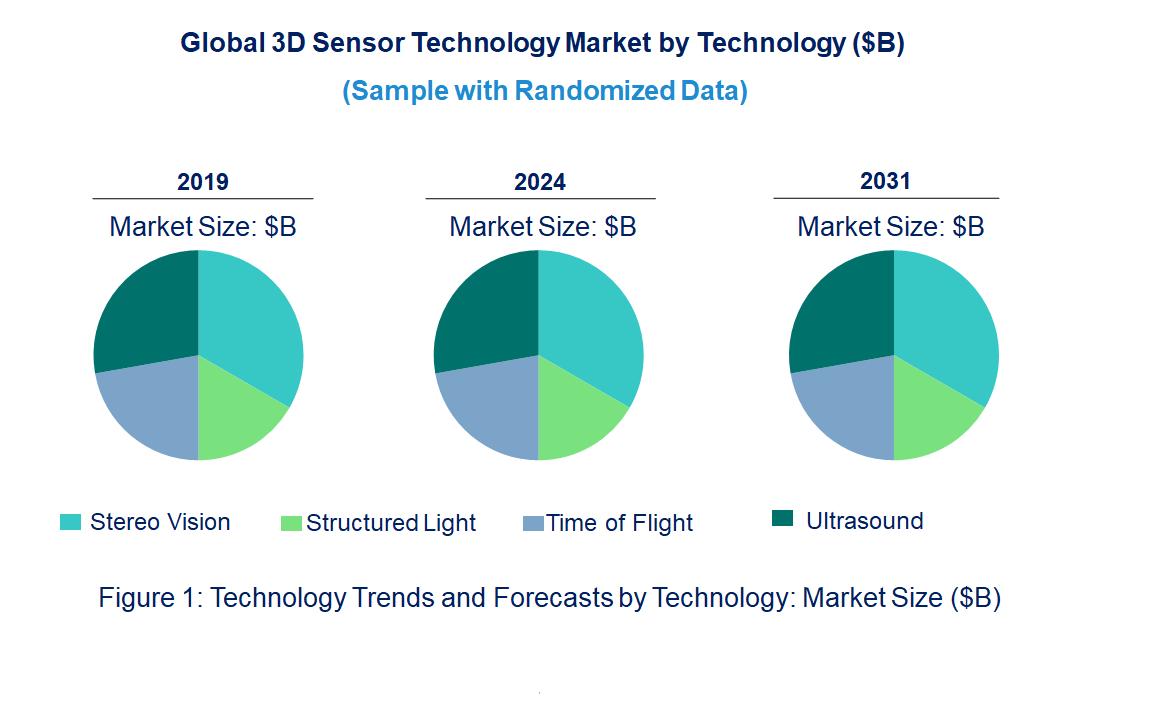
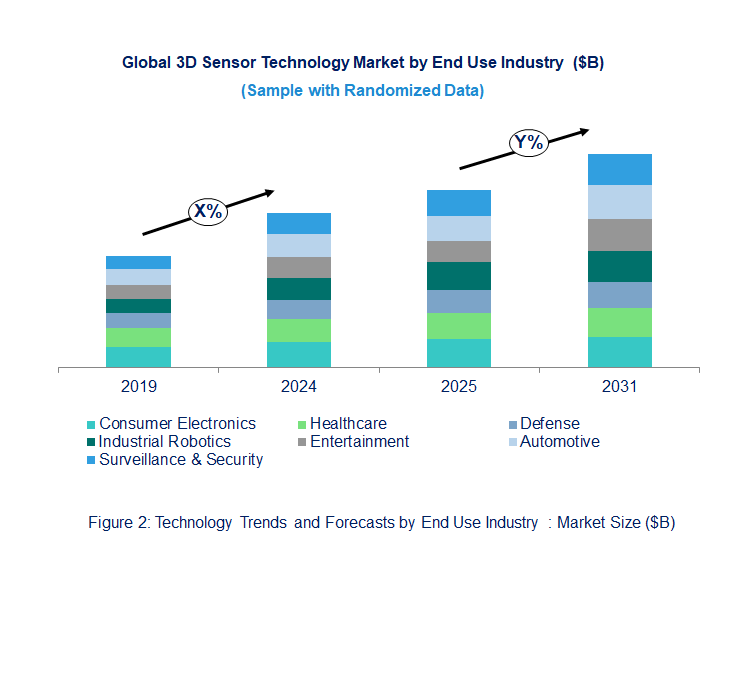
This market report covers trends, opportunities, and forecasts in the global 3d sensor technology market to 2031 by technology (stereo vision, structured light, time of flight, and ultrasound), end use industry (consumer electronics, healthcare, defense, industrial robotics, entertainment, automotive, surveillance & security, and others), and region (North America, Europe, Asia Pacific, and the Rest of the World)
We'll send your sample report shortly.
• Autonomous Vehicles with 3D Sensors: As the autonomy of vehicles evolves, 3D sensors, including Time of Flight (ToF) sensors, are in high demand for instant depth maps and obstacle detection to make driving secure and navigation more effective.
• Miniaturization of 3D Sensors for Consumer Electronics: There is increasing demand for portable, high-performance, accurate, and compact 3D sensors for consumer electronics, specifically for smartphone applications, wearables, gaming, and devices offering functionalities such as facial recognition and augmented reality.
• Advances in Healthcare Applications: Advances in 3D sensor technologies, particularly structured light and Time of Flight sensors, are being increasingly adopted in healthcare devices, including medical imaging systems and robotic surgery tools, to achieve more precise diagnostics and improved treatment results.
• Advancements in 3D Sensors Used in Robotics and Industrial Automation: The use of 3D sensors in robotics and industrial automation is expanding rapidly. Robots can now interact more effectively with their environment, which will continue to drive growth in sectors such as manufacturing that emphasize the need for automation and precision.
• Development of Gesture Recognition Technologies: Gesture recognition is an increasingly important application of 3D sensor technologies in gaming and entertainment, where advanced 3D sensing technologies, such as stereo vision and ToF, support more immersive experiences and natural interactions with digital environments. These trends reflect the growing reliance on cutting-edge 3D sensor technologies across various sectors, presenting both challenges and new opportunities for more interactive, accurate, and efficient products and systems.
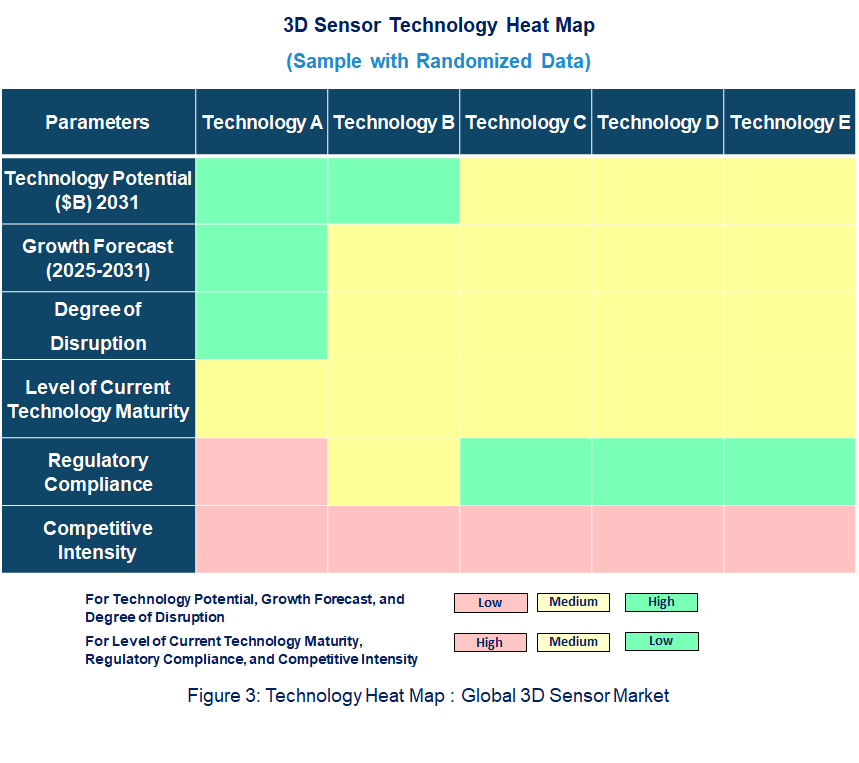
• Technology Potential: The potential of 3D sensor technology is immense, as it can revolutionize areas such as augmented reality, autonomous vehicles, and smart manufacturing. Highly accurate depth sensing can improve safety, enhance user experiences, and optimize automation processes, which are key drivers for these technologies in increasing demand across industries.
• Degree of Disruption: With a high degree of disruption, especially in automotive and consumer electronics, three-dimensional sensors bring critical innovation. For example, the implementation of 3D sensors in self-driving cars provides advanced functionalities such as obstacle detection and environment mapping. Consumer electronics also support innovations like facial recognition and gesture control, improving product usability.
• Current Technology Maturity: The technology maturity in the 3D sensor market is moderate. While some technologies like Time-of-Flight (ToF) and stereo vision are well-established, others, like LiDAR and structured light sensors, are still evolving, with ongoing research to improve their accuracy, resolution, and cost-effectiveness.
• Regulatory Compliance: Regulatory compliance for 3D sensor technologies is critical, especially in automotive and healthcare sectors, where safety standards are stringent. These sensors must meet regulatory requirements such as ISO 26262 for automotive safety and FDA guidelines for medical applications to ensure safety and reliability.
• Infineon: Infineon has launched its 3D Time-of-Flight sensors, offering high-precision depth sensing in various applications, including automotive safety systems and industrial automation, making real-time 3D sensing solutions more reliable.
• Microchip: Microchip has introduced low-power depth sensors with high accuracy, along with new 3D sensor technologies for consumer electronics and automotive applications, particularly for gesture recognition and object detection.
• Omnivision: Omnivision has developed 3D sensor solutions for mobile applications, mainly facial recognition in smartphones, with high resolution and real-time processing, helping drive the next generation of biometric security in consumer electronics.
• PMD Technologies: PMD Technologies has advanced Time-of-Flight (ToF) sensors, enabling highly accurate distance measurements used in various applications, including industrial robotics and automotive systems, enhancing automation and autonomous vehicle navigation.
• Asustek Computer: Asustek has led innovations in consumer electronics by incorporating 3D sensors in gaming devices and virtual reality systems, enhancing user experiences in terms of immersion and interactivity based on precise spatial sensing.
• Cognex: Cognex has designed sophisticated machine vision systems for industrial automation, including 3D sensor solutions used to improve quality control and inspection processes in manufacturing industries. These solutions drive the use of automation technologies in the industrial sector.
• IFM Electronic: IFM Electronic has developed high-performance 3D sensors for industrial robots, enabling more complex robotic capabilities for high-precision tasks in manufacturing and assembly lines.
• Intel: Intel has expanded its 3D sensor technology for facial recognition, automotive safety, and robotics with sophisticated sensors integrated into various applications that will enhance the next level of interaction and automation systems.
• LMI Technologies: LMI Technologies has developed state-of-the-art 3D sensor systems for industrial inspections, providing real-time, high-precision solutions that are revolutionizing the evaluation and control of quality in production. These developments demonstrate how key players are advancing 3D sensor technologies to meet growing demands for accuracy, real-time processing, and miniaturization across various sectors.
• Increased adoption in consumer electronics: The growing number of smart devices, such as smartphones, game consoles, and wearables, has significantly increased the demand for 3D sensors. These sensors enhance user experiences through functionalities like facial recognition, gesture control, and augmented reality, which in turn boost further market expansion.
• Industrial automation: Advancements in the application of 3D sensor technology in manufacturing and robotics have led to new uses in precision, automation, and quality control. These sensors allow for faster and more accurate assembly of products, reduce downtime, and increase productivity.
• Automotive sector: The market for 3D sensors has further grown with their widespread application in autonomous vehicles for environment mapping, obstacle detection, and navigation systems. These sensors play a significant role in developing safe, efficient, and self-driving technologies.
• Increasing demand for healthcare applications: In the medical field, imaging, diagnostics, and surgical assistance rely on 3D sensors. These sensors enhance the capabilities of the healthcare sector by providing better treatment plans with precise 3D models of the human body. Challenges in the 3D Sensor Technology include:
• High cost of 3D sensor systems: Although great progress has been made in technology, 3D sensors remain expensive, making them difficult to mainstream in small and medium-sized enterprises (SMEs). The high costs of entry may discourage smaller companies from adopting this new technology.
• Complex integration with current systems: Incorporating 3D sensors into legacy systems often involves overcoming significant technical difficulties. The need for specialized software and hardware, along with other system compatibility issues, lengthens integration time and discourages market acceptance.
• Data processing and storage constraints: 3D sensors generate large amounts of data, which requires solutions for real-time processing and storage. Handling complex data, especially in real-time applications such as autonomous driving and robotics, can be challenging. The 3D sensor technology market is defined by opportunities in industries including consumer electronics, automotive, industrial automation, and healthcare, all of which have significant growth potential. However, challenges such as high costs, integration complexities, and data management issues continue to impact sustained growth and widespread market acceptance. These factors have been ongoing influences in shaping the progression of 3D sensor technology.
• Infineon
• Microchip
• Omnivision
• Pmd Technologies
• Asustek Computer
• Cognex
• Technology Readiness by Type: Stereo Vision is very mature and widely applied in machine vision, robotics, and AR/VR. Its technology readiness is strong and continues to improve in algorithm processing. Structured Light is highly ready, with common applications in industrial automation and 3D scanning, enabling object inspection and quality control. ToF is progressing steadily, and the technology has already dominated mobile devices, automotive, and security applications. However, it faces challenges in cost and miniaturization to be adopted in mass markets. Ultrasound technology, while older, is indispensable in several applications related to medical imaging, industrial non-destructive testing, and automotive proximity sensing with mature technology and high regulatory compliance requirements, especially in healthcare (FDA, CE). Each of these technologies is at varying degrees of readiness, with ToF and Structured Light being most applicable to emerging sectors such as autonomous vehicles and mobile applications.
• Competitive Intensity and Regulatory Compliance: It is highly competitive in the 3D sensor market, with firms in nearly all sectors competing to gain leadership in Stereo Vision and Structured Light technologies, while ToF and Ultrasound applications face competition from Stereo Vision. ToF sensors face less competition in speed combined with accuracy; however, high costs and poor integration present stronger challenges. Structured Light is widely used in high-precision applications like quality control, facing competition from advanced ToF sensors. Ultrasound sensors, though mature, face competition in medical and industrial fields from more precise, non-contact technologies. Regulatory compliance is essential across these technologies, with standards for safety and accuracy in medical (FDA, ISO) and industrial applications (CE, UL). EMC and environmental impact regulations must also be adhered to for market acceptance.
• Disruption Potential: The 3D sensor technology market is experiencing disruption from technologies like Stereo Vision, Structured Light, Time of Flight (ToF), and Ultrasound. Stereo Vision is highly accurate in terms of depth perception and is widely used in robotics and AR/VR. Structured Light, due to its high precision in projecting light patterns, is popular in industrial automation and quality control. ToF sensors, known for their fast, real-time depth measurement, are disruptive in mobile devices, automotive, and security systems. Ultrasound technology, while more mature, is seeing opportunities in medical imaging and industrial applications due to its potential for accurate measurements in challenging environments. Each of these technologies brings different advantages to different industries, driving progress in automation, healthcare, and consumer electronics with massive disruption potential, particularly in fields like autonomous driving and robotics, which require real-time 3D sensing.
• Stereo Vision
• Structured Light
• Time of Flight
• Ultrasound
• Consumer Electronics
• Healthcare
• Defense
• Industrial Robotics
• Entertainment
• Automotive
• Surveillance & Security
• North America
• Europe
• Asia Pacific
• The Rest of the World
• Latest Developments and Innovations in the 3D Sensor Technology Technologies
• Companies / Ecosystems
• Strategic Opportunities by Technology Type


Choose a license that fits your team. Instant PDF delivery.
Prices exclude taxes. Instant delivery. Custom licensing available on request.
Market Report · May 18, 2026
Market Report · May 18, 2026
Market Report · May 18, 2026
Trusted partner for strategic intelligence and business growth


Receive a complimentary market analysis tailored to your industry. Our analysts will identify key growth opportunities and competitive dynamics specific to your business.

Market size, growth rate, and key trend analysis for your specific sector.

Top competitor positioning and market share analysis.

Strategic recommendations backed by data-driven insights.
Get curated market intelligence and competitive moves straight to your inbox.
By subscribing, you agree to receive our monthly insights. Unsubscribe anytime.
Receive a complimentary market analysis tailored to your industry. Our analysts will identify key growth opportunities and competitive dynamics specific to your business.
Market size, growth rate, and key trend analysis for your specific sector.
Top competitor positioning and market share analysis.
Strategic recommendations backed by data-driven insights.
Get curated market intelligence, emerging trends, and competitive moves straight to your inbox each month.
By subscribing, you agree to receive our monthly insights. Unsubscribe anytime.
We'll send your sample report shortly.