
Market Report · July 29, 2026

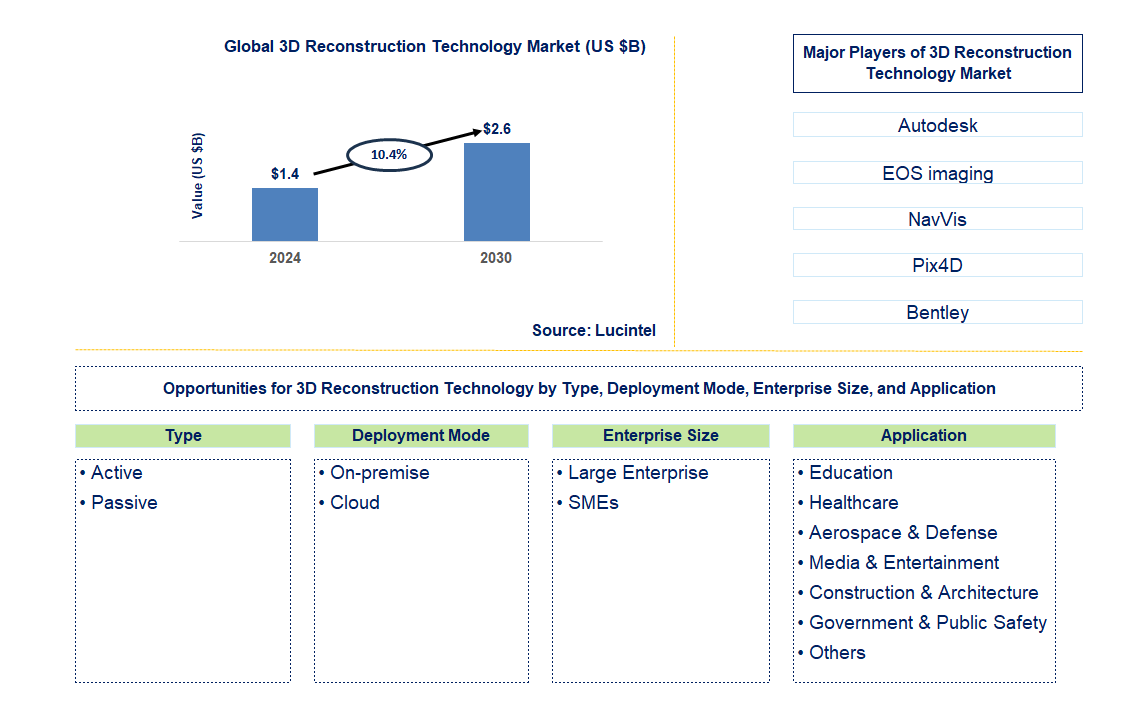
Key data points: The market size in 2030 = $2.6 billion, growth forecast = 10.4% annually next 6 years. Scroll below to get more insights. This market report covers trends, opportunities, and forecast in the global 3D reconstruction technology market to 2030 by type (active and passive), deployment mode (on-premise and cloud), enterprise size (large enterprise and SMEs), application (education, healthcare, aerospace & defense, media & entertainment, construction & architecture, government & public safety, and others), and region (North America, Europe, Asia Pacific, and the Rest of the World)
We'll send your sample report shortly.
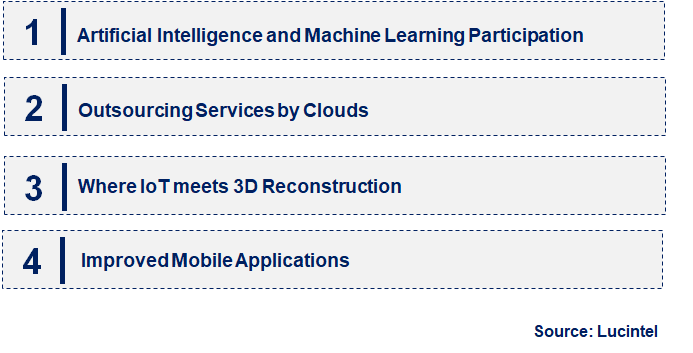
• Artificial Intelligence and Machine Learning Participation: The 3D reconstruction is revolutionizing the effectiveness and efficiency of the modeling process. New effective algorithms will appear which will allow the complete automation of the reconstruction process or improve the object identification, better the detail and resolution. This trend is making the 3D reconstruction process more accurate and more flexible for different types of needs, such as medical imaging, autonomous systems, etc.
• Outsourcing Services by Clouds: Services offered in the internet such as cloud computing are more appealing to users of 3D reconstruction because of their economic viability and mobility. Large 3D databases can be processed and stored in cloud services and therefore far-reaching collaborations and modeling can be performed. This trend allows increasing the opportunities of developing collaborative projects and embedding 3D reconstruction into the applications and services which use the cloud.
• Where IoT meets 3D Reconstruction: When it comes to integration with IoT spatial reconstruction technologies are made advanced by attaching real world objects to such 3D models. The devices and sensors that are connected to the internet of things and objects offer information that can be used to develop and improve 3D models. This is true especially for industrial applications where maintenance processes must be done in real time in the best effective ways as possible.
• Improved Mobile Applications: Improved mobile applications for filming construction and obtaining of a 3D structure are increasing technology's exposure to many more users. Availability of mobile devices fitted with high technology sensors and processing power has made it possible for people to capture and create 3D models while on the move, instead of going to the 3D scanning offices. It is opening up 3D camera devices to mass audiences performed where anybody can take part in this photographical intelligence extended despite motion restrictions with regards to expense or circulation region. The new trends in 3D reconstruction techniques adopted in the survey – real-time modeling, artificial intelligence, cloud based modeling, IoT, enhanced mobile applications – are making the new wave in the industry due to increased effectiveness, efficiency and usability. Hence these trends are also responsible for the developments as well as many other areas such as health care entertainment industrial and consumer markets have adopted the technology in their own sectors.
• Advancements in Imaging Techniques: Advancements in imaging techniques have facilitated construction of high dimensional and highly detailed 3 Dimensional models. Most of these techniques which include high definition laser scanning and photogrammetry offer better and more accurate and precise reconstructions. These improvements are improving the areas of architecture, cultural heritage preservation and medical imaging by providing more realistic and dependable models.
• Improvements in Computational Power: Improvements in computational power are enhancing the speed and efficiency of the 3D data processing. More efficient processing capabilities are improving the speed of 3D modeling and analysis and thus usage of the technology in real time becomes more viable. This progress enables sophisticated designs and modeling and high level simulations in nearly all sectors especially in automotive and aerospace industries.
• Development of AI Algorithms: Development of AI algorithms for 3D reconstruction has led to more automated and precise modeling processes. Techniques used in machine learning are helping to improve the processes of object detection, de-noising and model enhancement. These advancements in 3D reconstruction are resulting to improved efficiency and flexibility in the use of AI enabling such applications as self-driving vehicles and even virtual reality.
• Integration with Augmented Reality: Integration with augmented reality (AR) is a process which increases the possibilities of 3D reconstruction technologies. Platforms that support AR rely on the presence of 3D models to provide the end users with experiences and interactive scenarios. This inclusion is improving sectors such as gaming, training and design by rendering motion and interactive environments.
• Cloud-Based Processing and Storage: The processing and storage solutions derived from the clouds are revolutionizing the techniques of 3D reconstruction by providing a good approach for the large and difficult data set to handle. Services in the private cloud or in the cloud of a third party are optimizing the team work processes just like sharing of information in the ordinary cottage. This trend is making it easier to adapt systems based on 3D reconstruction to the web. 3D reconstruction techniques are furthering development in all aspects of life and drawing the attention of both industrial and consumer markets.
• Healthcare and Medical Imaging: The healthcare and medical imaging sector holds a great promise for the growth of 3D reconstruction technology. Modifications in imaging modalities and algorithms are making it possible to undertake detailed reconstructions specifically for diagnostic imaging, surgical treatment design, and pharmacotherapy. This is possible because such 3D rendering techniques allow the construction of realistic 3D models that serve anatomical, functional and pathologic purposes.
• Architectural Visualization and Design: Architectural visualization and design encompass the scope of 3D reconstruction technologies that enhance the existing and upcoming building models and spaces. Realistic visualizations and simulations enhance the design process, client presentations and renovations promoted by this technology. The need for more inventive design tools that allow extensive interaction with the designs available is fuelling advancement in this industry.
• Cultural Heritage Preservation: 3D reconstruction in the preservation of cultural heritage has empowered the protection and documentation of historical places and artifacts in cultural heritage preservation. These highly detailed computerized three-dimensional drawings of cultural representations and structures further aid in the effort against degradation and provide a repository of artifacts for future generations. Moreover, the ability of the technology to enable the construction of realistic models and simulations is significant in the protection and appreciation of cultural heritage.
• Industrial and Infrastructure Management-enhanced Effectiveness for Operation Activities: In industrial and infrastructure management, 3D reconstruction is being employed for maintenance, inspection and optimization. The creation of 3D models of industrial plant and structure make monitoring and management more efficient. This application allows for predictive maintenance, minimizes the downtimes and improves operational activities in industries.
• Entertainment and Gaming: As for the entertainment and gaming domains, they are using the principles of 3D reconstruction technology in virtual environment and game asset design. Unique 3D models are presented to users in an interactive way enhancing the user experience. 3D reconstruction is not only of concern in the present but also the consumption of requirements is impacting the makers of the entertainment and gaming industries. The evolving strategic opportunities and intervention of 3D reconstruction technology in areas such as healthcare, design and structural development, protection of cultural property and industrial management and entertainment indicates the increasing coverage of the technology. By taking on these opportunities, the development of the technology is improving the range of services, accuracy, and efficiency while dealing with wide range of applications.
• Autodesk
• EOS imaging
• NavVis
• Pix4D
• Bentley
• Skyline Software
• 3DHISTECH
• BioVis3D
• Reconstruct Me
• ELCOVISION 10
• Active
• Passive
• On-premise
• Cloud
• Large Enterprise
• SMEs
• Education
• Healthcare
• Aerospace & Defense
• Media & Entertainment
• Construction & Architecture
• Government & Public Safety
• Others
• North America
• Europe
• Asia Pacific
• The Rest of the World
• United States: The recent trends of 3D reconstruction technology development in the United States have an emphasis on AI and the machine learning tool in integration which aims to increase accuracy and efficiency. Other inventions include sophisticated algorithms for 3 d modeling which are able to work in real time and improved services in virtual and augmented reality (VR/AR). American firms are dominant in the utilization of 3 d reconstruction for various uses including but not limited to town planning, self-driving cars, and virtual reality gaming. Hefty costs have been incurred in order to advance the recent ones. In some fields such as health where 3D reconstruction finds its application in generating accurate images for medical reasons or pre surgery, a lot of investments are made in research and development.
• China: In China, the strengthening of 3D reconstruction technology is accompanied with the political push, and the resources allocated to artificial intelligence and data processing increase. For example, R&D undertakings in China concentrate on the application of this technology to smart cities, infrastructure, and cultural heritage. New horizons are being opened, such as the employment of 3D reconstruction in conservation management of cultural heritage sites, and the application of the technology in consumer electronics. The increasing demand for industrial and commercial uses and services indicates that China’s place in the global market for 3D reconstruction is becoming more prominent.
• Germany: In Germany, the improvement of 3D reconstruction technology is facilitated through local collaboration between industries and cities, with common goals and standards for accuracy and results. Expectations take industrial inspection, common for 3D visualizations in many industries, to the next level and include potential development of new. German industries are taking the lead in developing solutions that will help automate the process of 3D reconstruction by incorporating different IoT devices. Engineers are trained to build high fidelity models usable for engineering purposes and efforts are made to optimize processes in aerospace and automotive industries specifically.
• India: Yashasvini et al. observed that 3D reconstruction technology in India is improving in terms of cost and lower bound computational complexity rather than technology. This includes the part where 3D modeling and scanning has started in architectural aspects, urban design and heritage preservation. Integration of 3D reconstruction tools is becoming more prevalent due to increasing use of smartphones and new industrial solutions. Indian companies are using the new resolve in modern technologies in education and regional development in infrastructure seeking to expand the usage of 3D reconstruction in developing markets.
• Japan: Japan on the other hand is more focused on 3D reconstruction technologies concerned with robots and automation, virtual reality. These include recent innovations that focus on 3-D reconstruction attached to robotics acting as a form of manufacturing and the sophistication of the entertainment industry and even the re-emergence of VR as a training tool on various tasks. The Japanese technology is as well utilized for managing and recovering from disasters through mapping using three dimensional visualization to identify loss sucking and drawing a reconstruction plan. The major problems lie in device and consumer design topology where high and detailed models are needed.
• Autodesk
• EOS imaging
• NavVis
• Pix4D
• Bentley
• Skyline Software
• 3DHISTECH
• BioVis3D
• Reconstruct Me
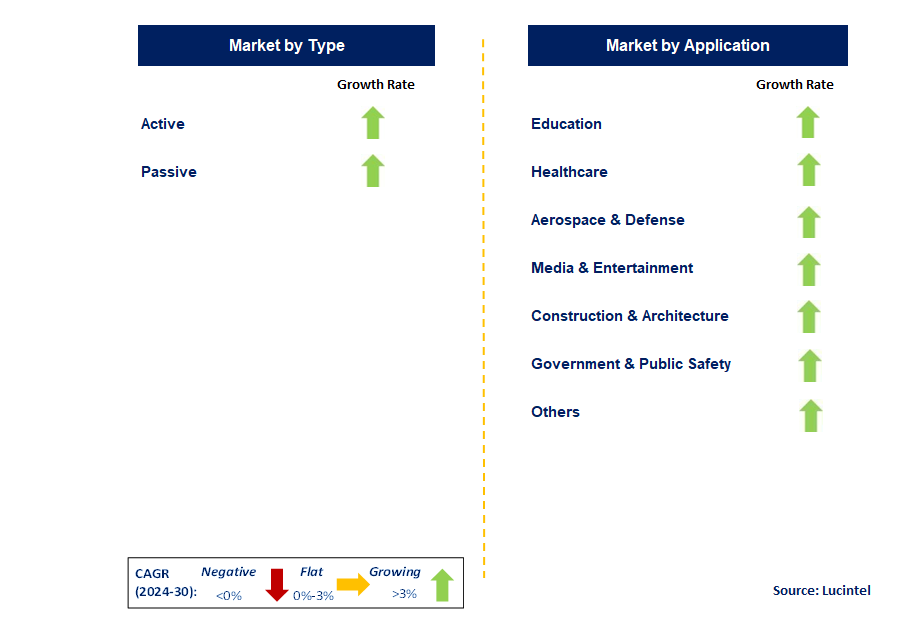
• ELCOVISION 10 Q6. Which 3D reconstruction technology market segment will be the largest in future? Answer: Lucintel forecast that active segment is expected to witness the highest growth over the forecast period. Q7. In 3D reconstruction technology market, which region is expected to be the largest in next 5 years? Answer: North America is expected to witness the highest growth over the forecast period due to the significant use of 3D reconstruction technology in medical sector of the region. Q.8 Do we receive customization in this report? Answer: Yes, Lucintel provides 10% customization without any additional cost.


Choose a license that fits your team. Instant PDF delivery.
Prices exclude taxes. Instant delivery. Custom licensing available on request.
Market Report · July 29, 2026
Market Report · July 20, 2026
Market Report · July 20, 2026
Trusted partner for strategic intelligence and business growth


Receive a complimentary market analysis tailored to your industry. Our analysts will identify key growth opportunities and competitive dynamics specific to your business.

Market size, growth rate, and key trend analysis for your specific sector.

Top competitor positioning and market share analysis.

Strategic recommendations backed by data-driven insights.
Get curated market intelligence and competitive moves straight to your inbox.
By subscribing, you agree to receive our monthly insights. Unsubscribe anytime.
Receive a complimentary market analysis tailored to your industry. Our analysts will identify key growth opportunities and competitive dynamics specific to your business.
Market size, growth rate, and key trend analysis for your specific sector.
Top competitor positioning and market share analysis.
Strategic recommendations backed by data-driven insights.
Get curated market intelligence, emerging trends, and competitive moves straight to your inbox each month.
By subscribing, you agree to receive our monthly insights. Unsubscribe anytime.
We'll send your sample report shortly.