
Market Report · May 18, 2026

This market report covers trends, opportunities, and forecasts in the global 3d printing thermoplastic market to 2031 by product technology (polylactic acid (pla), acrylonitrile butadiene styrene (abs), polyamide (pa), photopolymers, high impact polystyrene (hips), and thermoplastic elastomer (tpe)), end use industry (automotive, aerospace, medical, electronics, and others), and region (North America, Europe, Asia Pacific, and the Rest of the World)
We'll send your sample report shortly.
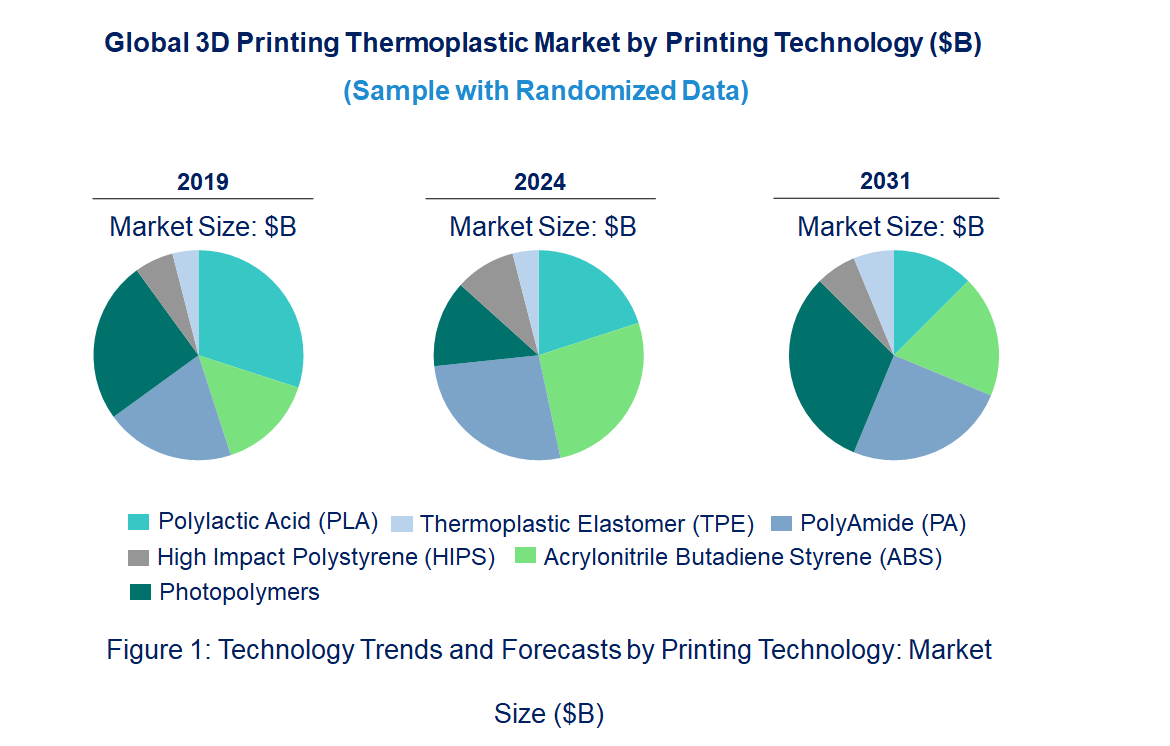
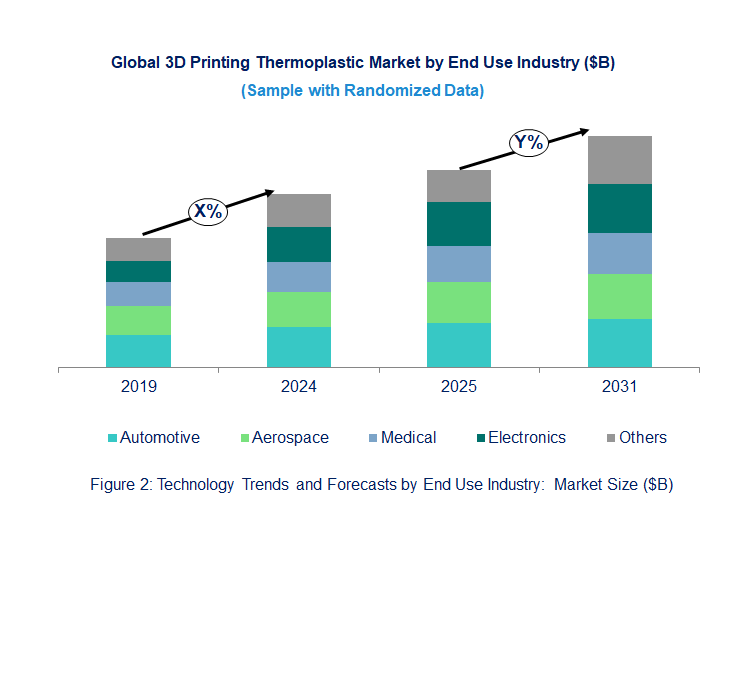
• High-Performance Thermoplastics: The use of materials like Polyamide (PA), Polycarbonate (PC), and thermoplastic elastomers (TPE) is increasing to produce stronger, more durable parts, making 3D printing competitive with traditional manufacturing techniques in aerospace and automotive industries.
• Multi-Material Printing: With 3D printing, the technologies are now integrating the multi-material printing capability, whereby a user can create parts with different properties in one single print. This trend is essential for applications requiring complex geometries and material combinations such as medical devices and electronics.
• Automation and Artificial Intelligence in 3D Printing: AI-driven optimization of the printing parameters, along with automated post-processing and quality control systems, enhances the speed, consistency, and accuracy of 3D printing and leads to better scalability and cost-effectiveness in production.
• Biocompatible Materials: The rise in biocompatible thermoplastics is opening the floodgates for innovation in the medical field, allowing customized prosthetics, implants, and surgical tools to be produced. It is a crucial factor for personalized medicine and improving patient outcomes.
• Sustainability and Recycling of Thermoplastics: The market shows a trend toward sustainable 3D printing, with more focus on recycling thermoplastic materials, such as PLA, and using bio-based or recyclable thermoplastics. This minimizes waste and supports eco-friendly production processes. Emerging trends conclude that 3D printing technologies are evolving into increasingly sophisticated and versatile applications in industries requiring high-quality, sustainable, and customized production solutions.
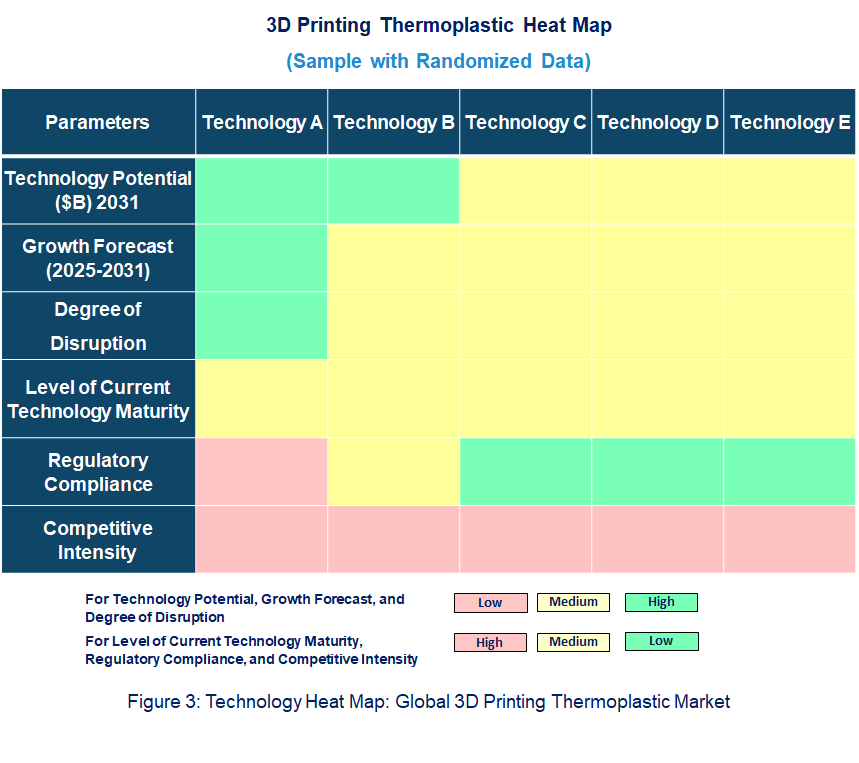
• Technology Potential: Thermoplastic 3D printing materials like PLA, ABS, and PA hold great potential in enabling customized, on-demand, sustainable production methods. PLA also serves as a biodegradable alternative with growing interest in medical and consumer-based applications. Photopolymers are used for high-precision printing in specialized sectors such as jewelry and dentistry.
• Degree of Disruption: These technologies are disrupting traditional manufacturing by reducing lead times, material waste, and enabling complex geometries. PLA offers strong disruption due to its sustainability, while TPE’s flexibility and ABS’s durability are impacting industries that require strong and resilient components.
• Technology Maturity: PLA and ABS are the most mature and widely adopted in consumer and prototyping sectors. Polyamide (PA) and thermoplastic elastomers (TPE) are rapidly advancing in high-performance applications with evolving materials and processes.
• Increasing Stringency of Regulatory Standards: Regulatory standards for ABS and PA, especially concerning safety in medical applications and environmental concerns, are growing. The stringency is increasing for materials like PLA. Regulatory compliance is more focused on safety and environmental concerns, with growing pressure for sustainable practices with ABS and PA.
• BASF SE: BASF has extended its 3D printing materials portfolio with particular emphasis on high-performance thermoplastics such as Ultramid and Ultrafuse. These developments are directed toward the production of advanced mechanical properties for aerospace and automotive industries.
• Solvay: Solvay has developed new high-performance polymer materials for 3D printing, including Radel® polyphenylsulfone (PPSU), which is suitable for applications in aerospace and medical industries due to its superior thermal and chemical resistance.
• Covestro: Covestro has worked on developing its high-performance thermoplastic polyurethanes (TPUs) for 3D printing, enabling flexible yet strong parts, especially in the automotive and industrial industries. Their developments are improving material options for 3D printing in general.
• SABIC: SABIC has developed production capabilities for high-performance, rugged thermoplastics like Ultem™ PEI and other specialized products intended for aerospace and healthcare. Innovation for lightweight, high-strength parts supports these demands.
• Henkel: Henkel has advanced significantly in providing photopolymers for high-resolution 3D printing. Their main applications have targeted electronics and medical devices, improving the precision and durability of end-use parts.
• 3D Systems Corporation: 3D Systems has developed a range of high-performance thermoplastic-based materials that can be used for rapid prototyping as well as end-use production. These include the DuraForm® and Selective Laser Sintering (SLS) materials, which have been widely used in the automotive and industrial markets.
• Evonik Industries: Evonik is developing high-performance, bio-based thermoplastic materials for 3D printing, such as VESTAMID® and VESTAKEEP®. These materials are used in demanding aerospace, automotive, and medical industries.
• Stratasys: Stratasys launched a number of advanced thermoplastic materials, including carbon-fiber reinforced filaments and high-temperature thermoplastics that improve the mechanical properties and performance of 3D printed parts in aerospace and automotive applications.
• Arkema: Arkema has been working on developing a range of thermoplastic materials, including their Rilsan® polyamide 11, a sustainable material derived from castor oil, for automotive and industrial applications where sustainability and performance are critical. These developments significantly influence the market by allowing the use of 3D printing for more complex, high-performance applications and pushing industries toward greater sustainability.
• Increased Demand for Personalization: The need for personalization in healthcare, automotive, and consumer goods is growing. The demand for custom products is high in sectors such as healthcare, automotive, and consumer goods. With 3D printing, customized components with complex geometries that cannot be produced by traditional manufacturing methods can be produced.
• Technological Advancements in 3D Printing: Ongoing innovations in 3D printing technologies, such as faster print speeds, improved precision, and multi-material printing, are making it easier to produce high-quality, durable parts. This expands the range of possible applications, including aerospace, automotive, and medical devices, driving further adoption.
• Cost-Effectiveness and Reduced Waste: The ability to produce parts on demand, without the need for expensive molds and tooling, makes 3D printing a more cost-effective solution, especially for low-volume production. Additionally, the technology helps minimize material waste, further contributing to its appeal to businesses aiming to optimize production processes.
• Eco-Friendly Manufacturing and Sustainability: 3D printing is also the way toward eco-friendly manufacturing because it is growing to be the most crucial across industries. The fact that it uses recyclable thermoplastics and PLA, a material that can be sourced from living organisms, further increases demand for this technology as it produces the least waste. Challenges in the 3D printing thermoplastic market include:
• Material Limitations: With all the advancements in thermoplastics, many of the materials used in 3D printing still face material limitations in terms of strength, heat resistance, and durability, especially in high-stress applications such as aerospace or automotive. There is still a need for more advanced, versatile materials.
• High Initial Investment: High-performance materials will cost to purchase 3D printers and other equipment required, hence posing a huge barrier in the adoption by small and medium-sized enterprises. Adoption and market penetration in particular sectors will be slowed because of these initial costs.
• Scalability and Production Speed: This remains a challenge for 3D printing, with production speed and consistency of results not yet at a quality that can replace traditional manufacturing. Such methods are still hard to replace in mass production settings since the speed and consistency of production through 3D printing aren't yet at a suitable level. These growth opportunities are largely reshaping the 3D printing thermoplastic market, including rising demand for customization, technological developments, cost-effectiveness, and sustainability. However, challenges in material limitations, high costs, and issues with scalability need to be overcome to reach the true potential of the industry. This is driving the development of new materials, better machines, and improved processes, making 3D printing an increasingly viable alternative to traditional manufacturing.
• BASF SE
• Solvay
• Covestro
• SABIC
• Henkel
• 3D Systems Corporation
• Technology Readiness by Technology Type: In 3D printing thermoplastic market is very mature for consumer and medical use with sustainability regulations. ABS is established in prototyping but faces environmental challenges. PA is ready for automotive and aerospace with industry-specific standards. Photopolymers are very suitable for small-scale, precise applications with safety regulations. HIPS is a niche in prototyping, with increasing recycling regulations. TPE is ready for consumer products but faces growing competition.
• Competitive Intensity and Regulatory Compliance: Polylactic acid faces low competition and increasing sustainability regulations. ABS has moderate competition and environmental concerns. PA competes heavily in high-performance sectors with evolving industrial standards. Photopolymers face intense competition with growing safety regulations. HIPS has limited competition and a regulatory focus on recycling. TPE experiences rising competition in flexible materials with increasing regulatory scrutiny. Overall, regulatory pressures are tightening across all materials, driving sustainability and safety standards. BS and PA dominate the industrial sectors.
• Disruption Potential in Different Technologies Types: In the 3D printing thermoplastic market polylactic acid is an eco-friendly polymer with strong disruption potential due to its biodegradable properties. ABS offers good durability but moderate disruption due to its reliance on petroleum. PA is strong in high-performance sectors such as automotive and thus offers good disruption. Photopolymers provide precise applications in the jewelry and dental sectors, offering disruptions to conventional manufacturing processes. HIPS has a niche role only as a support material, while TPE is gaining popularity for its flexible applications. These materials disrupt traditional production processes by offering customized on-demand manufacturing.
• Polylactic Acid (PLA)
• Acrylonitrile Butadiene Styrene (ABS)
• PolyAmide (PA)
• Photopolymers
• High Impact Polystyrene (HIPS)
• Thermoplastic Elastomer (TPE)
• Automotive
• Aerospace
• Medical
• Electronics
• Others
• North America
• Europe
• Asia Pacific
• The Rest of the World
• Latest Developments and Innovations in the 3D Printing Thermoplastic Technologies
• Companies / Ecosystems
• Strategic Opportunities by Technology Type


Choose a license that fits your team. Instant PDF delivery.
Prices exclude taxes. Instant delivery. Custom licensing available on request.
Market Report · May 18, 2026
Market Report · May 18, 2026
Market Report · May 18, 2026
Trusted partner for strategic intelligence and business growth


Receive a complimentary market analysis tailored to your industry. Our analysts will identify key growth opportunities and competitive dynamics specific to your business.

Market size, growth rate, and key trend analysis for your specific sector.

Top competitor positioning and market share analysis.

Strategic recommendations backed by data-driven insights.
Get curated market intelligence and competitive moves straight to your inbox.
By subscribing, you agree to receive our monthly insights. Unsubscribe anytime.
Receive a complimentary market analysis tailored to your industry. Our analysts will identify key growth opportunities and competitive dynamics specific to your business.
Market size, growth rate, and key trend analysis for your specific sector.
Top competitor positioning and market share analysis.
Strategic recommendations backed by data-driven insights.
Get curated market intelligence, emerging trends, and competitive moves straight to your inbox each month.
By subscribing, you agree to receive our monthly insights. Unsubscribe anytime.
We'll send your sample report shortly.