
Market Report · July 22, 2026

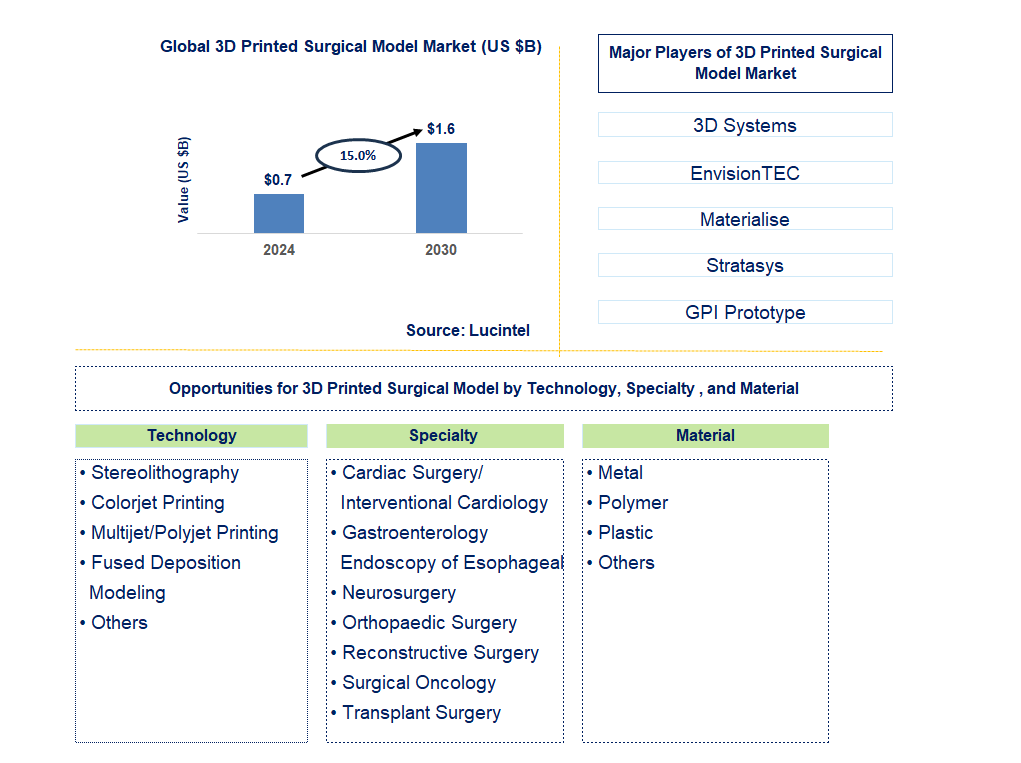
Key data points: The market size in 2030 = $1.6 billion, growth forecast = 15.0% annually for the next 6 years. Scroll below to get more insights. This market report covers trends, opportunities, and forecasts in the global 3d printed surgical model market to 2030 by technology (stereolithography, colorjet printing, multijet/polyjet printing, fused deposition modeling, and others), specialty (cardiac surgery/interventional cardiology, gastroenterology endoscopy of esophageal, neurosurgery, orthopaedic surgery, reconstructive surgery, surgical oncology, and transplant surgery), material (metal, polymer, plastic, and others), and region (North America, Europe, Asia Pacific, and the Rest of the World)
We'll send your sample report shortly.
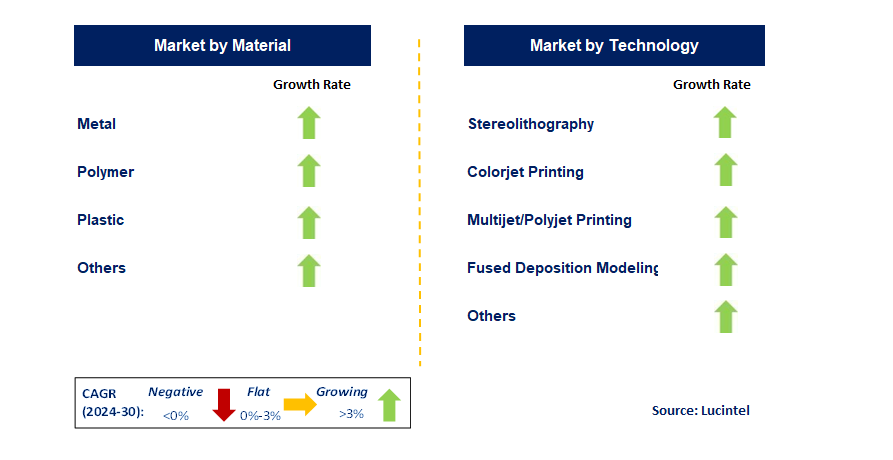
• Lucintel forecasts that, within the type category, within the material category, plastics will remain the fastest-growing segment over the forecast period due to the presence of enhanced thermoplastics and biodegradable plastics, along with their cost-effectiveness and reusability.
• In terms of regions, North America is expected to witness the highest growth over the forecast period due to the rising number of elderly people and the increasing incidence of diseases linked to a sedentary lifestyle. Gain valuabel insights for your business decisions with our comprehensive 150+ page report.
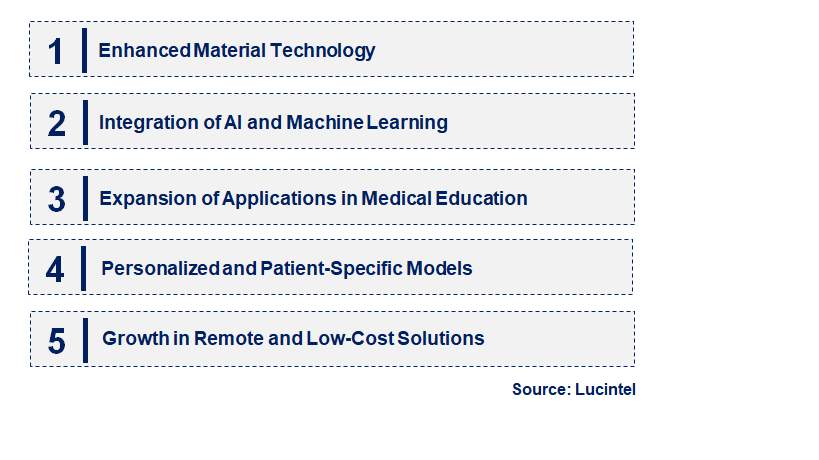
• Enhanced Material Technology: Advances in material science are significantly impacting the 3D printed surgical model market. New materials, such as biocompatible polymers and advanced composites, are being developed to improve the accuracy and functionality of surgical models. These materials offer better durability, flexibility, and resolution, enabling the creation of highly detailed and realistic models. The use of these advanced materials enhances surgical planning and simulation, leading to better patient outcomes and more precise surgical interventions.
• Integration of AI and Machine Learning: The integration of artificial intelligence (AI) and machine learning (ML) into 3D printing processes is revolutionizing the creation of surgical models. AI algorithms can analyze patient imaging data to automatically generate highly accurate and personalized models. Machine learning techniques enhance the efficiency of the printing process by optimizing parameters and predicting potential issues. This integration not only speeds up model production but also increases the precision and customization of surgical models, making them more valuable for complex procedures.
• Expansion of Applications in Medical Education: The use of 3D printed surgical models in medical education is expanding rapidly. These models are increasingly being used for training medical students and surgical residents, providing hands-on experience with realistic anatomical structures. They facilitate a better understanding of complex procedures and anatomical variations, enhancing the learning experience. Educational institutions are adopting these models to improve surgical skills and knowledge, bridging the gap between theoretical learning and practical application in a controlled environment.
• Personalized and Patient-Specific Models: There is a growing trend towards creating highly personalized and patient-specific 3D printed surgical models. By using patient imaging data, such as CT scans and MRIs, clinicians can produce models that accurately reflect the individual’s unique anatomy. These custom models aid in preoperative planning and surgical rehearsal, allowing surgeons to anticipate challenges and devise optimal strategies for each patient. Personalized models improve surgical precision and outcomes, leading to a more tailored approach to patient care.
• Growth in Remote and Low-Cost Solutions: The development of remote and low-cost 3D printing solutions is making surgical models more accessible globally. Advances in desktop 3D printers and open-source software are enabling smaller healthcare facilities and remote locations to produce high-quality surgical models affordably. This democratization of technology is expanding the use of 3D printed models beyond well-funded institutions, improving access to advanced medical tools in underserved areas and supporting global health equity. The 3D printed surgical model market is witnessing transformative changes driven by material advancements, technological integration, and expanded applications. Trends such as enhanced material technology, AI integration, and the focus on personalized models are setting new standards in surgical planning and education. The growth of remote and low-cost solutions is further broadening the market’s reach, making advanced medical tools more accessible worldwide. These developments are poised to improve surgical outcomes and patient care, underscoring the dynamic nature of the 3D printed surgical model market.
• Advances in 3D Printing Materials: Recent developments in 3D printing materials have significantly improved the quality and functionality of surgical models. Innovations include biocompatible materials that mimic human tissue properties, high-resolution resins for detailed anatomical accuracy, and durable composites that withstand surgical manipulation. These advancements enable the creation of more realistic and reliable models, enhancing preoperative planning and surgical simulation. The use of these advanced materials also supports the development of models for complex procedures, providing surgeons with valuable insights into patient-specific anatomical challenges.
• Integration of AI and Machine Learning: The integration of artificial intelligence (AI) and machine learning into the 3D printing process is revolutionizing surgical model creation. AI algorithms can analyze medical imaging data to automatically generate accurate, patient-specific models, reducing the time required for manual design. Machine learning enhances the optimization of printing parameters, improving model quality and consistency. This integration facilitates faster turnaround times for model production and increases the precision of surgical simulations, aiding in more effective preoperative planning and better surgical outcomes.
• Expansion of Applications in Medical Training: The use of 3D printed surgical models in medical training is expanding, offering hands-on learning experiences for students and surgical trainees. These models provide realistic representations of anatomical structures, allowing learners to practice techniques and understand complex procedures in a controlled environment. Institutions are increasingly adopting 3D printed models for training purposes, enhancing the educational experience and bridging the gap between theoretical knowledge and practical skills. This development is contributing to improved competency and confidence among medical professionals.
• Increased Focus on Personalized Models: The market is seeing a significant shift towards personalized 3D printed surgical models tailored to individual patient anatomies. By using patient-specific imaging data, such as CT scans and MRIs, clinicians can produce highly accurate models that reflect each patient’s unique anatomical features. These personalized models aid in precise surgical planning, enable better anticipation of surgical challenges, and enhance patient-specific treatment strategies. The focus on personalization is improving surgical outcomes and patient satisfaction by providing more tailored and effective care.
• Growth of Remote and Cost-Effective Solutions: The proliferation of remote and cost-effective 3D printing solutions is expanding access to surgical models globally. Advances in desktop 3D printers and open-source design software are making it feasible for smaller healthcare facilities and remote locations to produce high-quality models at lower costs. This democratization of technology is improving accessibility to advanced surgical tools in underserved areas and enabling a broader range of healthcare providers to benefit from 3D printing innovations. As a result, the market is experiencing increased inclusivity and global reach. The 3D printed surgical model market is undergoing transformative changes driven by advancements in materials, technology, and application scope. Innovations such as improved printing materials, AI integration, and personalized models are enhancing the quality and utility of surgical models. The expansion of applications in medical training and the growth of remote, cost-effective solutions are broadening access and impact. These developments are shaping the future of surgical planning and training, leading to better patient outcomes and more effective medical practices.
• Preoperative Planning and Simulation: 3D printed surgical models offer significant opportunities for preoperative planning and simulation. By creating detailed, patient-specific anatomical models, surgeons can visualize complex structures and plan procedures with greater precision. This leads to improved surgical outcomes by allowing for better anticipation of potential challenges and refinement of techniques before actual surgery. The ability to rehearse surgeries using these models enhances decision-making and reduces the risk of intraoperative complications, making preoperative planning a crucial growth area for 3D printed surgical models.
• Medical Training and Education: The application of 3D printed surgical models in medical training and education is a growing opportunity. These models provide realistic, hands-on training experiences for medical students and surgical residents, enhancing their understanding of anatomy and surgical techniques. By using models that accurately represent various pathologies and surgical scenarios, trainees can practice and refine their skills in a controlled environment. This practical experience helps bridge the gap between theoretical knowledge and real-world application, improving overall surgical competency and effectiveness.
• Development of Personalized Implants: The demand for personalized implants is creating substantial growth opportunities in the 3D printed surgical model market. Custom implants tailored to individual patient anatomies can be designed using 3D printed models derived from patient imaging data. This personalization ensures better fit and functionality, leading to improved clinical outcomes and patient satisfaction. The ability to create bespoke implants for complex cases, such as joint replacements or cranial implants, is driving innovation and expansion in this segment of the market.
• Integration with Robotics and AI: Integrating 3D printed surgical models with robotics and artificial intelligence (AI) is an emerging growth opportunity. Robotics can use these models for precise surgical navigation, while AI algorithms can enhance model accuracy and optimize surgical plans. This synergy allows for more precise and minimally invasive procedures, improving patient outcomes and expanding the use of 3D printed models in advanced surgical environments. As technology evolves, the integration of these systems will offer new avenues for market growth and application.
• Expansion into Developing Markets: Expanding the use of 3D printed surgical models into developing markets represents a significant growth opportunity. Advances in cost-effective 3D printing technologies and remote printing solutions are making it possible for healthcare providers in low-resource settings to access high-quality surgical models. This expansion not only improves surgical planning and training in these regions but also enhances overall healthcare quality. By targeting developing markets, companies can tap into new customer bases and address global disparities in access to advanced medical technologies. The 3D printed surgical model market is poised for strategic growth across several key applications. Opportunities in preoperative planning, medical training, personalized implants, robotics integration, and expansion into developing markets are driving the market forward. By capitalizing on these trends, stakeholders can enhance surgical precision, improve medical education, and expand their reach, ultimately contributing to better patient outcomes and advancing the field of surgery.
• Technological Advancements in 3D Printing: Rapid advancements in 3D printing technology are a primary driver for the growth of the surgical model market. Improvements in printing materials, resolution, and speed enable the creation of highly detailed and accurate models. Innovations such as biocompatible materials and multi-material printing expand the scope of applications, from preoperative planning to surgical simulation. These technological developments enhance the utility of 3D printed models, making them more valuable in complex surgical procedures and increasing their adoption in medical settings.
• Growing Demand for Personalized Medicine: The rising demand for personalized medicine is a significant driver for the 3D printed surgical model market. Personalized models tailored to individual patient anatomies allow for more precise surgical planning and custom implants, leading to improved clinical outcomes. As healthcare moves towards individualized treatment approaches, the need for patient-specific models that reflect unique anatomical features grows. This trend accelerates the adoption of 3D printing technologies in creating customized solutions for complex and diverse medical conditions.
• Enhanced Surgical Precision and Planning: 3D printed surgical models offer enhanced precision and planning capabilities, driving their adoption in the healthcare sector. By providing realistic, patient-specific anatomical representations, these models enable surgeons to plan and rehearse complex procedures more effectively. This preoperative advantage reduces the risk of complications and improves surgical outcomes. The ability to visualize and simulate surgeries before performing them is a critical factor in increasing the demand for 3D printed models, particularly in intricate and high-stakes procedures.
• Expanding Applications in Medical Training: The use of 3D printed surgical models in medical training is driving market growth. These models provide realistic and interactive training tools for medical students and surgical trainees, enhancing their learning experiences. By practicing on anatomically accurate models, trainees can develop and refine their skills in a controlled environment, bridging the gap between theoretical knowledge and practical application. This expansion in training applications is fostering greater adoption of 3D printed models in educational institutions and training programs.
• Growing Investment and Funding: Increased investment and funding in healthcare technologies, including 3D printing, are fueling market growth. Venture capital, research grants, and strategic partnerships are supporting innovation and commercialization of 3D printed surgical models. Financial backing enables the development of advanced printing technologies, materials, and applications. This influx of capital accelerates market expansion, fosters technological advancements, and enhances the overall capability and accessibility of 3D printed models in the medical field. Challenges in the 3D printed surgical model market are:
• High Production Costs: The cost of producing high-quality 3D printed surgical models can be substantial, involving expensive equipment, materials, and expertise. High production costs can limit accessibility for smaller healthcare facilities and impact the overall adoption of these models. Addressing cost challenges while maintaining model quality is crucial for expanding market reach.
• Regulatory Hurdles: Navigating regulatory requirements for 3D printed surgical models can be complex and time-consuming. Ensuring that models meet medical device regulations and obtaining necessary certifications pose significant challenges. The regulatory landscape for 3D printed medical devices is evolving, and staying compliant with changing standards can be difficult for manufacturers.
• Material and Quality Variability: Variability in 3D printing materials and model quality can impact the reliability and accuracy of surgical models. Ensuring consistent material properties and model fidelity is essential for effective pre-surgical planning and training. Addressing issues related to material performance and standardization is crucial for maintaining trust and effectiveness in 3D printed surgical models. In conclusion, the 3D printed surgical model market is poised for significant growth driven by technological advancements, the demand for personalized medicine, enhanced surgical precision, and expanding applications in medical training. These factors collectively enhance the utility and value of 3D printed models in complex surgical procedures, promoting their adoption in healthcare settings. However, challenges such as high production costs, regulatory hurdles, and material variability must be addressed to facilitate broader accessibility and consistency in quality. As investment and innovation continue to propel this field forward, overcoming these challenges will be crucial for realizing the full potential of 3D printed surgical models in improving patient outcomes and transforming surgical practices.
• 3D Systems
• EnvisionTEC
• Materialise
• Stratasys
• GPI Prototype
• Stereolithography
• Colorjet Printing
• Multijet/Polyjet Printing
• Fused Deposition Modeling
• Others
• Cardiac Surgery/Interventional Cardiology
• Gastroenterology Endoscopy of Esophageal
• Neurosurgery
• Orthopaedic Surgery
• Reconstructive Surgery
• Surgical Oncology
• Transplant Surgery
• Metal
• Polymer
• Plastic
• Others
• North America
• Europe
• Asia Pacific
• The Rest of the World
• United States: In the United States, recent developments in the 3D printed surgical model market include advancements in technology and its integration into clinical practice. Leading medical institutions are adopting 3D printing for creating highly detailed and patient-specific surgical models, improving preoperative planning and outcomes. Companies are focusing on the development of more sophisticated materials and techniques, such as biocompatible and high-resolution prints.
• China: China is rapidly advancing in the 3D printed surgical model market through significant investments in manufacturing capabilities and research. Chinese companies are developing cost-effective 3D printing solutions and expanding their production facilities to meet growing domestic demand. Additionally, there is a push towards integrating 3D printing technology into the healthcare system to improve medical training and patient-specific surgical planning.
• Germany: Germany is making strides in the 3D printed surgical model market with a strong emphasis on regulatory advancements and quality standards. The country is known for its stringent regulatory environment, which ensures that 3D printed models meet high safety and efficacy standards. Recent developments include partnerships between medical device companies and research institutions to enhance the precision and functionality of surgical models.
• India: In India, the 3D printed surgical model market is experiencing growth due to increased access to 3D printing technology and rising awareness of its benefits. Recent developments include the expansion of 3D printing services in hospitals and medical institutions, making advanced surgical models more accessible to a broader population. Indian startups and healthcare providers are collaborating to develop affordable and effective 3D printing solutions tailored to local needs.
• Japan: Japan is at the forefront of integrating 3D printed surgical models into advanced medical practices. Recent developments include the incorporation of 3D printing technology into complex surgical procedures and medical research. Japanese medical institutions are utilizing high-resolution 3D printed models to enhance surgical precision and planning. The country is also focusing on developing innovative materials and techniques to improve the performance and utility of these models.
• 3D Systems
• EnvisionTEC
• Materialise
• Stratasys
• GPI Prototype Q6. Which 3D printed surgical model market segment will be the largest in future? Answer: Lucintel forecasts that plastics will remain the fastest growing segment over the forecast period due to the presence of enhanced thermoplastics and biodegradable plastics, along with their cost-effectiveness and reusability. Q7. In 3D printed surgical model market, which region is expected to be the largest in next 5 years? Answer: North America is expected to witness highest growth over the forecast period due to rising number of elderly people and the increasing incidence of diseases linked to a sedentary lifestyle. Q.8 Do we receive customization in this report? Answer: Yes, Lucintel provides 10% customization without any additional cost.


Choose a license that fits your team. Instant PDF delivery.
Prices exclude taxes. Instant delivery. Custom licensing available on request.
Market Report · July 22, 2026
Market Report · July 22, 2026
Market Report · July 22, 2026
Trusted partner for strategic intelligence and business growth


Receive a complimentary market analysis tailored to your industry. Our analysts will identify key growth opportunities and competitive dynamics specific to your business.

Market size, growth rate, and key trend analysis for your specific sector.

Top competitor positioning and market share analysis.

Strategic recommendations backed by data-driven insights.
Get curated market intelligence and competitive moves straight to your inbox.
By subscribing, you agree to receive our monthly insights. Unsubscribe anytime.
Receive a complimentary market analysis tailored to your industry. Our analysts will identify key growth opportunities and competitive dynamics specific to your business.
Market size, growth rate, and key trend analysis for your specific sector.
Top competitor positioning and market share analysis.
Strategic recommendations backed by data-driven insights.
Get curated market intelligence, emerging trends, and competitive moves straight to your inbox each month.
By subscribing, you agree to receive our monthly insights. Unsubscribe anytime.
We'll send your sample report shortly.