
Market Report · July 31, 2026

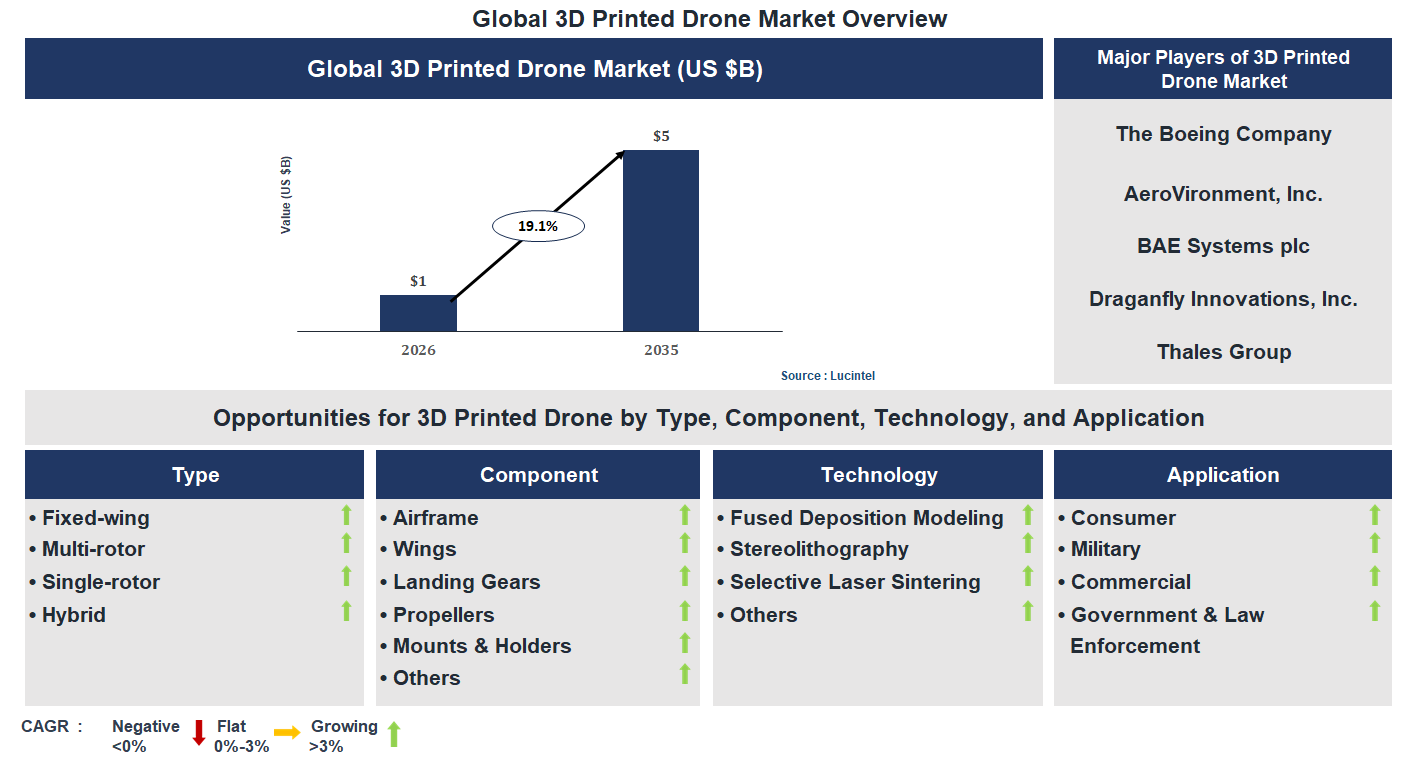
Key data points: The market size in 2035 = $5 billion, growth forecast = 19.1% annually for the next 8 years. Scroll below to get more insights. This market report covers trends, opportunities and forecasts in 3D printed drone market to 2035 by type (fixed-wing, multi-rotor, single-rotor, and hybrid), component (airframe, wings, landing gears, propellers, mounts & holders, and others), technology (fused deposition modeling, stereolithography, selective laser sintering, and others), application (consumer, military, commercial, and government & law enforcement), and region (North America, Europe, Asia Pacific, and the Rest of the World)
We'll send your sample report shortly.
• Lucintel forecasts that, within the type category, multi-rotor is expected to witness the highest growth over the forecast period.
• Within the application category, military is expected to witness the highest growth.
• In terms of region, North America is expected to witness the highest growth over the forecast period. Gain valuable insights for your business decisions with our comprehensive 150+ page report. Sample figures with some insights are shown below.
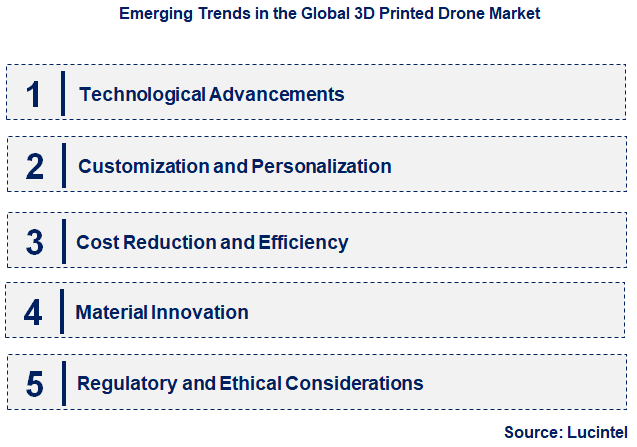
• Technological Advancements: The integration of high-resolution 3D printing with advanced materials is enabling the production of more complex and durable drone parts. This trend enhances design flexibility, reduces weight, and improves overall drone performance. As 3D printing technology continues to evolve, manufacturers can create intricate components that were previously impossible or too costly to produce using traditional methods. This progress is accelerating innovation, allowing for rapid prototyping, customization, and on-demand manufacturing, which significantly benefits industries requiring specialized drone solutions.
• Customization and Personalization: The ability to produce customized drone components through 3D printing is revolutionizing the market. Customers and industries now demand tailored solutions for specific applications, such as agriculture, surveillance, or delivery. 3D printing allows for quick modifications and iterations, reducing lead times and costs associated with traditional manufacturing. This trend is fostering a shift towards more personalized and niche drone products, enabling businesses to meet unique operational requirements and improve overall efficiency.
• Cost Reduction and Efficiency: 3D printing significantly lowers production costs by reducing material waste and minimizing the need for complex tooling. This trend makes drone manufacturing more accessible to small and medium-sized enterprises, fostering increased competition and innovation. Additionally, on-demand production reduces inventory costs and lead times, enabling faster deployment of new drone models. As a result, companies can respond swiftly to market demands and technological changes, making the industry more agile and cost-effective.
• Material Innovation: The development of new printable materials, including composites and flexible polymers, is expanding the capabilities of 3D printed drones. These materials offer enhanced strength, flexibility, and environmental resistance, which are critical for various operational environments. Material innovation is enabling the production of lightweight yet durable drone parts, improving flight efficiency and payload capacity. This trend is crucial for applications requiring high performance and resilience, such as military or industrial inspections, and is driving the adoption of 3D printed drones in more demanding scenarios.
• Regulatory and Ethical Considerations: As 3D printed drones become more prevalent, regulatory frameworks are evolving to address safety, security, and intellectual property concerns. The ability to rapidly produce and modify drones raises questions about airspace management, privacy, and counterfeit components. Governments and industry bodies are working to establish standards and guidelines to ensure safe deployment while fostering innovation. This trend highlights the importance of balancing technological progress with responsible use, shaping the future landscape of the 3D printed drone market. These trends are collectively reshaping the 3D printed drone market by fostering innovation, reducing costs, and enabling highly customized solutions. They are expanding the scope of drone applications, improving performance, and prompting regulatory adaptations, ultimately driving the industry toward a more dynamic and versatile future.
• Growing Adoption in Agriculture: The use of 3D printed drones in agriculture is revolutionizing crop monitoring and precision farming. Customizable drone designs allow for tailored solutions to specific farming needs, improving efficiency and reducing costs. These drones can carry specialized sensors and equipment, enabling real-time data collection and analysis. As farmers seek sustainable and cost-effective methods, the market for agricultural drones is expanding rapidly, offering new revenue streams and technological innovations.
• Advancements in Materials and Manufacturing: Innovations in 3D printing materials, such as lightweight composites and durable polymers, are enhancing drone performance. These materials enable the production of complex, customized drone parts with reduced weight and increased strength. Manufacturing processes are becoming faster and more cost-efficient, allowing for rapid prototyping and small-batch production. This progress is lowering barriers to entry for new players and fostering a more competitive market landscape.
• Increased Use in Defense and Security: Governments and defense agencies are increasingly deploying 3D printed drones for surveillance, reconnaissance, and tactical operations. The ability to quickly produce customized, mission-specific drones enhances operational flexibility. 3D printing reduces production time and costs, enabling rapid deployment and adaptation to evolving threats. This trend is driving innovation in military technology and expanding the market for specialized drone solutions in security applications.
• Expansion into Logistics and Delivery: The logistics sector is adopting 3D printed drones for last-mile delivery and warehouse inspections. Customizable drone designs facilitate efficient payload handling and navigation in complex environments. The ability to rapidly produce spare parts and modify drone configurations supports operational agility. As e-commerce grows, the demand for reliable, cost-effective delivery drones increases, positioning 3D printing as a key enabler of innovation in logistics.
• Rising Investment and Market Collaborations: Increased investments from venture capitalists and strategic partnerships are fueling market growth. Companies are collaborating to develop advanced 3D printed drone platforms with enhanced capabilities. Funding supports research into new materials, software, and manufacturing techniques, accelerating product development. These collaborations are fostering a competitive environment, attracting new entrants, and expanding the market’s scope across various sectors. The overall impact of these developments is transforming the 3D printed drone market into a dynamic, innovative industry. Enhanced customization, reduced costs, and expanded applications are driving growth and attracting diverse stakeholders. As technological barriers diminish, the market is poised for rapid expansion, offering new opportunities for innovation, investment, and global adoption.
• Customization and Rapid Prototyping Drive Market Expansion: The ability to quickly design and produce customized drone components using 3D printing accelerates development cycles and reduces costs. This flexibility allows manufacturers to tailor drones for specific applications, such as surveillance or delivery, enhancing performance and user satisfaction. Rapid prototyping also shortens time-to-market, enabling companies to respond swiftly to evolving customer needs and technological trends, thereby fueling overall market growth.
• Cost Reduction Through Additive Manufacturing: 3D printing significantly lowers production costs by reducing material waste and minimizing the need for complex tooling. This cost efficiency makes drone manufacturing more accessible for small and medium-sized enterprises, fostering innovation and competition. Additionally, on-demand production capabilities reduce inventory costs and enable localized manufacturing, further decreasing expenses and expanding market reach across different regions and sectors.
• Lightweight and Durable Drone Components: The use of advanced 3D printing materials results in lightweight yet durable drone parts, improving flight efficiency and battery life. These enhancements are crucial for applications requiring extended flight times, such as surveillance or delivery services. The ability to produce complex geometries also allows for innovative designs that optimize aerodynamics and structural integrity, thereby broadening the scope of drone applications and increasing market adoption.
• Integration of 3D Printing in Drone Manufacturing Ecosystems: Incorporating 3D printing into existing manufacturing processes streamlines production workflows and enables rapid customization. This integration supports the development of modular drone systems, facilitating easier upgrades and repairs. As manufacturers adopt integrated additive manufacturing solutions, they can respond more swiftly to market demands, improve product quality, and reduce lead times, ultimately strengthening their competitive position in the growing drone industry.
• Growing Adoption in Defense, Agriculture, and Logistics Sectors: The versatility of 3D printed drones is increasingly recognized across key industries such as defense, agriculture, and logistics. Customizable, lightweight, and cost-effective drones meet specific operational needs, from reconnaissance missions to crop monitoring and package delivery. As these sectors expand their use of drone technology, the demand for 3D printed components and fully integrated systems is expected to rise, creating substantial growth opportunities for market players. These strategic growth opportunities are poised to significantly influence the 3D printed drone market by enhancing customization, reducing costs, and expanding application scopes. As industries recognize the benefits of additive manufacturing, the market is set to experience accelerated innovation, increased adoption, and competitive differentiation. Overall, leveraging these opportunities will drive sustainable growth and establish 3D printing as a core enabler in the evolving drone landscape.
• Technological Advancements: The continuous evolution of 3D printing technologies, such as selective laser sintering and fused deposition modeling, has significantly improved the precision, strength, and material diversity of printed drone components. These innovations enable manufacturers to produce complex, lightweight, and customized drone parts efficiently, reducing production costs and lead times. As technology advances, the ability to print larger and more durable drone structures expands, opening new possibilities for applications in defense, agriculture, and delivery services. The integration of AI and automation further enhances design capabilities, making 3D printed drones more versatile and accessible, thus accelerating market growth.
• Cost Reduction and Customization: The decreasing costs of 3D printing equipment and materials have made drone manufacturing more affordable for both large companies and startups. This cost efficiency allows for rapid prototyping, iterative design testing, and small-batch production, which are crucial for innovation and market responsiveness. Customization is another key driver, as clients increasingly demand tailored drone solutions for specific tasks, such as specialized sensors or payloads. 3D printing facilitates on-demand manufacturing, reducing inventory and lead times, and enabling companies to quickly adapt to market needs. This flexibility enhances competitiveness and fosters innovation within the industry.
• Growing Demand Across Industries: The expanding application scope of 3D printed drones across sectors like agriculture, defense, logistics, and entertainment is a major growth driver. In agriculture, customized drones assist in crop monitoring and spraying, improving efficiency and yield. Defense agencies utilize lightweight, durable drones for surveillance and reconnaissance missions. Logistics companies explore drone delivery solutions, benefiting from rapid prototyping of specialized parts. The entertainment industry employs 3D printed drones for filming and aerial displays. This diverse demand encourages investment in R&D and accelerates adoption, fueling overall market expansion and technological development.
• Regulatory Environment and Safety Standards: Evolving regulations around drone operation, safety, and manufacturing significantly influence market growth. Governments are establishing frameworks to ensure safe integration of drones into airspace, which can either facilitate or hinder market expansion depending on the stringency and clarity of policies. Compliance with standards related to airworthiness, data security, and environmental impact requires ongoing adaptation by manufacturers. While clear regulations can boost consumer confidence and industry credibility, overly restrictive policies may limit innovation and deployment. Navigating this regulatory landscape is crucial for market players aiming for sustainable growth.
• Material Innovation and Sustainability: The development of new, eco-friendly, and high-performance materials for 3D printing is a key driver. Innovations in biodegradable filaments and lightweight composites enhance drone performance while reducing environmental impact. Sustainable materials lower the carbon footprint of manufacturing processes and align with global environmental goals, appealing to eco-conscious consumers and organizations. Additionally, material improvements contribute to increased durability, resistance to harsh conditions, and longer operational life of drones. As material science advances, the ability to produce more resilient and sustainable drones will further expand market opportunities and acceptance. The challenges facing the 3D printed drone market include:
• Regulatory and Legal Barriers: The lack of comprehensive and harmonized regulations for 3D printed drones presents a significant challenge. Variations in policies across regions create uncertainty for manufacturers and users, complicating international trade and deployment. Regulatory compliance involves rigorous testing, certification, and adherence to safety standards, which can be costly and time-consuming. Additionally, concerns over privacy, security, and airspace management pose hurdles to widespread adoption. Navigating these complex legal landscapes requires significant resources and strategic planning, potentially delaying market entry and limiting growth opportunities.
• Technological Limitations and Material Constraints: Despite advancements, current 3D printing technologies face limitations in producing large, complex, and high-strength drone components consistently. Material constraints, such as limited thermal resistance, impact durability and operational performance, especially in demanding environments. The resolution and surface finish of printed parts may also fall short of traditional manufacturing standards, affecting aerodynamics and reliability. Overcoming these technical barriers requires ongoing research and development, which can be costly and time-consuming, potentially slowing down innovation and market expansion.
• Market Competition and Intellectual Property Issues: The increasing number of players entering the 3D printed drone market intensifies competition, leading to price pressures and innovation races. Companies must invest heavily in R&D to differentiate their offerings, which can strain resources. Additionally, intellectual property rights related to proprietary designs and printing techniques pose challenges, as unauthorized replication or patent infringements can occur. Managing these legal issues requires robust legal strategies and can hinder collaboration or technology sharing, potentially stifling innovation and slowing overall market growth. The 3D printed drone market is driven by technological innovations, cost efficiencies, diverse industry applications, regulatory developments, and material advancements. However, it faces challenges such as regulatory uncertainties, technological and material limitations, and competitive pressures. These factors collectively shape the market’s trajectory, requiring stakeholders to navigate complex landscapes to capitalize on emerging opportunities. The interplay of drivers and challenges will determine the pace and scope of growth, influencing future innovations, market penetration, and industry standards. Overall, strategic adaptation and continued technological progress are essential for sustained expansion in this dynamic sector.
• The Boeing Company
• AeroVironment, Inc.
• BAE Systems plc
• Draganfly Innovations, Inc.
• Thales Group
• Parrot Drones SAS
• General Atomics
• Skydio, Inc.
• Airbus SE
• Flyability SA
• Fixed-wing
• Multi-rotor
• Single-rotor
• Hybrid
• Airframe
• Wings
• Landing Gears
• Propellers
• Mounts & Holders
• Others
• Fused Deposition Modeling
• Stereolithography
• Selective Laser Sintering
• Others
• Consumer
• Military
• Commercial
• Government & Law Enforcement
• North America
• Europe
• Asia Pacific
• The Rest of the World
• United States: The US leads in 3D printed drone innovation, with major companies and research institutions developing advanced prototypes for military and commercial use. Recent developments include the deployment of lightweight, customizable drones for surveillance and delivery services. Government agencies are funding research to improve drone durability and functionality, while startups are exploring new materials and printing techniques to reduce costs and enhance performance. The US also sees increased adoption of 3D printed drones in agriculture and disaster management, emphasizing rapid deployment and adaptability.
• China: China has rapidly expanded its 3D printed drone industry, focusing on mass production and cost efficiency. Key advancements include the development of affordable, high-performance drones for surveillance, agriculture, and logistics. Chinese firms are leveraging 3D printing to accelerate product development cycles and reduce manufacturing costs. The government supports innovation through funding and policy incentives, fostering a competitive environment. Recent efforts also involve integrating AI with 3D printed drones for autonomous operations, especially in border security and urban surveillance.
• Germany: Germany emphasizes precision engineering and sustainable manufacturing in its 3D printed drone sector. Recent developments include the creation of lightweight, high-strength drone components using advanced materials like carbon fiber composites. German companies are collaborating with research institutes to improve the aerodynamic efficiency and endurance of drones. The focus is on industrial applications, including inspection, maintenance, and environmental monitoring. Regulatory compliance and safety standards are prioritized, with innovations aimed at enhancing reliability and operational safety in commercial and governmental sectors.
• India: India is witnessing significant growth in 3D printed drone applications, driven by government initiatives and startup ecosystems. Recent advancements include the development of low-cost, durable drones for agricultural monitoring, disaster management, and defense. Indian firms are adopting 3D printing to customize drone parts rapidly, reducing lead times and costs. The government’s push for self-reliance and innovation has led to increased R&D investments. Additionally, collaborations between academia and industry are fostering the development of indigenous drone technologies, with a focus on affordability and scalability for domestic needs.
• Japan: Japan is focusing on integrating 3D printing with robotics and automation to enhance drone capabilities. Recent developments include the creation of highly precise, lightweight drone components for industrial inspection and disaster response. Japanese companies are exploring the use of advanced materials like ceramics and composites to improve durability and performance. The government promotes innovation through funding and regulatory support, emphasizing safety and environmental sustainability. Japan’s efforts also include developing autonomous drone systems for infrastructure inspection, disaster prevention, and urban planning, positioning itself as a leader in high-tech drone solutions.


• The Boeing Company
• AeroVironment, Inc.
• BAE Systems plc
• Draganfly Innovations, Inc.
• Thales Group
• Parrot Drones SAS
• General Atomics
• Skydio, Inc.
• Airbus SE
• Flyability SA Q6. Which 3D printed drone market segment will be the largest in future? Answer: Lucintel forecasts that, within the type category, multi-rotor is expected to witness the highest growth over the forecast period. Q7. In 3D printed drone market, which region is expected to be the largest in next 8 years? Answer: In terms of region, North America is expected to witness the highest growth over the forecast period. Q8. Do we receive customization in this report? Answer: Yes, Lucintel provides 10% customization without any additional cost.


Choose a license that fits your team. Instant PDF delivery.
Prices exclude taxes. Instant delivery. Custom licensing available on request.
Market Report · July 31, 2026
Market Report · July 31, 2026
Market Report · July 31, 2026
Trusted partner for strategic intelligence and business growth


Receive a complimentary market analysis tailored to your industry. Our analysts will identify key growth opportunities and competitive dynamics specific to your business.

Market size, growth rate, and key trend analysis for your specific sector.

Top competitor positioning and market share analysis.

Strategic recommendations backed by data-driven insights.
Get curated market intelligence and competitive moves straight to your inbox.
By subscribing, you agree to receive our monthly insights. Unsubscribe anytime.
Receive a complimentary market analysis tailored to your industry. Our analysts will identify key growth opportunities and competitive dynamics specific to your business.
Market size, growth rate, and key trend analysis for your specific sector.
Top competitor positioning and market share analysis.
Strategic recommendations backed by data-driven insights.
Get curated market intelligence, emerging trends, and competitive moves straight to your inbox each month.
By subscribing, you agree to receive our monthly insights. Unsubscribe anytime.
We'll send your sample report shortly.