
Market Report · May 18, 2026

This market report covers trends, opportunities, and forecasts in the global 3d multifunctional fiber optic interferometer market to 2031 by technology (commercial grade, industrial grade, and others), application (physics & astronomy, engineering & applied science, biology & medicine, and others), and region (North America, Europe, Asia Pacific, and the Rest of the World)
We'll send your sample report shortly.
• Integration of AI and Machine Learning for Enhanced Precision: The integration of artificial intelligence (AI) and machine learning (ML) algorithms with fiber optic interferometers is helping improve measurement accuracy, error detection, and system adaptability. By using AI-driven data analysis, these systems can learn from data patterns, enabling real-time adjustments and providing more precise results, even in complex or noisy environments.
• Shift Toward Miniaturization and Portability: There is a growing trend toward miniaturizing 3D fiber optic interferometer systems, making them more compact and portable. These miniaturized devices are increasingly being used in field applications, where space and ease of transport are crucial. Such systems are particularly valuable in aerospace, defense, and on-site testing in medicine.
• Advancements in Multi-Mode and Multi-Channel Fiber Optic Interferometry: The use of multi-mode and multi-channel fiber optic interferometers is increasing, allowing for simultaneous measurements across multiple points or wavelengths. This trend enables more comprehensive data collection, enhancing system efficiency and accuracy. In applications like industrial monitoring and physics research, multi-channel systems are particularly valuable for simultaneous real-time analysis.
• Integration of Fiber Optic Interferometry in Medical and Biological Applications: There is an increasing focus on the use of 3D fiber optic interferometers in biology and medicine, particularly in areas such as non-invasive diagnostics, biomedical imaging, and cellular analysis. These systems are being used to measure cellular structures, tissue dynamics, and other biological processes with high precision.
• Emerging Use in Smart Manufacturing and Industrial Automation: As industries increasingly adopt automation, 3D multifunctional fiber optic interferometers are becoming essential for real-time monitoring, quality control, and precision measurement in manufacturing processes. These systems can track material properties, surface characteristics, and even detect defects during production, making them ideal for industries such as automotive, aerospace, and electronics. The emerging trends in the 3D multifunctional fiber optic interferometer market are significantly transforming industries that rely on precise measurements and diagnostics. Innovations like AI integration, miniaturization, multi-channel interferometry, and advancements in medical and industrial applications are driving increased demand and offering new capabilities. These trends are not only improving measurement accuracy and system efficiency but also enabling greater flexibility and real-time performance, thus reshaping the future of interferometric technology in critical sectors such as healthcare, manufacturing, and scientific research.
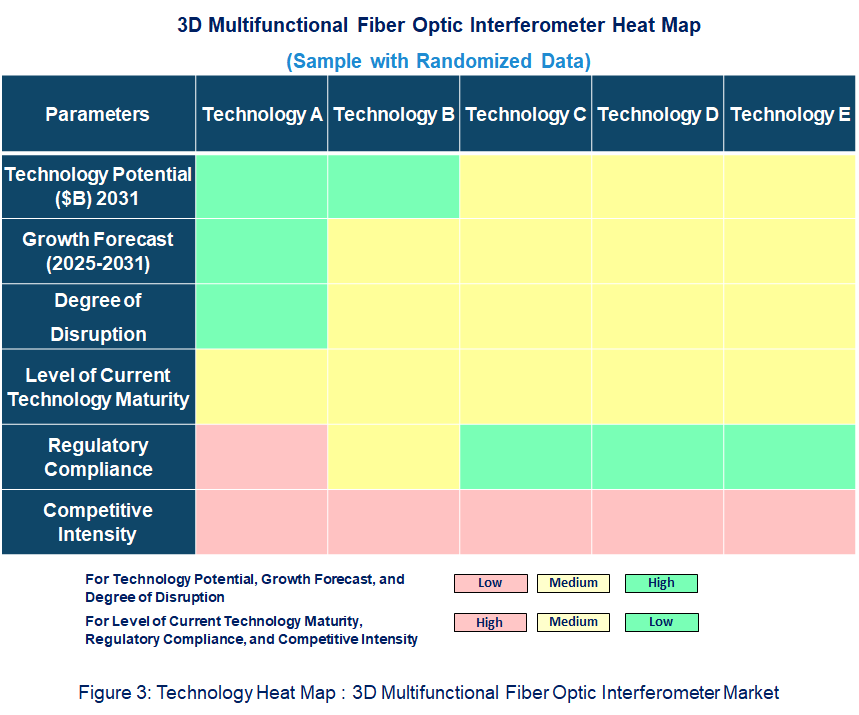
• Potential in Technology: The technology potential of 3D multifunctional fiber optic interferometers (FOIs) is significant, with the ability to revolutionize industries that require high precision, such as physics, engineering, biology, and medicine. These systems provide detailed measurements of material properties, surface dynamics, and even biological structures with high sensitivity and accuracy. The integration of advanced technologies like AI, machine learning, and miniaturization is unlocking new capabilities, making these systems adaptable, faster, and more versatile. The potential to offer real-time, non-invasive diagnostic solutions in fields such as medical imaging and industrial automation is particularly compelling.
• Degree of Disruption: The degree of disruption posed by 3D multifunctional fiber optic interferometers is high, especially in industries reliant on traditional measurement techniques. By enabling more precise, faster, and cost-effective solutions, these interferometers are disrupting legacy methods in fields like manufacturing quality control, medical diagnostics, and environmental monitoring.
• Current Technology Maturity Level: In terms of technology maturity, 3D fiber optic interferometers are already well-established in niche applications, with demonstrated success in sectors such as astronomy, defense, and industrial measurement. However, further advancements are needed to fully integrate AI and improve system scalability and miniaturization for wider application.
• Regulatory Compliance: Regarding regulatory compliance, fiber optic interferometers need to comply with industry-specific regulations, particularly in medical and environmental sectors, to ensure data accuracy, safety, and environmental protection. These technologies must meet stringent standards to gain widespread adoption.
• Optiphase: Advances in Compact Fiber Optic Interferometers: Optiphase has introduced more compact and highly sensitive 3D fiber optic interferometers designed for use in tight spaces, making them ideal for semiconductor manufacturing and other precision applications. Their focus on miniaturization and enhanced measurement accuracy is enabling industries to integrate these systems into complex production lines with higher efficiency, reducing costs while improving product quality. This development positions Optiphase as a leader in providing space-efficient and precise optical measurement solutions.
• Renishaw: Integration of AI for Real-Time Data Processing: Renishaw has integrated artificial intelligence (AI) into its fiber optic interferometers, enabling real-time data processing and more dynamic measurement capabilities. By combining machine learning algorithms with high-resolution 3D measurements, Renishaw's systems can automatically adjust to varying conditions, offering superior precision in fields like automotive manufacturing, aerospace, and medical device production. This advancement is a major step toward enhancing the automation and intelligence of precision measurement systems.
• Zygo: Enhanced Surface Metrology with 3D Interferometers: Zygo has made significant strides in surface metrology by enhancing its 3D interferometer systems with multi-sensor integration and better resolution capabilities. Their new systems are capable of capturing both microscopic and macroscopic surface features, which has led to improved accuracy in applications like optics manufacturing, microelectronics, and materials testing. Zygo's developments contribute to improved production yields, reduced material waste, and more consistent quality control in high-precision manufacturing environments.
• Tosei Eng: Innovations in High-Speed Measurement Solutions: Tosei Eng has developed high-speed 3D fiber optic interferometer systems aimed at increasing throughput in high-volume manufacturing processes. These interferometers, designed for rapid measurement and analysis, have been widely adopted in automotive and electronics industries. The improved speed without compromising measurement accuracy allows manufacturers to speed up quality control and reduce production cycle times, thus improving operational efficiency.
• Haag-Streit: Expansion into Medical Applications: Haag-Streit has focused on adapting 3D multifunctional fiber optic interferometers for medical imaging, particularly in ophthalmology. Their advanced systems are used to capture high-resolution 3D images of the eye, enabling better diagnosis and treatment planning. The ability to offer non-invasive, highly detailed measurements has improved diagnostic accuracy in the medical field, contributing to the growth of fiber optic interferometers as a critical tool in medical diagnostics and research. These recent developments illustrate the continued evolution of 3D multifunctional fiber optic interferometers, with innovations that enhance precision, speed, and versatility across various industries. As these key players continue to push the boundaries of what is possible, the demand for advanced, high-performance measurement systems is expected to grow across multiple sectors, leading to new opportunities in both traditional and emerging markets.
• Technological Advancements in Fiber Optic Interferometers: The development of more accurate and compact interferometers is enhancing measurement precision and versatility.
• Growing Demand for Automation and Precision in Manufacturing: The rise of smart manufacturing is driving the need for automated, high-precision measurement systems.
• Integration with AI and Data Analytics: AI and machine learning are being integrated to process measurement data in real time, improving adaptability.
• Increasing Adoption in Medical Applications: 3D interferometers are finding critical applications in medical diagnostics, such as ophthalmology. Major Challenges:
• High Initial Investment and Maintenance Costs: The complex technology and high-quality components make these systems expensive.
• Integration with Existing Systems: Adapting fiber optic interferometers to existing manufacturing setups can be technically challenging.
• Limited Awareness and Expertise: Lack of awareness and specialized expertise in fiber optic interferometry can hinder market growth. The 3D multifunctional fiber optic interferometer market is shaped by rapid technological advancements, automation needs, and new applications in medical fields. While these opportunities drive growth, challenges such as high costs, integration issues, and the need for specialized expertise must be addressed to accelerate adoption. These factors collectively influence the pace and extent of market expansion across multiple industries.
• OPTIPHASE
• Renishaw
• Zygo
• TOSEI Eng
• Haag-Streit
• OptoTechand
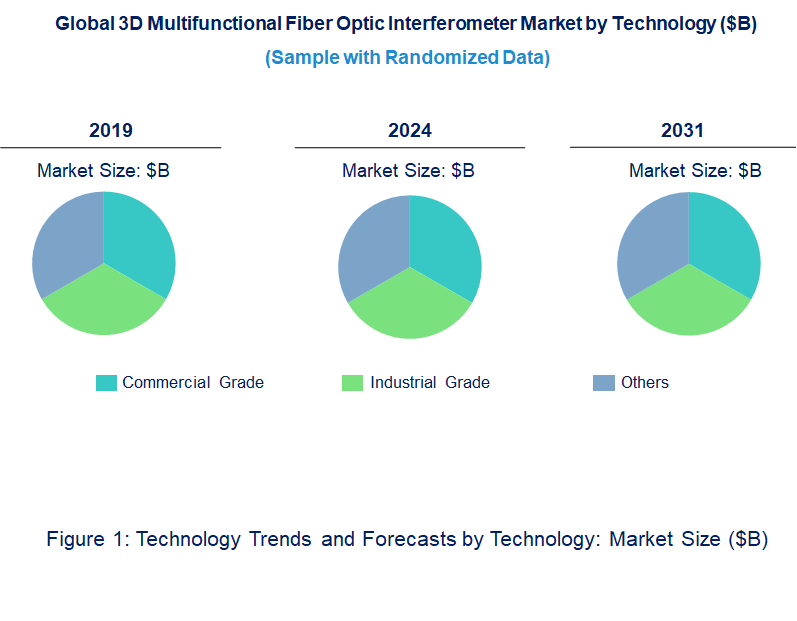
• Technology Readiness by Technology Type for 3D multifunctional fiber optic interferometer market: Commercial-grade interferometers are well-established and cost-effective, widely used in general manufacturing. Industrial-grade interferometers, while more expensive, cater to industries requiring high precision, such as aerospace and automotive, and offer advanced reliability. Emerging technologies like MEMS and fiber optic sensors are still developing, with promising applications in medical imaging and manufacturing. These newer technologies are competitive in specific areas but are less widely adopted than commercial and industrial-grade systems. All technologies must meet regulatory standards, with industrial systems subject to stricter precision requirements. While commercial solutions are mature, industrial-grade technologies are advancing, and emerging solutions are still maturing for broader market adoption.
• Competitive Intensity and Regulatory Compliance of Different Technologies: The competitive intensity varies across commercial, industrial, and emerging technologies. Commercial-grade interferometers face high competition due to cost-effectiveness and broader adoption. Industrial-grade systems, less competitive but essential for high-precision industries, command a premium price. Emerging technologies like MEMS and fiber-based sensors cater to niche applications but face competition from traditional systems. Regulatory compliance is crucial, especially for industrial-grade technologies, which must meet stringent safety, accuracy, and environmental standards. Commercial-grade technologies, though more relaxed in compliance, must still meet industry-specific performance standards. Compliance remains a challenge as the market grows, especially for new technologies entering the market.
• Disruption Potential of Different Technologies for 3D multifunctional fiber optic interferometer market: The disruption potential in the 3D multifunctional fiber optic interferometer market is significant. Commercial-grade interferometers, offering cost-effective solutions, are widely used in general industrial applications. Industrial-grade interferometers, with higher precision, dominate high-precision sectors like aerospace and automotive. Emerging technologies such as fiber-based and MEMS interferometers bring miniaturized, faster, and integrated solutions, disrupting traditional systems. These advancements provide enhanced efficiencies and broaden the scope of applications, such as in medical diagnostics and automation. The competition between commercial, industrial, and emerging technologies will drive further innovation, enhancing measurement accuracy and expanding use cases across various industries.
• Commercial Grade
• Industrial Grade
• Others
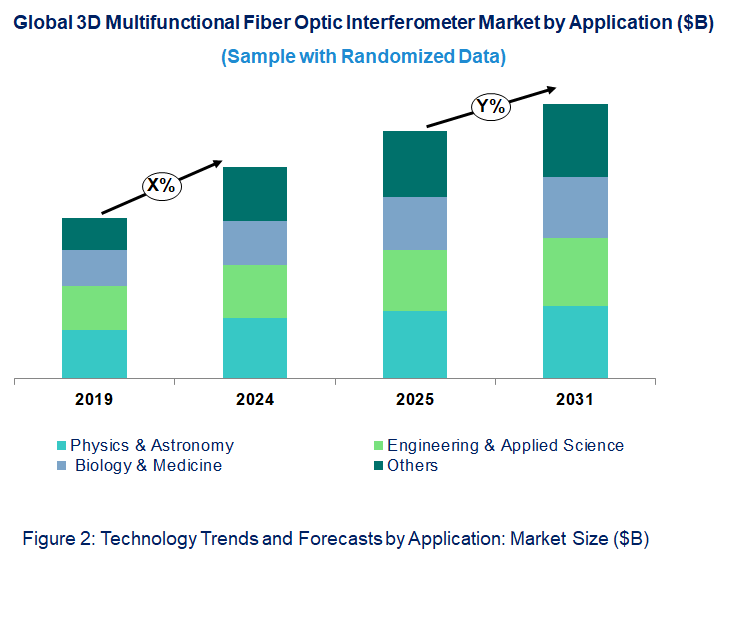
• Physics & Astronomy
• Engineering & Applied Science
• Biology & Medicine
• Others
• North America
• Europe
• Asia Pacific
• The Rest of the World
• Latest Developments and Innovations in the 3D Multifunctional Fiber Optic Interferometer Technologies
• Companies / Ecosystems
• Strategic Opportunities by Technology Type


Choose a license that fits your team. Instant PDF delivery.
Prices exclude taxes. Instant delivery. Custom licensing available on request.
Market Report · May 18, 2026
Market Report · May 18, 2026
Market Report · May 18, 2026
Trusted partner for strategic intelligence and business growth


Receive a complimentary market analysis tailored to your industry. Our analysts will identify key growth opportunities and competitive dynamics specific to your business.

Market size, growth rate, and key trend analysis for your specific sector.

Top competitor positioning and market share analysis.

Strategic recommendations backed by data-driven insights.
Get curated market intelligence and competitive moves straight to your inbox.
By subscribing, you agree to receive our monthly insights. Unsubscribe anytime.
Receive a complimentary market analysis tailored to your industry. Our analysts will identify key growth opportunities and competitive dynamics specific to your business.
Market size, growth rate, and key trend analysis for your specific sector.
Top competitor positioning and market share analysis.
Strategic recommendations backed by data-driven insights.
Get curated market intelligence, emerging trends, and competitive moves straight to your inbox each month.
By subscribing, you agree to receive our monthly insights. Unsubscribe anytime.
We'll send your sample report shortly.