
Market Report · May 18, 2026

This market report covers trends, opportunities, and forecasts in the global 3d lidar mapping market to 2031 by technology (aerial lidar systems, solid-state lidar, terrestrial lidar systems, mechanical lidar systems, and lidar sensors with ai integration), end use industry (aerospace & defense, automotive & transportation, agriculture & forestry, construction & infrastructure, mining & geology, oil & gas, and others), and region (North America, Europe, Asia Pacific, and the Rest of the World)
We'll send your sample report shortly.
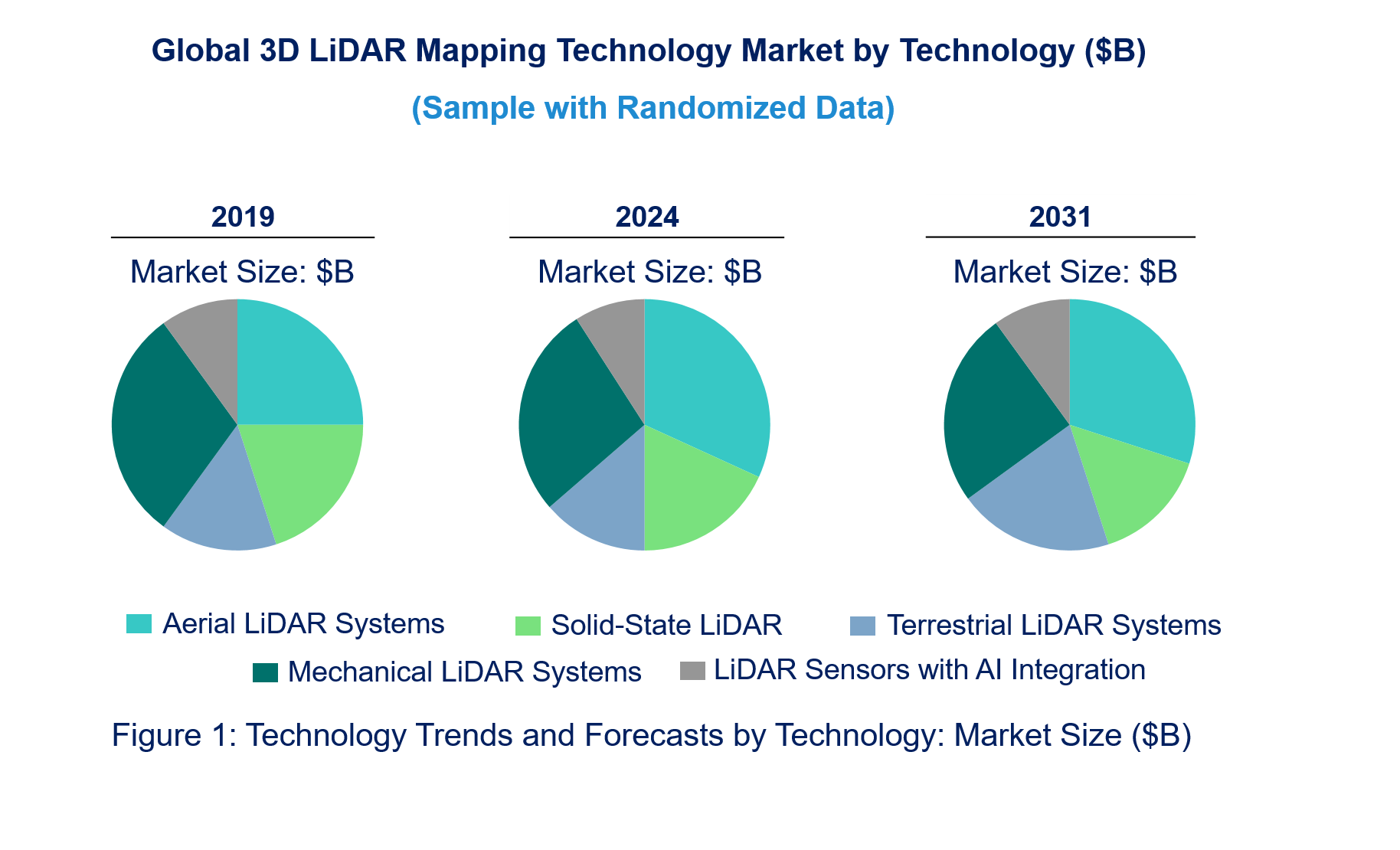
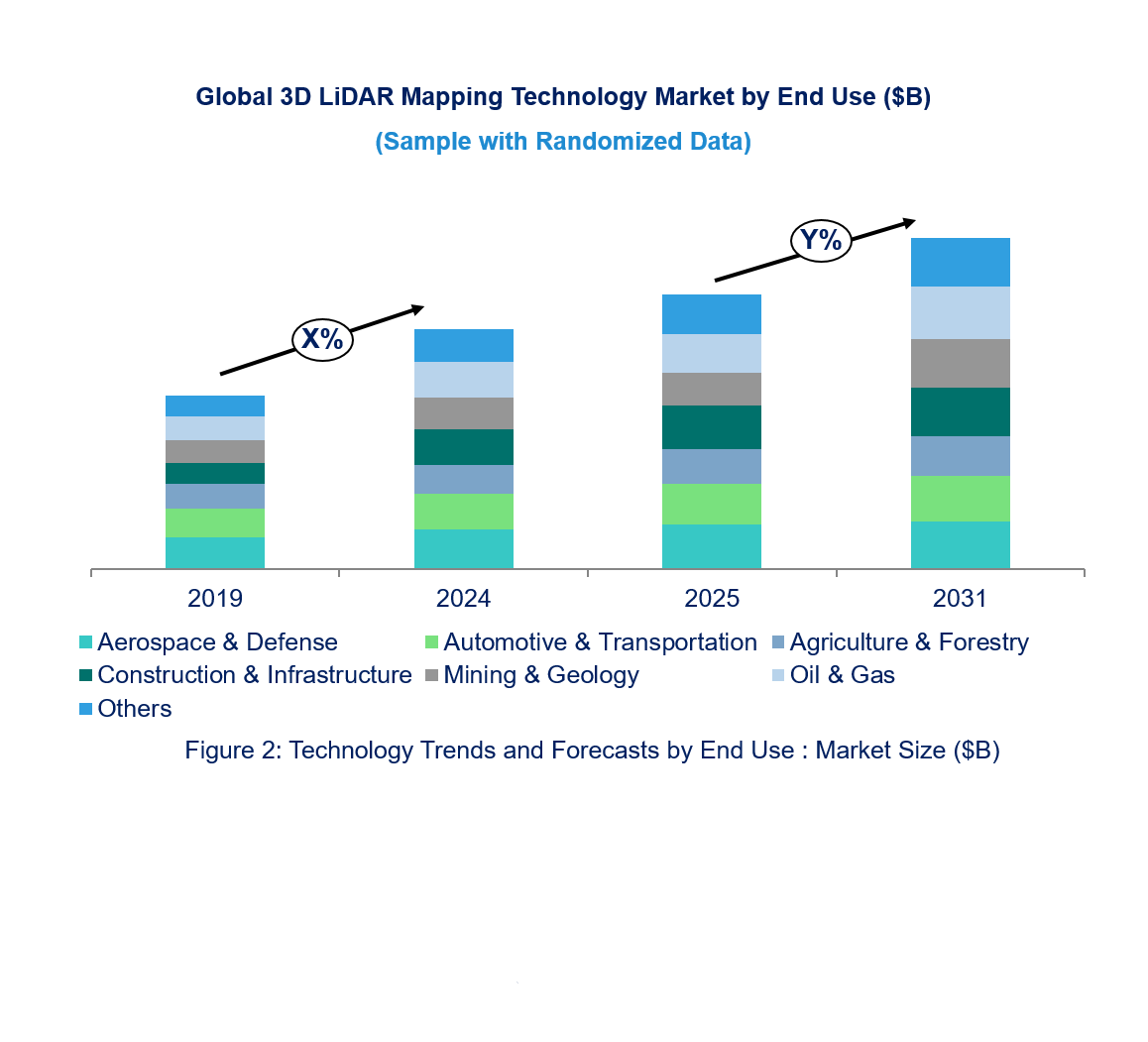
• Solid-State Lidar Adoption: The compact, durable lidar is replacing the mechanical system and offers more reliability with lower production costs. It will be more significant in the future for autonomous vehicles and drones.
• AI-Powered Lidar Systems: AI integration facilitates faster data processing and intelligent feature extraction, benefiting cities and smart city initiatives in urban planning.
• Cost-Effective Miniaturization: The reduced size and cheaper lidar units are opening up applications in consumer electronics and agriculture.
• Multi-Application Flexibility: Hybrid lidar systems are being engineered to work on different platforms, including aerial, terrestrial, and automotive systems. This facilitates efficient deployment.
• More Accurate Mapping: Innovations in algorithms and sensor resolutions are reaching unparalleled levels, which are being applied to unique applications such as archaeology and environmental monitoring. These trends are enabling broader adoption of lidar technologies while unlocking new opportunities in emerging industries and applications.
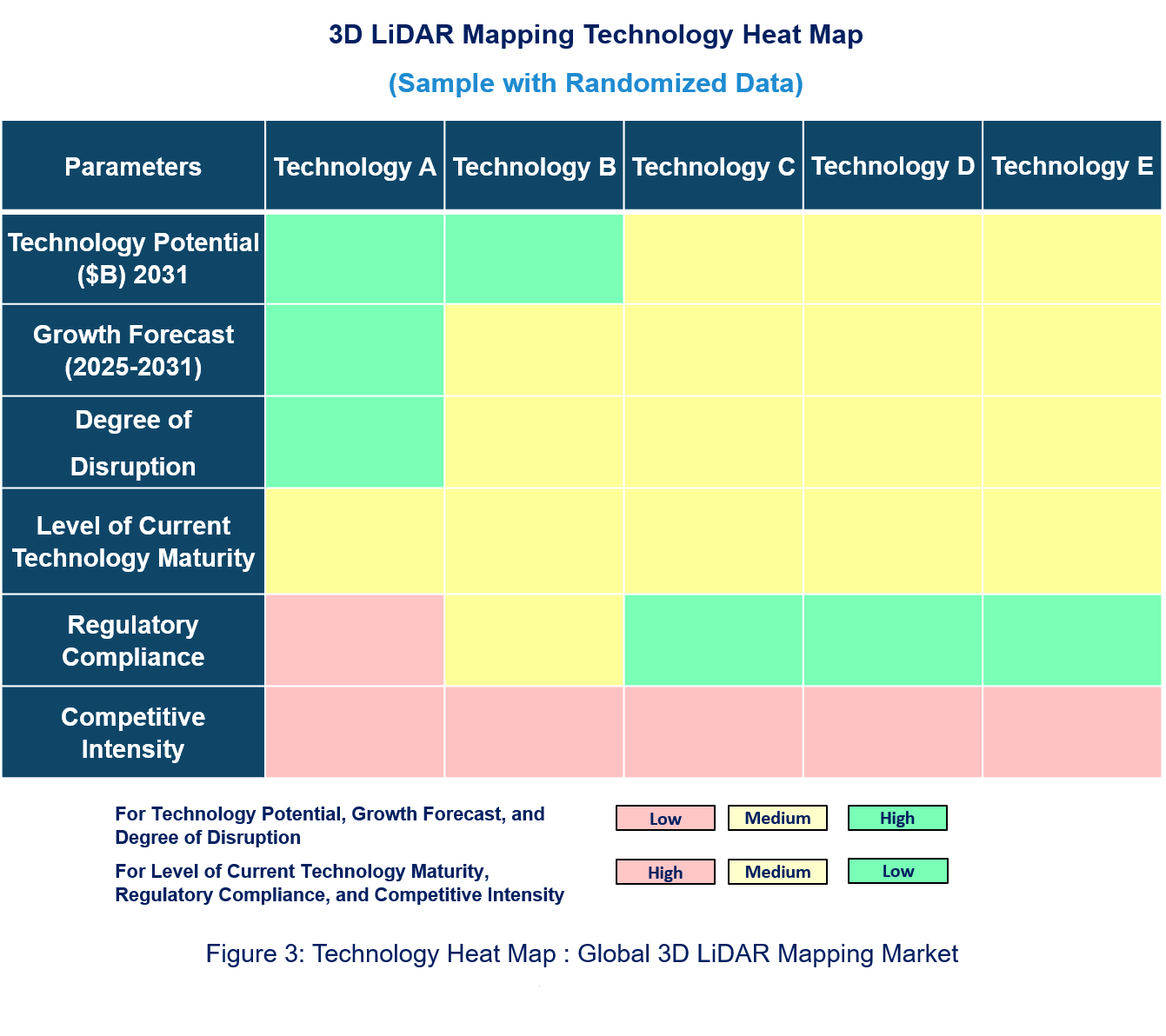
• Potential in Technology: The potential of 3D lidar mapping technology lies in providing high-resolution, accurate spatial data in real-time. Its applications in vehicles, urban planning, environmental conservation, and many other areas add value to its versatility when precise mapping is required across various industries. The emerging integration of the technology with AI and machine learning further amplifies its predictive and analytical potential.
• Level of Disruption: 3D lidar mapping technology is highly disruptive, breaking conventional trends of traditional surveying procedures like photogrammetry. Accuracy, speed, and agility in challenging conditions are driving shifts in the automotive industry, making self-driving technology easier, while in construction environments, they optimize planning and monitoring.
• Current Technology Maturity Level: The technology is evolving from early adoption to mass adoption. Aerial and terrestrial systems are more established, while solid-state lidar and AI-integrated systems are in a nascent stage but are advancing rapidly, promising scalability across the board.
• Regulatory Compliance: Standards for data security, electromagnetic emissions, and safety operations are essential considerations as a critical component of safety-critical domains like transportation and defense. Regulations differ by region, influencing adoption. Great promises are built into 3D lidar mapping technology. Its full potential will be realized when technical, economic, and regulatory challenges are solved.
• Luminar Technologies: Released a next-generation Solid-State lidar tailored for automotive safety and autonomous driving, offering extended range and reliability.
• Quanergy Systems: Developed 3D lidar sensors with AI-powered analytics for enhanced smart city and security applications.
• Innoviz Technologies: Collaborated with OEMs to integrate its high-end automotive-grade lidar into autonomous vehicle platforms.
• Aeva: Launched a novel frequency-modulated continuous wave (FMCW) technology that allows for simultaneous velocity and position measurement.
• Ouster: Diversified its product line with rugged, high-resolution lidar sensors for industrial and environmental applications. These developments highlight a dynamic focus on application-driven innovations, positioning these companies as leaders in the emerging market.
• Autonomous Vehicle Growth: Rising investments in autonomous driving are boosting demand for high-precision lidar systems.
• Urbanization and Smart Cities: Expanding smart city initiatives are driving demand for accurate urban mapping solutions.
• Agricultural Optimization: Precision farming applications are using lidar for efficient resource management and increased yield.
• Environmental Monitoring: Growing focus on climate change is driving demand for lidar in forestry and conservation efforts. Challenges in the 3D lidar mapping market include:
• High Initial Costs: The cost of lidar systems has been a barrier to widespread adoption, particularly in emerging economies.
• Data Processing Complexity: Handling and analyzing massive data from lidar systems is operationally challenging.
• Regulatory Barriers: Varying regional regulations are barriers to deploying aerial and autonomous lidar systems. Though drivers are creating vast opportunities, challenges need to be addressed to ensure sustainable growth in the 3D lidar mapping market.
• Luminar Technologies
• Quanergy Systems
• Innoviz Technologies
• Aeva
• Ouster
• Technology Readiness by Technology Type: Aerial lidar is mature but expensive, while solid-state lidar is quickly advancing in autonomous vehicles. Terrestrial lidar is excellent for static mapping but not portable. Mechanical lidar is well-established but less reliable than newer alternatives. AI-integrated lidar is emerging with transformative potential but faces challenges related to reliability and compliance.
• Competitive Intensity and Regulatory Compliance: The market for 3D lidar mapping at the global level is increasing like aerial lidar is moderately competitive and strictly regulated because of its airborne nature. Solid-state lidar is very competitive in automotive markets with changing safety standards. Terrestrial lidar faces less competition but has very high accuracy requirements. Mechanical lidar competes in niche markets but is also threatened by solid-state lidar. AI-integrated lidar is a new competitive segment with constantly changing regulatory frameworks.
• Disruption Potential by Technology Type: Aerial lidar systems offer high coverage for large applications but are expensive. Solid-state lidar is revolutionizing industries such as autonomous vehicles with its compact, cost-effective design. Terrestrial lidar offers detailed ground-level mapping but is not scalable. Mechanical lidar is reliable for niche applications but has limitations due to moving parts. AI-integrated lidar sensors offer significant disruption with real-time data processing, enhancing applications in smart cities and autonomous transportation.
• Aerial LiDAR Systems
• Solid-State LiDAR
• Terrestrial LiDAR Systems
• Mechanical LiDAR Systems
• LiDAR Sensors with AI Integration
• Aerospace & Defense
• Automotive & Transportation
• Agriculture & Forestry
• Construction & Infrastructure
• Mining & Geology
• Oil & Gas
• Others
• North America
• Europe
• Asia Pacific
• The Rest of the World
• Latest Developments and Innovations in the 3D LiDAR Mapping Technologies
• Companies / Ecosystems
• Strategic Opportunities by Technology Type




Choose a license that fits your team. Instant PDF delivery.
Prices exclude taxes. Instant delivery. Custom licensing available on request.
Market Report · May 18, 2026
Market Report · May 18, 2026
Market Report · May 18, 2026
Trusted partner for strategic intelligence and business growth


Receive a complimentary market analysis tailored to your industry. Our analysts will identify key growth opportunities and competitive dynamics specific to your business.

Market size, growth rate, and key trend analysis for your specific sector.

Top competitor positioning and market share analysis.

Strategic recommendations backed by data-driven insights.
Get curated market intelligence and competitive moves straight to your inbox.
By subscribing, you agree to receive our monthly insights. Unsubscribe anytime.
Receive a complimentary market analysis tailored to your industry. Our analysts will identify key growth opportunities and competitive dynamics specific to your business.
Market size, growth rate, and key trend analysis for your specific sector.
Top competitor positioning and market share analysis.
Strategic recommendations backed by data-driven insights.
Get curated market intelligence, emerging trends, and competitive moves straight to your inbox each month.
By subscribing, you agree to receive our monthly insights. Unsubscribe anytime.
We'll send your sample report shortly.