
Market Report · July 15, 2026

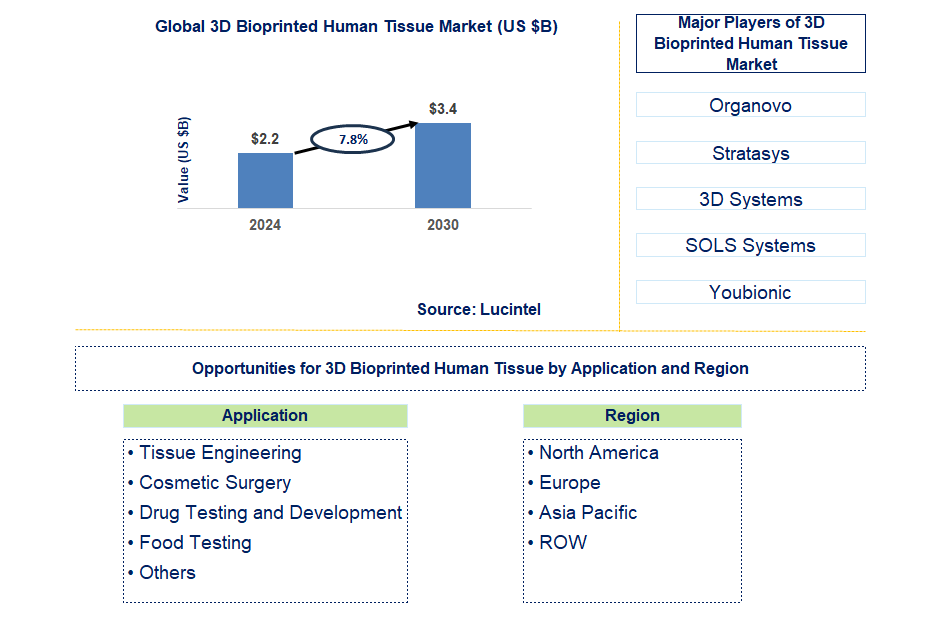
Key data points: The market size in 2030 = $3.4 billion, growth forecast = 7.8% annually for the next 6 years. Scroll below to get more insights. This market report covers trends, opportunities, and forecasts in the global 3d bioprinted human tissue market to 2030 by application (tissue engineering, cosmetic surgery, drug testing and development, food testing, and others) and region (North America, Europe, Asia Pacific, and the Rest of the World)
We'll send your sample report shortly.
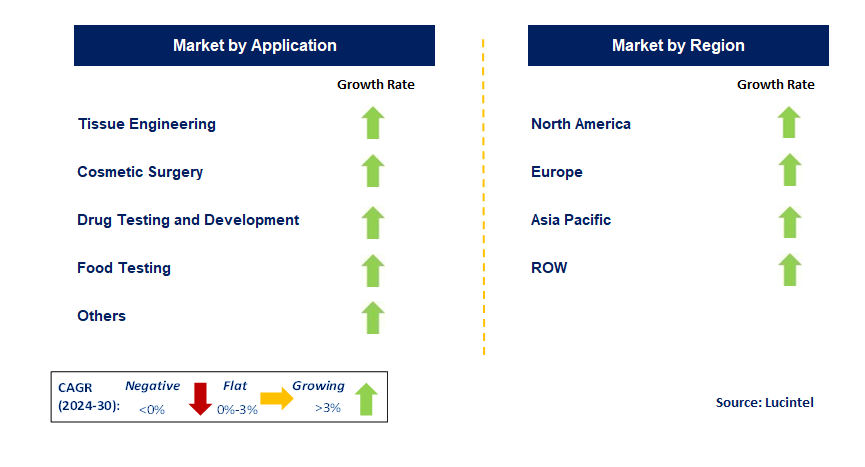
• Lucintel forecasts that, within the application category, drug testing and development segment is expected to witness the highest growth over the forecast period due to its increasing adoption in the clinical trial applications.
• In terms of regions, North America will remain the largest region over the forecast period due to rising government R&D spending. Gain valuable insight for your business decision with our comprehensive 150+ page report.
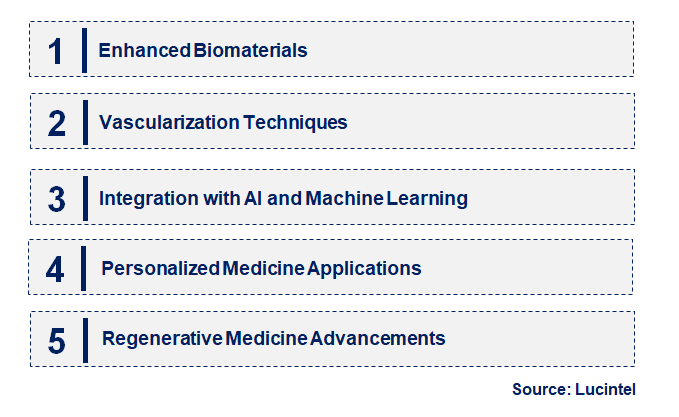
• Enhanced Biomaterials: The development of new biomaterials with improved biocompatibility and functionality is accelerating. These materials enhance the structural integrity and performance of bioprinted tissues, making them more suitable for complex applications in regenerative medicine and research.
• Vascularization Techniques: Innovations in vascularization techniques are crucial for creating more functional bioprinted tissues. Advances in incorporating vascular networks within bioprinted constructs improve tissue survival and integration, bringing the field closer to fully functional organ replacements.
• Integration with AI and Machine Learning: The integration of AI and machine learning in bioprinting processes is improving precision and efficiency. These technologies help optimize design parameters, predict tissue behavior, and enhance overall bioprinting outcomes.
• Personalized Medicine Applications: There is a growing focus on using bioprinted tissues for personalized medicine. Custom bioprinted tissues tailored to individual patient needs are being developed for drug testing and therapeutic applications, offering more personalized treatment options.
• Regenerative Medicine Advancements: Advances in regenerative medicine are driving the demand for bioprinted tissues. The ability to create functional tissue constructs for repairing or replacing damaged tissues and organs is expanding the potential applications of 3D bioprinting. Emerging trends such as enhanced biomaterials, vascularization techniques, AI integration, personalized medicine applications, and regenerative medicine advancements are reshaping the 3D bioprinted human tissue market. These trends are driving innovation and expanding possibilities for bioprinted tissues in research and clinical applications.
• Advanced Bioprinting Technologies: New bioprinting technologies enhance the resolution and complexity of bioprinted tissues. These advancements allow for the creation of more detailed and functional tissue models, improving their utility for research and therapeutic applications.
• Improved Biomaterial Formulations: Recent improvements in biomaterial formulations increase the viability and functionality of bioprinted tissues. Innovations in materials such as hydrogels and bio-inks enhance the structural integrity and biological performance of printed constructs.
• Functional Tissue Constructs: Progress in creating functional tissue constructs advances the field. Researchers are developing bioprinted tissues with complex structures and functionalities, such as organs and tissues with integrated vascular networks, for more realistic and useful models.
• Regulatory Advances: Recent regulatory developments support the commercialization of bioprinted tissues. Updated guidelines and frameworks help streamline approval processes for bioprinted products, facilitating their transition from research to clinical applications.
• Collaborative Research Initiatives: Increased collaboration between academia, industry, and healthcare institutions drives innovation in 3D bioprinting. These partnerships accelerate the development and application of bioprinted tissues, enhancing research capabilities and expanding market potential. Key developments in the 3D bioprinted human tissue market include advancements in bioprinting technologies, improved biomaterial formulations, creation of functional tissue constructs, regulatory advances, and collaborative research initiatives. These developments enhance the capabilities and applications of bioprinted tissues.
• Drug Discovery and Testing: Bioprinted tissues are increasingly used in drug discovery and testing. This application offers opportunities to create accurate models of human tissues for evaluating drug efficacy and safety, reducing the reliance on animal testing.
• Regenerative Medicine: The potential for bioprinted tissues in regenerative medicine is substantial. Opportunities exist in developing tissue constructs for repairing or replacing damaged organs and tissues, providing new treatments for various medical conditions.
• Personalized Medicine: The use of bioprinted tissues in personalized medicine is growing. Custom bioprinted tissues tailored to individual patients' genetic profiles and medical needs are being developed, providing more effective and personalized treatment options.
• Research and Development: The market for bioprinted tissues in research and development is expanding. Bioprinted models offer valuable tools for studying disease mechanisms, tissue development, and cellular interactions, driving innovation in biomedical research.
• Clinical Applications: Advances in bioprinting technology are creating opportunities for clinical applications. As the technology matures, bioprinted tissues are being explored for direct clinical use in treating injuries and degenerative diseases. Strategic growth opportunities in the 3D bioprinted human tissue market include applications in drug discovery, regenerative medicine, personalized medicine, research and development, and clinical applications. These opportunities reflect the expanding potential of bioprinted tissues to transform various aspects of healthcare and research.
• Organovo
• Stratasys
• 3D Systems
• SOLS Systems
• Youbionic
• Tissue Engineering
• Cosmetic Surgery
• Drug Testing and Development
• Food Testing
• Others
• North America
• Europe
• Asia Pacific
• The Rest of the World
• United States: In the United States, significant progress has been made in the development of complex tissue structures for drug testing and regenerative medicine. Companies are focusing on enhancing tissue vascularization and functionality, with breakthroughs in bioprinting organs and tissues that more accurately mimic human physiology.
• China: China is advancing in scaling up 3D bioprinting technologies, particularly in creating tissue models for medical research and testing. Government support and funding have accelerated advancements in bioprinting capabilities, with the aim of establishing China as a leader in bioprinted tissue development.
• Germany: Germany has been progressing in 3D bioprinting with an emphasis on integrating advanced biomaterials and improving tissue engineering techniques. German research institutions are working on enhancing the precision and complexity of bioprinted tissues to support drug discovery and regenerative therapies.
• India: In India, the focus is on developing cost-effective bioprinting solutions and scaling up research capabilities. Indian institutions and startups are making progress in creating bioprinted tissues for research and medical applications, emphasizing affordability and accessibility for broader use.
• Japan: Japan is leading in the development of advanced bioprinting technologies and materials. Japanese researchers are focusing on bioprinting functional tissue constructs for regenerative medicine and exploring collaborations to integrate these technologies into clinical applications.


• Organovo
• Stratasys
• 3D Systems
• SOLS Systems
• Youbionic Q6. Which 3D bioprinted human tissue market segment will be the largest in future? Answer: Lucintel forecasts that drug testing and development segment is expected to witness the highest growth over the forecast period due to its increasing adoption in the clinical trial applications. Q7. In 3D bioprinted human tissue market, which region is expected to be the largest in next 5 years? Answer: North America will remain the largest region over the forecast period due to rising government R&D spending. Q.8 Do we receive customization in this report? Answer: Yes, Lucintel provides 10% customization without any additional cost.


Choose a license that fits your team. Instant PDF delivery.
Prices exclude taxes. Instant delivery. Custom licensing available on request.
Market Report · July 15, 2026
Market Report · May 18, 2026
Market Report · May 18, 2026
Trusted partner for strategic intelligence and business growth


Receive a complimentary market analysis tailored to your industry. Our analysts will identify key growth opportunities and competitive dynamics specific to your business.

Market size, growth rate, and key trend analysis for your specific sector.

Top competitor positioning and market share analysis.

Strategic recommendations backed by data-driven insights.
Get curated market intelligence and competitive moves straight to your inbox.
By subscribing, you agree to receive our monthly insights. Unsubscribe anytime.
Receive a complimentary market analysis tailored to your industry. Our analysts will identify key growth opportunities and competitive dynamics specific to your business.
Market size, growth rate, and key trend analysis for your specific sector.
Top competitor positioning and market share analysis.
Strategic recommendations backed by data-driven insights.
Get curated market intelligence, emerging trends, and competitive moves straight to your inbox each month.
By subscribing, you agree to receive our monthly insights. Unsubscribe anytime.
We'll send your sample report shortly.