
Market Report · July 29, 2026

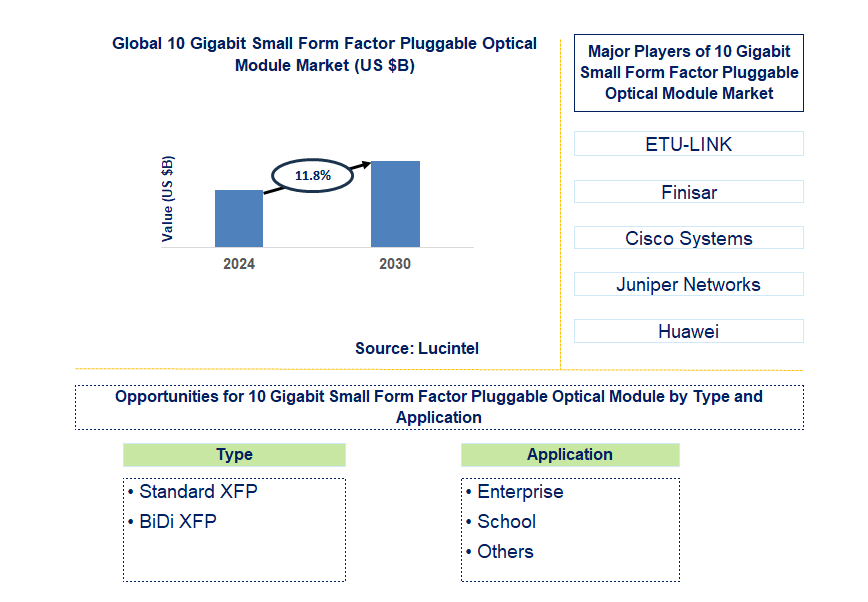
Key data points: The growth forecast = 11.8% annually for the next 6 years. Scroll below to get more insights. This market report covers trends, opportunities, and forecasts in the global 10 gigabit small form factor pluggable optical module market to 2030 by type (standard xfp and bidi xfp), application (enterprise, school, and others), and region (North America, Europe, Asia Pacific, and the Rest of the World)
We'll send your sample report shortly.
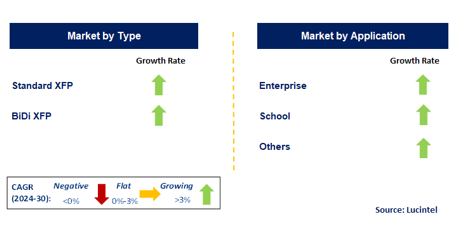
• Lucintel forecasts that, within the type category, standard xfp is expected to witness higher growth over the forecast period.
• Within the application category, enterprise is expected to witness higher growth.
• In terms of regions, APAC is expected to witness the highest growth over the forecast period. A more than 150-page report is developed to help in your business decisions.
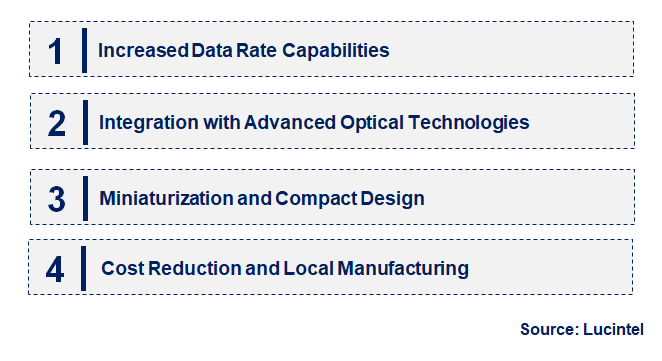
• Increased Data Rate Capabilities: To meet growing demand, SFP+ modules have been developed to provide faster transmission speeds. It is significant to note that current optical technologies are already fully stretched due to the use of these devices in data centers and other high-speed network applications.
• Enhanced Energy Efficiency: Energy efficiency of a given SFP+ module has become a critical concern among stakeholders in this niche area. Innovations focus on low-power designs targeting green computing by reducing energy consumption within data centers and computer networks, while maintaining their performance at the highest possible levels. This leads to operational cost savings and environmental conservation, which are crucial for all parties concerned about saving Mother Earth from the global warming crisis impacting her climate system.
• Integration with Advanced Optical Technologies: There is an increasing trend in integrating advanced optical technologies like silicon photonics. This allows for better performance and miniaturization of SFP+ modules, which means higher data rates and better signal integrity.
• Miniaturization and Compact Design: SFP+ modules are getting smaller and more compact in line with the miniaturization trend. Network equipment can accommodate more of these modules due to increased density and flexibility, thus fitting more into a small space without compromising performance.
• Cost Reduction and Local Manufacturing: Cost reduction strategies, coupled with increased local manufacturing capabilities, are becoming more common. Relying on local production and supply chain efficiencies seeks to make SFP+ modules cheaper and more easily available, especially in emerging markets. Emerging trends are redefining the 10-gigabit SFP+ optical module market through technological advancements, improving performance and efficiency, and expanding market accessibility. Firms that embrace such transformations will have a competitive advantage over others while conforming to changing industry requirements.
• Development of High-Speed Modules: New high-speed SFP+ modules with enhanced data rates and performance characteristics are being developed. This will help support modern data centers’ growing bandwidth demands and fast networking applications, resulting in improved transmission speeds of information through cables.
• Innovations in Energy Efficiency: Manufacturers are emphasizing energy efficiency improvements in SFP+ modules, including power optimization and heat management, to reduce operational costs associated with environmental impacts, while still maintaining high performance levels.
• Enhanced Thermal Management Solutions: Improvements have been made in thermal management solutions for components like SFP+ modules that dissipate heat. Enhanced thermal solutions guarantee stability and durability, especially for high-density and high-power use cases.
• Expansion of Local Manufacturing Capabilities: Emphasis on expanding local manufacturing capabilities is gradually gaining momentum to reduce costs and enhance supply chain efficiency. Affordable SFP+ modules will be more readily available in emerging markets, making them accessible to a broader audience.
• Adoption of Advanced Optical Technologies: Performance and miniaturization of SFP+ modules have been made possible by integrating advanced optical technologies such as silicon photonics. These technologies push the boundaries of optical communication by allowing higher data rates with improved signal integrity. The recent developments in the 10-gigabit SFP+ optical module market are massively transforming performance, efficiency, and market accessibility. They reflect a broader trend toward innovation and adaptation to meet the evolving needs of high-speed data transmission.
• Data Centers: The demand for high-speed data transmission and efficient networking solutions has created an opportunity for growth in data centers, where SFP+ modules are concerned. Modules are increasingly used to support high-bandwidth applications and improve data center performance.
• Telecommunications: SFP+ modules support the telecommunication industry in expanding network infrastructures and deploying advanced communications technologies, offering large growth potential. The sector needs improved performance and cost-effective solutions.
• Enterprise Networks: Enterprises are now using SFP+ modules to improve their networks’ performance and reliability. These modules provide fast connections, flexibility, and meet the requirements of today’s enterprise networking environments.
• Educational Institutions: Educational institutions need reliable SFP+ modules with good performance as they expand their IT infrastructure. Campus networking can be supported by these modules, allowing for high-speed data transfer when required.
• Government and Military Applications: For secure communications, government agencies and the military use robust, high-performance SFP+ modules. There is also an opportunity for specialized modules that could meet strict security and performance standards. These strategic growth opportunities highlight key areas where SFP+ modules can drive market expansion by focusing on specific applications that enable companies to innovate and develop solutions meeting diverse industry needs, capitalizing on new trends as well.
• Technological Advancements: High-performance SFP+ development is driven by advances in optical technology and miniaturization. Increased transmission speeds for data sets, coupled with integration improvements, fuel industry expansion aimed at realizing faster networking capabilities and a demand for more speed in data transmission systems.
• Growing Data Center Demand: The rapid growth of the data center market is one of the key reasons for the adoption of SFP+ module technology at higher scales due to the need for high-speed connectivity and efficient networking solutions.
• Expansion of Telecommunications Networks: The deployment of advanced telecommunications infrastructure, including 5G networks, drives demand for high-performance SFP+ modules. These modules provide fast and reliable communication in today’s networks.
• Increasing Need for Energy Efficiency: The focus on providing more energy-efficient SFP+ modules is becoming stronger. Power consumption and thermal management innovations address environmental concerns and lower operational costs as well.
• Cost Reduction Initiatives: Economical SFP+ modules have been made possible by cost-reduction initiatives targeting both manufacturing and materials. This has resulted from localizing production within countries and optimizing supply chains. Challenges in the 10-gigabit small form factor pluggable optical module market include:
• Material Costs: This can impact the overall pricing of SFP+ modules due to the specialized materials they use. Striking a balance between material costs, performance, and quality is a challenge for manufacturers.
• Complex Manufacturing Processes: Manufacturing challenges are often encountered when producing high-tech SFP+ modules, which require complexity to meet performance goals consistently as needed by market demands.
• Regulatory Compliance: Complying with safety and performance requirements dictated by regulations governing their use in products can be costly and challenging. Manufacturers must invest in global certification programs and ensure adherence to strict quality control processes during product development stages. These drivers and challenges determine how the 10-gigabit SFP+ optical module market will evolve, influencing product development, market demand trends, and regulatory compliance. Mastering all these factors will help companies navigate the industry while maximizing available growth potential.
• ETU-LINK
• Finisar
• Cisco Systems
• Juniper Networks
• Huawei
• ZTE
• Alcatel-Lucent
• Broadcom
• Source Photonics
• Lumentum
• Standard XFP
• BiDi XFP
• Enterprise
• School
• Others
• North America
• Europe
• Asia Pacific
• The Rest of the World
• United States: In the US, this has seen the development of energy efficient SFP+ models that have better thermal management than those that have been there before. This innovation is centered towards miniaturization capabilities of advanced optics aimed at faster data centers supported by greater network infrastructures which are required during a fast transmission of information with lesser delays.
• China: In China, manufacturers have made major strides in advancing low-cost SFP+ modules via investment in state-of-the-art fabrication technology. Such modules have therefore been designed to address high volume demand in telecommunications field and data centers while balancing between performance requirements and price.
• Germany: Precision engineering coupled with integration of top-quality raw materials forms the basis upon which German manufacturers are building their SFP+ module technology. These innovations aim at improving industrial reliability especially in relation to enterprise solutions hence emphasizing robustness alongside superior quality that affect critical infrastructure.
• India: There has been growth of the India’s SFP+ module market that emphasizes on affordability plus increased local manufacturing capabilities. This means that such modules can now be used as lower cost solutions in emerging data centers and even network expansion programs designed for developing India’s digital infrastructure.
• Japan: This country has developed ultra-high speed SFP+ modules with higher data rates and lower power consumption. These modules are being integrated into next generation networking equipment such as data centers that will support Japanese high-tech industry needs hence establishing another paradigm of optical communication technology in the world today.


• ETU-LINK
• Finisar
• Cisco Systems
• Juniper Networks
• Huawei
• ZTE
• Alcatel-Lucent
• Broadcom
• Source Photonics
• Lumentum Q5. Which 10 gigabit small form factor pluggable optical module market segment will be the largest in future? Answer: Lucintel forecasts that standard xfp is expected to witness higher growth over the forecast period. Q6. In 10 gigabit small form factor pluggable optical module market, which region is expected to be the largest in next 5 years? APAC is expected to witness the highest growth over the forecast period. Q.7 Do we receive customization in this report? Answer: Yes, Lucintel provides 10% customization without any additional cost.


Choose a license that fits your team. Instant PDF delivery.
Prices exclude taxes. Instant delivery. Custom licensing available on request.
Market Report · July 29, 2026
Market Report · July 20, 2026
Market Report · July 20, 2026
Trusted partner for strategic intelligence and business growth


Receive a complimentary market analysis tailored to your industry. Our analysts will identify key growth opportunities and competitive dynamics specific to your business.

Market size, growth rate, and key trend analysis for your specific sector.

Top competitor positioning and market share analysis.

Strategic recommendations backed by data-driven insights.
Get curated market intelligence and competitive moves straight to your inbox.
By subscribing, you agree to receive our monthly insights. Unsubscribe anytime.
Receive a complimentary market analysis tailored to your industry. Our analysts will identify key growth opportunities and competitive dynamics specific to your business.
Market size, growth rate, and key trend analysis for your specific sector.
Top competitor positioning and market share analysis.
Strategic recommendations backed by data-driven insights.
Get curated market intelligence, emerging trends, and competitive moves straight to your inbox each month.
By subscribing, you agree to receive our monthly insights. Unsubscribe anytime.
We'll send your sample report shortly.